Describe the change
White surface growth on affected fruit bodies.
 MushroomFarming.in
A joint educational initiative by

 ICAR–DMRSolan
Fungal diseases
White growth and fruit-body collapse in morels can involve a primary pathogen plus secondary colonisers. A list of isolates is not a list of equally proven causes.
Organism / cause: Pseudodiploöspora longispora; other fungi occur in disease surveys
Where this evidence applies: Cultivated Morchella, especially Chinese M. sextelata studies. Indian field prevalence is not established by these sources.
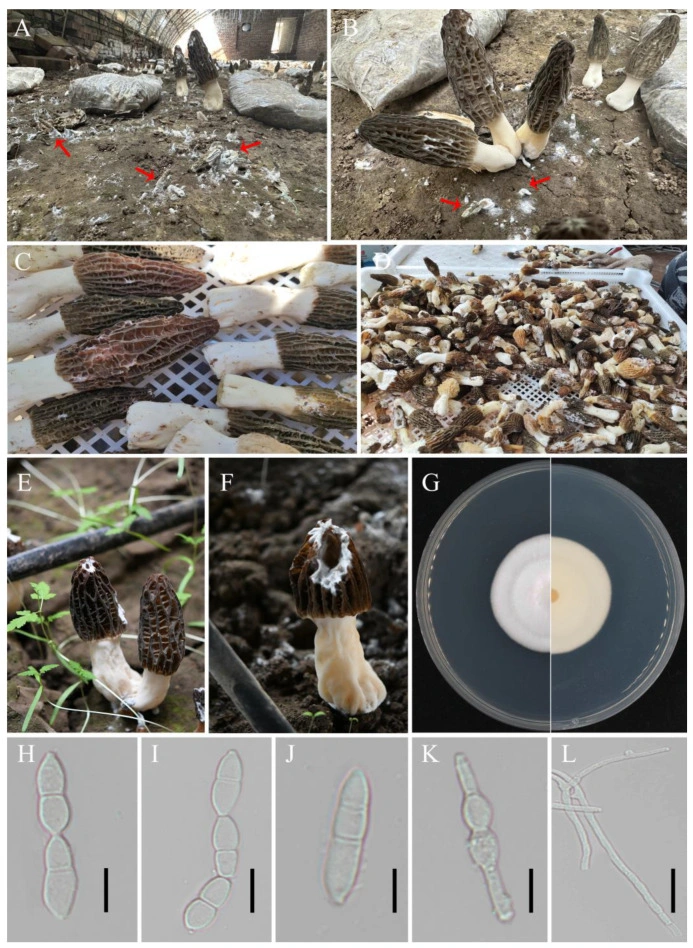
Reference image only. These are published study examples, not photographs of your crop or claims about an Indian outbreak.
Picture → observation → next check
White surface growth on affected fruit bodies.
Water injury, secondary saprophytes and bacterial decay.
Map first disease positions against irrigation, bed conditions and crop age.
A visual match is only a starting point. Microscopy, sequencing and interpretation of pathogenicity evidence are needed; current names differ from older papers.
01 · Observe
02 · Compare
Diseased material can act as inoculum; soil, bed conditions and production history need local investigation.
03 · Check
What confirmation needs: Microscopy, sequencing and interpretation of pathogenicity evidence are needed; current names differ from older papers.
Use the field record and sampling checklist →04 · Respond
These are investigation and containment steps, not a guaranteed cure. Do not eat, sell or distribute suspect material on the strength of a visual match. Do not culture unknown contaminants or experiment with pesticides in a growing room.
05 · Learn
After intervention, compare new affected units, crop condition and inspection results against the same recorded baseline. A lack of visible growth does not, by itself, verify decontamination or food safety.
Read the stage-by-stage prevention plan →Multi-site survey, taxonomic revision and mechanistic study; location-specific evidence.
Journal of Fungi · 2022
Used for: Survey of diseased fruit bodies; distinguishes dominant organisms from secondary colonisers.
Limit: Sampled Chinese sites, not an Indian disease-incidence survey.
Mycological Progress · 2023
Used for: New combinations Pseudodiploöspora and Zelopaecilomyces for morel-associated organisms.
Limit: Names in older manuals may differ. Updated naming does not add a treatment recommendation.
Journal of Fungi · 2024
Used for: White mould/pileus disease and confirmation in the tested morel system.
Limit: Mechanistic study, not a universal field cure or chemical authorisation.
Bacterial diseases
Reddening in a cultivated morel should be recorded with tissue condition and bed history, not automatically labelled as one bacterium.
Gansu, China research; redness alone is not diagnostic.
Signs, checks & response →Environmental disorders
Room humidity does not tell the whole water story. A crop can have wet caps in one rack zone and drying injury in another.
All production systems, with different crop-specific tolerances.
Signs, checks & response →