Describe the change
Tiny moving organisms on bags, shelves, fruit bodies or substrate.
 MushroomFarming.in
A joint educational initiative by

 ICAR–DMRSolan
Pests & vectors
Some mites damage crops or carry contaminants; others feed on mould or other small organisms. Their presence may point to an underlying contamination problem.
Organism / cause: Several mite groups with different ecological roles
Where this evidence applies: A small moving speck is not enough to identify a harmful mite.
Picture → observation → next check
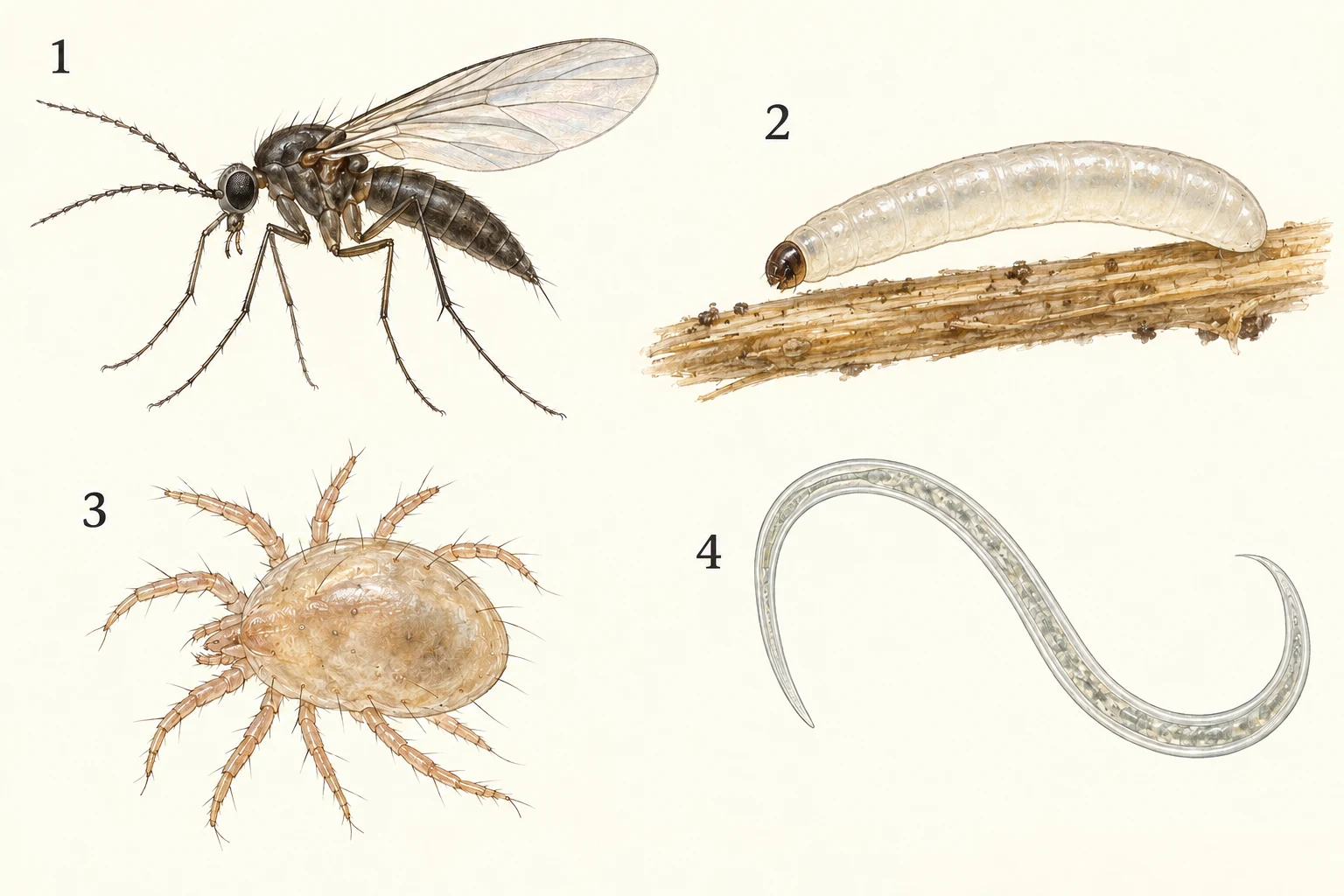
Record where it is seen and whether it walks, runs or flies. Adult identification and larval damage are separate observations.
A gnat-like legless larva is shown. Do not assume that every pale organism in substrate is the same pest.
Mites may feed on crop tissue, mould or other organisms. Presence alone is not proof of crop damage.
Nematode groups have different roles. Microscopic examination and specialist identification may be necessary.
Tiny moving organisms on bags, shelves, fruit bodies or substrate.
Springtails, larvae and non-living debris.
Photograph with a scale and ask for magnified identification.
A visual match is only a starting point. A qualified identifier must distinguish feeding groups before a control decision.
01 · Observe
No verified reusable diagnostic photograph is included for this entry. The illustration above explains observation context, not a confirmed disease specimen. Consult the original source figures where available.
02 · Compare
Infested materials, equipment and pests can transport mites; the route differs by species.
03 · Check
What confirmation needs: A qualified identifier must distinguish feeding groups before a control decision.
Use the field record and sampling checklist →04 · Respond
These are investigation and containment steps, not a guaranteed cure. Do not eat, sell or distribute suspect material on the strength of a visual match. Do not culture unknown contaminants or experiment with pesticides in a growing room.
05 · Learn
After intervention, compare new affected units, crop condition and inspection results against the same recorded baseline. A lack of visible growth does not, by itself, verify decontamination or food safety.
Read the stage-by-stage prevention plan →Institutional IPM references distinguish pepper mites and predatory forms; not every mite is a crop pest.
Teagasc · Historical report, pre-2005 pesticide context
Used for: Functional distinctions among flies, pepper mites, predators and eelworms.
Limit: Old pesticide registrations are obsolete as operational guidance. Use for biology, not dosing.
ICAR–DMR Solan · Undated
Used for: Indian pest groups, farm hygiene and observation questions.
Limit: Historical chemical advice is not reproduced. Identification and management depend on the crop and organism.
Pests & vectors
Identification can prevent the removal of useful organisms. Biological control still needs the correct pest, product, conditions and local legal status.
A decision guide, not an instruction to release an unapproved organism.
Signs, checks & response →Pests & vectors
Jumping specks and surface grazing require identification and evidence of damage. Not every organism found near a crop is its primary problem.
A broad pest differential, especially where substrate contacts soil or wet organic residues.
Signs, checks & response →Fungal diseases
A bag can contain competing mould before green colour is visible. Oyster-associated Trichoderma species differ from the main button-mushroom epidemic species.
Detailed pathogen evidence exists for Pleurotus; the other listed crops have published green-mould host reports, not a shared diagnosis.
Signs, checks & response →