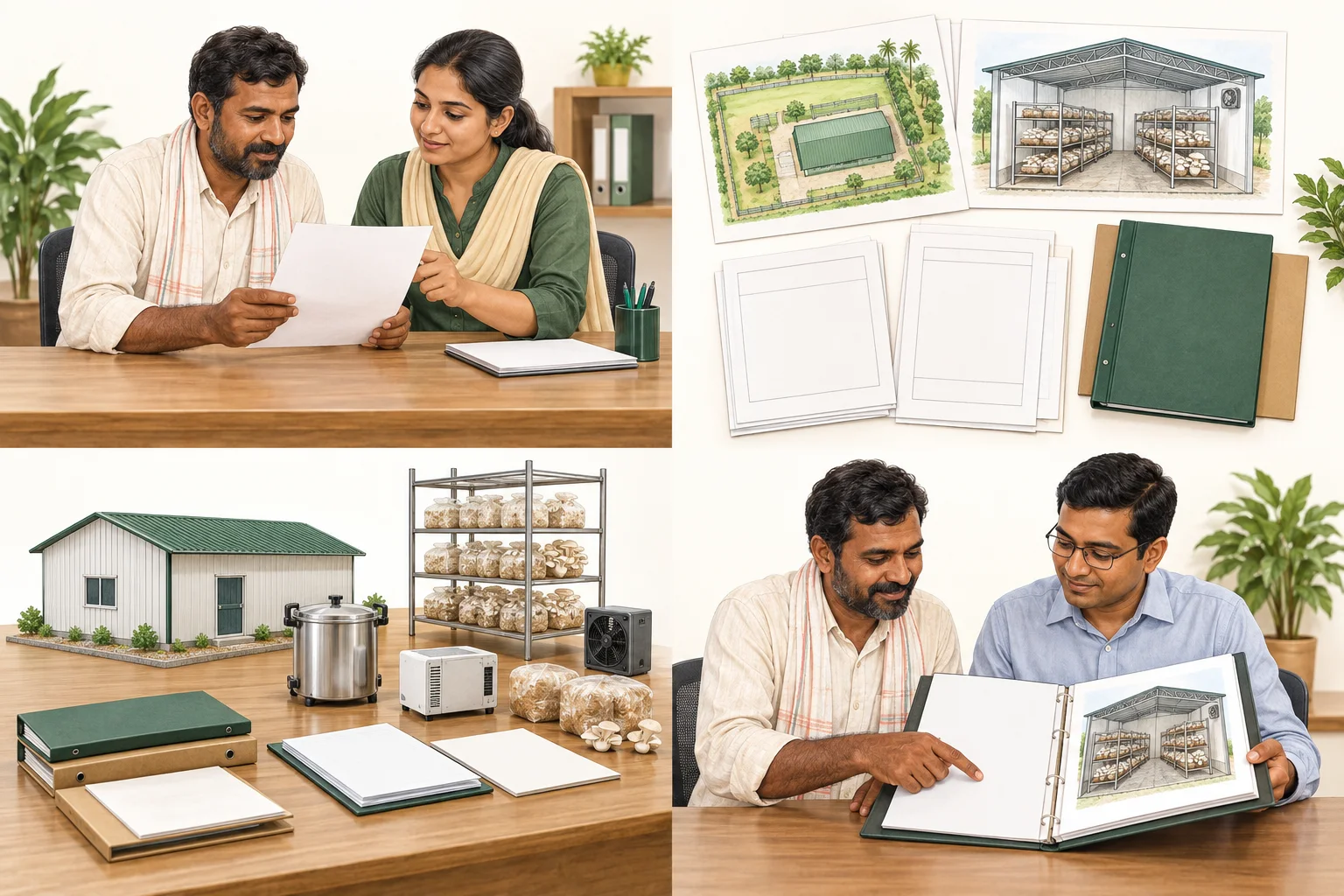
Follow a Button crop without confusing compost preparation, colonisation, casing and fruiting. The study sequence includes eighteen detailed lessons; the practical walkthrough below connects the handovers.
Read one page, study its picture, then turn to the next. Use Contents whenever you want a particular topic.
Start here
Practical workbook
What you need before starting
Keep these beside you while you learn. You do not need to buy equipment just to read this book.
01
Compost delivery stage and batch information
02
Separate air and compost measurement records
03
The selected strain and farm’s stage-specific operating procedure
Understand the basics
Look closely
The mushroom is not the whole organism
The visible mushroom is a fruiting body. The fungus also grows as mycelium: a network of fine threads through its growing material. A farmer first establishes that growth, then manages conditions in which fruiting bodies can develop. A bag without mushrooms may still be in its growing stage.
In this Button illustration, the cap, gills and stem belong to the fruiting body. The network below represents mycelium in compost. The separate top layer is casing. Other cultivated mushrooms may use different materials and may not need casing.
For your own crop, record two different observations: development of the growing material and development of the mushrooms. Do not describe both simply as “the crop looks white”. A drawing cannot distinguish cultivated mycelium from contamination in your bag.
An instrument gives a reading at a particular place and time. The three bed markers in the picture are different locations from the instrument standing in room air. A reading from air should not be recorded as if it came from the growing material.
Use a consistent location code: room, rack, tier and position. Record time, crop stage, instrument and recent changes such as watering or a door opening. Compare locations at reasonably comparable times, using a method suitable for the quantity being measured.
If one location behaves differently, repeat the observation and check the instrument before changing the whole room. Investigate airflow, loading and material history with the responsible operator. The picture does not specify the number, depth or placement of sensors needed on your farm.
Water in the growing material, water vapour in the room air and liquid water on a mushroom surface are different observations. A humid room does not prove that the material contains enough water. A wet cap does not prove that the crop needs more mist.
Before adding water, identify the crop stage and material you intend to affect. Record the previous application and inspect representative locations using the method taught for that crop. Consider recent changes in temperature, ventilation and surface drying.
Also include the supply itself in the farm plan: source, storage, distribution, cleaning and any testing required for its intended use. Clear-looking water is not evidence that it is suitable for food-contact or cultivation operations. Use the applicable trained procedure rather than a universal daily litre figure.
Start with what you can show: crop and stage, date first noticed, number or area affected, location, recent operations and whether the pattern is spreading. Photograph a whole-room view, an affected area, an unaffected comparison and a close detail.
A brown mark, slow patch or unusual shape can have more than one explanation. Record relevant material lots, watering, environment and insect observations. Keep the distinction between “I saw this” and “I think this caused it”.
Follow the farm’s containment procedure while seeking qualified advice. Do not open suspect material just to smell it, move it through clean work, or choose a pesticide from a photograph. A specialist may require samples, records or testing before recommending action.
Unspawned Phase II compost and colonised Phase III compost are different purchases. Their remaining work, handling and room occupancy differ. Keep the supplier’s release information with the batch rather than treating a dark colour as acceptance evidence.
The process
Practical workbook
Separate spawn run and casing
Colonisation develops through the compost; casing is a later, distinct surface operation. Uniform filling and a consistent casing application help make comparisons between bed locations meaningful. Casing cannot repair inadequately prepared compost.
The process
Practical workbook
Read the fruiting transition
Case run, pin formation and mushroom enlargement are not the same stage. A planned transition needs observations from representative crop locations. Changing a setpoint does not prove that the crop surface or compost has reached the intended condition.
The process
Practical workbook
Harvest, grade and reset
Picking decisions affect the next operation: clean containers, grading, packing and dispatch. Keep rejects visible in the crop account. Plan room emptying and cleaning before the last harvest so spent material does not cross the next crop’s clean workflow.
In the field
Field notes
Know exactly what compost you are buying
Button mushroom is grown on selectively prepared compost. Ask whether the delivery is Phase II compost ready for spawning, already spawned material, or fully colonised Phase III compost. These deliveries require different facilities and schedules. A quotation that says only ‘mushroom compost’ is insufficient for planning the work you must do after it arrives.
Before unloading, match the delivery to the supplier's batch record and acceptance specification. Record temperature at representative locations, delivered mass, transport duration and any visible difference between loads. Ask how preparation, conditioning and release were verified. Material that has completed a heating programme may still need conditioning or cooling; the calendar alone does not establish that it is ready for spawn.
In the field
Field notes
Know exactly what compost you are buying · continued
Agree where an uncertain load will wait and who can authorise its use. Spawning questionable compost commits further money and makes later cause tracing harder. Keep the supplier's instructions with the batch instead of mixing advice from different compost systems. Use the detailed compost and parameter pages below for the preparation method being used.
In the field
Compare the evidence
Three purchase stages and the work still required
Three purchase stages and the work still required
Delivered material
Main work remaining
Confirm before ordering
Phase II compost
Spawning, spawn run, casing and cropping
Release criteria, transport conditions and spawn requirement
Recently spawned compost
Complete colonisation, then casing and cropping
Inoculation date, strain and handling instructions
Phase III compost
Handling of colonised material, casing and cropping
Readiness, delivery temperature and filling procedure
In the field
Field notes
Separate the jobs of compost and casing
During spawn run the objective is reliable colonisation of the compost. Protect batch identity, distribute and fill material consistently, and record both air and compost conditions. A change in the room display does not show how quickly the centre of a bed responds. Compare representative bed locations and investigate unusual heating or stalled development before moving the whole room to the next stage.
Casing provides the surface environment in which fruiting develops, including water storage and gas exchange. Its preparation, physical structure and hygiene affect that environment. Prepare an even layer using the method specified for the material, while avoiding unintended compression. Record where a particular casing batch is used so that later patchy performance can be compared with material and watering history.
In the field
Field notes
Separate the jobs of compost and casing · continued
Check moisture in the layer itself as well as conditions above it. A room can feel humid while the casing has dried. Conversely, a wet-looking surface can hide compaction or poor distribution. Learn to compare samples under a consistent method with a trained grower; do not turn one photograph or a hand-squeeze description into a universal acceptance test.
In the field
Field notes
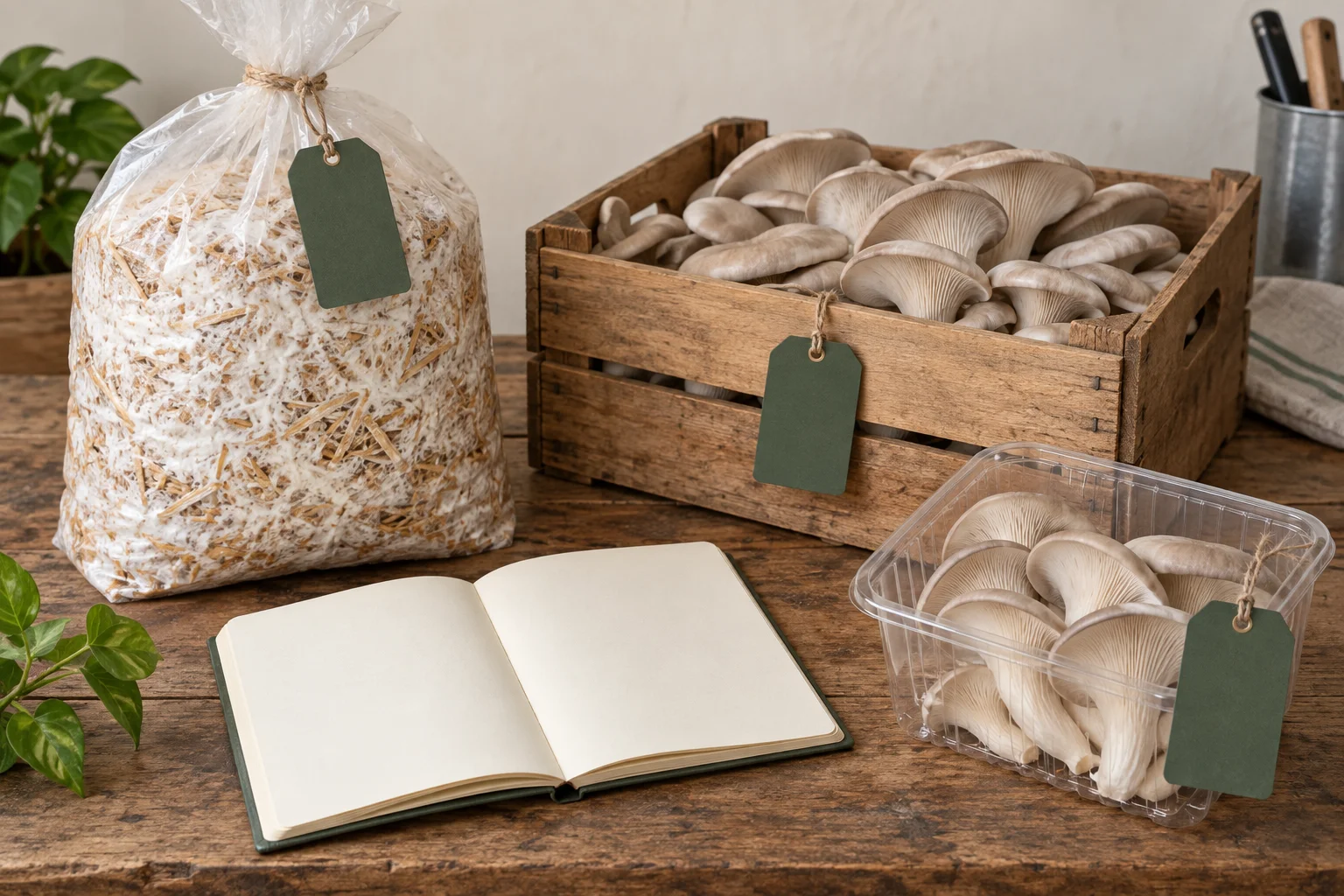
Write it in your farm notebook
For each bed or rack: compost lot and fill mass, spawn lot and inoculation date, colonisation observations, casing lot and application date, and the operator responsible.
In the field
Field notes
Manage the transition to pins as a sequence
Pinning follows the development of the crop and the change to suitable fruiting conditions. Review compost and casing development first. Then follow the strain and crop programme for air, temperature and moisture together. A sudden change in ventilation also changes drying and cooling, so treat the room as an interacting system rather than a set of independent switches.
Map the response. Pins only near the door, drying along an air outlet or delayed patches on one tier are useful patterns. Compare those locations with air distribution, casing depth, watering and bed measurements. Record the time of an adjustment and assess its effect at the next planned observation. Avoid repeatedly changing several controls because pins did not appear on the expected date.
In the field
Compare the evidence
From observation to an evidence-based check
From observation to an evidence-based check
Observation
Compare first
Useful next record
Patchy colonisation
Material batch, filling and compost conditions
Map of slow areas and batch IDs
Uneven pins
Casing history, moisture and room distribution
Matched photos of early and late areas
Long stems or small caps
Strain, maturity and air measurements
Stage, morphology and sensor location together
Wet caps
Watering time, condensation and cooling changes
Surface condition before and after the event
In the field
Field notes
Plan harvest, later flushes and the reset
Agree the buyer's grade before picking starts. Train pickers to recognise the agreed maturity, handle mushrooms gently, segregate damaged material and protect nearby developing mushrooms. Use clean, identified containers and keep the elapsed time from picking to packing and temperature control short enough for your validated handling process.
Record each flush separately. This helps distinguish an uneven first pinset from poor recovery later in the crop. Review harvest mass with watering and climate history, rather than assuming that a large first flush guarantees the rest of the cycle. Close the room only after spent material has been removed through the planned route and the appropriate cleaning process completed.
In the field
Field notes
Plan harvest, later flushes and the reset · continued
Reconcile gross harvest, trimmed or rejected mass, packed quantity, sales and returns. Include room turnaround time when planning the next crop. Filling a room earlier is not an improvement if cleaning, maintenance or compost readiness has been compromised.
In the field
Field notes
A useful batch comparison
Two beds share the same room air but only one develops poorly. Check whether they also share the compost lot, spawn lot, casing batch, filling depth and watering history. Shared air makes a room-wide climate explanation less convincing by itself; it does not exclude a local airflow or bed-temperature problem.
In the field
Sources & further reading
Where the field guidance comes from
ICAR-DMR: Button mushroom production systems: Compost stages, crop-room operations and infrastructure context. Historic material is not a current pesticide instruction.
Penn State: microbial activity in mushroom substrate: Why preparation, conditioning, uniform filling and cooling are distinct operations.
In button mushroom you grow the food for the fungus first and the fungus second. See why compost, casing and the room each exist, and every later decision makes sense.
By the end you can name the stages of the button crop in order and say what each does.
By the end you can explain what compost does and what casing does.
By the end you can state the two temperature bands and match each to its stage.
Button Mushroom Fundamentals
Field notes
What you are growing
Agaricus bisporus, the white button mushroom, is a fungus. It has no roots or leaves. Its body is a web of fine white threads called mycelium, and what you sell is its fruit body.
In nature it lives on rotted horse manure and straw and cannot digest fresh straw. So the grower first ferments straw and manure into compost the fungus can eat and its competitors cannot. Then the grower adds a moist soil layer, the casing, because casing supports reliable commercial fruiting. Everything else on the farm serves those two facts.
Button Mushroom Fundamentals
Field notes
The stage ladder
The crop climbs fixed rungs. Phase I ferments raw straw. Phase II pasteurises it and clears ammonia. Spawning mixes in grain coated with mycelium. Spawn run is the 12 to 14 days in which mycelium fills the compost. Casing lays 3 to 4 cm of soil on top. Case run lets mycelium climb into that soil, about a week. Pinning is when the grower changes the room and pinheads appear. Cropping is the weeks of picking, in waves called flushes.
ICAR-DMR gives a duration for each rung but no single day count from spawning to last flush. Learn the ladder, not a total.
Button Mushroom Fundamentals
Field notes
Two temperatures, two jobs
The fungus wants warmth to spread and cool to fruit. ICAR-DMR's species table puts spawn run at 22 to 25 °C and fruiting at 14 to 18 °C. Hold the first band until the compost is colonised, then move the room into the second.
The drop is not a small adjustment. With fresh air and lower carbon dioxide it is the signal that tells mycelium to stop spreading and start fruiting. A seasonal grower in the plains gets that drop from winter itself. A controlled farm buys it from a cooling unit. Both are managing the same biology.
Button Mushroom Fundamentals
Field notes
Compost is food, casing is a trigger
New growers treat casing as a second layer of food. It is not. Compost carries the carbon and nitrogen the mycelium eats. Casing carries almost none: it holds water, lets carbon dioxide escape, and its surface is where pins form.
So a farm can have good compost and no crop when the casing is too dry, too wet or diseased. And good casing gives a poor crop when the compost was spawned with ammonia still in it. Yield is counted per 100 kg of compost because compost is the input everything else scales from.
Button Mushroom Fundamentals
Compare the evidence
Read the numbers in context
These figures belong to the named source and method. Historical costs are not current quotations. A value without its stage, material basis or measurement location is not a farm instruction.
Source-specific reference figures
What is measured
Value and basis
Source and limitation
Spawn-run temperature
22-25 °C
ICAR-DMR seasonal folder. ICAR-DMR species table, room air.
Fruiting temperature
14-18 °C
ICAR-DMR seasonal folder. Other DMR documents give 14-16, 15-17 and 16-18.
These figures belong to the named source and method. Historical costs are not current quotations. A value without its stage, material basis or measurement location is not a farm instruction.
Source-specific reference figures
What is measured
Value and basis
Source and limitation
Casing thickness
3-4 cm
ICAR-DMR manual, 2011. The 2011 manual's definition.
Yield, long-method compost
10-15 kg per 100 kg compost
ICAR-DMR manual, 2011. Reported range; short method 18 to 25.
Record: Date, room, days since spawning and casing, air temperature, the stage you judged, what did not fit.
01
Visit any button unit with a notebook and a thermometer.
02
Look at one bag: dark compost is early spawn run, light brown with white threads means the run is complete, soil on top means cased, pins mean pinning.
03
Read the air temperature and write which band it sits in.
04
Ask the days since spawning and casing, compare with the 12 to 14 day and 7 day rungs, and note what does not fit.
Button Mushroom Fundamentals
Pause and recall
Avoid these mistakes
Treating the crop as one process, so a Phase II fault gets blamed on the room.
Keeping the room warm after casing, so the crop never gets its fruiting signal.
Comparing your yield per bag with a neighbour's yield per 100 kg compost.
Button Mushroom Fundamentals
Pause and recall
Check your understanding
Choose your answer before opening the explanation. This is a learning exercise, not a competency assessment.
What is the main job of the casing layer?
Feed the mycelium nitrogen
Hold water and trigger fruiting on its surface
Keep the compost warm
Stop flies
See the answer and why
Hold water and trigger fruiting on its surface Casing carries almost no food. It holds water and gives the pinning surface.
Button Mushroom Fundamentals
Pause and recall
Check your understanding
Choose your answer before opening the explanation. This is a learning exercise, not a competency assessment.
A room reads 24 °C and the bags are dark brown with a few white threads. Which stage?
Pinning
Cropping
Spawn run
Case run
See the answer and why
Spawn run Warm air on partly colonised, uncased compost is spawn run.
Button Mushroom Fundamentals
Pause and recall
Check your understanding
Choose your answer before opening the explanation. This is a learning exercise, not a competency assessment.
Why is yield quoted per 100 kg of compost?
Bags weigh 100 kg
Compost is the input every figure scales from
It hides low yields
NHB requires it
See the answer and why
Compost is the input every figure scales from Bags and rooms vary, so compost weight is the common base.
A bamboo shed in a Punjab winter and a panelled room in Tamil Nadu both grow button mushroom, but not the same way. Choosing a system you cannot run is the costliest early mistake.
By the end you can describe seasonal and controlled production and what each depends on.
By the end you can name ICAR-DMR's growing months for plains, mid-hills and high hills.
By the end you can list what to check about your own site before choosing.
Production Systems
Field notes
Seasonal: the winter does the cooling
Seasonal growers use the cold months to supply the fruiting temperature for free. ICAR-DMR's seasonal folder gives November to February for the north Indian plains, September to March for the mid-hills and March to November for the high hills. The 2011 manual says October to February for the plains, so treat the edges as soft.
The room is brick, mud or bamboo with a thatch roof, and ICAR-DMR says a start can be made in a 10 by 10 by 12 foot room. One crop is taken and picking runs 8 to 10 weeks.
Production Systems
Field notes
Controlled: the room replaces the season
A controlled unit has insulated rooms, an air handling unit that cools and humidifies, and usually a Phase II tunnel. ICAR-DMR's planning model assumes 60 day crops, 6 crops per room per year and an air to bed ratio of 1 to 5.
The price of independence from weather is a machine that must run every hour. A controlled farm is judged on crops completed per room per year and on how evenly its rooms perform. One good crop proves nothing, six in a row prove the system, and the power bill has to be paid by the crop.
Production Systems
Field notes
Same biology, different tolerances
Two documented growing settings
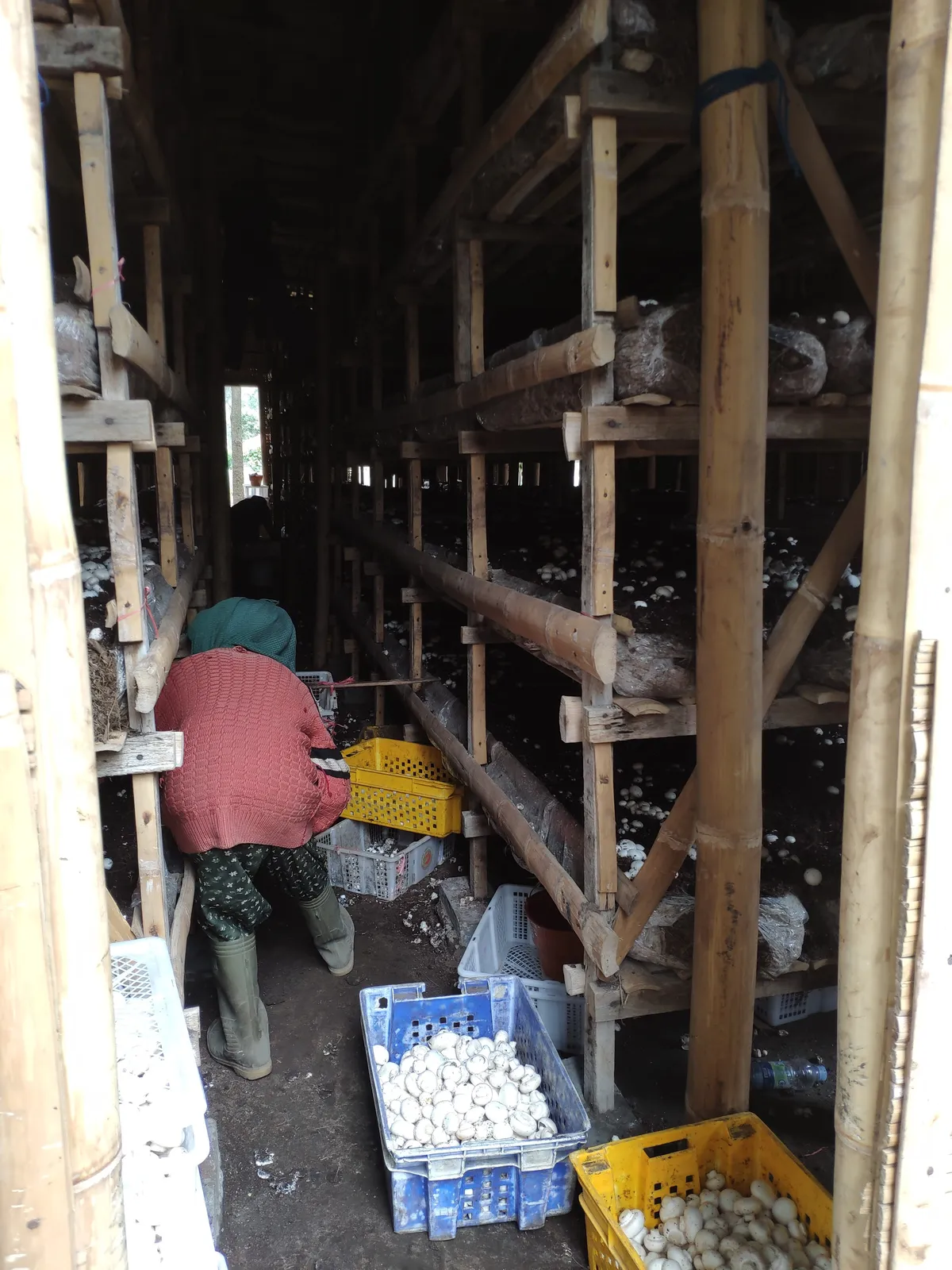
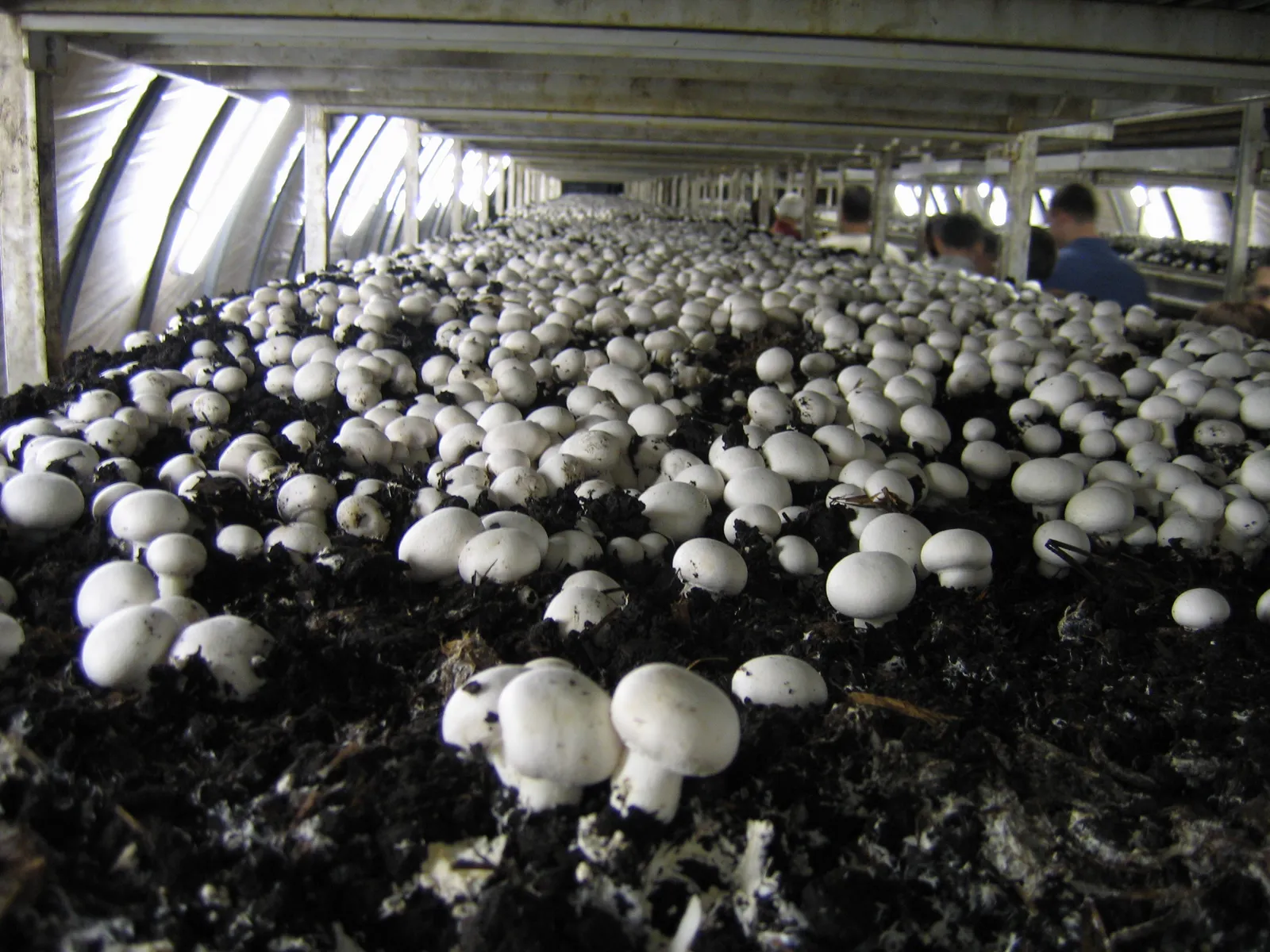
Bamboo grow house · IndonesiaPhoto credit & full view
Interior of a low-cost bamboo button-mushroom grow house with tiered beds and a worker (Indonesia). Context photograph, not a prescribed layout, diagnostic result or performance standard.
Button mushrooms on casing in long shelf beds inside a grow room (Hungary). Context photograph, not a prescribed layout, diagnostic result or performance standard.
Both chase the same targets but cannot hold them equally. ICAR-DMR quotes 95 percent relative humidity for a controlled spawn run and 80 to 90 percent for a seasonal one, because a ventilated shed cannot hold 95 percent. Each figure belongs to its own room.
Compost pairs with the room too. A tunnel unit makes short-method compost and a seasonal grower makes long-method compost, and ICAR-DMR reports 18 to 25 kg per 100 kg for the first against 10 to 15 kg for the second. Do not expect short-method yields from long-method compost.
Production Systems
Field notes
What the norms say about scale
MIDH guidelines of 2025 give a cost norm of 30 lakh rupees for a production unit, with 40 percent assistance to private growers as a credit-linked, back-ended subsidy. A low-cost norm of 2 lakh rupees for 200 square feet carries 50 percent.
Read these as two doorways, not as advice. The large norm needs a bank loan and full machinery; the small one fits a seasonal start. Know first how many months your site sits near 14 to 18 °C at night, whether power is reliable, where compost will come from, and who buys within a day's travel.
Production Systems
Compare the evidence
Read the numbers in context
These figures belong to the named source and method. Historical costs are not current quotations. A value without its stage, material basis or measurement location is not a farm instruction.
Source-specific reference figures
What is measured
Value and basis
Source and limitation
Season, north Indian plains
November to February months
ICAR-DMR seasonal folder. The manual says October to February.
Season, mid-hills and high hills
September to March; March to November months
ICAR-DMR seasonal folder. Mid-hills confirmed in the manual.
These figures belong to the named source and method. Historical costs are not current quotations. A value without its stage, material basis or measurement location is not a farm instruction.
Source-specific reference figures
What is measured
Value and basis
Source and limitation
Controlled crop cycle
60 days, 6 crops per year
ICAR-DMR manual, 2011. Planning assumption, air to bed ratio 1 to 5.
MIDH cost norms
30; 2 lakh rupees
MIDH guidelines, 2025. Production unit; low-cost 200 sq ft unit.
Record: The 7-day temperature table, power notes, input sources with prices, buyer list with weekly quantities, your written choice.
01
For 7 nights record outdoor minimum and maximum temperature at the same two times daily.
02
Note power: phases, outage hours in a normal week, cost per unit from the last bill.
03
List straw and manure sources within 30 km with prices, and buyers within a day's travel with the weekly kg each would take.
04
Mark your region on the ICAR-DMR season table, count your natural fruiting months, and write your choice with its reason.
Production Systems
Pause and recall
Avoid these mistakes
Building a controlled room before securing short-method compost, so its capacity is wasted.
Starting a plains crop late and losing the last flushes to March heat.
Sizing the farm to the subsidy norm instead of to weekly buyers.
Production Systems
Pause and recall
Check your understanding
Choose your answer before opening the explanation. This is a learning exercise, not a competency assessment.
Why does ICAR-DMR give 80 to 90 percent humidity for a seasonal spawn run but 95 percent for a controlled one?
Seasonal compost needs less water
A ventilated room cannot hold 95 percent
Different spawn
A printing error
See the answer and why
A ventilated room cannot hold 95 percent Both are ICAR-DMR figures, each practical for its room.
Production Systems
Pause and recall
Check your understanding
Choose your answer before opening the explanation. This is a learning exercise, not a competency assessment.
A controlled unit should be judged mainly on what?
Its first crop
Room size
Crops per room per year and evenness
The cooling brand
See the answer and why
Crops per room per year and evenness The model assumes 6 crops a year, so one good crop proves little.
Production Systems
Pause and recall
Check your understanding
Choose your answer before opening the explanation. This is a learning exercise, not a competency assessment.
Which MIDH component fits a 200 square foot start?
Spawn unit
Compost unit
Production unit at 30 lakh
Low-cost unit at 2 lakh
See the answer and why
Low-cost unit at 2 lakh It is the smallholder route, up to five units.
Production Systems
Visual glossary
Words used in this lesson
01Seasonal cultivation
AI illustration · details
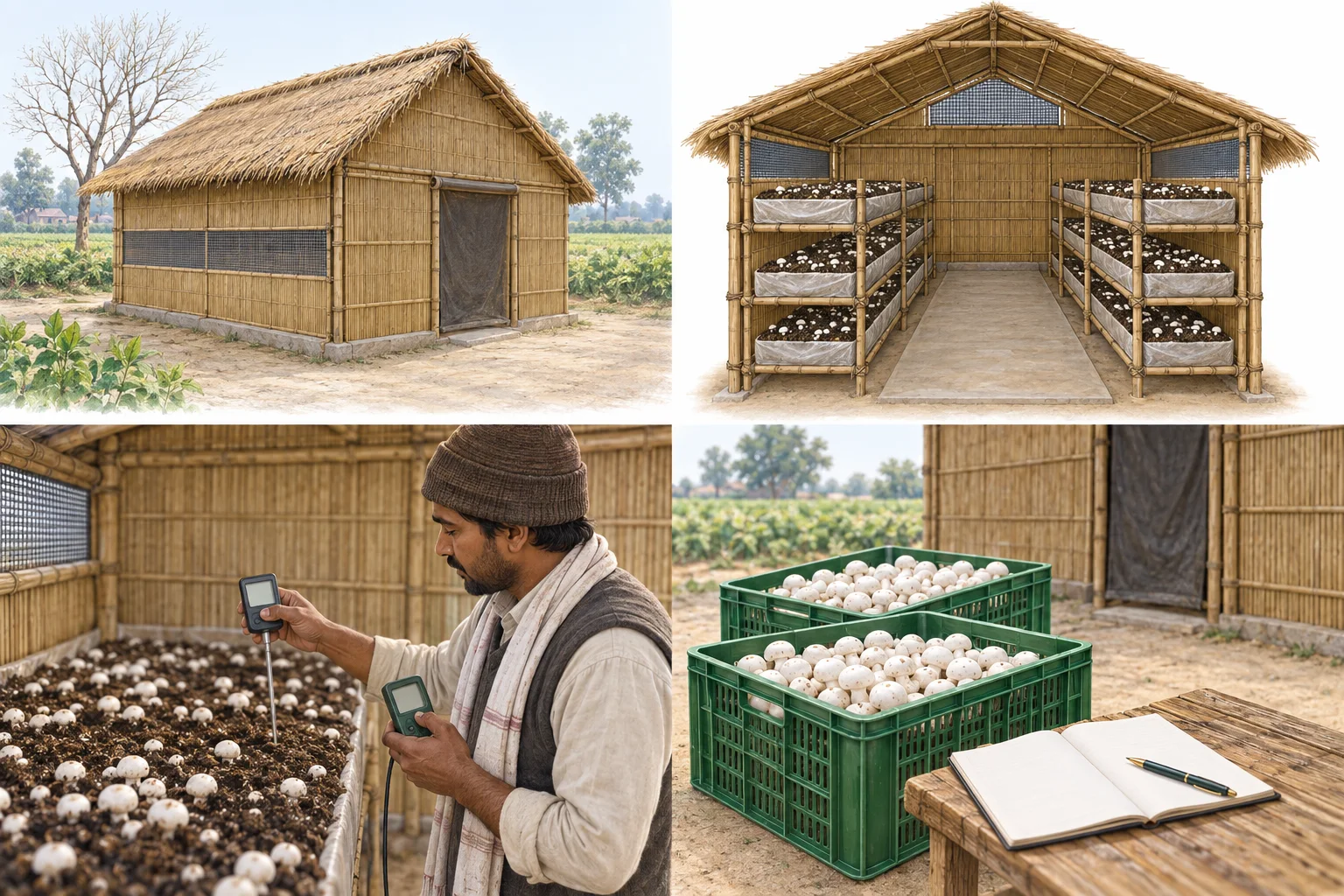
AI teaching illustration. People need room to load, inspect, harvest and remove spent material. Low-cost construction still needs safe structure, drainage and access.
Compost is not a recipe you copy. It is a living process you steer so that only the button mushroom can eat the result. Stop asking for a formula and start asking for a measurement.
By the end you can explain why compost is called a selective substrate.
By the end you can state ICAR-DMR's nitrogen, moisture, pH and ammonia targets.
By the end you can judge a finished compost by hand, nose and eye.
Compost Fundamentals
Field notes
Selective means the competitors starve
Fresh straw holds sugars that hundreds of fungi and bacteria can eat. Spawn it directly and moulds outgrow the mushroom in days. Composting changes that: heat-loving microbes consume the easy sugars, turn ammonia into their own protein, and leave a dark crumbly material rich in microbial bodies.
The button mushroom digests that material. Most competitors cannot, or not fast enough. That is what ICAR-DMR means by a selective substrate. A formulation only sets the process up. Selectivity is created by the process and judged by measurements at the end, not by the ingredients you started with.
Compost Fundamentals
Field notes
The nitrogen corridor
ICAR-DMR sets nitrogen in the mixed raw materials at 1.5 to 1.75 percent of dry weight and the carbon to nitrogen ratio at 25 to 30 to 1, falling to about 16 to 1 after composting.
Both edges matter. Below 1.5 percent the heap may not pass 55 to 60 °C and moulds such as Stachybotrys move in. Above 1.75 percent, nitrogen leaves as ammonia and the compost is invariably infested by Sepedonium yellow moulds and ink caps. Nitrogen comes from whatever is cheap near you: ICAR-DMR gives wheat straw 0.6 percent, deep-litter chicken manure 3.0, wheat bran 2.0 and cotton seed meal 7.0.
Compost Fundamentals
Field notes
Water, air and gypsum
Microbes need water to work and air to work cleanly. ICAR-DMR wets straw to about 75 percent moisture, roughly 4000 litres per tonne. Too wet and the heap turns anaerobic and sour; too dry and it never heats. Straw should be fresh, chopped 5 to 8 cm, and a batch under 300 kg will not hold heat.
Gypsum, added at the third turning, keeps the compost open rather than greasy and buffers the pH. Finished compost should sit at pH 7.2 to 7.8. Outside that band growth slows and white plaster mould invades, and a low pH favours green mould.
Compost Fundamentals
Field notes
Judging the finished product
Compost readiness requires a set of measurements and observations interpreted for the selected preparation method. Moisture, structure, temperature, conditioning and ammonia must be assessed together. A single moisture threshold does not establish that all compost above it will fail.
Use the documented batch release specification, calibrated instruments and representative sampling. Visual and tactile observations can supplement measurements, but do not deliberately smell compost or assign an ammonia concentration from odour. Older numerical recipes describe particular methods and must not be treated as universal release criteria.
Compost Fundamentals
Compare the evidence
Read the numbers in context
These figures belong to the named source and method. Historical costs are not current quotations. A value without its stage, material basis or measurement location is not a farm instruction.
Source-specific reference figures
What is measured
Value and basis
Source and limitation
Nitrogen of the raw mix
1.5-1.75 % of dry weight
ICAR-DMR manual, 2011. The mineral table says 1.5 to 1.8.
Carbon to nitrogen ratio at stacking
25-30 to 1 ratio
ICAR-DMR manual, 2011. About 16 to 1 after composting.
These figures belong to the named source and method. Historical costs are not current quotations. A value without its stage, material basis or measurement location is not a farm instruction.
Source-specific reference figures
What is measured
Value and basis
Source and limitation
Moisture and pH of finished compost
68-72; 7.2-7.8 %; pH
ICAR-DMR manual, 2011. Long-method compost; Phase II compost is 64 to 66 percent.
Free ammonia at spawning
8-10 ppm maximum
ICAR-DMR manual, 2011. Do not infer concentration from smell; use a validated measurement method.
Record: Raw material table with price, nitrogen percentage, measured moisture, and your reason for the nitrogen source.
01
List every straw, manure and bran source in reach with a price per quintal and its freshness.
02
Next to each, write its nitrogen percentage from the ICAR-DMR table.
03
Weigh 1 kg of each wet, sun-dry it three days, weigh again and note the moisture lost.
04
Squeeze-test a compost sample from a nearby farm and write which nitrogen source you would use and why.
Compost Fundamentals
Pause and recall
Avoid these mistakes
Copying a formulation without checking your own straw, so nitrogen lands outside the corridor.
Making a trial heap under 300 kg and concluding that composting does not work.
Spawning compost that still smells of ammonia because the calendar said day 28.
Compost Fundamentals
Pause and recall
Check your understanding
Choose your answer before opening the explanation. This is a learning exercise, not a competency assessment.
What makes compost selective?
Gypsum
The recipe on paper
A fermentation that removes the easy sugars
Keeping it dry
See the answer and why
A fermentation that removes the easy sugars Selectivity is created by the process; the recipe only sets it up.
Compost Fundamentals
Pause and recall
Check your understanding
Choose your answer before opening the explanation. This is a learning exercise, not a competency assessment.
Nitrogen above 1.75 percent at stacking leads to what?
Faster spawn run
Ammonia loss and yellow mould infestation
Lower heap temperature
Higher moisture
See the answer and why
Ammonia loss and yellow mould infestation ICAR-DMR says excess nitrogen leaves as ammonia and Sepedonium follows.
Compost Fundamentals
Pause and recall
Check your understanding
Choose your answer before opening the explanation. This is a learning exercise, not a competency assessment.
You can smell ammonia on filling day. What does that tell you?
It is ready
Ammonia is under 10 ppm
Hold for validated ammonia and readiness assessment
Gypsum was forgotten
See the answer and why
Hold for validated ammonia and readiness assessment Smell cannot establish an ammonia concentration. Hold the batch for a validated release assessment; do not deliberately inhale compost gases.
Compost Fundamentals
Visual glossary
Words used in this lesson
01Selective substrate
Material the mushroom can digest but its competitors mostly cannot.
02Ammonia
A sharp-smelling nitrogen gas released in composting; it kills mushroom mycelium.
Phase I turns straw and manure into something hot, dark and alive. Growers lose yield here because they judge the heap by the calendar instead of by what it is doing.
By the end you can state what Phase I must achieve and how the compost ends up.
By the end you can describe pre-wetting, heap size and the turning schedule.
By the end you can organise temperature, material observations and validated process measurements without using odour as a concentration test.
Phase I
Field notes
What Phase I is for
Phase I has three jobs. It wets and mixes the raw materials so every straw touches nitrogen and water. It starts a fermentation in which heat-loving microbes eat the easy sugars. And it turns much of the added nitrogen into ammonia and microbial protein for Phase II to finish.
It is deliberately incomplete. ICAR-DMR describes compost after Phase I as having a heavy ammonia smell, a pH of about 8.2 to 8.5, moisture of 72 to 75 percent and ammonia around 800 to 1000 ppm. That is the expected state before pasteurising.
Phase I
Field notes
Pre-wetting and stacking
Dry straw repels water. ICAR-DMR wets it for 24 to 48 hours until it holds about 75 percent moisture, roughly 4000 litres per tonne, mixing in the nitrogen sources so fermentation starts everywhere at once.
Heap size follows climate. In the plains ICAR-DMR builds 100 to 120 cm wide; in the cooler hills 130 to 150 cm wide and about 150 cm high. A bigger heap holds heat and a small one never ferments, so never attempt less than 300 kg. Within two to three days the core should reach 65 to 70 °C.
Phase I
Field notes
Turning: why and when
A heap heats from inside. The outer layer stays cool and the core can go anaerobic. Turning moves the outside to the inside and lets air back in.
For the long method ICAR-DMR turns on day 6, day 10, day 13 with gypsum, then days 16, 19, 22 and 25, and fills on day 28: 7 to 8 turnings over 28 to 30 days. The short method runs outdoor Phase I for only 10 to 12 days before a tunnel, and the bunker method finishes in 6 to 8 days with forced air.
Phase I
Field notes
Temperature is the instrument
Buy a long-stem compost thermometer before anything else. ICAR-DMR says the heap may reach 70 °C in 24 to 48 hours, and that above 80 °C in the core is undesirable because the heap goes anaerobic. A peak stuck near 55 °C says nitrogen is short.
Measure centre, mid-depth and near-surface each morning. One centre reading hides a cold shoulder, and cold shoulders are where competitor moulds start. A sour, black, greasy heap went anaerobic. Insects breed at the last turnings, and current label approval must be checked before using anything against them.
Phase I
Compare the evidence
Read the numbers in context
These figures belong to the named source and method. Historical costs are not current quotations. A value without its stage, material basis or measurement location is not a farm instruction.
Source-specific reference figures
What is measured
Value and basis
Source and limitation
Pre-wetting
24-48 hours
ICAR-DMR manual, 2011. To about 75 percent moisture.
These figures belong to the named source and method. Historical costs are not current quotations. A value without its stage, material basis or measurement location is not a farm instruction.
Source-specific reference figures
What is measured
Value and basis
Source and limitation
Core temperature reached
65-70 °C in 2 to 3 days
ICAR-DMR button folder. Manual: ceiling 80 °C.
State after Phase I
8.2-8.5 pH
ICAR-DMR manual, 2011. With 800 to 1000 ppm ammonia.
Phase II is a few days that decide the whole crop. Too cool and the pests survive; too hot and you kill the microbes that finish the compost. Release it on evidence, never on the clock.
By the end you can separate pasteurisation, conditioning and cooling.
By the end you can state ICAR-DMR's bands and the two limits that must not be crossed.
By the end you can describe finished Phase II compost and why release depends on ammonia.
Phase II
Field notes
Three jobs in one tunnel
Phase II is called pasteurisation, but that is only its middle act. First comes pre-pasteurisation conditioning: the compost is levelled to a uniform 45 to 48 °C and held in the 45 to 52 °C band for two days. Then pasteurisation, a short controlled peak that kills insects, nematodes and competitor spores. Then post-pasteurisation conditioning, back to 45 to 48 °C until the ammonia is gone.
Run the tunnel as one long hot period instead and you get compost that is clean but still full of ammonia, and the spawn dies in it.
Phase II
Field notes
The peak and its ceiling
ICAR-DMR finds compost properly pasteurised when it is held at 58 to 59 °C for 4 to 6 hours. It is not pushed there suddenly: the temperature climbs at about 1 °C per hour, reaching the target in 10 to 12 hours largely from the compost's own heat.
The ceiling is hard. Above 60 °C, ICAR-DMR says, all organisms are killed including the thermophilic fungi Phase II depends on, and the same manual names that as a cause of olive green mould. A tunnel needs a compost probe, not an air thermometer by the door.
Phase II
Field notes
Conditioning: where the ammonia goes
After the peak the compost is brought down at about 1.5 °C per hour and held at 45 to 48 °C. Surviving heat-loving fungi turn free ammonia into their own bodies, which the mushroom later eats. This step is what makes the compost selective. ICAR-DMR says it takes 3 to 4 days in a modern tunnel, or until the compost is free of ammonia.
Two limits protect it. Never condition below 40 °C, because mesophilic fungi set in and spoil the compost. Keep oxygen above 10 percent, since the fan is not optional.
Phase II
Field notes
Uniformity, then evidence
A tunnel is filled 2 to 2.2 metres deep at about 900 to 1000 kg per square metre, with air pushed up from the plenum below. ICAR-DMR insists that the air above the compost, the compost itself and the plenum differ by no more than 3 °C, or one layer is under-pasteurised while another is over-cooked. On a small farm, probe a covered heap top, middle and bottom.
Finished compost has ammonia below 10 ppm, moisture around 64 to 66 percent with no liquid oozing when squeezed firmly, and a dark crumbly texture.
Phase II
Compare the evidence
Read the numbers in context
These figures belong to the named source and method. Historical costs are not current quotations. A value without its stage, material basis or measurement location is not a farm instruction.
Source-specific reference figures
What is measured
Value and basis
Source and limitation
Pre-pasteurisation conditioning
45-52 °C for 2 days
ICAR-DMR manual, 2011. After levelling the mass to 45 to 48 °C.
These figures belong to the named source and method. Historical costs are not current quotations. A value without its stage, material basis or measurement location is not a farm instruction.
Source-specific reference figures
What is measured
Value and basis
Source and limitation
Post-pasteurisation conditioning
45-48 °C for 3 to 4 days
ICAR-DMR manual, 2011. Until ammonia is under 10 ppm, never below 40 °C.
Compost temperature at spawning
25-30 °C
ICAR-DMR manual, 2011. With 64 to 66 percent moisture.
Record: Compost temperature log, validated ammonia results, moisture assessment and the authorised release decision.
01
Draw hours across and 20 to 65 °C up, shade 45 to 52 and 58 to 59, and rule a red line at 60.
02
Log the compost probe every 2 hours and plot it.
03
During conditioning, record validated ammonia measurements and the process observations specified by the trained operator. Never use deliberate smelling as a release test.
04
Mark release only when the validated temperature, conditioning, ammonia and material acceptance criteria have all been met and recorded.
Phase II
Pause and recall
Avoid these mistakes
Running one long cycle above 60 °C, which leaves ammonia in a dead compost.
Trusting the air sensor by the door while the compost core sits degrees away.
Releasing on the planned day while the compost still smells of ammonia.
Phase II
Pause and recall
Check your understanding
Choose your answer before opening the explanation. This is a learning exercise, not a competency assessment.
The probe reads 62 °C for three hours during pasteurisation. What has happened?
Extra safety against pests
The thermophilic flora may be killed
Nothing, the limit is 65
The ammonia is gone
See the answer and why
The thermophilic flora may be killed ICAR-DMR sets 60 °C as the ceiling; above it the essential fungi die.
Phase II
Pause and recall
Check your understanding
Choose your answer before opening the explanation. This is a learning exercise, not a competency assessment.
Conditioning is held at 38 °C to save fuel. Why is that a problem?
Ammonia is released faster
Mesophilic fungi set in and spoil the compost
Moisture rises
It is not a problem
See the answer and why
Mesophilic fungi set in and spoil the compost ICAR-DMR says never condition below 40 °C.
Phase II
Pause and recall
Check your understanding
Choose your answer before opening the explanation. This is a learning exercise, not a competency assessment.
Which observation releases compost from Phase II?
Day 5 has arrived
The air above reads 45 °C
Documented compliance with the validated batch release criteria
The fan stopped
See the answer and why
Documented compliance with the validated batch release criteria Release is on evidence that conditioning has finished, not on time.
Spawning takes a few hours and decides whether the crop starts clean. The compost is cool, open and defenceless on that one day.
By the end you can list the evidence that says compost is ready to spawn.
By the end you can state ICAR-DMR's spawn rate and its fill depths for bags and beds.
By the end you can plan a spawning day that protects the batch.
Spawn & Spawning
Field notes
What spawn actually is
Spawn is sterilised grain that a laboratory has grown mushroom mycelium through. It is not seed. Nothing crosses or pollinates on your farm, so every mushroom in the bag is a copy of the strain the lab supplied.
Strain choice therefore travels with the spawn. The NHB model report lists Indian strains from 14 to 16 kg per 100 kg compost up to 22 to 27 kg for DMR-NBS-5, measured with spawn run near 24 °C and fruiting near 15 °C. Buy from a recognised laboratory and note the strain and lot number.
Spawn & Spawning
Field notes
The gate before you spawn
Spawning should follow a documented release decision. Confirm that conditioning and cooling are complete under the selected production protocol. Use suitable calibrated instruments and representative sampling; record temperature, moisture and validated ammonia results against that protocol.
Do not infer an ammonia concentration from smell or deliberately inhale compost gases. A lack of smell does not prove safe working conditions or crop readiness. If a criterion is unresolved, hold the batch and obtain a competent assessment before adding spawn.
Spawn & Spawning
Field notes
Rate, mixing and fill depth
ICAR-DMR mixes grain spawn at 0.5 to 0.7 percent of the wet compost weight. Its Hindi farmer folder gives 0.5 to 0.75 percent, which is 500 to 750 g for 100 kg of prepared compost. More spawn is not better: it costs more and adds heat.
Mix so grains are spread through the whole mass and not left in a band. The manual fills polythene bags 12 to 15 inches deep, or shelf beds 6 to 8 inches. The folder says 10 to 12 kg per bag, because a deeper bag overheats in the middle.
Spawn & Spawning
Field notes
Hygiene on the day
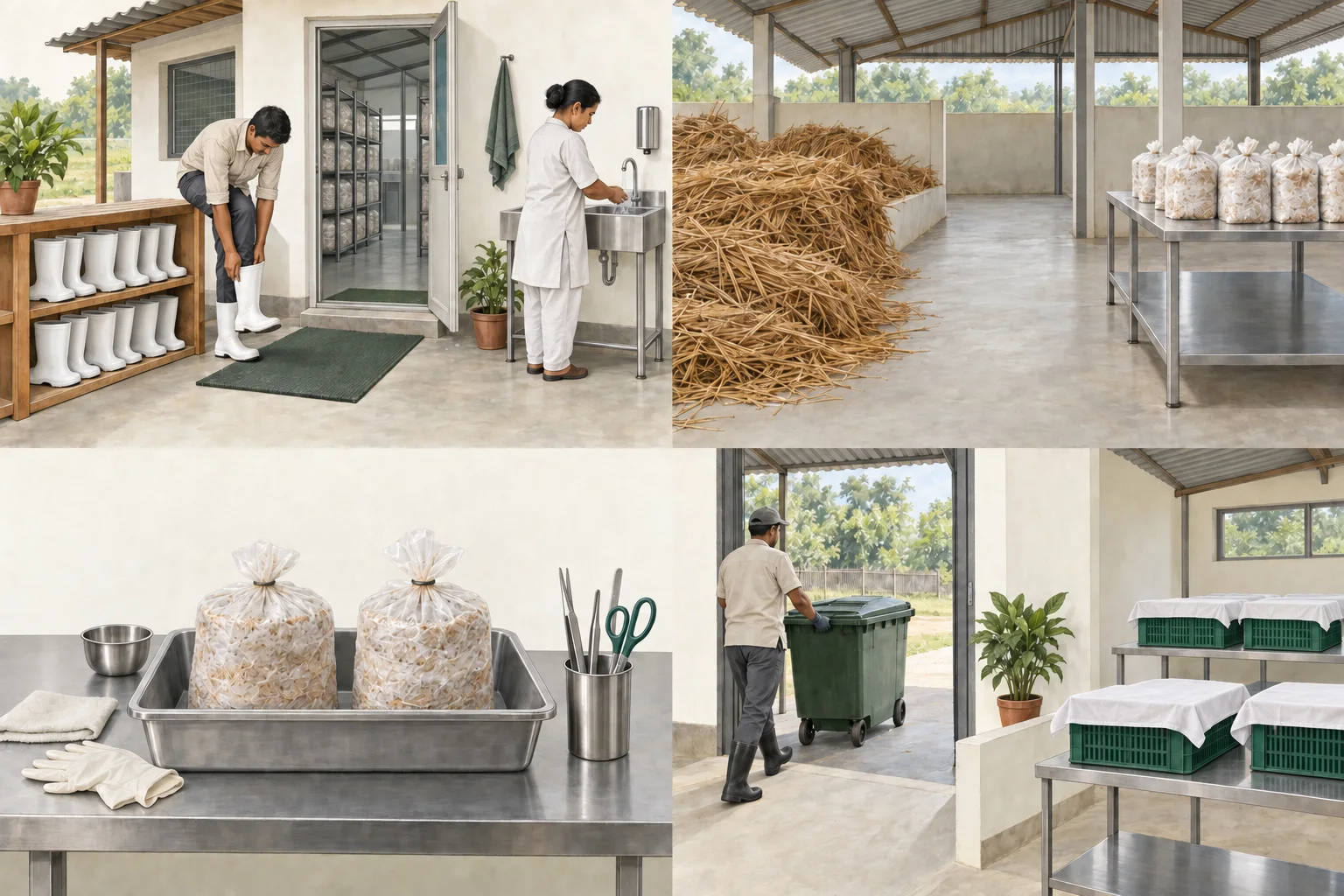
For a few hours the compost is cool, moist, rich and open, and every competitor on the farm would like it. Wash the floor and the mixing platform before the compost arrives. Keep the room shut against flies. Use clean tools, wash hands, and let nobody walk in from the composting yard in the same footwear.
Work fast and finish in one session, because spawn left open for hours collects spores. ICAR-DMR documents chemical treatments for rooms and tools, and current label approval must be checked before anything is used.
Spawn & Spawning
Compare the evidence
Read the numbers in context
These figures belong to the named source and method. Historical costs are not current quotations. A value without its stage, material basis or measurement location is not a farm instruction.
Source-specific reference figures
What is measured
Value and basis
Source and limitation
Grain spawn rate
0.5-0.7 % of wet compost weight
ICAR-DMR manual, 2011. The farmer folder gives 0.5 to 0.75 percent.
These figures belong to the named source and method. Historical costs are not current quotations. A value without its stage, material basis or measurement location is not a farm instruction.
Source-specific reference figures
What is measured
Value and basis
Source and limitation
Free ammonia at spawning
8-10 ppm maximum
ICAR-DMR manual, 2011. Odour is not a quantitative release test.
Compost per bag
10-12 kg
ICAR-DMR button folder. Shelf beds 6 to 8 inches deep.
These figures belong to the named source and method. Historical costs are not current quotations. A value without its stage, material basis or measurement location is not a farm instruction.
For about two weeks nothing shows from outside the bag and yet everything is being decided. This is the last stage where a room fault can still be fixed cheaply.
By the end you can state the air and compost temperatures ICAR-DMR gives for spawn run.
By the end you can explain why carbon dioxide is wanted now and unwanted later.
By the end you can describe what a complete spawn run looks like.
Spawn Run
Field notes
What is happening inside
Each grain of spawn is a starting point. Mycelium grows out of it in every direction, digests the compost and joins threads from other grains. The compost changes from dark brown to light brown as the white web spreads, and ICAR-DMR treats that colour change as the sign the run is complete.
The fungus also makes heat. ICAR-DMR holds the room at 23 plus or minus 1 °C, which gives a bed temperature of 24 to 25 °C, one to two degrees higher. The number that matters is therefore the compost temperature, not the air.
Spawn Run
Field notes
The climate that suits spreading
Spawn run wants warm, still, wet and stale air. ICAR-DMR recirculates all of the air with no fresh-air entry, keeps carbon dioxide between 10000 and 15000 ppm, and works at 95 percent relative humidity in a controlled room. Its seasonal folder gives 22 to 25 °C and 80 to 90 percent humidity, because a naturally ventilated room cannot hold 95 percent.
Carbon dioxide is useful here. It helps the mycelium move through the compost. After casing the same gas becomes the thing you must remove, so the fan settings for the two stages are opposite.
Spawn Run
Field notes
The ceiling and the clock
Warm helps, hot does not. The NHB model report, reproducing ICAR-DMR guidance, says temperature above 26 to 27 °C during spawn run and after casing should be avoided. ICAR-DMR adds that false truffle, a competitor that ruins compost, appears above 23 °C and is common in February and early March in the north Indian plains.
The run takes 12 to 14 days under controlled conditions, and the Hindi folder gives 12 to 15 days for a seasonal room. Do not case on a date. Case when the compost has turned light brown right through.
Spawn Run
Field notes
What to observe, daily
Observe bags without unnecessary opening or handling. Use the farm's hygienic measurement procedure at representative locations and record the same points at comparable times. Compare development across bags, material lots and room positions.
Record stalled growth, abnormal colour, visible insects and packaging damage. Do not deliberately smell bags or diagnose their cause from odour. Several input, environmental and biological problems can produce similar signs; preserve the batch record and obtain an assessment before treating the crop.
Spawn Run
Compare the evidence
Read the numbers in context
These figures belong to the named source and method. Historical costs are not current quotations. A value without its stage, material basis or measurement location is not a farm instruction.
Source-specific reference figures
What is measured
Value and basis
Source and limitation
Air temperature
22-24 °C
ICAR-DMR manual, 2011. Stated as 23 plus or minus 1 °C.
Bed temperature
24-25 °C
ICAR-DMR manual, 2011. One to two degrees above the air.
These figures belong to the named source and method. Historical costs are not current quotations. A value without its stage, material basis or measurement location is not a farm instruction.
Source-specific reference figures
What is measured
Value and basis
Source and limitation
Carbon dioxide
10000-15000 ppm
ICAR-DMR manual, 2011. Full recirculation, no fresh air.
Spawn-run duration
12-14 days
ICAR-DMR manual, 2011. The farmer folder gives 12 to 15 days.
These figures belong to the named source and method. Historical costs are not current quotations. A value without its stage, material basis or measurement location is not a farm instruction.
Source-specific reference figures
What is measured
Value and basis
Source and limitation
Upper temperature limit
26-27 °C
NHB DPR model, 2018. Avoid during spawn run and after casing.
Casing is soil, and growers treat it like any soil. It is the one layer where the crop's worst diseases live and where every pin will form.
By the end you can explain what the casing layer does and what it does not do.
By the end you can name the casing materials ICAR-DMR recommends in India and their limits.
By the end you can describe how casing is wetted, treated and applied.
Casing
Field notes
Why a soil layer at all
The mushroom will not fruit on bare compost. ICAR-DMR calls casing a 3 to 4 cm layer of soil laid on spawn-run compost and a prerequisite for fruiting.
It works in four ways. It holds a reserve of water the crop can draw on. It lets carbon dioxide escape from the compost below. It supports the crop physically. And its bacteria give the signal that turns spreading mycelium into pinheads. What it does not do is feed the crop. Casing carries almost no nutrition, and a rich casing grows moulds rather than mushrooms.
Casing
Field notes
Materials you can get in India
Peat is the world standard and is not available here, so ICAR-DMR lists substitutes: well decomposed farmyard manure, preferably two years old; two-year-old spent mushroom compost; composted coir pith; and mixtures of these in stated proportions. In Haryana and Punjab burnt rice husk is used along with decomposed farmyard manure. The farmer folder's seasonal mix is two-year-old farmyard manure and loam soil in equal parts.
Quality is specified rather than assumed. ICAR-DMR asks for a neutral pH of 7.0 to 7.5 and low electrical conductivity, in the range of 400 to 600 micromho.
Casing
Field notes
Treatment, because casing carries disease
Casing is the main route by which wet bubble enters a farm. ICAR-DMR reports that its resting spores survive up to three years in casing soil, so soil carried over from an old crop is a standing risk.
Wet the material to 50 to 60 percent of its water holding capacity first, because dry soil does not carry heat. ICAR-DMR then steam pasteurises at 60 to 65 °C for 6 to 8 hours. Its wet bubble folder gives a shorter, hotter schedule of 54.4 °C for 15 minutes. Chemical drenching is also documented, and current label approval must be checked.
Casing
Field notes
Applying an even layer
The 2011 manual gives two thicknesses. It defines casing as a 3 to 4 cm layer, then instructs an even 4 to 5 cm applied using 4 cm iron rings or wooden blocks. The Hindi farmer folder says 3 to 4 cm. Pick one figure, write it down and keep it the same on every bed.
Evenness matters more than the number itself. A thin patch dries first and pins early, a thick patch pins late, and the bed then carries two flushes at once. Do not press the layer down, and water it lightly rather than flooding it.
Casing
Compare the evidence
Read the numbers in context
These figures belong to the named source and method. Historical costs are not current quotations. A value without its stage, material basis or measurement location is not a farm instruction.
Source-specific reference figures
What is measured
Value and basis
Source and limitation
Casing thickness
3-4 cm
ICAR-DMR manual, 2011. The same manual also instructs 4 to 5 cm.
Casing pH
7.0-7.5 pH
ICAR-DMR manual, 2011. With conductivity 400 to 600 micromho.
These figures belong to the named source and method. Historical costs are not current quotations. A value without its stage, material basis or measurement location is not a farm instruction.
Source-specific reference figures
What is measured
Value and basis
Source and limitation
Wetting before treatment
50-60 % of water holding capacity
ICAR-DMR manual, 2011. Dry soil does not carry heat.
Steam pasteurisation
60-65 °C for 6 to 8 hours
ICAR-DMR manual, 2011. The wet bubble folder gives 54.4 °C for 15 minutes.
These figures belong to the named source and method. Historical costs are not current quotations. A value without its stage, material basis or measurement location is not a farm instruction.
Source-specific reference figures
What is measured
Value and basis
Source and limitation
Wet bubble spore survival
3 years
ICAR-DMR wet bubble folder. In untreated casing soil.
After casing the crop disappears again for about a week. What you do with water in that week sets the size of the first flush, because once pins appear you cannot water freely.
By the end you can state the conditions ICAR-DMR holds during case run and for how long.
By the end you can describe the end point that says the layer is ready.
By the end you can list what to check before changing climate or watering.
Case Run
Field notes
The mycelium climbs
Case run is the week in which mycelium leaves the compost and grows up into the casing. ICAR-DMR runs it at 24 plus or minus 1 °C with 95 percent relative humidity and carbon dioxide above 7500 ppm, with no fresh air, for about one week. The settings are close to spawn run, deliberately.
Its end point is visible. ICAR-DMR looks for mycelium in the casing valleys, the low lines between the ruffled high spots. When white threads show there across the whole bed, the layer is ready for the change.
Case Run
Field notes
Charging the layer with water
This is the last week in which you can water heavily. Once pinheads appear, water sitting on them marks and spoils them, so the casing must carry its reserve before that. ICAR-DMR wants about 50 plus or minus 2 percent moisture in the casing at pinning.
Water little and often rather than once and heavily. Water that runs through into the compost does not come back and drives out air the mycelium needs. Judge by lifting a pinch from three places: it should be damp all through, not wet on top and dusty underneath.
Case Run
Field notes
Reading the layer before you act
An uneven case run is information, not a nuisance. Gather the context before changing anything.
Note days since casing, because a bed on day 4 and a bed on day 8 are not the same problem. Measure casing depth at five points, since a thick patch simply takes longer. Read compost temperature as well as air, because the bed still runs above the room. Note where the slow area sits: near the door, under a vent, at one end of a rack. The same symptom from a different cause needs a different answer.
Case Run
Field notes
The change, and what follows
When mycelium shows in the valleys the room changes: temperature down towards the fruiting band, fresh air in, carbon dioxide down. ICAR-DMR reports pinheads 3 to 4 days after that change.
Timing is the risk. Change too early and the mycelium has not reached the surface, so pinning is thin and late. Change too late and it overgrows the casing into a dense mat that pins poorly. NHB, following ICAR-DMR, adds that temperature above 26 to 27 °C after casing must be avoided, so a warm week is a problem to fix.
Case Run
Compare the evidence
Read the numbers in context
These figures belong to the named source and method. Historical costs are not current quotations. A value without its stage, material basis or measurement location is not a farm instruction.
Source-specific reference figures
What is measured
Value and basis
Source and limitation
Case-run temperature
23-25 °C
ICAR-DMR manual, 2011. Stated as 24 plus or minus 1 °C.
Relative humidity
95 %
ICAR-DMR manual, 2011. With carbon dioxide above 7500 ppm and no fresh air.
These figures belong to the named source and method. Historical costs are not current quotations. A value without its stage, material basis or measurement location is not a farm instruction.
Source-specific reference figures
What is measured
Value and basis
Source and limitation
Case-run duration
7 days
ICAR-DMR manual, 2011. Ends when mycelium shows in the casing valleys.
Casing moisture at pinning
48-52 %
ICAR-DMR manual, 2011. Stated as about 50 plus or minus 2 percent.
These figures belong to the named source and method. Historical costs are not current quotations. A value without its stage, material basis or measurement location is not a farm instruction.
The crop does not decide to fruit. You do, on one day, by cooling the room and pushing the stale air out.
By the end you can list what changes at venting and in what order.
By the end you can read mushroom shape as a carbon dioxide signal.
By the end you can choose between DMR's three airing schedules.
Pinning
Field notes
What venting really does
Venting, also called airing, is the day you stop the mycelium spreading and ask it to make mushrooms. Until then the room is warm, wet and closed: DMR runs the case run at 23 to 25 C air, 95 per cent humidity and about 7500 ppm of carbon dioxide with no fresh air.
At venting you bring the air down to the fruiting band and open fresh air until carbon dioxide falls to 800 to 1000 ppm. The fungus reads the change and begins to knot on the casing surface. Pinheads follow within a few days.
Pinning
Field notes
Evaporation is the real trigger
Mushrooms form where water is leaving the casing surface, so moving air matters as much as the thermometer.
DMR measures 31 g of water leaving one square metre of bed every hour at 17 C and 85 per cent humidity, and puts the permissible air speed over the bed at 15 cm per second. A dead corner with no air movement will not pin, even though the wall thermometer looks right. Air that is too fast and too dry crusts the casing and kills young pins.
Pinning
Field notes
Evaporation is the real trigger · continued
Casing moisture at pinning is 48 to 52 per cent, judged by squeezing the casing itself.
Pinning
Field notes
Read carbon dioxide from the mushroom
The crop is your second meter. DMR states that high carbon dioxide at pinning can seal the casing surface or give onion shaped mushrooms with a bulbous base and a small cap. Between pinhead and button stage, high carbon dioxide gives long stalks with small open caps.
Once pins have become buttons the cropping band is 1000 to 1500 ppm. If your pins look like onions or your stalks run long, you are venting too little, whatever the meter says.
Pinning
Field notes
Read carbon dioxide from the mushroom · continued
With no meter, read the crop and write down what you see each day.
Pinning
Field notes
Soft, moderate or severe airing
DMR publishes three schedules and they give different crops. Soft airing brings air to 19 C in 48 hours and 17 C in 72 hours, with carbon dioxide falling from 4000 to 1000 ppm over those 72 hours, and gives smaller, better spaced flushes. Severe airing takes air to 15 C as soon as possible and carbon dioxide below 1000 ppm in 12 hours, for a heavy first flush. Moderate airing sits between them.
Pick by your labour and your buyer, not by habit. Four DMR documents give four fruiting bands between 14 and 18 C, so do not chase one number.
Pinning
Compare the evidence
Read the numbers in context
These figures belong to the named source and method. Historical costs are not current quotations. A value without its stage, material basis or measurement location is not a farm instruction.
Source-specific reference figures
What is measured
Value and basis
Source and limitation
Fruiting air temperature
15-17 °C
ICAR-DMR manual, 2011. other DMR tables give 14-16, 14-18 and 16-18
Carbon dioxide at venting
800-1000 ppm
ICAR-DMR manual, 2011. room air, after the case run
These figures belong to the named source and method. Historical costs are not current quotations. A value without its stage, material basis or measurement location is not a farm instruction.
Source-specific reference figures
What is measured
Value and basis
Source and limitation
Venting to pinhead
3-4 days
ICAR-DMR manual, 2011. then 3 to 4 days to picking size
These figures belong to the named source and method. Historical costs are not current quotations. A value without its stage, material basis or measurement location is not a farm instruction.
Source-specific reference figures
What is measured
Value and basis
Source and limitation
Water evaporating from the bed
31 g per m2 per hour
ICAR-DMR manual, 2011. at 17 C and 85 per cent humidity
Air speed over the bed
15 cm per second
ICAR-DMR manual, 2011. raise it only if the air is humidified
Button mushrooms come in waves called flushes, and the quiet days between waves are where growers lose money.
By the end you can describe a flush and the gap between two flushes.
By the end you can match fresh air to the flush you are in.
By the end you can build a crop calendar from your own diary.
Cropping & Flushes
Field notes
Waves, not a steady harvest
After venting, pinheads appear in 3 to 4 days and reach picking size in another 3 to 4 days. The bed then goes quiet while the mycelium rebuilds, and a second wave follows.
DMR's Hindi farmer folder gives 8 to 10 weeks of picking in seasonal cultivation. Environment controlled units plan a 60 day room cycle and 6 crops per room per year.
Cropping & Flushes
Field notes
Waves, not a steady harvest · continued
DMR does not publish a line saying first flush on day N with so many flushes in total, because compost, strain and room all move it. Your own diary is the calendar.
Cropping & Flushes
Field notes
Fresh air changes with the flush
Carbon dioxide production peaks in the first two flushes, when DMR measures about 10 g of carbon dioxide per square metre of bed per hour.
For that period DMR asks for about 6 air changes per hour, with the fresh air vent at 30 per cent and 70 per cent recirculated. From the third flush, 4 air changes per hour hold oxygen near 16 per cent and fresh air drops to 20 per cent. Room carbon dioxide during cropping sits at 1000 to 1500 ppm.
Cropping & Flushes
Field notes
Fresh air changes with the flush · continued
Running full fresh air all crop long only burns power and dries the casing.
Cropping & Flushes
Field notes
What you do between flushes
Pick the bed truly clean. Every stump, broken stalk and dead pin left behind is food for moulds and a breeding site for flies.
Put back the water the crop took away. DMR's rule is one litre of water for every kilogram of mushroom harvested, applied after picking rather than onto swelling pins.
Cropping & Flushes
Field notes
What you do between flushes · continued
Hold the band steady. Warming the room does not restart a crop, it only invites disease. Expect each flush to be smaller than the one before and plan labour that way, so your pickers are not idle in week six.
Cropping & Flushes
Field notes
Yield follows the compost
DMR's Table 7.1 gives yields per 100 kg of compost by method: long method 10 to 15 kg, short method 18 to 25 kg, indoor method 20 to 30 kg. Some seasonal growers taking a single crop have reported 18 to 22 kg with long method compost.
NHB's strain table runs from 14 to 16 kg for older strains to 22 to 27 kg for DMR-NBS-5 under Indian conditions. DMR's own project model assumes 18 kg per 100 kg compost.
Cropping & Flushes
Field notes
Yield follows the compost · continued
These are reported ranges, not promises. Weigh your compost and weigh your crop.
Cropping & Flushes
Compare the evidence
Read the numbers in context
These figures belong to the named source and method. Historical costs are not current quotations. A value without its stage, material basis or measurement location is not a farm instruction.
Source-specific reference figures
What is measured
Value and basis
Source and limitation
Pinhead to picking size
3-4 days
ICAR-DMR manual, 2011. the Hindi folder says 2 to 4 days
Picking period, seasonal
8-10 weeks
ICAR-DMR button folder. after casing, seasonal cultivation
These figures belong to the named source and method. Historical costs are not current quotations. A value without its stage, material basis or measurement location is not a farm instruction.
Source-specific reference figures
What is measured
Value and basis
Source and limitation
Air changes, first two flushes
6 per hour
ICAR-DMR manual, 2011. 4 per hour from the third flush
Carbon dioxide during cropping
1000-1500 ppm
ICAR-DMR manual, 2011. after pinheads become buttons
These figures belong to the named source and method. Historical costs are not current quotations. A value without its stage, material basis or measurement location is not a farm instruction.
Source-specific reference figures
What is measured
Value and basis
Source and limitation
Yield, long method compost
10-15 kg per 100 kg compost
ICAR-DMR manual, 2011. short method 18 to 25, indoor 20 to 30
Crops per room per year
6 crops
ICAR-DMR manual, 2011. controlled unit on a 60 day cycle
A thermometer near the door is not the crop's temperature. The bed, the sensor and the machine each carry a different number.
By the end you can separate the biological target from the sensor reading.
By the end you can say why the cooling unit runs colder than the room.
By the end you can judge what your equipment delivers in your season.
Climate Management
Field notes
Four different temperatures
There is the temperature the fungus wants, the temperature your probe reads, the temperature in the far corner, and the temperature the machine can hold.
DMR makes the first gap plain: during spawn run the air is held at 23 plus or minus 1 C, which gives a bed temperature of 24 to 25 C, because compost makes its own heat and runs 1 to 2 C above air.
Climate Management
Field notes
Four different temperatures · continued
The bed keeps making heat in cropping too. A room that reads correct at the door can still be too warm inside the bed.
Climate Management
Field notes
The machine runs colder than the room
To deliver 17 C and 85 per cent humidity at the bed, DMR brings air out of the air handling unit at 14 C and full humidity. The air warms and dries as it travels down the room.
So the set point on the machine is never the crop target. Set the unit to 17 C and you will not get 17 C at the bed.
Climate Management
Field notes
The machine runs colder than the room · continued
Air speed at the bed is limited to 15 cm per second, and may be raised only if the air is humidified. Fast dry air is a drying machine pointed at your casing.
Climate Management
Field notes
Humidity is a band, not a target
DMR's crop chapter gives 85 per cent humidity for pinning and cropping, and the watering section gives an operating band of 80 to 85 per cent. Spawn run and case run are given as 95 per cent in controlled rooms.
The Hindi farmer folder gives 80 to 90 per cent for the same seasonal stage, because a naturally ventilated bamboo or brick room cannot hold 95 per cent. Both are DMR, and each is honest about the room it describes.
Climate Management
Field notes
Humidity is a band, not a target · continued
NHB warns that humidity above 85 per cent with temperature above 20 C is the condition bacterial blotch likes.
Climate Management
Field notes
Match ambition to equipment
If you have no cooling, your calendar is your cooling. DMR gives white button months as October to February in the plains in the manual and November to February in the seasonal folder, September to March in the mid hills and March to November in the high hills.
Before buying machinery, size it against the loads DMR publishes: heat from the bed, carbon dioxide from the bed, and 31 g of water leaving each square metre every hour. A unit that cannot remove that water cannot hold your humidity band.
Climate Management
Compare the evidence
Read the numbers in context
These figures belong to the named source and method. Historical costs are not current quotations. A value without its stage, material basis or measurement location is not a farm instruction.
Source-specific reference figures
What is measured
Value and basis
Source and limitation
Bed above air temperature
1-2 °C
ICAR-DMR manual, 2011. air 23 plus or minus 1 C gives bed 24 to 25 C
Air handling unit exit air
14 °C
ICAR-DMR manual, 2011. at full humidity, to give 17 C at the bed
These figures belong to the named source and method. Historical costs are not current quotations. A value without its stage, material basis or measurement location is not a farm instruction.
Source-specific reference figures
What is measured
Value and basis
Source and limitation
Humidity band during cropping
80-85 %
ICAR-DMR manual, 2011. the crop chapter prints 85 per cent
These figures belong to the named source and method. Historical costs are not current quotations. A value without its stage, material basis or measurement location is not a farm instruction.
Source-specific reference figures
What is measured
Value and basis
Source and limitation
Season in the north Indian plains
October to February months
ICAR-DMR manual, 2011. the folder says November to February
Water is the easiest thing to add to a mushroom bed and the hardest to take back.
By the end you can separate a humidity problem from a casing problem.
By the end you can decide how much water to give after picking.
By the end you can see when free water on caps becomes a risk.
Watering
Field notes
You water the casing, not the mushrooms
The casing layer is a water store. The mycelium sits inside it, draws water up into the growing mushrooms, and the surface loses water to the air all day long.
So watering is refilling a store, not washing a crop. Humidity in the air and water in the casing are two different things.
Watering
Field notes
You water the casing, not the mushrooms · continued
Judge the casing by hand. DMR gives casing moisture at pinning as 48 to 52 per cent, and the field method is to squeeze a pinch of it and see whether it holds together without water running out.
Watering
Field notes
How much: replace what you picked
DMR's rule is to spray at the rate at which the mushrooms were harvested: for every kilogram picked, add one litre of water.
Give it in light passes rather than one drench. A heavy single watering runs through the casing, reaches the compost, and pushes out the air the mycelium needs. Time the water after picking, not onto swelling pins, because young pins that are watered directly stop, discolour and are lost.
Watering
Field notes
How much: replace what you picked · continued
Between flushes, when the bed looks empty, the casing store still has to be refilled, so keep watering lightly on those days.
Watering
Field notes
Free water on caps is a disease decision
DMR reports that bacterial blotch spots spread when temperature is at least 20 C and a film of free water sits on the cap, and that a film lasting more than about three hours is the dangerous case. NHB adds that humidity above 85 per cent with temperature above 20 C should be avoided.
That gives a practical rule needing no chemical: after watering, run air movement until caps are dry to the touch. Never leave a wet crop overnight in a warm room.
Watering
Field notes
Free water on caps is a disease decision · continued
If blotch appears, treat it as a climate and water problem first.
Watering
Field notes
Too wet and too dry both show a face
Over wet casing brings cinnamon mould, which DMR lists against casing that is too wet or too strongly disinfected. Over wet compost is worse: above 72 per cent moisture at spawning the compost goes airless and plaster moulds appear.
The opposite fault shows up as weepers. NHB describes leaking, stinking mushrooms where the compost is below 64 per cent moisture and the casing above it is wet.
Watering
Field notes
Too wet and too dry both show a face · continued
Dry casing cracks and crusts, pins abort at the tray edges first, and the mushrooms that do come are small and open early.
Watering
Compare the evidence
Read the numbers in context
These figures belong to the named source and method. Historical costs are not current quotations. A value without its stage, material basis or measurement location is not a farm instruction.
Source-specific reference figures
What is measured
Value and basis
Source and limitation
Water replacement after picking
1 litre per kg picked
ICAR-DMR manual, 2011. sprayed after harvest, in light passes
Casing moisture at pinning
48-52 %
ICAR-DMR manual, 2011. judged by squeezing the casing
These figures belong to the named source and method. Historical costs are not current quotations. A value without its stage, material basis or measurement location is not a farm instruction.
Source-specific reference figures
What is measured
Value and basis
Source and limitation
Water film that risks blotch
3 hours at 20 °C
ICAR-DMR manual, 2011. dry the caps with air movement
These figures belong to the named source and method. Historical costs are not current quotations. A value without its stage, material basis or measurement location is not a farm instruction.
Source-specific reference figures
What is measured
Value and basis
Source and limitation
Compost moisture floor for weepers
64 %
NHB DPR model, 2018. dry compost under wet casing leaks
Naming a disease from one photograph is the fastest way to treat the wrong problem. The evidence is in the pattern.
By the end you can describe a problem by pattern, spread and stage.
By the end you can link common moulds to the fault behind them.
By the end you can act on insect counts instead of guesses.
Crop Health
Field notes
Describe before you name
Four questions come before any name. Is it one tray or the whole room. Is it near the door, under a duct, or spread evenly. Which flush is running. What changed on the farm about three days earlier.
Negative evidence counts too: if the same compost in the next room is clean, the compost is probably not the cause.
Crop Health
Field notes
Describe before you name · continued
Write these four answers in the diary before you telephone anyone. A KVK scientist or the ICAR-DMR helpdesk can work with that description. Nobody can work with the words the crop is finished.
Crop Health
Field notes
Most moulds are compost and casing history
DMR's table of causes reads like a compost audit. Green mould follows low compost pH, carbohydrate rich and nitrogen poor compost, or immature spawn. Ink caps follow free ammonia, too much nitrogen or old straw. White plaster mould invades when compost pH sits outside 7.2 to 7.8. Olive green mould follows poor aeration in Phase II or pasteurisation above 60 C.
Cinnamon mould follows casing that is too wet or too strongly disinfected.
Crop Health
Field notes
Most moulds are compost and casing history · continued
So the honest question after a mould outbreak is not which spray, it is which step in the last three weeks was out of range.
Crop Health
Field notes
The ones that move fast
Some problems give you days, not weeks. DMR states that dry bubble, if left uncontrolled, can destroy a crop in 2 to 3 weeks.
Wet bubble is carried by the casing soil, and DMR's folder records that its resting spores survive there for three years, which is why casing source and treatment matter more than any later action.
Crop Health
Field notes
The ones that move fast · continued
False truffle appears above 23 C, which in the north Indian plains means February and early March. Bacterial blotch needs 20 C and free water on the cap. Each of these is a measurement you can take today.
Crop Health
Field notes
Insects, counts and the chemical boundary
Sciarid flies are managed by counting, not by smell. DMR's threshold table treats any live adult in the first flush as an action point, and more than 20 catches per trap per week from the second flush onwards.
NHB describes 35 mesh nylon screening on doors and ventilators, and a 15 W yellow light trap over an oil coated sheet.
Crop Health
Field notes
Insects, counts and the chemical boundary · continued
This site prints no pesticide names or doses. Approvals change and mushrooms are eaten fresh. Check the current label approval for mushrooms in India and your state advisory, and note the exact approved product label and required pre-harvest interval; no universal 48-hour rule is appropriate.
Crop Health
Compare the evidence
Read the numbers in context
These figures belong to the named source and method. Historical costs are not current quotations. A value without its stage, material basis or measurement location is not a farm instruction.
Source-specific reference figures
What is measured
Value and basis
Source and limitation
Dry bubble time to total crop loss
2-3 weeks
ICAR-DMR manual, 2011. if left uncontrolled
Wet bubble spore survival in casing soil
3 years
ICAR-DMR wet bubble folder. casing soil is the main source
These figures belong to the named source and method. Historical costs are not current quotations. A value without its stage, material basis or measurement location is not a farm instruction.
Source-specific reference figures
What is measured
Value and basis
Source and limitation
False truffle appears above
23 °C
ICAR-DMR manual, 2011. late winter in the plains, summer in the hills
Compost pH range for healthy mycelium
7.2-7.8 pH
ICAR-DMR manual, 2011. outside this band plaster moulds invade
These figures belong to the named source and method. Historical costs are not current quotations. A value without its stage, material basis or measurement location is not a farm instruction.
Source-specific reference figures
What is measured
Value and basis
Source and limitation
Sciarid fly action threshold
20 catches per trap per week
ICAR-DMR manual, 2011. from the second flush; any adult in the first
A mushroom picked an hour late is a different grade and a different price.
By the end you can judge picking readiness from cap size and veil.
By the end you can pick and trim without damaging the casing.
By the end you can start grading and cooling at the bed itself.
Harvest
Field notes
Readiness is a size and a veil
DMR's manual says mushrooms of 4 to 5 cm cap diameter with a firm cap and a closed veil are ready. The Hindi farmer folder says pick at 3 to 4 cm while the cap is still closed.
Both are DMR and both are correct for the market they describe. The veil is the thin skin joining cap edge to stalk. Once it tears the gills show, the mushroom loses weight and colour fast and the grade drops.
Harvest
Field notes
Readiness is a size and a veil · continued
Walk the bed twice a day in the flush and pick to the size your buyer pays for, not to the biggest size you can grow.
Harvest
Field notes
How to pick
Hold the cap, twist gently and lift, so the stalk comes away without pulling the casing with it. Fill the hole left behind with a little casing.
Trim the soil stained base with a clean knife at the bed, so soil never travels with the crop. Place mushrooms gills down in shallow crates and never heap them deep, because the weight bruises the caps underneath.
Harvest
Field notes
How to pick · continued
Pick the bed clean, including small dead pins, and remove every stump. Leftovers feed moulds and flies into the next flush. Then put back one litre of water for each kilogram picked.
Harvest
Field notes
Grading starts at the bed
Sort as you pick rather than once at the packing table. Three streams work on most Indian farms: closed veil and clean, open veil or over size, and damaged or spotted.
Keep blemished and blotchy mushrooms out of the main crate entirely, because one wet spotted cap marks the ones around it in transport.
Harvest
Field notes
Grading starts at the bed · continued
DMR records that Indian local markets use retail packs of 200 g or 400 g, so a farm that grades at the bed can fill those packs straight from the crate. Your buyer's specification is the final word, so write it down and train pickers to it.
Harvest
Field notes
Heat is the clock
The moment a mushroom leaves the bed it is still breathing and still warming. ICAR-DMR's post harvest bulletin puts field heat at picking at 15 to 18 C and asks that the mushroom's own temperature be brought to 4 to 5 C as fast as possible.
The manual's practical instruction is to grade, pack and chill at 4 C for 6 to 8 hours before sending to market.
Harvest
Field notes
Heat is the clock · continued
So the harvest job does not end at the crate. On farms without a cold room, pick earlier in the morning and move faster to the buyer.
Harvest
Compare the evidence
Read the numbers in context
These figures belong to the named source and method. Historical costs are not current quotations. A value without its stage, material basis or measurement location is not a farm instruction.
Source-specific reference figures
What is measured
Value and basis
Source and limitation
Cap diameter at picking
4-5 cm
ICAR-DMR manual, 2011. the Hindi farmer folder says 3 to 4 cm; veil closed in both
Water replaced after picking
1 litre per kg picked
ICAR-DMR manual, 2011. applied after the bed is picked clean
These figures belong to the named source and method. Historical costs are not current quotations. A value without its stage, material basis or measurement location is not a farm instruction.
Source-specific reference figures
What is measured
Value and basis
Source and limitation
Field heat at picking
15-18 °C
ICAR-DMR post-harvest bulletin, 2008. the mushroom's own temperature when it leaves the bed
These figures belong to the named source and method. Historical costs are not current quotations. A value without its stage, material basis or measurement location is not a farm instruction.
Button mushroom is mostly water and has no skin. What you earn is decided in the first two hours after picking.
By the end you can say why cooling speed beats packing material.
By the end you can describe a cooling chain from bed to buyer.
By the end you can say which shelf life figures exist and which do not.
Post-Harvest
Field notes
Why speed beats packing
A picked mushroom keeps breathing, and breathing burns the crop's own weight and quality. ICAR-DMR's post harvest bulletin estimates that mushrooms at 10 C respire about 3.5 times faster than at 0 C.
So the first job is not the box, it is the temperature. The bulletin asks that mushroom temperature be brought down to 4 to 5 C as quickly as possible, from a field heat of 15 to 18 C at picking.
Post-Harvest
Field notes
Why speed beats packing · continued
A farm with no cold room can still pick into shade, keep crates shallow, and reach the buyer while the crop is cool.
Post-Harvest
Field notes
The cooling chain
The chain is short and each step has a published band. Pre cool first, then hold. DMR's manual grades, packs and chills at 4 C for 6 to 8 hours before despatch.
Ordinary refrigerators run at 4 to 7 C, chill storage may go to minus 1 to minus 4 C depending on how fresh the crop is, and freezing is done below minus 18 C.
Post-Harvest
Field notes
The cooling chain · continued
What matters is that the crop never warms again. A crate chilled to 4 C and then left on a hot platform for an hour has lost the benefit.
Post-Harvest
Field notes
Packing and the air inside the pack
DMR records that Indian local markets use retail packs of 200 g or 400 g in thin polythene. For longer holding, the manual gives an optimum storage atmosphere of 2.5 to 5 per cent carbon dioxide with 5 to 10 per cent oxygen, and says that in pack humidity of 87 to 90 per cent gives the best colour.
Over wrapped punnets can hold a fresh appearance for about three days at 18 C.
Post-Harvest
Field notes
Packing and the air inside the pack · continued
Start simple: shallow crates, a clean liner, no heaping, and a pack size your buyer actually sells.
Post-Harvest
Field notes
Know what is not published
There is no published Indian figure for commercial cold chain shelf life of fresh button mushroom. The 2011 manual says only that it can be stored at 4 C for a few days without deterioration, and that fresh marketing is still preferable.
The Hindi farmer folder gives the small grower's version: about 12 hours at ambient temperature after picking, and 2 to 3 days in a household refrigerator.
Post-Harvest
Field notes
Know what is not published · continued
So measure your own losses by route and by season and write them down. Your own record is the only shelf life figure that applies to your crop.
Post-Harvest
Compare the evidence
Read the numbers in context
These figures belong to the named source and method. Historical costs are not current quotations. A value without its stage, material basis or measurement location is not a farm instruction.
Source-specific reference figures
What is measured
Value and basis
Source and limitation
Respiration at 10 °C compared with 0 °C
3.5 times faster
ICAR-DMR post-harvest bulletin, 2008. the reason to pre cool at once
Target mushroom temperature after cooling
4-5 °C
ICAR-DMR post-harvest bulletin, 2008. from a field heat of 15 to 18 C
These figures belong to the named source and method. Historical costs are not current quotations. A value without its stage, material basis or measurement location is not a farm instruction.
Source-specific reference figures
What is measured
Value and basis
Source and limitation
Chilling before despatch
4 °C for 6 to 8 hours
ICAR-DMR manual, 2011. after grading and packing
Holding without a cold chain
12 hours ambient, 2 to 3 days in a fridge storage life
These figures belong to the named source and method. Historical costs are not current quotations. A value without its stage, material basis or measurement location is not a farm instruction.
Disease rarely walks into a mushroom farm alone. It is carried in on hands, tools, crates and old casing.
By the end you can set a clean to dirty order of movement.
By the end you can use screens, traps and counts as routine.
By the end you can close a crop so the next one starts clean.
Farm Hygiene
Field notes
Hygiene is a direction of movement
The cheapest control on any farm is the order in which people walk. Go from the youngest, cleanest room to the oldest and most suspect room, never the other way, and never back on the same day.
Keep tools, knives and crates with a room rather than carrying them between rooms. Keep a footbath at each door and change it, because a dirty footbath is only decoration.
Farm Hygiene
Field notes
Hygiene is a direction of movement · continued
Spent compost, waste crates and old casing belong far from the doors. Clothes worn in the last room of the day should not be worn into the first room next morning.
Farm Hygiene
Field notes
Screens, traps and counts
Flies are the vehicle for most mushroom diseases, and they are managed by numbers. NHB describes screening doors and ventilators with nylon net of 35 mesh or finer, and a 15 W yellow light trap over an oil coated sheet for monitoring and catching.
DMR's threshold table treats any live adult in the first flush as an action point, and more than 20 catches per trap per week from the second flush onwards.
Farm Hygiene
Field notes
Screens, traps and counts · continued
So a hygiene routine has a number in it. Count traps weekly, write the count on the room board, and act on the trend.
Farm Hygiene
Field notes
The end of a crop starts the next one
The last day of a crop is the most powerful disease control day you have. NHB records a cook out of the spent compost at 70 C held for 12 hours to kill pathogen mycelium and spores, and 70 C for 2 to 3 hours for insect pests.
Spent compost and used casing then go well away from the rooms, into a pit covered with at least 10 cm of manure, which stops flies breeding in it.
Farm Hygiene
Field notes
The end of a crop starts the next one · continued
Wet bubble spores survive three years in casing soil, so used casing is never reused and never stored near a door.
Farm Hygiene
Field notes
Worker safety and the chemical boundary
Steam, formalin and bleaching agents are used on mushroom farms and all of them can injure people. Anyone applying them needs gloves, eye protection, a respirator suited to the job, and a room ventilated before the next person enters it.
This site prints no pesticide names or doses. Mushrooms are eaten fresh, approvals change, and a wrong dose becomes a residue on the crop.
Farm Hygiene
Field notes
Worker safety and the chemical boundary · continued
Check the current label approval for mushrooms in India and your state advisory before any chemical decision, and note the exact approved product label and required pre-harvest interval; no universal 48-hour rule is appropriate.
Farm Hygiene
Compare the evidence
Read the numbers in context
These figures belong to the named source and method. Historical costs are not current quotations. A value without its stage, material basis or measurement location is not a farm instruction.
Source-specific reference figures
What is measured
Value and basis
Source and limitation
End of crop cook out
70 °C for 12 hours
NHB DPR model, 2018. 70 C for 2 to 3 hours for insects
These figures belong to the named source and method. Historical costs are not current quotations. A value without its stage, material basis or measurement location is not a farm instruction.
Source-specific reference figures
What is measured
Value and basis
Source and limitation
Light trap
15 watt
NHB DPR model, 2018. yellow bulb over an oil coated sheet
These figures belong to the named source and method. Historical costs are not current quotations. A value without its stage, material basis or measurement location is not a farm instruction.
Source-specific reference figures
What is measured
Value and basis
Source and limitation
Minimum gap between spray and picking
48 hours
NHB DPR model, 2018. check the current label approval first
Number your rooms by age and write the walking order on the wall.
02
Check every screen for holes and fit 35 mesh net where missing.
03
Put one light trap per room and start a weekly count sheet.
04
Assign tools and crates to a single room and mark them.
05
Book the cook out and compost disposal before the crop ends.
Farm Hygiene
Pause and recall
Avoid these mistakes
Sharing knives and crates between rooms, which moves disease fast.
Dumping spent compost beside the rooms, where flies breed.
Spraying on a neighbour's advice without checking approval or waiting period.
Farm Hygiene
Pause and recall
Check your understanding
Choose your answer before opening the explanation. This is a learning exercise, not a competency assessment.
The correct order of movement between rooms is:
Youngest and cleanest first, oldest last
Oldest first
Any order if you wash hands
Whichever is nearest the gate
See the answer and why
Youngest and cleanest first, oldest last Moving from old to young carries spores into a clean crop.
Farm Hygiene
Pause and recall
Check your understanding
Choose your answer before opening the explanation. This is a learning exercise, not a competency assessment.
NHB's cook out for pathogens in spent compost is:
70 C held for 12 hours
45 C for one hour
100 C for 10 minutes
No heating needed
See the answer and why
70 C held for 12 hours 12 hours for pathogens, 2 to 3 hours for insects.
Farm Hygiene
Pause and recall
Check your understanding
Choose your answer before opening the explanation. This is a learning exercise, not a competency assessment.
Why is used casing soil never reused?
Wet bubble spores survive three years in it
It has no nutrients left
It is too heavy
It changes compost pH
See the answer and why
Wet bubble spores survive three years in it DMR's folder records three year survival in casing.
Farm Hygiene
Visual glossary
Words used in this lesson
01Cook out
Heating the room and compost at the end of a crop.
02Footbath
AI illustration · details
AI teaching illustration. Clean entry has a place and a repeatable sequence. Footwear, hands and movement between areas are part of farm hygiene. The illustration does not demonstrate a validated disinfection process.
Most mushroom budgets fail because they start from a price someone quoted on a phone call.
By the end you can build a yield estimate from compost weight.
By the end you can tell a dated reference cost from a current one.
By the end you can see what a subsidy scheme does and does not pay.
Basic Economics
Field notes
Start from compost weight
Every published Indian button yield figure is given per 100 kg of compost. So the first number in your sheet is not price, it is how many kilograms of compost you filled.
Weigh it. Do not estimate from bag counts, because bag weights vary with moisture.
Basic Economics
Field notes
Start from compost weight · continued
Then the arithmetic is simple. Compost weight divided by 100, multiplied by a yield figure from the published range, gives a production estimate. From that, subtract what you will not sell: mushrooms that open, bruise or are rejected. What is left is saleable yield, and only saleable yield earns anything.
Basic Economics
Field notes
Yield ranges you may use as a check
DMR's Table 7.1 gives 10 to 15 kg per 100 kg compost for long method compost, 18 to 25 kg for short method and 20 to 30 kg for indoor compost.
NHB's strain table runs from 14 to 16 kg for older strains up to 22 to 27 kg for DMR-NBS-5 under Indian conditions. DMR's own project model uses 18 kg per 100 kg compost as a planning assumption.
Basic Economics
Field notes
Yield ranges you may use as a check · continued
Use the range for the compost you actually make, and the lower end for a first crop. None of these ranges is a promise to you.
Basic Economics
Field notes
The published cost figures are dated
The only Indian cost of production figure in our source set comes from DMR's undated Hindi farmer folder, which reads as early 2010s. It gives a seasonal white button production cost of Rs 20 to 25 per kg and states a margin of at least Rs 25 to 35 per kg.
That is a reference from another decade, not a forecast for you. Straw, spawn, coal, labour and power have all moved since.
Basic Economics
Field notes
The published cost figures are dated · continued
Price your own inputs this week and keep the DMR figure beside yours only as a sanity check.
Basic Economics
Field notes
What a scheme actually pays for
MIDH's 2025 guidelines set cost norms of Rs 30 lakh for a production unit, Rs 20 lakh for a spawn unit, Rs 30 lakh for a compost unit, and Rs 2 lakh for a low cost unit of 200 sq ft.
Assistance for private applicants is 40 per cent of the cost norm, raised to 50 per cent in the north eastern and Himalayan states, scheduled areas and other listed areas. The low cost unit is assisted at 50 per cent.
Basic Economics
Field notes
What a scheme actually pays for · continued
It is credit linked and back ended, a bank loan is mandatory, and it covers capital cost only.
Basic Economics
Compare the evidence
Read the numbers in context
These figures belong to the named source and method. Historical costs are not current quotations. A value without its stage, material basis or measurement location is not a farm instruction.
Source-specific reference figures
What is measured
Value and basis
Source and limitation
Yield, long method compost
10-15 kg per 100 kg compost
ICAR-DMR manual, 2011. short method 18 to 25, indoor 20 to 30
These figures belong to the named source and method. Historical costs are not current quotations. A value without its stage, material basis or measurement location is not a farm instruction.
Source-specific reference figures
What is measured
Value and basis
Source and limitation
Planning yield in DMR's model
18 kg per 100 kg compost
ICAR-DMR manual, 2011. 2011 planning assumption, not a promise
These figures belong to the named source and method. Historical costs are not current quotations. A value without its stage, material basis or measurement location is not a farm instruction.
Source-specific reference figures
What is measured
Value and basis
Source and limitation
MIDH cost norm, production unit
30 INR lakh per unit
MIDH guidelines, 2025. 40 per cent for private applicants
MIDH cost norm, low cost unit
2 INR lakh per unit
MIDH guidelines, 2025. 200 sq ft structure, assisted at 50 per cent
Using one temperature for every stage. Read the stage, measurement location and applicable source together.
Treating casing as extra compost. Track its preparation, structure and water management separately.
Practise and review
Practical workbook
Build a crop-stage handover board
For receiving, spawn run, casing, pinning, cropping and reset, write what enters, what is observed and who authorises the next operation.
Sources and next steps
Sources & further reading
Keep learning with the field guides
English editorial teaching material. Independent technical review and full Hindi translation remain pending. Reading or completing an exercise is not proof of practical competence.
Illustrations are not diagnostic evidence, construction drawings or operating specifications. Use species-, strain- and method-specific guidance for practical work.
English learning edition · Independent technical review pending. Keyboard: focus the reading page and use ← / →. Page turning does not mark practical competence.
Button mushroom: follow each crop-stage handover | MushroomFarming.in