


Phase II
Phase II is a few days that decide the whole crop. Too cool and the pests survive; too hot and you kill the microbes that finish the compost. Release it on evidence, never on the clock.
- By the end you can separate pasteurisation, conditioning and cooling.
- By the end you can state ICAR-DMR's bands and the two limits that must not be crossed.
- By the end you can describe finished Phase II compost and why release depends on ammonia.
Compost temperature from day 0 to spawning
Long-method heap 65 to 70 °C with turnings, then pasteurisation at 58 to 59 °C for 4 to 6 hours, conditioning at 45 to 52 °C, cooling to 25 to 30 °C for spawning. Source: ICAR-DMR manual 2011.
Read numerical examples with their source, method and crop context. They are not universal operating instructions. Historical prices are not current quotations.
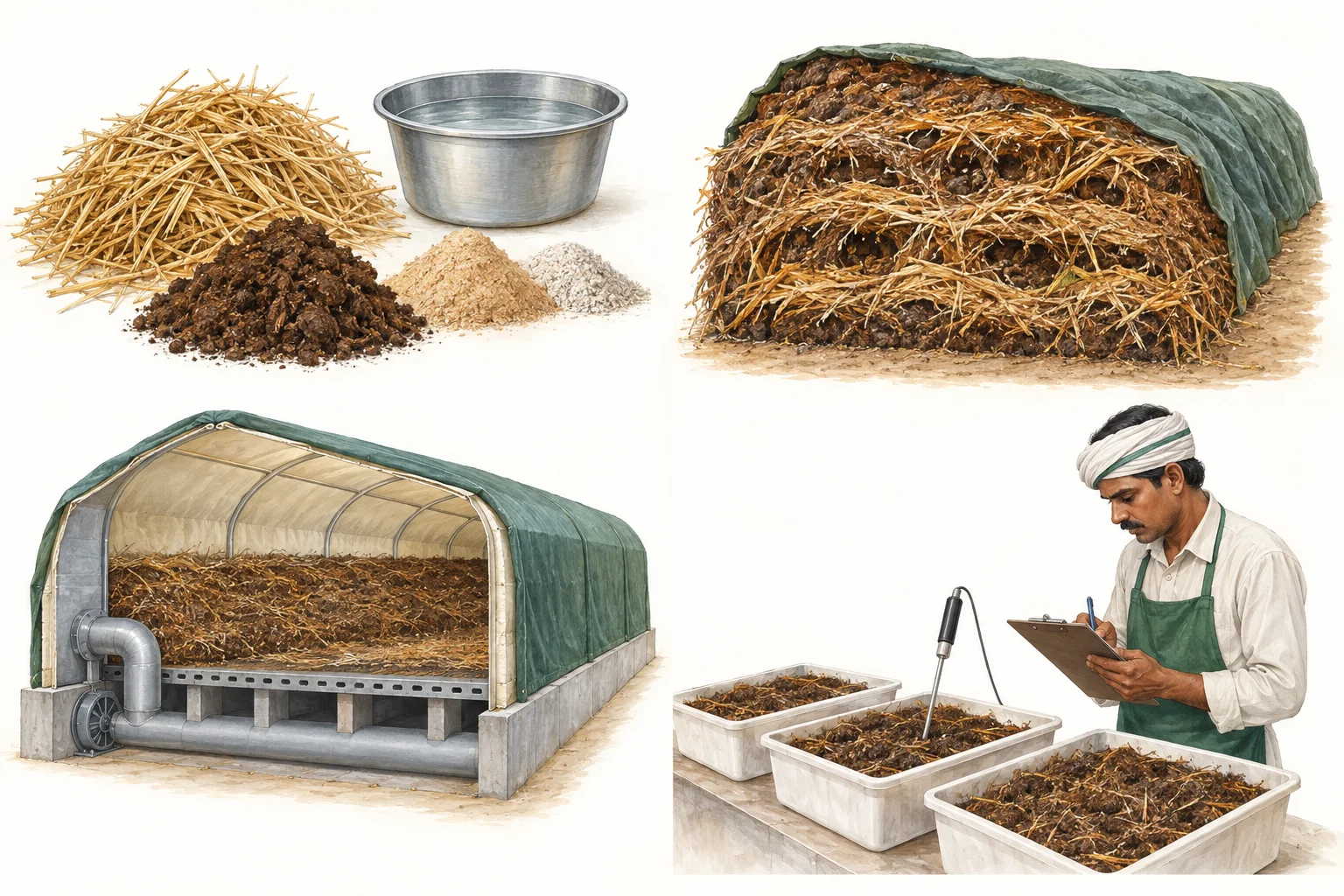
Understand the tunnel
- Notice
- Air must pass through the loaded material.
- Understand
- Pasteurisation, conditioning and cooling have distinct purposes.
- Try it
- Use the validated process and release criteria, not an odour test.
01Three jobs in one tunnel
Phase II is called pasteurisation, but that is only its middle act. First comes pre-pasteurisation conditioning: the compost is levelled to a uniform 45 to 48 °C and held in the 45 to 52 °C band for two days. Then pasteurisation, a short controlled peak that kills insects, nematodes and competitor spores. Then post-pasteurisation conditioning, back to 45 to 48 °C until the ammonia is gone.
Run the tunnel as one long hot period instead and you get compost that is clean but still full of ammonia, and the spawn dies in it.
02The peak and its ceiling
ICAR-DMR finds compost properly pasteurised when it is held at 58 to 59 °C for 4 to 6 hours. It is not pushed there suddenly: the temperature climbs at about 1 °C per hour, reaching the target in 10 to 12 hours largely from the compost's own heat.
The ceiling is hard. Above 60 °C, ICAR-DMR says, all organisms are killed including the thermophilic fungi Phase II depends on, and the same manual names that as a cause of olive green mould. A tunnel needs a compost probe, not an air thermometer by the door.
03Conditioning: where the ammonia goes
After the peak the compost is brought down at about 1.5 °C per hour and held at 45 to 48 °C. Surviving heat-loving fungi turn free ammonia into their own bodies, which the mushroom later eats. This step is what makes the compost selective. ICAR-DMR says it takes 3 to 4 days in a modern tunnel, or until the compost is free of ammonia.
Two limits protect it. Never condition below 40 °C, because mesophilic fungi set in and spoil the compost. Keep oxygen above 10 percent, since the fan is not optional.
04Uniformity, then evidence
A tunnel is filled 2 to 2.2 metres deep at about 900 to 1000 kg per square metre, with air pushed up from the plenum below. ICAR-DMR insists that the air above the compost, the compost itself and the plenum differ by no more than 3 °C, or one layer is under-pasteurised while another is over-cooked. On a small farm, probe a covered heap top, middle and bottom.
Finished compost has ammonia below 10 ppm, moisture around 64 to 66 percent with no liquid oozing when squeezed firmly, and a dark crumbly texture.
Plot a Phase II curve and mark the release gate
- Draw hours across and 20 to 65 °C up, shade 45 to 52 and 58 to 59, and rule a red line at 60.
- Log the compost probe every 2 hours and plot it.
- During conditioning, record validated ammonia measurements and the process observations specified by the trained operator. Never use deliberate smelling as a release test.
- Mark release only when the validated temperature, conditioning, ammonia and material acceptance criteria have all been met and recorded.
Write in your farm diary: Compost temperature log, validated ammonia results, moisture assessment and the authorised release decision.
Mistakes that cost a crop
- Running one long cycle above 60 °C, which leaves ammonia in a dead compost.
- Trusting the air sensor by the door while the compost core sits degrees away.
- Releasing on the planned day while the compost still smells of ammonia.
Check yourself
Three questions, instant answersThe probe reads 62 °C for three hours during pasteurisation. What has happened?
Conditioning is held at 38 °C to save fuel. Why is that a problem?
Which observation releases compost from Phase II?
An editorial self-check, not a certificate. Answers are not stored, not even on this device.
Words used in this lesson
- Pasteurisation
- A controlled heat peak that kills pests and competitor spores.
- Conditioning
- Holding compost at 45 to 48 °C so microbes remove ammonia.
- Plenum
- The air space under the tunnel floor through which the fan pushes air.
References & further reading
Operating values require stage, strain, sensor and production-system context.
Open current reference