


Phase I
Phase I turns straw and manure into something hot, dark and alive. Growers lose yield here because they judge the heap by the calendar instead of by what it is doing.
- By the end you can state what Phase I must achieve and how the compost ends up.
- By the end you can describe pre-wetting, heap size and the turning schedule.
- By the end you can organise temperature, material observations and validated process measurements without using odour as a concentration test.
The long-method Phase I schedule, judged by thermometer and nose.
- Day 0 to 2: pre-wetStraw to about 75 percent moisture.
- Day 2 to 5: stackHeap 100 to 120 cm wide; core 65 to 70 °C.
- Day 6 to 13: early turningsGypsum at the third turning.
- Day 16 to 28: finishTurn on days 16, 19, 22 and 25; fill on day 28.
Read numerical examples with their source, method and crop context. They are not universal operating instructions. Historical prices are not current quotations.
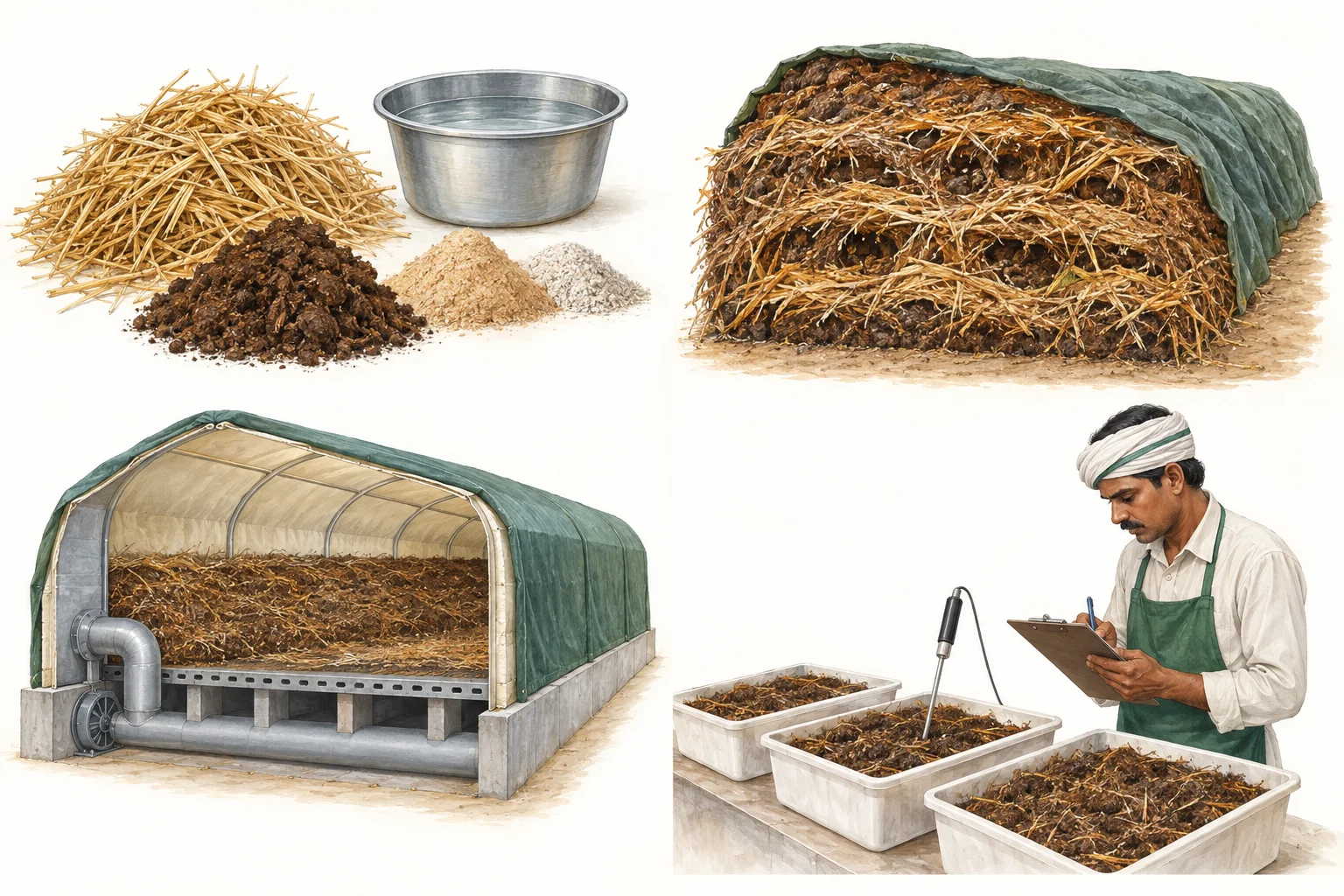
Structure and air
- Notice
- The heap has structure, depth and internal variation.
- Understand
- One central reading does not describe every part of the material.
- Try it
- Record representative readings and the actual preparation sequence.
01What Phase I is for
Phase I has three jobs. It wets and mixes the raw materials so every straw touches nitrogen and water. It starts a fermentation in which heat-loving microbes eat the easy sugars. And it turns much of the added nitrogen into ammonia and microbial protein for Phase II to finish.
It is deliberately incomplete. ICAR-DMR describes compost after Phase I as having a heavy ammonia smell, a pH of about 8.2 to 8.5, moisture of 72 to 75 percent and ammonia around 800 to 1000 ppm. That is the expected state before pasteurising.
02Pre-wetting and stacking
Dry straw repels water. ICAR-DMR wets it for 24 to 48 hours until it holds about 75 percent moisture, roughly 4000 litres per tonne, mixing in the nitrogen sources so fermentation starts everywhere at once.
Heap size follows climate. In the plains ICAR-DMR builds 100 to 120 cm wide; in the cooler hills 130 to 150 cm wide and about 150 cm high. A bigger heap holds heat and a small one never ferments, so never attempt less than 300 kg. Within two to three days the core should reach 65 to 70 °C.
03Turning: why and when
A heap heats from inside. The outer layer stays cool and the core can go anaerobic. Turning moves the outside to the inside and lets air back in.
For the long method ICAR-DMR turns on day 6, day 10, day 13 with gypsum, then days 16, 19, 22 and 25, and fills on day 28: 7 to 8 turnings over 28 to 30 days. The short method runs outdoor Phase I for only 10 to 12 days before a tunnel, and the bunker method finishes in 6 to 8 days with forced air.
04Temperature is the instrument
Buy a long-stem compost thermometer before anything else. ICAR-DMR says the heap may reach 70 °C in 24 to 48 hours, and that above 80 °C in the core is undesirable because the heap goes anaerobic. A peak stuck near 55 °C says nitrogen is short.
Measure centre, mid-depth and near-surface each morning. One centre reading hides a cold shoulder, and cold shoulders are where competitor moulds start. A sour, black, greasy heap went anaerobic. Insects breed at the last turnings, and current label approval must be checked before using anything against them.
Run a three-point temperature log on a heap
- Get a long-stem thermometer that reads to at least 90 °C.
- Fix three points: centre, mid-depth and 15 cm under the surface, read daily at the same hour.
- At each turning record colour, structure, moisture assessment and the validated process readings; do not deliberately inhale compost gases.
- Plot the centre line, mark the turning days, and compare with 65 to 70 °C by day 2 to 3.
Write in your farm diary: Representative temperatures, turning and gypsum days, material observations and validated process readings.
Mistakes that cost a crop
- Judging the heap by days elapsed and never by a thermometer.
- Building a small trial heap that cannot hold heat, then blaming the straw.
- Skipping a turning in wet weather, so the core goes anaerobic and smells sour.
Check yourself
Three questions, instant answersThe core of a 4-day-old heap reads 52 °C. Most likely cause?
The compost smells strongly of ammonia at the end of Phase I. Is that a fault?
Why turn a heap?
An editorial self-check, not a certificate. Answers are not stored, not even on this device.
Words used in this lesson
- Pre-wetting
- Soaking dry straw so it holds about 75 percent moisture.
- Turning
- Rebuilding the heap so outer material goes to the centre and air re-enters.
- Anaerobic
- Without oxygen; such a heap smells sour and turns black.
References & further reading
Operating values require stage, strain, sensor and production-system context.
Open current reference