

Compost Fundamentals
Compost is not a recipe you copy. It is a living process you steer so that only the button mushroom can eat the result. Stop asking for a formula and start asking for a measurement.
- By the end you can explain why compost is called a selective substrate.
- By the end you can state ICAR-DMR's nitrogen, moisture, pH and ammonia targets.
- By the end you can judge a finished compost by hand, nose and eye.
Read numerical examples with their source, method and crop context. They are not universal operating instructions. Historical prices are not current quotations.
Start with the inputs
- Notice
- Wet weight is not the same as dry matter.
- Understand
- Two equally heavy ingredient loads can contain different amounts of dry material.
- Try it
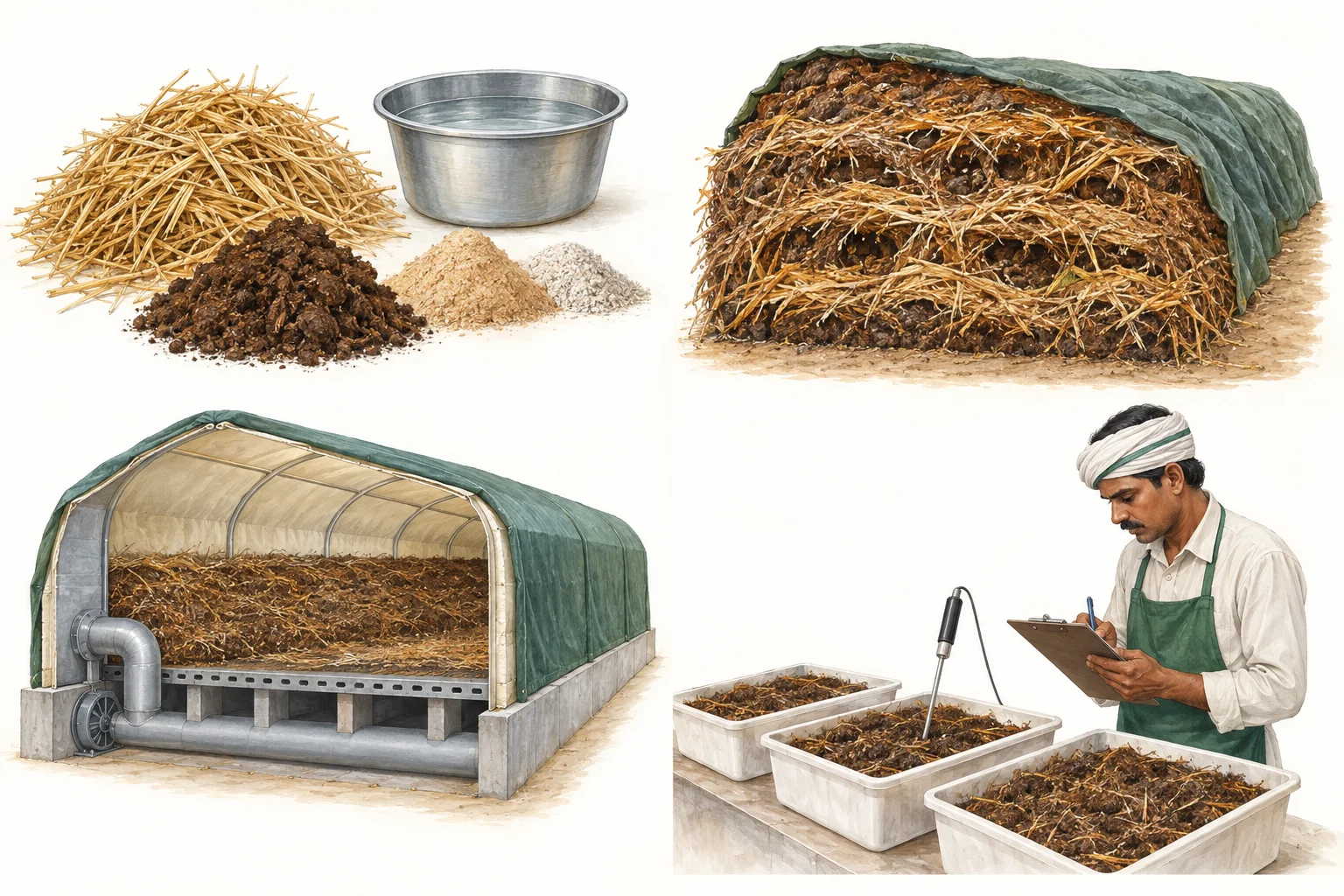
- Record input identity, moisture basis and the formulation being followed.
01Selective means the competitors starve
Fresh straw holds sugars that hundreds of fungi and bacteria can eat. Spawn it directly and moulds outgrow the mushroom in days. Composting changes that: heat-loving microbes consume the easy sugars, turn ammonia into their own protein, and leave a dark crumbly material rich in microbial bodies.
The button mushroom digests that material. Most competitors cannot, or not fast enough. That is what ICAR-DMR means by a selective substrate. A formulation only sets the process up. Selectivity is created by the process and judged by measurements at the end, not by the ingredients you started with.
02The nitrogen corridor
ICAR-DMR sets nitrogen in the mixed raw materials at 1.5 to 1.75 percent of dry weight and the carbon to nitrogen ratio at 25 to 30 to 1, falling to about 16 to 1 after composting.
Both edges matter. Below 1.5 percent the heap may not pass 55 to 60 °C and moulds such as Stachybotrys move in. Above 1.75 percent, nitrogen leaves as ammonia and the compost is invariably infested by Sepedonium yellow moulds and ink caps. Nitrogen comes from whatever is cheap near you: ICAR-DMR gives wheat straw 0.6 percent, deep-litter chicken manure 3.0, wheat bran 2.0 and cotton seed meal 7.0.
03Water, air and gypsum
Microbes need water to work and air to work cleanly. ICAR-DMR wets straw to about 75 percent moisture, roughly 4000 litres per tonne. Too wet and the heap turns anaerobic and sour; too dry and it never heats. Straw should be fresh, chopped 5 to 8 cm, and a batch under 300 kg will not hold heat.
Gypsum, added at the third turning, keeps the compost open rather than greasy and buffers the pH. Finished compost should sit at pH 7.2 to 7.8. Outside that band growth slows and white plaster mould invades, and a low pH favours green mould.
04Judging the finished product
Compost readiness requires a set of measurements and observations interpreted for the selected preparation method. Moisture, structure, temperature, conditioning and ammonia must be assessed together. A single moisture threshold does not establish that all compost above it will fail.
Use the documented batch release specification, calibrated instruments and representative sampling. Visual and tactile observations can supplement measurements, but do not deliberately smell compost or assign an ammonia concentration from odour. Older numerical recipes describe particular methods and must not be treated as universal release criteria.
Grade your local raw materials
- List every straw, manure and bran source in reach with a price per quintal and its freshness.
- Next to each, write its nitrogen percentage from the ICAR-DMR table.
- Weigh 1 kg of each wet, sun-dry it three days, weigh again and note the moisture lost.
- Squeeze-test a compost sample from a nearby farm and write which nitrogen source you would use and why.
Write in your farm diary: Raw material table with price, nitrogen percentage, measured moisture, and your reason for the nitrogen source.
Mistakes that cost a crop
- Copying a formulation without checking your own straw, so nitrogen lands outside the corridor.
- Making a trial heap under 300 kg and concluding that composting does not work.
- Spawning compost that still smells of ammonia because the calendar said day 28.
Check yourself
Three questions, instant answersWhat makes compost selective?
Nitrogen above 1.75 percent at stacking leads to what?
You can smell ammonia on filling day. What does that tell you?
An editorial self-check, not a certificate. Answers are not stored, not even on this device.
Words used in this lesson
- Selective substrate
- Material the mushroom can digest but its competitors mostly cannot.
- Ammonia
- A sharp-smelling nitrogen gas released in composting; it kills mushroom mycelium.
- Thermophilic
- Heat-loving; the microbes that do the composting work above 45 °C.
References & further reading
Operating values require stage, strain, sensor and production-system context.
Open current reference