


Spawn & Spawning
Spawning takes a few hours and decides whether the crop starts clean. The compost is cool, open and defenceless on that one day.
- By the end you can list the evidence that says compost is ready to spawn.
- By the end you can state ICAR-DMR's spawn rate and its fill depths for bags and beds.
- By the end you can plan a spawning day that protects the batch.
A spawning day in order, with the compost check as the first gate.
- Check the compostMeasure representative compost temperatures, moisture and ammonia using the validated release procedure.
- Prepare the roomFloor washed, tools clean, flies out.
- Weigh the spawn0.5 to 0.7 percent of the wet compost weight.
- Mix and fillGrains spread through the mass; bags 12 to 15 inches deep.
- LabelBatch, date, strain and lot on every bag.
Read numerical examples with their source, method and crop context. They are not universal operating instructions. Historical prices are not current quotations.
Look, explain, then apply
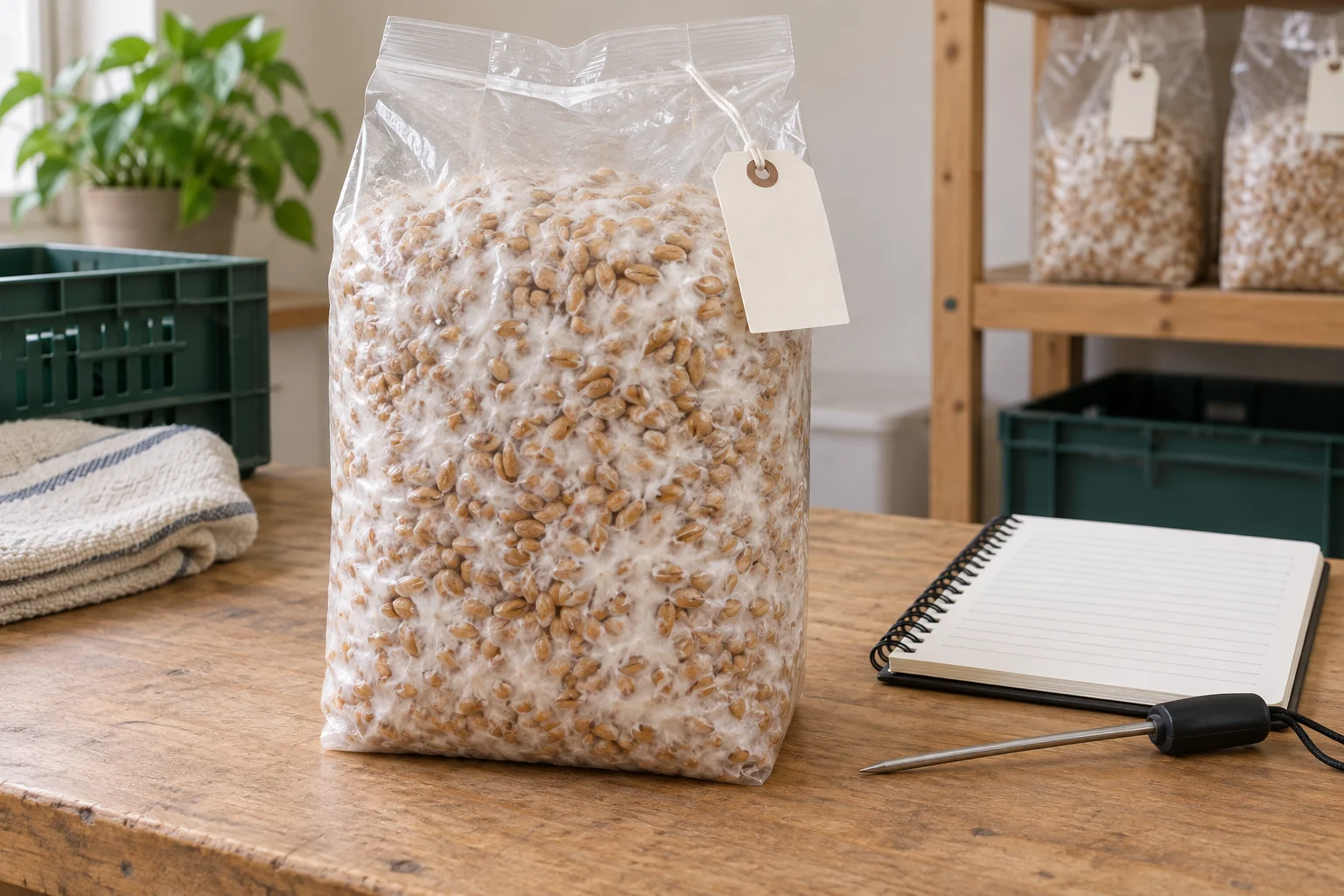
Receiving concept, not a laboratory-production or purity standard. Keep material closed during initial inspection; the blank tag must be replaced by real batch information in practice.
See where this fits in the full workflow →01What spawn actually is
Spawn is sterilised grain that a laboratory has grown mushroom mycelium through. It is not seed. Nothing crosses or pollinates on your farm, so every mushroom in the bag is a copy of the strain the lab supplied.
Strain choice therefore travels with the spawn. The NHB model report lists Indian strains from 14 to 16 kg per 100 kg compost up to 22 to 27 kg for DMR-NBS-5, measured with spawn run near 24 °C and fruiting near 15 °C. Buy from a recognised laboratory and note the strain and lot number.
02The gate before you spawn
Spawning should follow a documented release decision. Confirm that conditioning and cooling are complete under the selected production protocol. Use suitable calibrated instruments and representative sampling; record temperature, moisture and validated ammonia results against that protocol.
Do not infer an ammonia concentration from smell or deliberately inhale compost gases. A lack of smell does not prove safe working conditions or crop readiness. If a criterion is unresolved, hold the batch and obtain a competent assessment before adding spawn.
03Rate, mixing and fill depth
ICAR-DMR mixes grain spawn at 0.5 to 0.7 percent of the wet compost weight. Its Hindi farmer folder gives 0.5 to 0.75 percent, which is 500 to 750 g for 100 kg of prepared compost. More spawn is not better: it costs more and adds heat.
Mix so grains are spread through the whole mass and not left in a band. The manual fills polythene bags 12 to 15 inches deep, or shelf beds 6 to 8 inches. The folder says 10 to 12 kg per bag, because a deeper bag overheats in the middle.
04Hygiene on the day
For a few hours the compost is cool, moist, rich and open, and every competitor on the farm would like it. Wash the floor and the mixing platform before the compost arrives. Keep the room shut against flies. Use clean tools, wash hands, and let nobody walk in from the composting yard in the same footwear.
Work fast and finish in one session, because spawn left open for hours collects spores. ICAR-DMR documents chemical treatments for rooms and tools, and current label approval must be checked before anything is used.
Plan and run one spawning day
- Two days ahead, confirm the spawn lot, its manufacture date and the strain in writing.
- Before spawning, record representative compost temperature, moisture and validated ammonia results against the release specification.
- Weigh the spawn against the actual wet weight of compost, not an estimate.
- Fill and label every bag with batch, date and strain before leaving.
Write in your farm diary: Compost temperature, validated ammonia and moisture results, spawn lot and strain, kg compost, g spawn and bags filled.
Mistakes that cost a crop
- Spawning on a planned date while the compost is still warm or still smells.
- Buying spawn with no strain name, date or laboratory name on it.
- Mixing spawn only into the top, so colonisation starts from one place.
Check yourself
Three questions, instant answersCompost is at 34 °C and smells faintly of ammonia. What now?
ICAR-DMR's grain spawn rate is what?
Why not fill a bag much deeper than a foot?
An editorial self-check, not a certificate. Answers are not stored, not even on this device.
Words used in this lesson
- Grain spawn
- Sterilised grain grown through with mycelium, used as planting material.
- Strain
- A named line within the species; strains differ in yield and temperature.
- Contamination
- Any competing mould or bacterium that gets into compost or spawn.
References & further reading
Operating values require stage, strain, sensor and production-system context.
Open current reference