


Basic Economics
Most mushroom budgets fail because they start from a price someone quoted on a phone call.
- By the end you can build a yield estimate from compost weight.
- By the end you can tell a dated reference cost from a current one.
- By the end you can see what a subsidy scheme does and does not pay.
Example: a small button farm's first year
Illustrative shares for a two-room, purchased-compost unit. Your quotation and buyer decide the real numbers.
Read numerical examples with their source, method and crop context. They are not universal operating instructions. Historical prices are not current quotations.
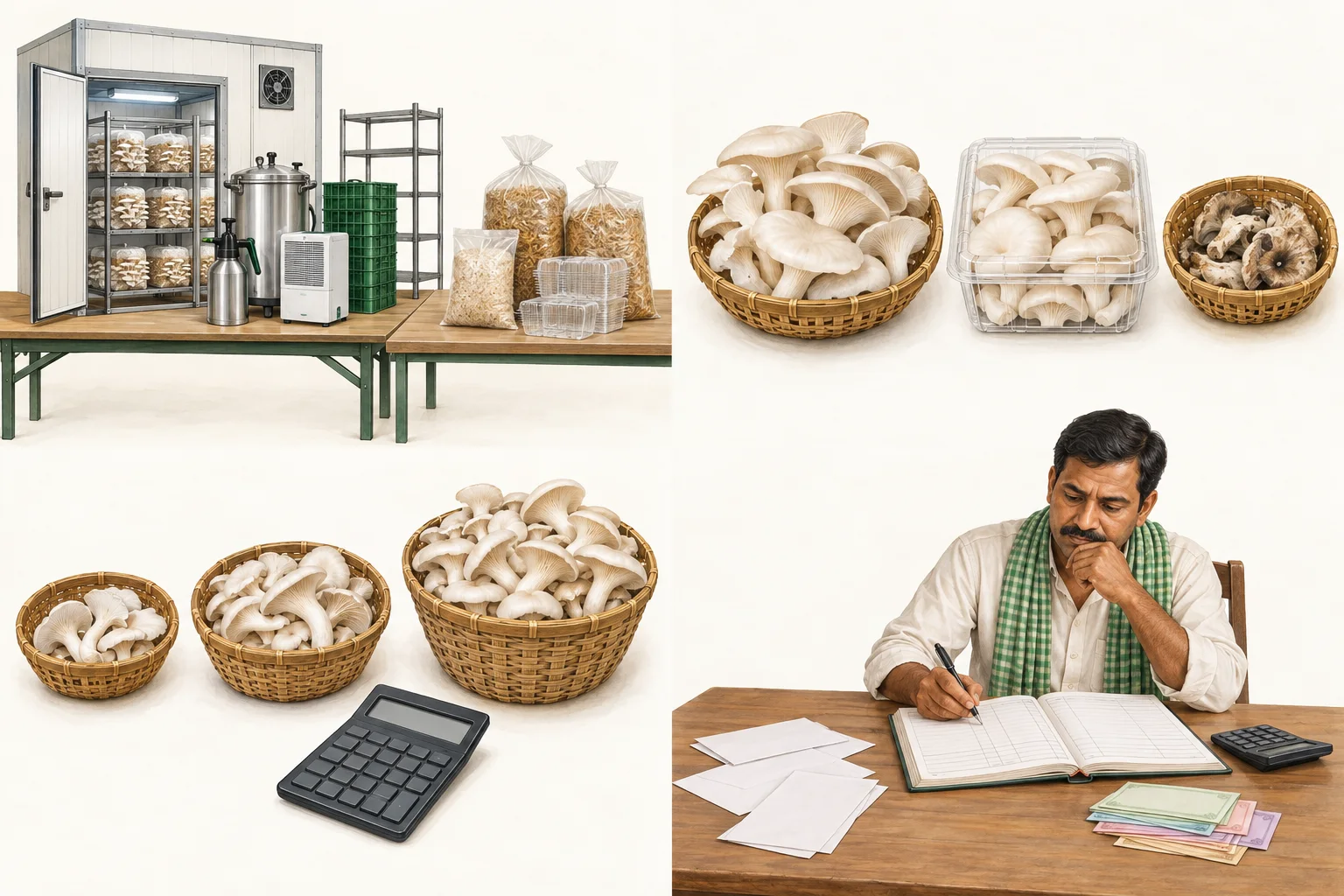
Harvest is not all sold
- Notice
- Harvested, sold and rejected quantities are different records.
- Understand
- Only accepted sales support the sales calculation.
- Try it
- Weigh each destination and keep buyer deductions visible.
01Start from compost weight
Every published Indian button yield figure is given per 100 kg of compost. So the first number in your sheet is not price, it is how many kilograms of compost you filled.
Weigh it. Do not estimate from bag counts, because bag weights vary with moisture.
Then the arithmetic is simple. Compost weight divided by 100, multiplied by a yield figure from the published range, gives a production estimate. From that, subtract what you will not sell: mushrooms that open, bruise or are rejected. What is left is saleable yield, and only saleable yield earns anything.
02Yield ranges you may use as a check
DMR's Table 7.1 gives 10 to 15 kg per 100 kg compost for long method compost, 18 to 25 kg for short method and 20 to 30 kg for indoor compost.
NHB's strain table runs from 14 to 16 kg for older strains up to 22 to 27 kg for DMR-NBS-5 under Indian conditions. DMR's own project model uses 18 kg per 100 kg compost as a planning assumption.
Use the range for the compost you actually make, and the lower end for a first crop. None of these ranges is a promise to you.
03The published cost figures are dated
The only Indian cost of production figure in our source set comes from DMR's undated Hindi farmer folder, which reads as early 2010s. It gives a seasonal white button production cost of Rs 20 to 25 per kg and states a margin of at least Rs 25 to 35 per kg.
That is a reference from another decade, not a forecast for you. Straw, spawn, coal, labour and power have all moved since.
Price your own inputs this week and keep the DMR figure beside yours only as a sanity check.
04What a scheme actually pays for
MIDH's 2025 guidelines set cost norms of Rs 30 lakh for a production unit, Rs 20 lakh for a spawn unit, Rs 30 lakh for a compost unit, and Rs 2 lakh for a low cost unit of 200 sq ft.
Assistance for private applicants is 40 per cent of the cost norm, raised to 50 per cent in the north eastern and Himalayan states, scheduled areas and other listed areas. The low cost unit is assisted at 50 per cent.
It is credit linked and back ended, a bank loan is mandatory, and it covers capital cost only.
Build a one crop sheet you can defend
- Weigh the compost filled into each room and write it on the sheet.
- Pick a yield figure from the range for your compost method.
- Get this week's price for straw, FYM, spawn, casing, fuel and labour.
- Record picked weight daily and the weight you could not sell.
- At the end of the crop, replace every assumption with a measured figure.
Write in your farm diary: Compost weight, assumed yield, dated input prices, daily picked and rejected weight.
Mistakes that cost a crop
- Budgeting on total production instead of saleable yield.
- Using a decade old published cost as if it were this year's price.
- Assuming a scheme pays running costs; MIDH covers capital items only.
Check yourself
Three questions, instant answersA room takes 4000 kg of compost. Using the long method range, production is:
DMR's Rs 20 to 25 per kg cost of production should be treated as:
MIDH assistance for a private production unit is:
An editorial self-check, not a certificate. Answers are not stored, not even on this device.
Words used in this lesson
- Saleable yield
- The part of the crop that reaches a buyer in good condition.
- Cost norm
- The maximum project cost a scheme calculates assistance on.
- Back ended subsidy
- Assistance released after the work is done and verified.
- Realised price
- Money actually received per kg after deductions.
References & further reading
Operating values require stage, strain, sensor and production-system context.
Open current reference