


A practical guide to growing mushrooms in IndiaA joint educational initiative by MushroomWale & DMR Solan
MushroomFarming.in

A joint educational initiative by

MushroomWale.com
ICAR–Directorate of Mushroom Research, Solan logoICAR–DMRSolan

Read · Observe · Practise · Check

Button mushroom: follow each crop-stage handover

Follow a Button crop without confusing compost preparation, colonisation, casing and fruiting. The study sequence includes eighteen detailed lessons; the practical walkthrough below connects the handovers.

Begin the walkthrough ↓
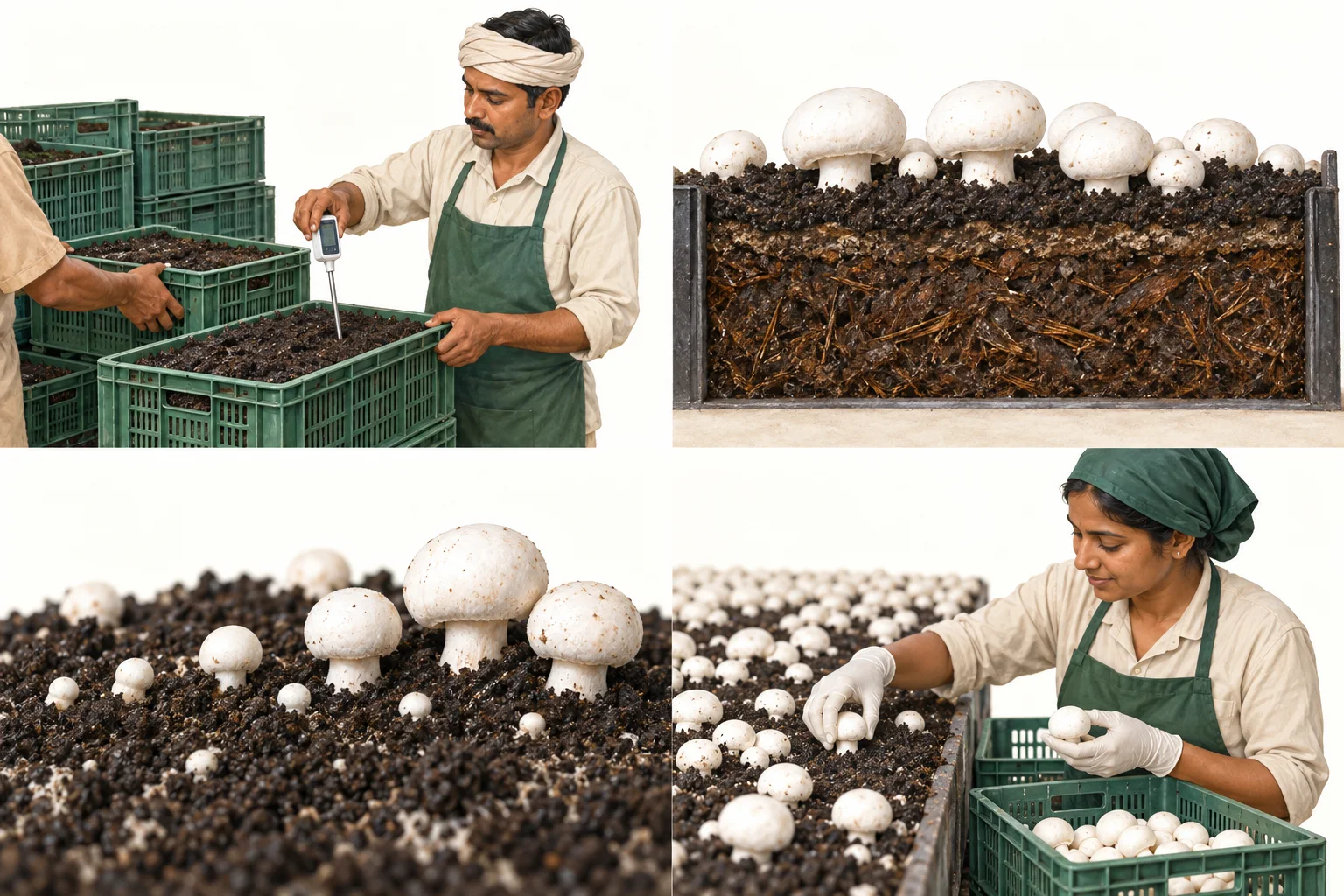
Illustration of compost receipt and a probe measurement.
AI-generated teaching illustrationConceptual learning scene, not a diagnostic photograph or construction specification.

Before you begin

  • Compost delivery stage and batch information
  • Separate air and compost measurement records
  • The selected strain and farm’s stage-specific operating procedure

Use the linked crop and technical lessons for method-specific detail. Practical work involving chemicals, pressure, electrical equipment or uncertain crop health requires competent supervision; illustrations are not operating specifications.

Illustration of compost receipt and a probe measurement.

Conceptual AI teaching scene

Stage 1

Receive the correct starting stage

Unspawned Phase II compost and colonised Phase III compost are different purchases. Their remaining work, handling and room occupancy differ. Keep the supplier’s release information with the batch rather than treating a dark colour as acceptance evidence.

Put it into practice
Record supplier, lot, quantity, stage, receipt time, condition and unresolved discrepancies before allocation to a room.
Check your work
The room plan begins at the actual supplied stage and any release concern has a named decision-maker.
Educational cross-section of a Button mushroom bed with compost below a distinct casing layer.

Conceptual AI teaching scene

Stage 2

Separate spawn run and casing

Colonisation develops through the compost; casing is a later, distinct surface operation. Uniform filling and a consistent casing application help make comparisons between bed locations meaningful. Casing cannot repair inadequately prepared compost.

Put it into practice
Mark bed locations and keep compost and casing lot identities separate. Document observations before and after the casing operation.
Check your work
The team can describe the growing material underneath, the surface layer above and the purpose of each.
Illustrated Button mushroom pins at different sizes on a casing surface.

Conceptual AI teaching scene

Stage 3

Read the fruiting transition

Case run, pin formation and mushroom enlargement are not the same stage. A planned transition needs observations from representative crop locations. Changing a setpoint does not prove that the crop surface or compost has reached the intended condition.

Put it into practice
Use the pinning and climate lessons together. Compare location, stage, air reading, compost reading and recent watering history.
Check your work
The next adjustment has a stated reason, an observation to watch and a planned recheck.
Illustration of careful Button mushroom harvesting into clean food-contact containers.

Conceptual AI teaching scene

Stage 4

Harvest, grade and reset

Picking decisions affect the next operation: clean containers, grading, packing and dispatch. Keep rejects visible in the crop account. Plan room emptying and cleaning before the last harvest so spent material does not cross the next crop’s clean workflow.

Put it into practice
Record grade weights and dispatch lots, then complete the room-reset checklist and unresolved-defect list.
Check your work
The next fill is released after cleaning and checks, not simply because the previous crop has left.

Common mistakes—and the better question

Using one temperature for every stage
Read the stage, measurement location and applicable source together.
Treating casing as extra compost
Track its preparation, structure and water management separately.

A task to complete, not just a page to read

Build a crop-stage handover board

For receiving, spawn run, casing, pinning, cropping and reset, write what enters, what is observed and who authorises the next operation.

Bring back this evidence

Six stage cards linked to one crop ID, with unanswered conditions clearly marked.

Completing this self-guided task is not verification of practical competence. Review it with a suitable instructor before relying on it for farm operation.

Study the detailed lessons in order

Button Mushroom Grower. Every lesson keeps its explanations, practical exercise, mistakes and self-checks.

  1. Button Mushroom FundamentalsExplain the Button crop system and the role of compost, casing and controlled stages.
  2. Production SystemsCompare seasonal and controlled production without assuming one design fits every farm.
  3. Compost FundamentalsDescribe compost as a selective biological substrate rather than a fixed recipe.
  4. Phase IIdentify Phase I objectives, process observations and the information needed before judging progress.
  5. Phase IIDistinguish pasteurisation, conditioning and cooling and explain why release needs evidence.
  6. Spawn & SpawningConnect spawn quality, handling, distribution and hygiene to a defensible spawning decision.
  7. Spawn RunObserve colonisation while interpreting air and compost measurements in crop-stage context.
  8. CasingExplain casing function, preparation and application without treating it as nutrient compost.
  9. Case RunRecognise case development and identify context required before changing climate or watering.
  10. PinningConnect stage transition, evaporation, air movement and crop response without a single-number shortcut.
  11. Cropping & FlushesInterpret crop pattern, flush development and interventions as a connected operating system.
  12. Climate ManagementDistinguish biological target, sensor reading, room distribution and equipment capacity.
  13. WateringSeparate RH, surface condition and watering decisions and observe response before escalation.
  14. Crop HealthUse pattern, distribution, stage and negative evidence before naming a cause.
  15. HarvestRecognise harvest readiness and handling priorities without inventing a universal market specification.
  16. Post-HarvestTrace quality loss through handling, cooling, packing, logistics and sale channel.
  17. Farm HygieneDesign observation and movement discipline while respecting chemical and worker-safety boundaries.
  18. Basic EconomicsCalculate only from explicit production, saleable yield, realised price and cost assumptions.

Keep the field guidance beside the lesson

Open the main subject guide →Button Mushroom CompostCasing knowledge systemPinning and initiationHarvesting Button Mushroom

Sources, scope and review

Editorial learning material; no independent technical review is claimed. The tasks are original teaching exercises. Source-specific numerical schedules remain in the detailed lessons with their context, rather than being turned into universal instructions here.