


Crop Health
Naming a disease from one photograph is the fastest way to treat the wrong problem. The evidence is in the pattern.
- By the end you can describe a problem by pattern, spread and stage.
- By the end you can link common moulds to the fault behind them.
- By the end you can act on insect counts instead of guesses.
From symptom to cause
A first look, not a diagnosis. Source: ICAR-DMR manual and disease bulletin.
| What you see | Likely cause | First step |
|---|---|---|
| Long stems, small caps | CO₂ too high (above about 1,500 ppm) | More fresh air |
| Green patches on compost | Trichoderma; low pH or leftover ammonia | Isolate, remove; check next batch |
| No pins after casing | Room not aired and cooled | 16 to 18 °C, ventilate |
| Brown sunken spots on caps | Bacterial blotch; wet caps | Dry the surface, humidity under 85% |
| White wet lumps | Wet bubble from casing | Salt, remove; steam next casing |
| Small flies | Sciarid or phorid flies | Screens, light traps, hygiene |
Read numerical examples with their source, method and crop context. They are not universal operating instructions. Historical prices are not current quotations.
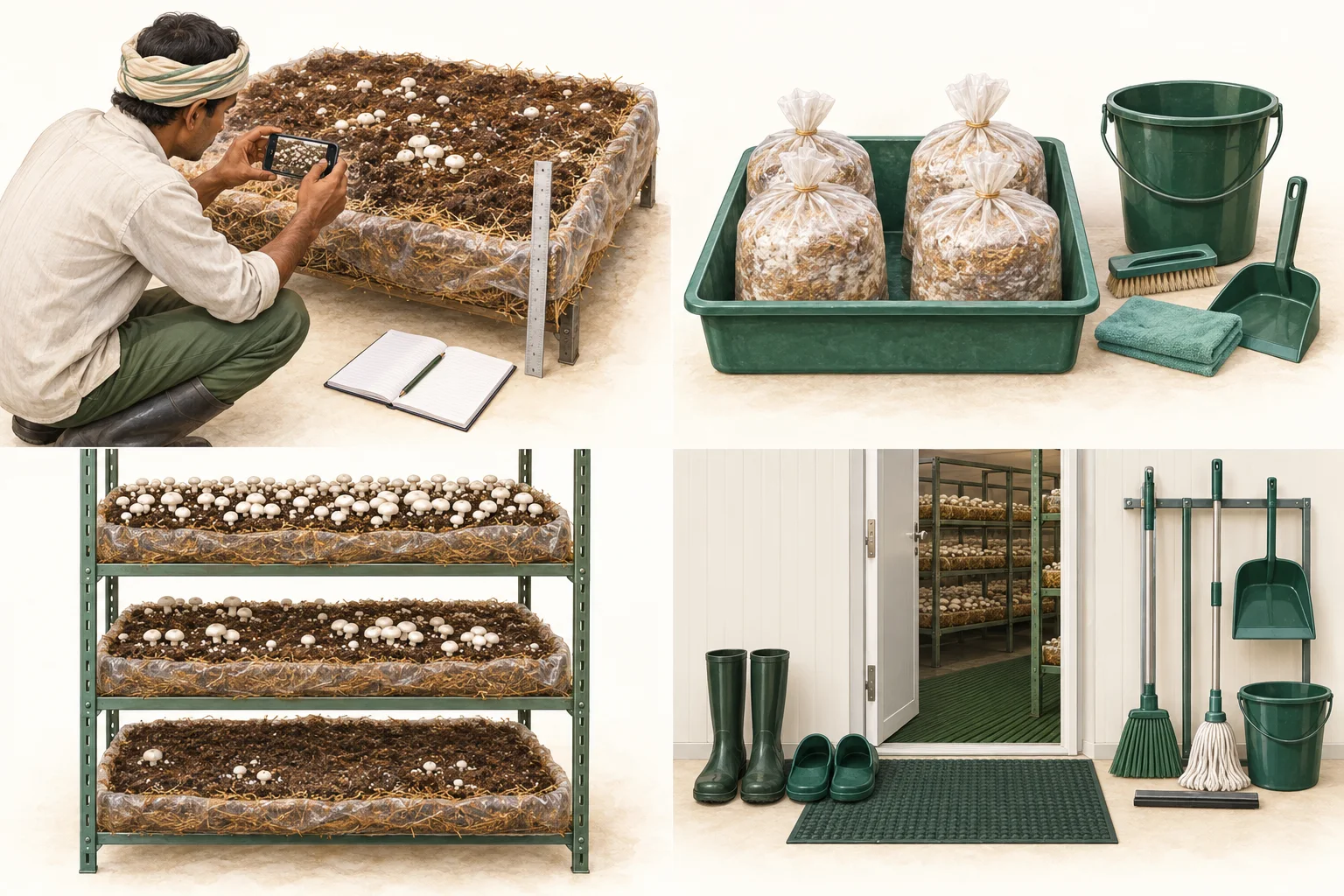
Capture the pattern
- Notice
- The location and pattern of symptoms are useful evidence.
- Understand
- A close-up alone leaves out the batch, room and timeline.
- Try it
- Photograph affected and unaffected areas and record when signs began.
01Describe before you name
Four questions come before any name. Is it one tray or the whole room. Is it near the door, under a duct, or spread evenly. Which flush is running. What changed on the farm about three days earlier.
Negative evidence counts too: if the same compost in the next room is clean, the compost is probably not the cause.
Write these four answers in the diary before you telephone anyone. A KVK scientist or the ICAR-DMR helpdesk can work with that description. Nobody can work with the words the crop is finished.
02Most moulds are compost and casing history
DMR's table of causes reads like a compost audit. Green mould follows low compost pH, carbohydrate rich and nitrogen poor compost, or immature spawn. Ink caps follow free ammonia, too much nitrogen or old straw. White plaster mould invades when compost pH sits outside 7.2 to 7.8. Olive green mould follows poor aeration in Phase II or pasteurisation above 60 C.
Cinnamon mould follows casing that is too wet or too strongly disinfected.
So the honest question after a mould outbreak is not which spray, it is which step in the last three weeks was out of range.
03The ones that move fast
Some problems give you days, not weeks. DMR states that dry bubble, if left uncontrolled, can destroy a crop in 2 to 3 weeks.
Wet bubble is carried by the casing soil, and DMR's folder records that its resting spores survive there for three years, which is why casing source and treatment matter more than any later action.
False truffle appears above 23 C, which in the north Indian plains means February and early March. Bacterial blotch needs 20 C and free water on the cap. Each of these is a measurement you can take today.
04Insects, counts and the chemical boundary
Sciarid flies are managed by counting, not by smell. DMR's threshold table treats any live adult in the first flush as an action point, and more than 20 catches per trap per week from the second flush onwards.
NHB describes 35 mesh nylon screening on doors and ventilators, and a 15 W yellow light trap over an oil coated sheet.
This site prints no pesticide names or doses. Approvals change and mushrooms are eaten fresh. Check the current label approval for mushrooms in India and your state advisory, and note the exact approved product label and required pre-harvest interval; no universal 48-hour rule is appropriate.
Write a proper problem report
- Photograph the affected patch and one clean patch in the same room.
- Write which trays and which part of the room are affected.
- Write the flush number and the day count since venting.
- List every change made on the farm in the previous three days.
- Send all of it to your KVK or ICAR-DMR before buying anything.
Write in your farm diary: Date, room, tray positions, flush number, symptom description, recent changes, trap counts.
Mistakes that cost a crop
- Naming the disease first and only then looking at where it is and is not.
- Reusing or storing casing soil near the rooms, which carries wet bubble into the next crop.
- Reaching for a spray a neighbour recommended without checking approval or the waiting period.
Check yourself
Three questions, instant answersGreen mould in compost is linked by DMR mainly to:
Why does casing source matter so much for wet bubble?
In the first flush, how many live sciarid adults are an action point?
An editorial self-check, not a certificate. Answers are not stored, not even on this device.
Words used in this lesson
- Negative evidence
- What is not affected, which often points to the cause.
- Dry bubble
- A fungal disease that deforms caps and can take a crop in weeks.
- Sciarid fly
- A small dark fly whose larvae feed on mycelium.
- Label approval
- Official permission for a product to be used on a named crop.
References & further reading
Operating values require stage, strain, sensor and production-system context.
Open current reference