

Watering
Water is the easiest thing to add to a mushroom bed and the hardest to take back.
- By the end you can separate a humidity problem from a casing problem.
- By the end you can decide how much water to give after picking.
- By the end you can see when free water on caps becomes a risk.
Casing soil carrying young buttons: this surface is what you water.
- Weigh the pickNote kilograms picked from each room.
- Check the casingSqueeze casing from three places.
- Water in light passesOne litre per kilogram, over two or three passes.
- Dry the capsKeep air moving until caps feel dry.
- Look next morningRecord pin numbers and any brown spots.
Read numerical examples with their source, method and crop context. They are not universal operating instructions. Historical prices are not current quotations.
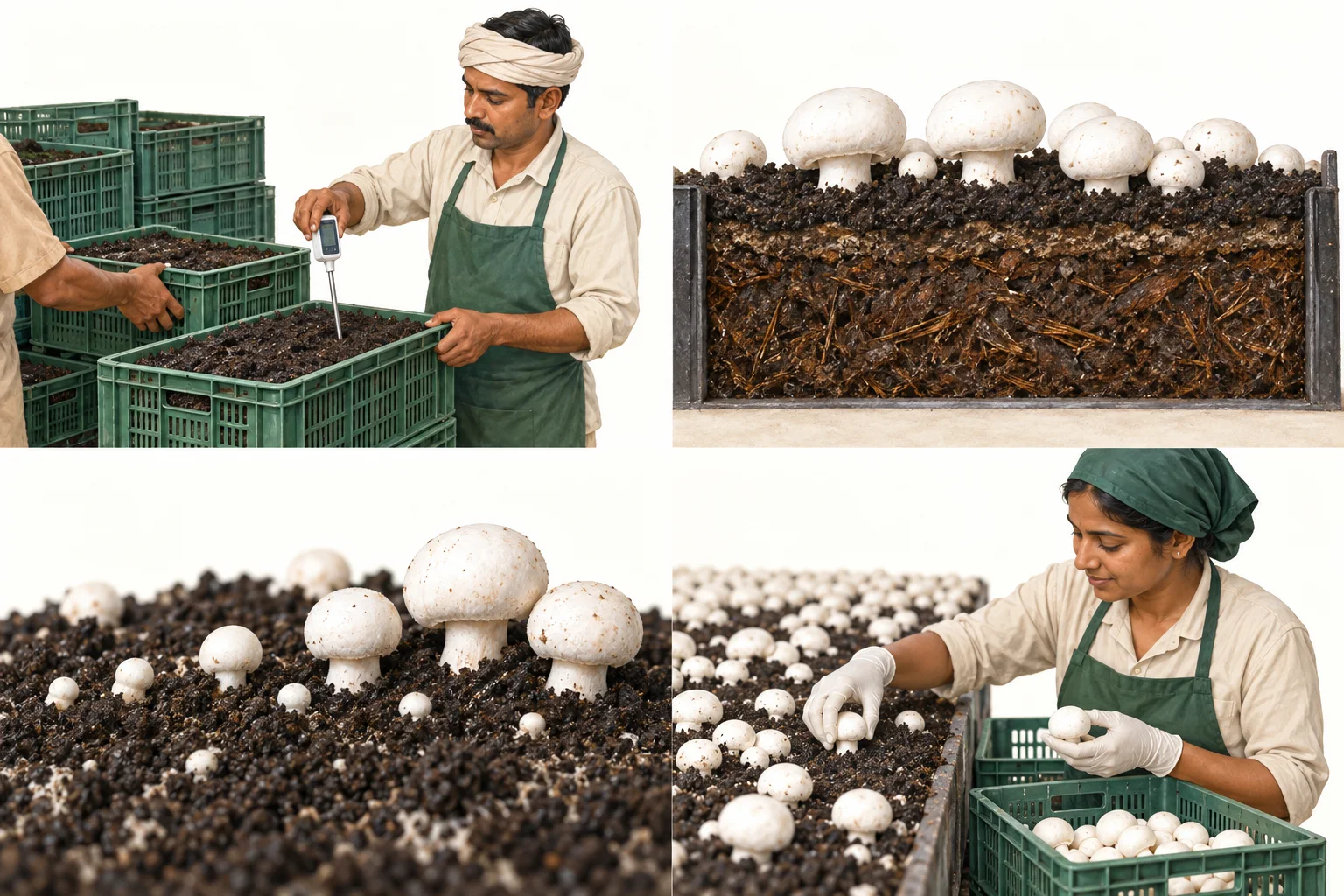
Recognise developing pins
- Notice
- Tiny pins develop at the casing surface before visible mushrooms enlarge.
- Understand
- The condition of the crop matters alongside the planned transition date.
- Try it
- Compare marked bed locations and record where development differs.
01You water the casing, not the mushrooms
The casing layer is a water store. The mycelium sits inside it, draws water up into the growing mushrooms, and the surface loses water to the air all day long.
So watering is refilling a store, not washing a crop. Humidity in the air and water in the casing are two different things.
Judge the casing by hand. DMR gives casing moisture at pinning as 48 to 52 per cent, and the field method is to squeeze a pinch of it and see whether it holds together without water running out.
02How much: replace what you picked
DMR's rule is to spray at the rate at which the mushrooms were harvested: for every kilogram picked, add one litre of water.
Give it in light passes rather than one drench. A heavy single watering runs through the casing, reaches the compost, and pushes out the air the mycelium needs. Time the water after picking, not onto swelling pins, because young pins that are watered directly stop, discolour and are lost.
Between flushes, when the bed looks empty, the casing store still has to be refilled, so keep watering lightly on those days.
03Free water on caps is a disease decision
DMR reports that bacterial blotch spots spread when temperature is at least 20 C and a film of free water sits on the cap, and that a film lasting more than about three hours is the dangerous case. NHB adds that humidity above 85 per cent with temperature above 20 C should be avoided.
That gives a practical rule needing no chemical: after watering, run air movement until caps are dry to the touch. Never leave a wet crop overnight in a warm room.
If blotch appears, treat it as a climate and water problem first.
04Too wet and too dry both show a face
Over wet casing brings cinnamon mould, which DMR lists against casing that is too wet or too strongly disinfected. Over wet compost is worse: above 72 per cent moisture at spawning the compost goes airless and plaster moulds appear.
The opposite fault shows up as weepers. NHB describes leaking, stinking mushrooms where the compost is below 64 per cent moisture and the casing above it is wet.
Dry casing cracks and crusts, pins abort at the tray edges first, and the mushrooms that do come are small and open early.
Set a watering routine for one flush
- Weigh every pick and write the figure on the room board.
- Water after picking at one litre per kilogram, never onto white pins.
- Split the water into two or three light passes.
- Run air movement afterwards until caps feel dry.
- Squeeze test the casing next morning and note what you felt.
Write in your farm diary: Kilograms picked, litres applied, passes, drying time, casing squeeze note.
Mistakes that cost a crop
- Watering pins directly during pin formation, which stops and browns them.
- One heavy drench instead of light passes, which drives air out of the compost.
- Leaving caps wet in a warm room overnight, the exact blotch condition.
Check yourself
Three questions, instant answersWhich is the safest time to water a cropping bed?
NHB links leaking, stinking mushrooms to:
Casing moisture at pinning is given by DMR as:
An editorial self-check, not a certificate. Answers are not stored, not even on this device.
Words used in this lesson
- Casing layer
- The soil mixture on the compost that holds water and carries pins.
- Squeeze test
- Pressing a pinch of casing to judge its water.
- Weeper
- A leaking mushroom from dry compost under wet casing.
- Free water
- A visible film of water on the cap.
References & further reading
Operating values require stage, strain, sensor and production-system context.
Open current reference