


Climate Management
A thermometer near the door is not the crop's temperature. The bed, the sensor and the machine each carry a different number.
- By the end you can separate the biological target from the sensor reading.
- By the end you can say why the cooling unit runs colder than the room.
- By the end you can judge what your equipment delivers in your season.
Controlled room: how the air moves
Cooled, humid air drops from the overhead duct onto the beds, returns through the room, and 20 to 30 percent fresh air is mixed in. About 15 cm per second over the beds, 4 to 6 air changes an hour. Source: ICAR-DMR manual.
Read numerical examples with their source, method and crop context. They are not universal operating instructions. Historical prices are not current quotations.
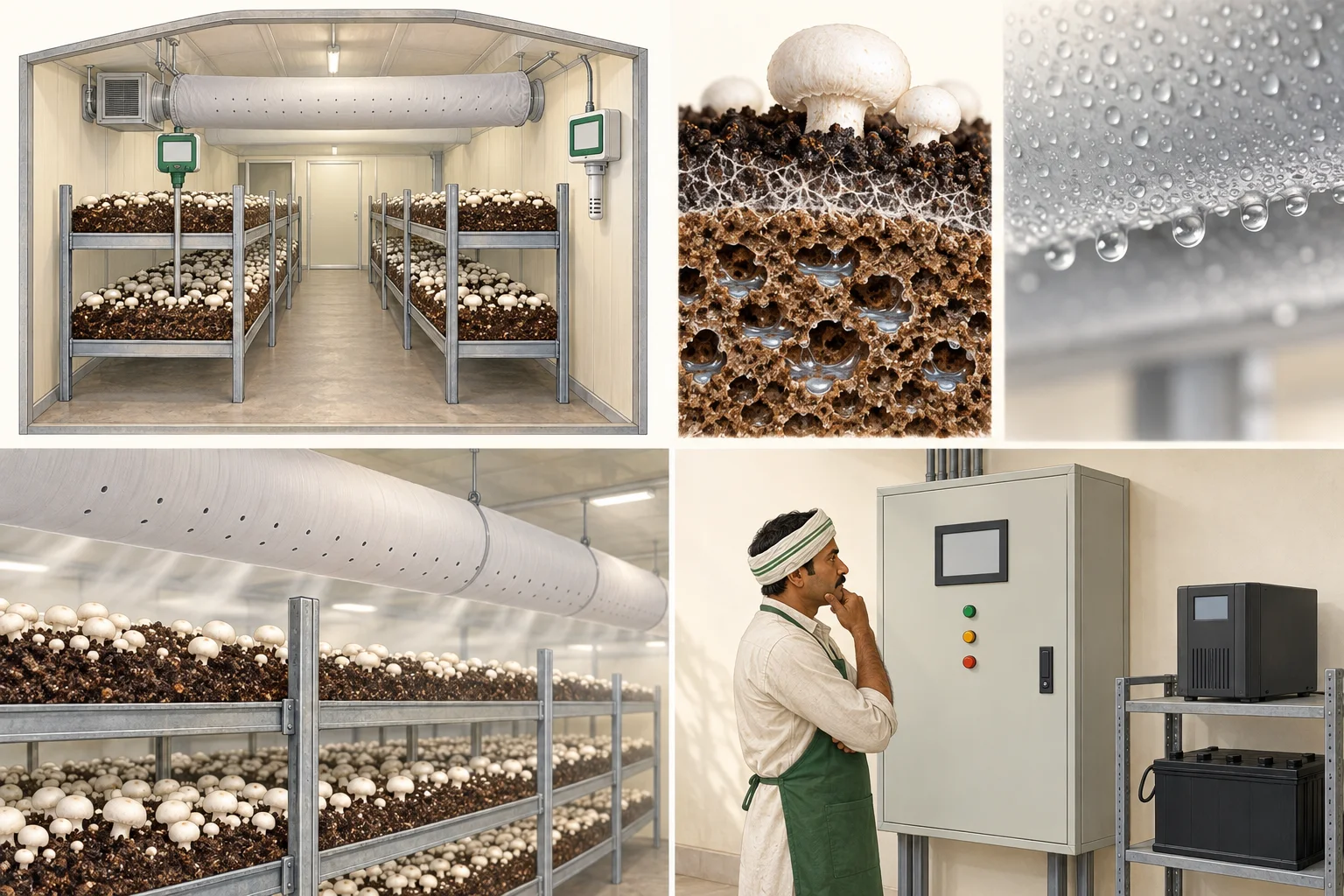
Air versus bed
- Notice
- Air and growing material are different measurement locations.
- Understand
- An active crop releases heat; the wall display is not every bed's temperature.
- Try it
- Map probes, sensor locations and representative crop readings.
01Four different temperatures
There is the temperature the fungus wants, the temperature your probe reads, the temperature in the far corner, and the temperature the machine can hold.
DMR makes the first gap plain: during spawn run the air is held at 23 plus or minus 1 C, which gives a bed temperature of 24 to 25 C, because compost makes its own heat and runs 1 to 2 C above air.
The bed keeps making heat in cropping too. A room that reads correct at the door can still be too warm inside the bed.
02The machine runs colder than the room
To deliver 17 C and 85 per cent humidity at the bed, DMR brings air out of the air handling unit at 14 C and full humidity. The air warms and dries as it travels down the room.
So the set point on the machine is never the crop target. Set the unit to 17 C and you will not get 17 C at the bed.
Air speed at the bed is limited to 15 cm per second, and may be raised only if the air is humidified. Fast dry air is a drying machine pointed at your casing.
03Humidity is a band, not a target
DMR's crop chapter gives 85 per cent humidity for pinning and cropping, and the watering section gives an operating band of 80 to 85 per cent. Spawn run and case run are given as 95 per cent in controlled rooms.
The Hindi farmer folder gives 80 to 90 per cent for the same seasonal stage, because a naturally ventilated bamboo or brick room cannot hold 95 per cent. Both are DMR, and each is honest about the room it describes.
NHB warns that humidity above 85 per cent with temperature above 20 C is the condition bacterial blotch likes.
04Match ambition to equipment
If you have no cooling, your calendar is your cooling. DMR gives white button months as October to February in the plains in the manual and November to February in the seasonal folder, September to March in the mid hills and March to November in the high hills.
Before buying machinery, size it against the loads DMR publishes: heat from the bed, carbon dioxide from the bed, and 31 g of water leaving each square metre every hour. A unit that cannot remove that water cannot hold your humidity band.
Find the gap between your sensor and your bed
- Hang one thermometer where you normally read the room.
- Push a second probe into the compost of a middle bed.
- Read both together for three days and record the difference.
- Repeat at the far end and near the door to see the spread.
- Adjust the set point using your measured gap, not a book figure.
Write in your farm diary: Date, time, air reading, bed reading, position in room, outside weather.
Mistakes that cost a crop
- Reading only air temperature and never probing the compost.
- Setting the cooling unit to the crop target, so the bed stays warm.
- Quoting 95 per cent humidity from a manual while growing in an open shed.
Check yourself
Three questions, instant answersWhat air temperature does DMR set at the unit to hold 17 C at the bed?
During spawn run the compost bed is usually:
Which pair of conditions does NHB flag as favouring blotch?
An editorial self-check, not a certificate. Answers are not stored, not even on this device.
Words used in this lesson
- Air handling unit
- The machine that cools, humidifies and pushes air into a room.
- Set point
- The number you tell the machine to hold.
- Bed temperature
- Temperature inside the compost, read with a probe.
- Room spread
- The difference between the warmest and coolest places in one room.
References & further reading
Operating values require stage, strain, sensor and production-system context.
Open current reference