


Pinning
The crop does not decide to fruit. You do, on one day, by cooling the room and pushing the stale air out.
- By the end you can list what changes at venting and in what order.
- By the end you can read mushroom shape as a carbon dioxide signal.
- By the end you can choose between DMR's three airing schedules.
Room climate by crop stage
Pinheads on casing in a dark room, a few days after the air was cooled and vented.
Read numerical examples with their source, method and crop context. They are not universal operating instructions. Historical prices are not current quotations.
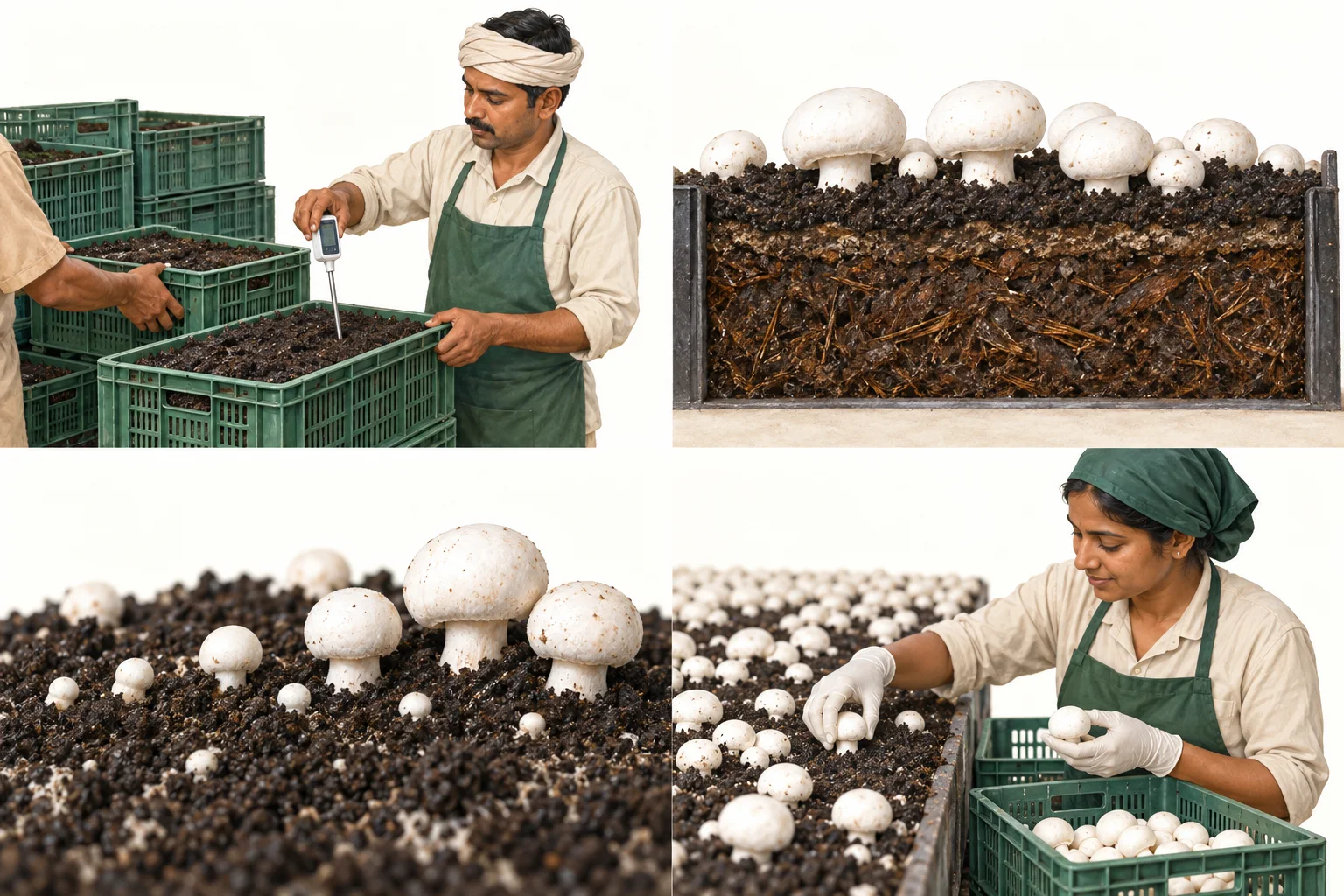
Recognise developing pins
- Notice
- Tiny pins develop at the casing surface before visible mushrooms enlarge.
- Understand
- The condition of the crop matters alongside the planned transition date.
- Try it
- Compare marked bed locations and record where development differs.
01What venting really does
Venting, also called airing, is the day you stop the mycelium spreading and ask it to make mushrooms. Until then the room is warm, wet and closed: DMR runs the case run at 23 to 25 C air, 95 per cent humidity and about 7500 ppm of carbon dioxide with no fresh air.
At venting you bring the air down to the fruiting band and open fresh air until carbon dioxide falls to 800 to 1000 ppm. The fungus reads the change and begins to knot on the casing surface. Pinheads follow within a few days.
02Evaporation is the real trigger
Mushrooms form where water is leaving the casing surface, so moving air matters as much as the thermometer.
DMR measures 31 g of water leaving one square metre of bed every hour at 17 C and 85 per cent humidity, and puts the permissible air speed over the bed at 15 cm per second. A dead corner with no air movement will not pin, even though the wall thermometer looks right. Air that is too fast and too dry crusts the casing and kills young pins.
Casing moisture at pinning is 48 to 52 per cent, judged by squeezing the casing itself.
03Read carbon dioxide from the mushroom
The crop is your second meter. DMR states that high carbon dioxide at pinning can seal the casing surface or give onion shaped mushrooms with a bulbous base and a small cap. Between pinhead and button stage, high carbon dioxide gives long stalks with small open caps.
Once pins have become buttons the cropping band is 1000 to 1500 ppm. If your pins look like onions or your stalks run long, you are venting too little, whatever the meter says.
With no meter, read the crop and write down what you see each day.
04Soft, moderate or severe airing
DMR publishes three schedules and they give different crops. Soft airing brings air to 19 C in 48 hours and 17 C in 72 hours, with carbon dioxide falling from 4000 to 1000 ppm over those 72 hours, and gives smaller, better spaced flushes. Severe airing takes air to 15 C as soon as possible and carbon dioxide below 1000 ppm in 12 hours, for a heavy first flush. Moderate airing sits between them.
Pick by your labour and your buyer, not by habit. Four DMR documents give four fruiting bands between 14 and 18 C, so do not chase one number.
Plan one venting day
- Check that white mycelium has reached the casing surface across the whole bed.
- Squeeze casing from three places and note damp, wet or crumbly.
- Write the schedule you chose, with target air temperature and hours.
- Drop temperature and open fresh air together, then feel for dead corners.
- Count the days to the first pinheads and mark trays that pinned late.
Write in your farm diary: Venting date, schedule, air and casing readings, date pins appeared, late trays.
Mistakes that cost a crop
- Venting on a date instead of on mycelium reaching the casing surface.
- Cooling the room but leaving fresh air shut, so pins turn into onions.
- Chasing a single fruiting temperature when DMR publishes four different bands.
Check yourself
Three questions, instant answersYour pins have bulbous bases and very small caps. The most likely cause is:
How long after venting does DMR expect pinheads?
Severe airing is chosen when you want:
An editorial self-check, not a certificate. Answers are not stored, not even on this device.
Words used in this lesson
- Venting or airing
- The planned change from spreading conditions to fruiting conditions.
- Pinhead
- The white knot on the casing that grows into a mushroom.
- ppm
- Parts per million, the unit for carbon dioxide in air.
- Casing moisture
- Water held by the casing layer, judged by squeezing.
References & further reading
Operating values require stage, strain, sensor and production-system context.
Open current reference