


Casing
Casing is soil, and growers treat it like any soil. It is the one layer where the crop's worst diseases live and where every pin will form.
- By the end you can explain what the casing layer does and what it does not do.
- By the end you can name the casing materials ICAR-DMR recommends in India and their limits.
- By the end you can describe how casing is wetted, treated and applied.
Four ways to treat straw before spawning
Source: ICAR-DMR 2011 manual and oyster folder. Chemical doses are deliberately not printed here.
| Method | Conditions | Best for | Limit |
|---|---|---|---|
| Hot water | 60 to 65 °C for 20 to 30 minutes | Cheap, small batches | Fuel and labour |
| Chemical soak | 10 to 12 kg straw in 90 litres water, DMR method | No heat, larger batches | Check current label approval and safety |
| Steam (pasteurisation) | 58 to 62 °C for several hours | Uniform, commercial scale | Needs a boiler and tunnel |
| Autoclave (sterilisation) | 20 psi for 1 to 2 hours | Shiitake blocks, spawn | Costly equipment |
Read numerical examples with their source, method and crop context. They are not universal operating instructions. Historical prices are not current quotations.
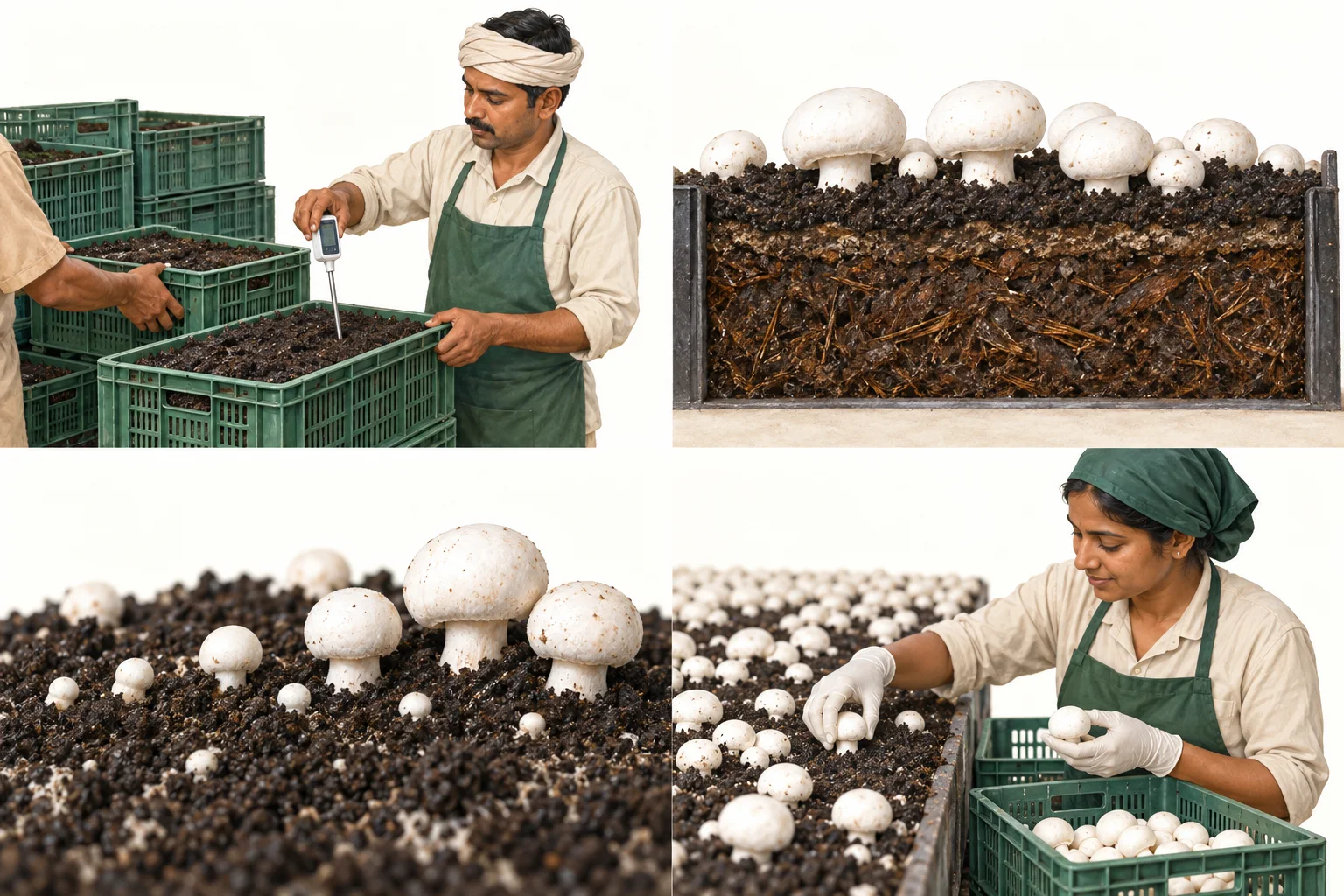
See inside the bed
- Notice
- Compost and casing are separate layers with different jobs.
- Understand
- The crop needs both a colonised food base and a suitable surface environment.
- Try it
- Record compost and casing lots separately; inspect layer uniformity.
01Why a soil layer at all
The mushroom will not fruit on bare compost. ICAR-DMR calls casing a 3 to 4 cm layer of soil laid on spawn-run compost and a prerequisite for fruiting.
It works in four ways. It holds a reserve of water the crop can draw on. It lets carbon dioxide escape from the compost below. It supports the crop physically. And its bacteria give the signal that turns spreading mycelium into pinheads. What it does not do is feed the crop. Casing carries almost no nutrition, and a rich casing grows moulds rather than mushrooms.
02Materials you can get in India
Peat is the world standard and is not available here, so ICAR-DMR lists substitutes: well decomposed farmyard manure, preferably two years old; two-year-old spent mushroom compost; composted coir pith; and mixtures of these in stated proportions. In Haryana and Punjab burnt rice husk is used along with decomposed farmyard manure. The farmer folder's seasonal mix is two-year-old farmyard manure and loam soil in equal parts.
Quality is specified rather than assumed. ICAR-DMR asks for a neutral pH of 7.0 to 7.5 and low electrical conductivity, in the range of 400 to 600 micromho.
03Treatment, because casing carries disease
Casing is the main route by which wet bubble enters a farm. ICAR-DMR reports that its resting spores survive up to three years in casing soil, so soil carried over from an old crop is a standing risk.
Wet the material to 50 to 60 percent of its water holding capacity first, because dry soil does not carry heat. ICAR-DMR then steam pasteurises at 60 to 65 °C for 6 to 8 hours. Its wet bubble folder gives a shorter, hotter schedule of 54.4 °C for 15 minutes. Chemical drenching is also documented, and current label approval must be checked.
04Applying an even layer
The 2011 manual gives two thicknesses. It defines casing as a 3 to 4 cm layer, then instructs an even 4 to 5 cm applied using 4 cm iron rings or wooden blocks. The Hindi farmer folder says 3 to 4 cm. Pick one figure, write it down and keep it the same on every bed.
Evenness matters more than the number itself. A thin patch dries first and pins early, a thick patch pins late, and the bed then carries two flushes at once. Do not press the layer down, and water it lightly rather than flooding it.
Prepare and test one batch of casing
- Source two-year-old farmyard manure and loam, or another material on the ICAR-DMR list, and sieve out stones.
- Test pH with a soil kit and record it against the 7.0 to 7.5 target.
- Wet the batch until a squeezed handful holds together without dripping, then run the treatment you can actually manage.
- Air the treated casing for two to three days, and record depth at five points when you apply it.
Write in your farm diary: Material and source, pH reading, treatment temperature and time, airing days, depth at five points.
Mistakes that cost a crop
- Reusing old casing or garden soil untreated, which carries the last crop's disease in.
- Treating dry casing, so the heat never reaches the middle of the heap.
- Laying the layer unevenly, which splits one bed into early and late patches.
Check yourself
Three questions, instant answersWhat is the casing layer for?
ICAR-DMR's stated quality limits for casing material are what?
Why treat casing soil before use?
An editorial self-check, not a certificate. Answers are not stored, not even on this device.
Words used in this lesson
- Casing
- The moist soil layer laid over spawn-run compost to bring on fruiting.
- Water holding capacity
- The most water a material can hold before it starts to drain.
- Wet bubble
- A casing-borne disease that turns mushrooms into deformed masses.
References & further reading
Operating values require stage, strain, sensor and production-system context.
Open current reference