

A practical guide to growing mushrooms in IndiaA joint educational initiative by MushroomWale & DMR Solan
MushroomFarming.in

A joint educational initiative by

MushroomWale.com
ICAR–Directorate of Mushroom Research, Solan logoICAR–DMRSolan

MushroomFarming / guide

Button Mushroom post-harvest system

Protect quality through handling, product cooling, packing, storage and transport.

Practical explanation + detailed referenceSources & review ↓
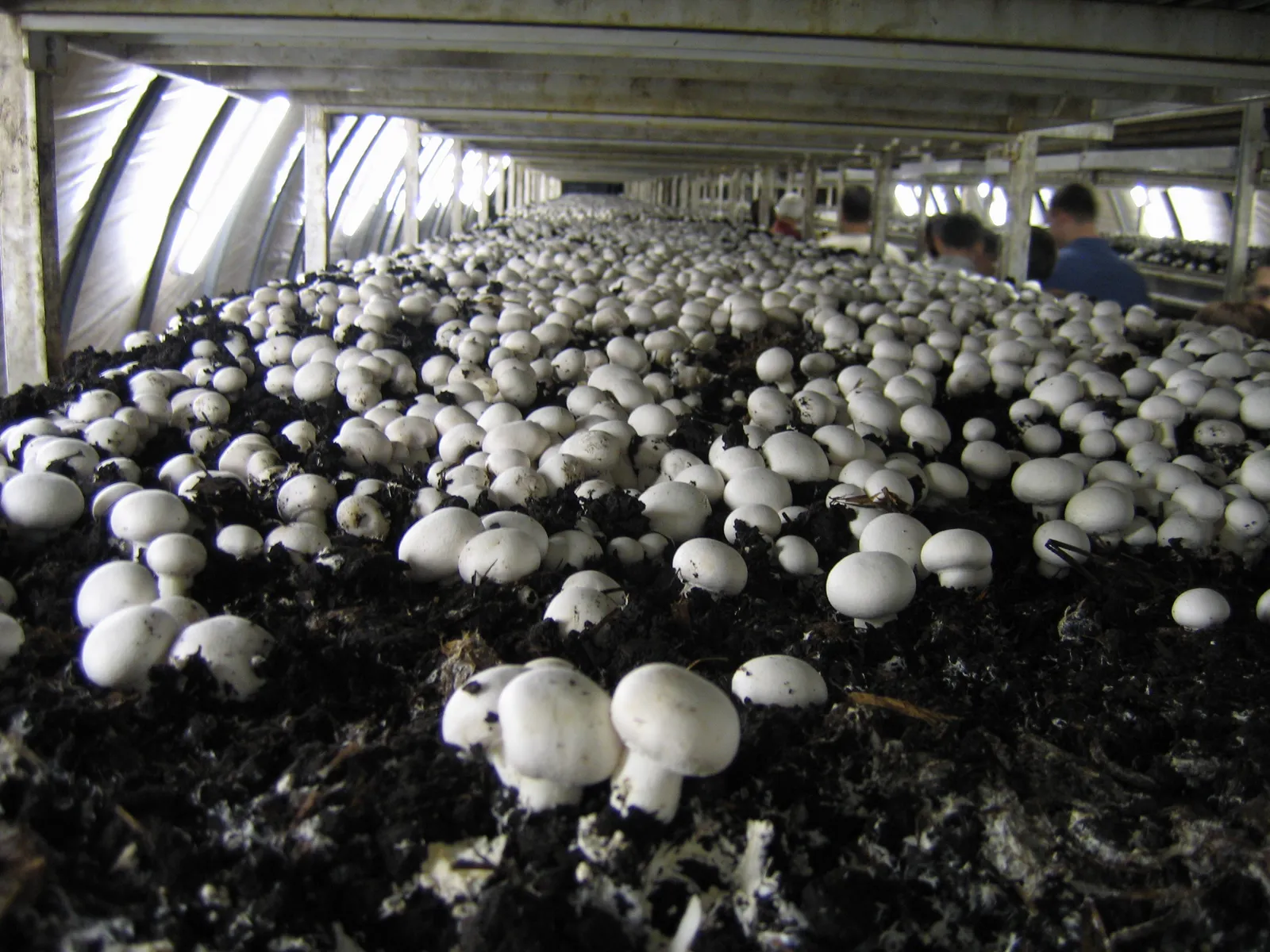
White button mushrooms on casing soil in long shelf beds inside a commercial cropping room near Eger, Hungary.
Real cultivation photograph. Read its source for location and context; it is not a universal operating specification.Andrew Bossi · CC BY-SA 2.5View full photograph ↗
On this pageChoose a section, or keep reading below

Read this in the full guide: Run a Button mushroom crop from receipt to room reset

Understand the topic

Start with the explanation.

Post-harvest control begins at picking. Product temperature, handling time, pack design and distribution conditions should be recorded as a chain rather than treated as a cold-room claim.

Part 01

Why this matters

The post-harvest chain links harvest lots to cooling, grading, packing, storage, transport and customer specification.

Illustration of careful Button mushroom harvesting into clean food-contact containers.
AI teaching illustrationHarvest and reset

Picking, grading, packing and room reset are connected tasks. A strong flush can still lose value through poor handling or delayed dispatch.

Conceptual explanation—not a real farm photograph, diagnostic finding or construction specification.
Part 02

What to look for

Build a record before making a change.

  • Product temperature
  • Time and handling events
  • Surface condition and damage
  • Package and transport environment
Part 03

How to make the next decision

Use the observation to narrow a decision, then verify the response.

  • Prioritise cooling by risk
  • Choose and validate pack format
  • Maintain lot identity
  • Reject unsupported shelf-life promises
Part 04

What to check before moving on

This topic cannot be interpreted in isolation.

  • Harvest hygiene
  • Cooling capacity
  • Clean packaging
  • Cold-chain continuity
  • Market specification
Part 05

On the farm

Start in the room with product temperature and time and handling events. Record location, stage and recent events before changing the process.

Part 06

The technical explanation

The technical model joins harvest hygiene, cooling capacity, clean packaging. Any operating value must be attached to a registered parameter, measurement location and applicable condition.

Part 07

What the evidence can tell you

This page is grounded in: Technical Bulletins; Mushroom Cultivation, Marketing and Consumption. Source provenance does not remove the need to check stage, system, date and local applicability.

Go deeper

Technical reference, records and tools.

Detailed crop-stage information, parameters, diagrams and specialist tools are kept together below. This material retains its source conditions and review limits.

Open the complete technical reference

Button Mushroom · process

Button Mushroom post-harvest system

Agaricus bisporus

Protect quality through handling, product cooling, packing, storage and transport.

Publication
Public editorial page
External review
Not yet recorded · needed from Button Mushroom technical reviewer
Updated
2026-08-22
Evidence records
2
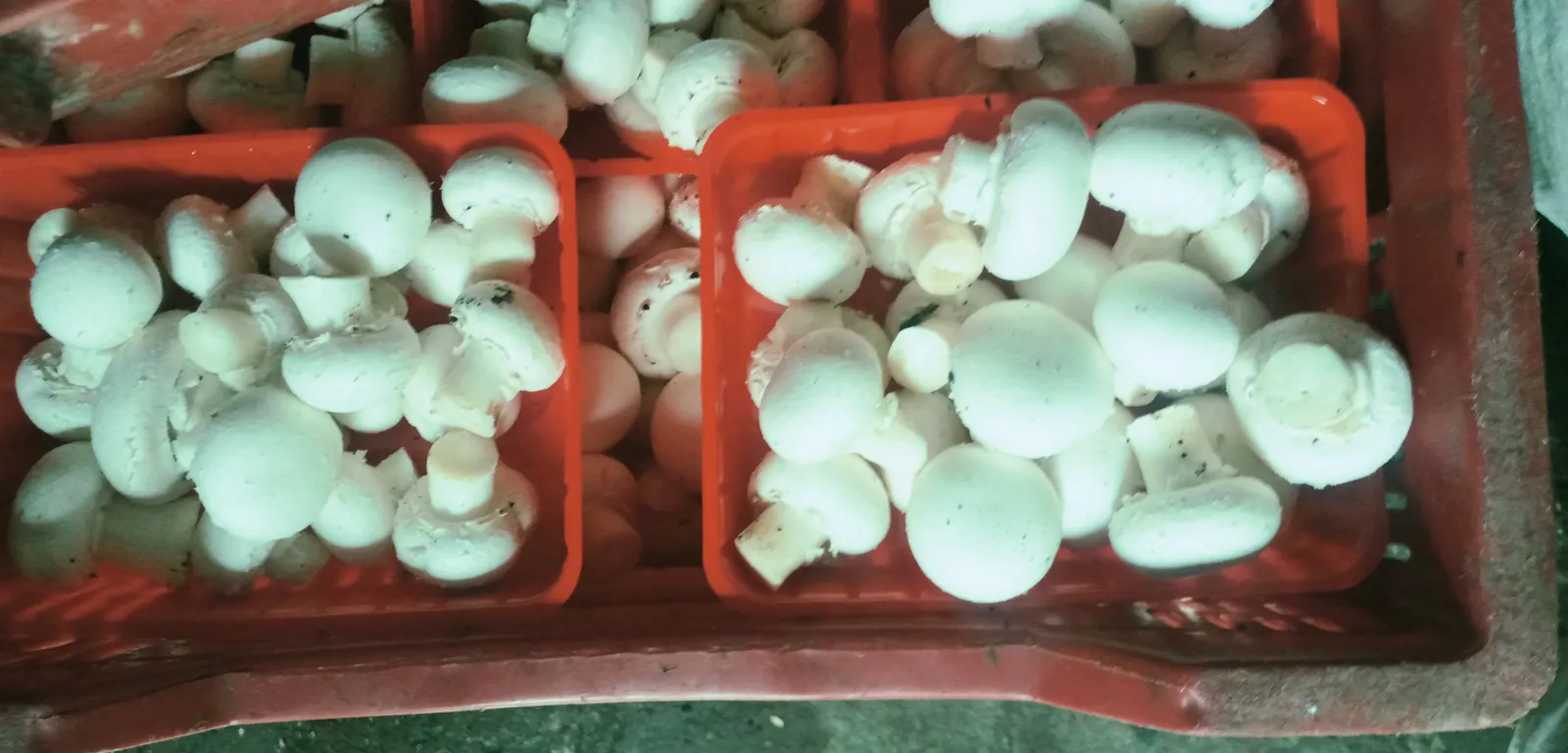
Freshly harvested white button mushrooms sorted into red plastic punnets inside a crate, Tamil Nadu, India (Tamil caption 'button mushroom').
Harvested button mushrooms graded into punnets/crates. Photo: POURNIMA D, CC BY-SA 4.0. Source

From harvest to market

Source: ICAR-DMR manual and post-harvest bulletin 2008.

  1. PickBefore the veil opens, cap 3 to 5 cm; twist and pull.Morning
  2. Trim and gradeCut the soil end; grade by size and openness.Within 1 hour
  3. CoolPulp temperature down to 4 to 5 °C; no direct ice contact.Within hours
  4. Pack200 to 400 g packs with vents; in-pack humidity 87 to 90 percent.Same day
  5. Sell2 to 3 days in a refrigerator; 12 hours at room temperature.24 to 72 hours
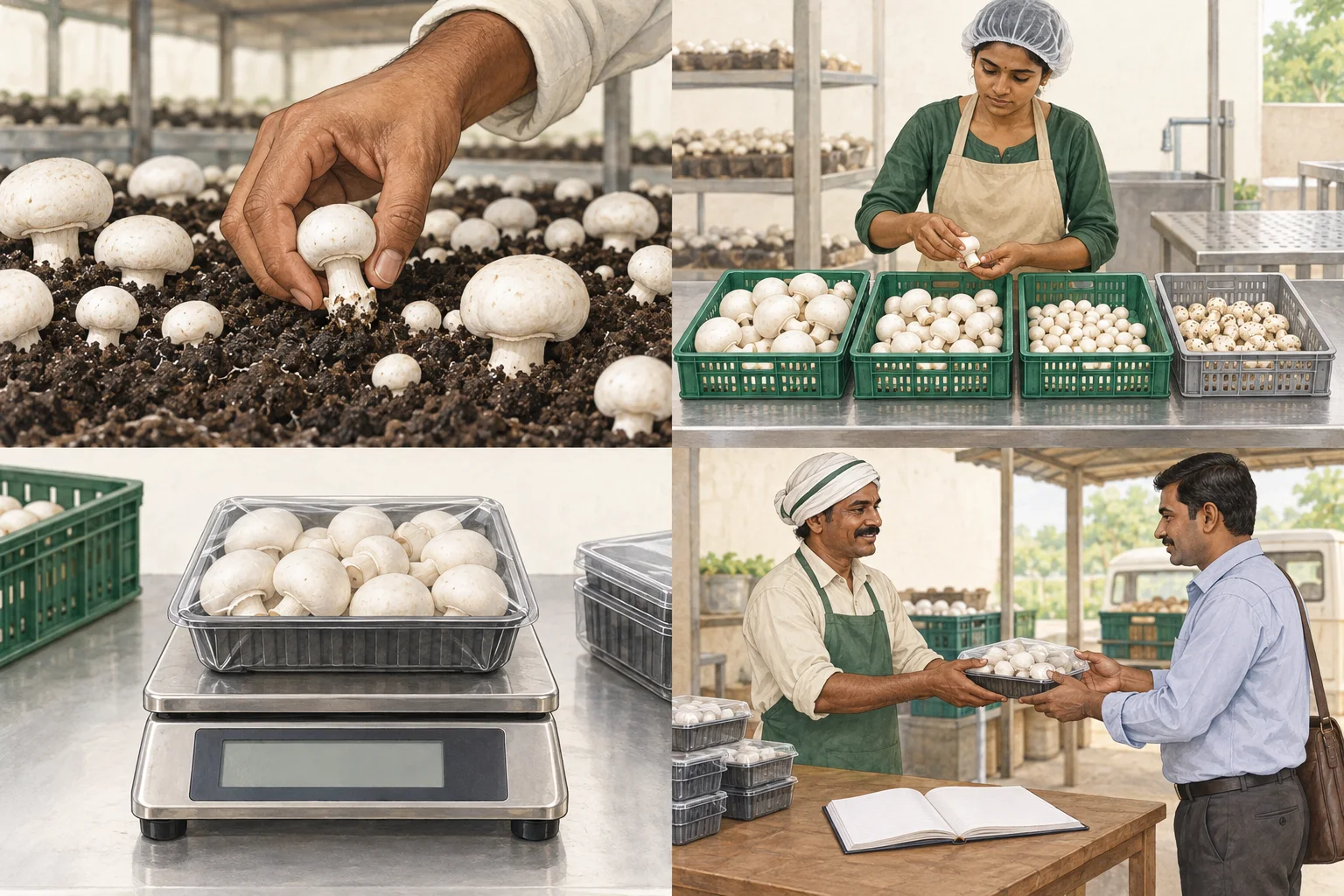
Picture → explanation → field task

From bed to buyer

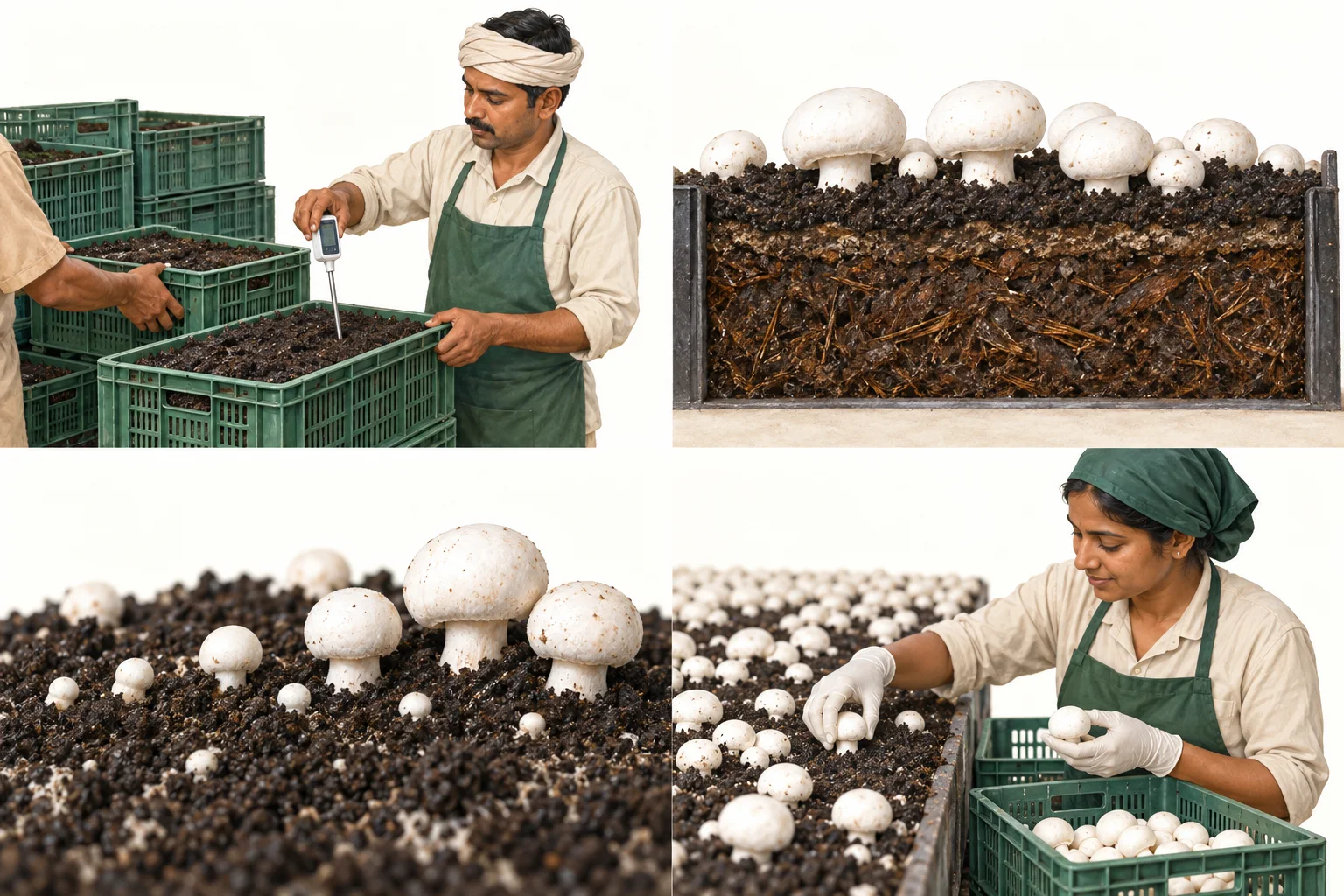
AI-generated educational illustrations. Not actual farm photographs, diagnostic evidence or construction specifications.

Generated close-up illustration of a hand picking a Button mushroom from casing.
01

Pick with the next task in mind

The harvested crop is a delicate food product. Picking affects subsequent grading and handling. Skill and clean working practices matter beyond the amount picked.

Try this on your farm

Train pickers on the crop-specific method and buyer grade. Keep harvest containers and tools clean.

Generated illustration of a grower sorting Button mushrooms into different crates.
02

Separate grades and rejects

The lot is divided before it is priced or packed. Buyer requirements determine accepted grades. The illustrated sizes are not a universal grading standard.

Try this on your farm

Weigh each accepted grade and the rejected or unsold quantity separately. Record the reason for rejection.

Generated illustration of packaged mushrooms on a scale with an intentionally blank display.
03

Know what the scale includes

The pack and the mushrooms both add weight. Net produce weight and total packed weight are different. Blank displays in this illustration are not measurement evidence.

Try this on your farm

Check the scale and record tare, net weight, pack count and batch identity under the actual buyer's specification.

Generated illustration of an Indian grower handing a packed mushroom tray to a buyer beside a ledger.
04

Record acceptance and payment

Product handover and the financial record are connected. A delivery can be accepted before its money is received. Sales revenue is not the same as cash collected.

Try this on your farm

Record accepted quantity, agreed price, returns, payment received and outstanding balance. Reconcile these with harvest records.

Stage16

Crop-stage dashboard

Post-harvest

Biological state
Harvested mushrooms continue to change and lose quality
Operator objective
Remove heat and protect the product through distribution
Handoff
Close product traceability and return the room to hygiene reset
ObserveProduct temperaturehandlingpack condition
Depends onHarvest lotcoolingclean pack route

Quick orientation

Post-harvest control begins at picking. Product temperature, handling time, pack design and distribution conditions should be recorded as a chain rather than treated as a cold-room claim.

01

System role

The post-harvest chain links harvest lots to cooling, grading, packing, storage, transport and customer specification.

02

What to observe

Build a record before making a change.

  • Product temperature
  • Time and handling events
  • Surface condition and damage
  • Package and transport environment

03

Decision framework

Use the observation to narrow a decision, then verify the response.

  • Prioritise cooling by risk
  • Choose and validate pack format
  • Maintain lot identity
  • Reject unsupported shelf-life promises

04

Dependencies and handoffs

This topic cannot be interpreted in isolation.

  • Harvest hygiene
  • Cooling capacity
  • Clean packaging
  • Cold-chain continuity
  • Market specification

05

Practical layer

Start in the room with product temperature and time and handling events. Record location, stage and recent events before changing the process.

06

Technical layer

The technical model joins harvest hygiene, cooling capacity, clean packaging. Any operating value must be attached to a registered parameter, measurement location and applicable condition.

07

Evidence boundary

This page is grounded in: Technical Bulletins; Mushroom Cultivation, Marketing and Consumption. Source provenance does not remove the need to check stage, system, date and local applicability.

Progressive depth

Go deeper without losing the field question.

PracticalWhat to notice in the room
  • Product temperature
  • Time and handling events
  • Surface condition and damage
  • Package and transport environment
TechnicalHow the interacting system is interpreted
  • Harvest hygiene
  • Cooling capacity
  • Clean packaging
  • Cold-chain continuity
  • Market specification
ResearchWhich evidence records govern this page
  • ICAR-DMR-TECH-BULLETINS
  • ICAR-DMR-CULTIVATION-MANUAL

Technical registry

The numbers for this stage, with their source.

Values are published from ICAR-DMR guidance with the stage and measuring point they apply to. A parameter still marked pending has no published Indian value yet.

BUTTON.POSTHARVEST.PRODUCT_TEMPERATURE

Product temperature after pre-cooling

4 to 5 °C

Pre-cool to a pulp temperature of 4 to 5 °C; refrigerated storage at 4 to 7 °C keeps fresh buttons for 2 to 3 days.

Stage
Post-harvest
Measured at
Representative product core or validated proxy
Crop meaning
The mushroom itself through cooling, packing and distribution.
Applicable conditions
Pack format; Cooling method; Measurement method
published sourced
Evidence and review record2 mapped sources

Sources support the page architecture and conceptual guidance. Technical values remain governed separately in the Button registry.

Tier A · institutional

Technical Bulletins

Official index for crop protection, post-harvest, farm design, spawn and developed technologies.

Accessed
2026-08-22
Publisher
ICAR-Directorate of Mushroom Research
Open original source
Tier A · foundational

Mushroom Cultivation, Marketing and Consumption

Broad cultivation, post-harvest and market context. Values are not promoted without page-level review.

Accessed
2026-08-22
Publisher
ICAR-Directorate of Mushroom Research
Open original source

Read the evidence

Sources & review.

Editorial update: 2026-08-22. Independent technical review is not recorded for this entry.

  1. Technical Bulletins

    ICAR-Directorate of Mushroom Research

  2. Mushroom Cultivation, Marketing and Consumption

    ICAR-Directorate of Mushroom Research

Reading a source is not the same as applying its instructions to every farm. Confirm species, strain, crop stage, system, region and publication date. Old chemical recommendations are not current-use instructions.

See something that needs correcting? Tell us →