


A practical guide to growing mushrooms in IndiaA joint educational initiative by MushroomWale & DMR Solan
MushroomFarming.in

A joint educational initiative by

MushroomWale.com
ICAR–Directorate of Mushroom Research, Solan logoICAR–DMRSolan

Read · Observe · Practise · Check

Compost operations: inputs, process and release

Learn the eighteen compost lessons as one batch workflow. Formulation, material structure, aeration, biological activity, treatment and release belong together; a recipe by weight alone is not a process.

Begin the walkthrough ↓
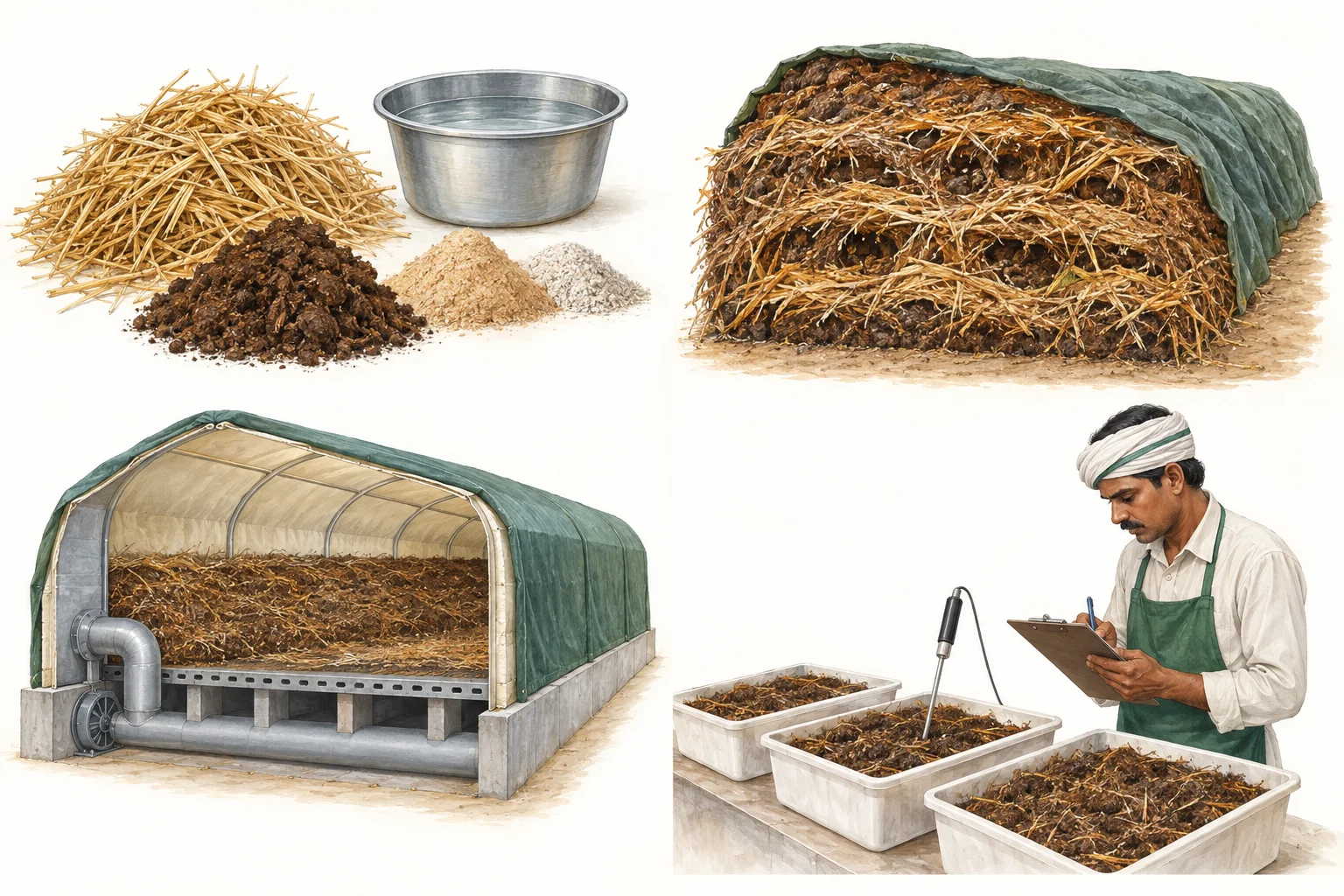
Educational illustration of straw, compost ingredients and water shown separately.
AI-generated teaching illustrationConceptual learning scene, not a diagnostic photograph or construction specification.

Before you begin

  • One complete, applicable compost method
  • Ingredient identities, weights and moisture basis
  • Batch map, instrument locations and operator release criteria

Use the linked crop and technical lessons for method-specific detail. Practical work involving chemicals, pressure, electrical equipment or uncertain crop health requires competent supervision; illustrations are not operating specifications.

Educational illustration of straw, compost ingredients and water shown separately.

Conceptual AI teaching scene

Stage 1

Make the material balance explicit

The moisture in received material contributes to its weight. Comparing wet tonnes without identifying water and dry matter can change the formulation unintentionally. Ingredient identity and variability matter as well as arithmetic.

Put it into practice
For each input, write wet weight, moisture basis, dry matter if measured, supplier and lot. Label estimates as estimates.
Check your work
Every percentage has a denominator and every weight has a unit. Unmeasured moisture is not presented as laboratory data.
Conceptual compost heap cutaway showing straw structure and internal spaces.

Conceptual AI teaching scene

Stage 2

Connect structure with the process

A compact wet pocket and a looser outer region do not experience identical conditions. Treat turning, loading and aeration as part of the chosen method, not as interchangeable calendar events.

Put it into practice
Draw the pile or bunker and mark representative observation positions. Record the actual operation and readings together.
Check your work
The batch record shows spatial differences and deviations rather than only the most favourable central value.
Conceptual cutaway of a compost conditioning tunnel with material above an air plenum.

Conceptual AI teaching scene

Stage 3

Distinguish Phase II objectives

Pasteurisation, conditioning and cooling serve different functions. The process must be assessed in the loaded material, not only from an air display. Completion of one heating period is not automatic permission to spawn.

Put it into practice
Match the process record to its stages. Identify the measurements used for release and the person responsible for checking them.
Check your work
A failed or missing release criterion leads to a hold and assessment. Deliberate smelling is not an ammonia test.
Illustration of an operator recording a compost probe reading beside material samples.

Conceptual AI teaching scene

Stage 4

Close the batch record

Receiving results and later crop performance belong to the same lot history. When a crop problem appears, a traceable record lets the team compare batches without guessing which ingredients or process changes were involved.

Put it into practice
Attach transfer records, release evidence, delivery conditions and the receiving farm’s observations to one lot number.
Check your work
Another operator can reconstruct the batch history without relying on memory.

Common mistakes—and the better question

A hot reading proves the whole batch is ready
Review representative locations and the full release criteria.
Mixing steps from different compost methods
Follow one complete method and document qualified review of substitutions.

A task to complete, not just a page to read

Review a deliberately incomplete batch sheet

Remove the moisture basis, one sensor location and the release sign-off from a training copy. Identify what conclusions can no longer be made.

Bring back this evidence

A corrected record with missing evidence requested, rather than guessed.

Completing this self-guided task is not verification of practical competence. Review it with a suitable instructor before relying on it for farm operation.

Study the detailed lessons in order

Compost Operator. Every lesson keeps its explanations, practical exercise, mistakes and self-checks.

  1. Raw MaterialsEvaluate material role, variability, condition and evidence without copying a universal formula.
  2. FormulationExplain formulation as a governed balance of declared materials and assumptions.
  3. Water & MoistureSeparate water addition, moisture measurement, distribution and material response.
  4. MicrobiologyConnect biological activity to heat, selectivity and process transitions without oversimplification.
  5. Phase IInterpret mixing, aeration, heat and material change through the actual process system.
  6. Bunker OperationUnderstand airflow path, resistance, fill condition and monitoring before changing equipment.
  7. AerationDistinguish fan rating from delivered airflow and inspect distribution evidence.
  8. Phase IISequence equalisation, pasteurisation, conditioning and cooling with release boundaries.
  9. PasteurizationExplain the process purpose and why time, distribution and measurement context matter.
  10. ConditioningRelate ammonia conversion to biological and process evidence rather than smell alone.
  11. AmmoniaAsk for stage, test method, sample location and cooling status before a readiness decision.
  12. Tunnel OperationRead tunnel, floor, fan, pressure and compost as one operating system.
  13. SensorsCheck instrument, placement, sampling and calibration before trusting a displayed value.
  14. Quality ControlCombine observations, samples, process records and release criteria transparently.
  15. SamplingCollect representative evidence without treating one convenient point as the whole batch.
  16. TroubleshootingGenerate competing causes, negative evidence and the next measurement before action.
  17. HygieneControl movement and contamination pathways without unsafe chemical improvisation.
  18. Batch RecordsRecord inputs, process states, deviations and decisions so outcomes remain auditable.

Keep the field guidance beside the lesson

Open the main subject guide →Compost FormulationPhase I CompostingPhase II CompostingCompost Quality Control

Sources, scope and review

Editorial learning material; no independent technical review is claimed. The tasks are original teaching exercises. Source-specific numerical schedules remain in the detailed lessons with their context, rather than being turned into universal instructions here.