


Formulation
A compost formula is not a recipe handed down by a neighbour. It is arithmetic on the materials standing in your own yard this week.
- By the end you can state the nitrogen and carbon to nitrogen targets at stacking.
- By the end you can compute the nitrogen of a mix from dry weights.
- By the end you can say what goes wrong outside the nitrogen band.
Formulation as a sequence: declare materials, assume a nitrogen value, compute, adjust, record.
- List materialsEvery input with wet weight and assumed moisture.
- Convert to dry weightRemove water so all materials compare on one basis.
- Compute mix nitrogenMultiply, add, then divide by total dry weight.
- Adjust and recordMove one material only, and note every assumption.
Read numerical examples with their source, method and crop context. They are not universal operating instructions. Historical prices are not current quotations.
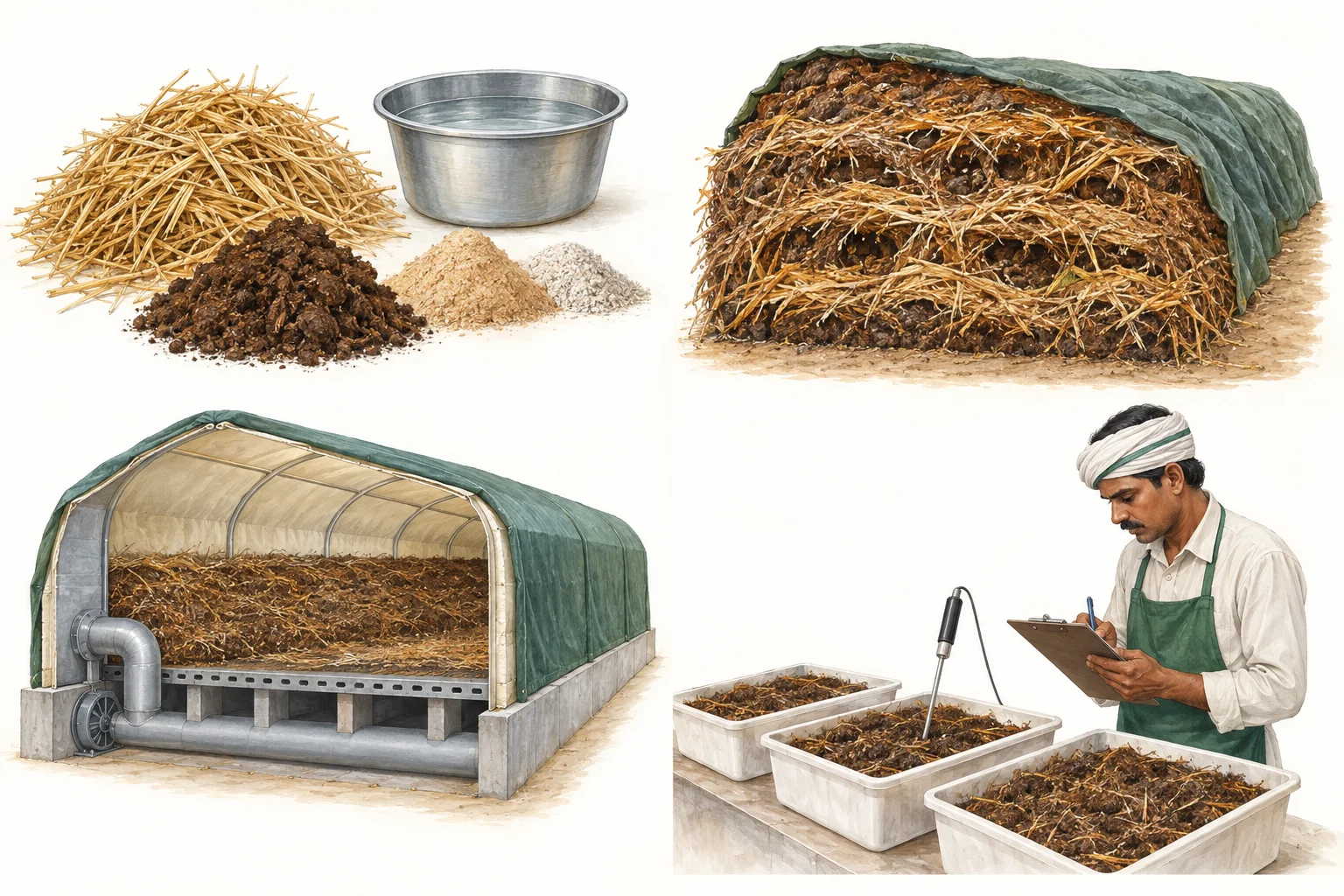
Start with the inputs
- Notice
- Wet weight is not the same as dry matter.
- Understand
- Two equally heavy ingredient loads can contain different amounts of dry material.
- Try it
- Record input identity, moisture basis and the formulation being followed.
01The two targets
DMR sets the compounding mixture at 1.5 to 1.75 per cent nitrogen on a dry weight basis at stacking. The mineral table in the same chapter prints 1.5 to 1.8 per cent, so treat the upper edge as soft and never round upward on purpose.
The second target is the carbon to nitrogen ratio, written C:N. It is adjusted to 25 to 30 parts carbon for each part nitrogen at stacking, and falls to about 16:1 in finished compost. Both targets describe one mix from two sides: how much protein food is present, and how much energy food sits around it.
02Published Indian formulae
The formulation DMR calls widely used in India, for the short method, is wheat straw 1000 kg, chicken manure 500 kg, urea 15 kg, wheat bran 75 kg and gypsum 30 kg. The DMR indoor method uses wheat straw 1000 kg, poultry manure 500 kg, wheat bran 70 kg, cotton seed cake 20 kg and gypsum 40 kg.
As a rule of thumb DMR gives 0.7 to 0.8 tonne of chicken manure and 0.05 to 0.15 tonne of gypsum per tonne of straw, gypsum going in at the third turning. Older formulae also list BHC or lindane, an insecticide now banned in India. Read those lines as history.
03Doing the arithmetic yourself
Take each material, convert its wet weight to dry weight using its moisture, multiply the dry weight by its nitrogen per cent, and add the results. Divide that total by the total dry weight and you have the nitrogen of your mix.
If the answer lands below the band, add a nitrogen carrier such as bran, an oil cake or a nitrogen fertiliser. If it lands above, add straw rather than cutting manure to nothing, because straw is also your structure. Write the assumed nitrogen of every material beside the sum.
04Outside the band
Below 1.5 per cent nitrogen, DMR reports that the compost does not ferment properly, the heap may not pass 55 to 60 degrees Celsius, and moulds such as Stachybotrys move in.
Above 1.75 per cent the ratio is wrong, more nitrogen escapes as ammonia, and the yellow mould Sepedonium often follows and can cut yield badly. The method also shows in the finished nitrogen: DMR reports about 1.75 to 2.0 per cent for long method compost, 2.0 to 2.2 for the short method and 2.2 to 2.5 for indoor compost.
Rebuild your own formula on paper
- Write your last batch as weights of straw, manure, bran and gypsum.
- Beside each, write the nitrogen per cent you assume and its source.
- Work out the mix nitrogen on a dry weight basis.
- Compare with 1.5 to 1.75 per cent and adjust one material.
- File the sheet with the batch number for comparison.
Write in your farm diary: Batch number, each material with wet weight, assumed moisture and nitrogen, computed mix nitrogen, and what changed.
Mistakes that cost a crop
- Copying weights from a bulletin while using manure of unknown nitrogen.
- Pushing nitrogen higher for a bigger crop; it leaves as ammonia instead.
- Leaving out gypsum to save money; the mass goes greasy and airless.
Check yourself
Three questions, instant answersAt stacking, DMR adjusts C:N to about:
Your mix computes to 2.1 per cent nitrogen. Expect:
An old published formula lists BHC. You should:
An editorial self-check, not a certificate. Answers are not stored, not even on this device.
Words used in this lesson
- Compounding mixture
- All materials together at stacking, before fermentation begins.
- C:N ratio
- Parts of carbon for each part of nitrogen in the mix.
- Nitrogen carrier
- A material added mainly for its nitrogen, such as bran or oil cake.
References & further reading
A lesson cannot replace batch measurements or plant-specific procedures.
Open current reference