


Pasteurization
Pasteurisation is not sterilisation. You are killing pests and weed moulds while deliberately keeping alive the organisms that finish the compost for you.
- By the end you can state what the heat must kill and what it must spare.
- By the end you can give the temperature, hold time and upper limit DMR publishes.
- By the end you can say where the measurement must be taken.
Four ways to treat straw before spawning
Source: ICAR-DMR 2011 manual and oyster folder. Chemical doses are deliberately not printed here.
| Method | Conditions | Best for | Limit |
|---|---|---|---|
| Hot water | 60 to 65 °C for 20 to 30 minutes | Cheap, small batches | Fuel and labour |
| Chemical soak | 10 to 12 kg straw in 90 litres water, DMR method | No heat, larger batches | Check current label approval and safety |
| Steam (pasteurisation) | 58 to 62 °C for several hours | Uniform, commercial scale | Needs a boiler and tunnel |
| Autoclave (sterilisation) | 20 psi for 1 to 2 hours | Shiitake blocks, spawn | Costly equipment |
Read numerical examples with their source, method and crop context. They are not universal operating instructions. Historical prices are not current quotations.
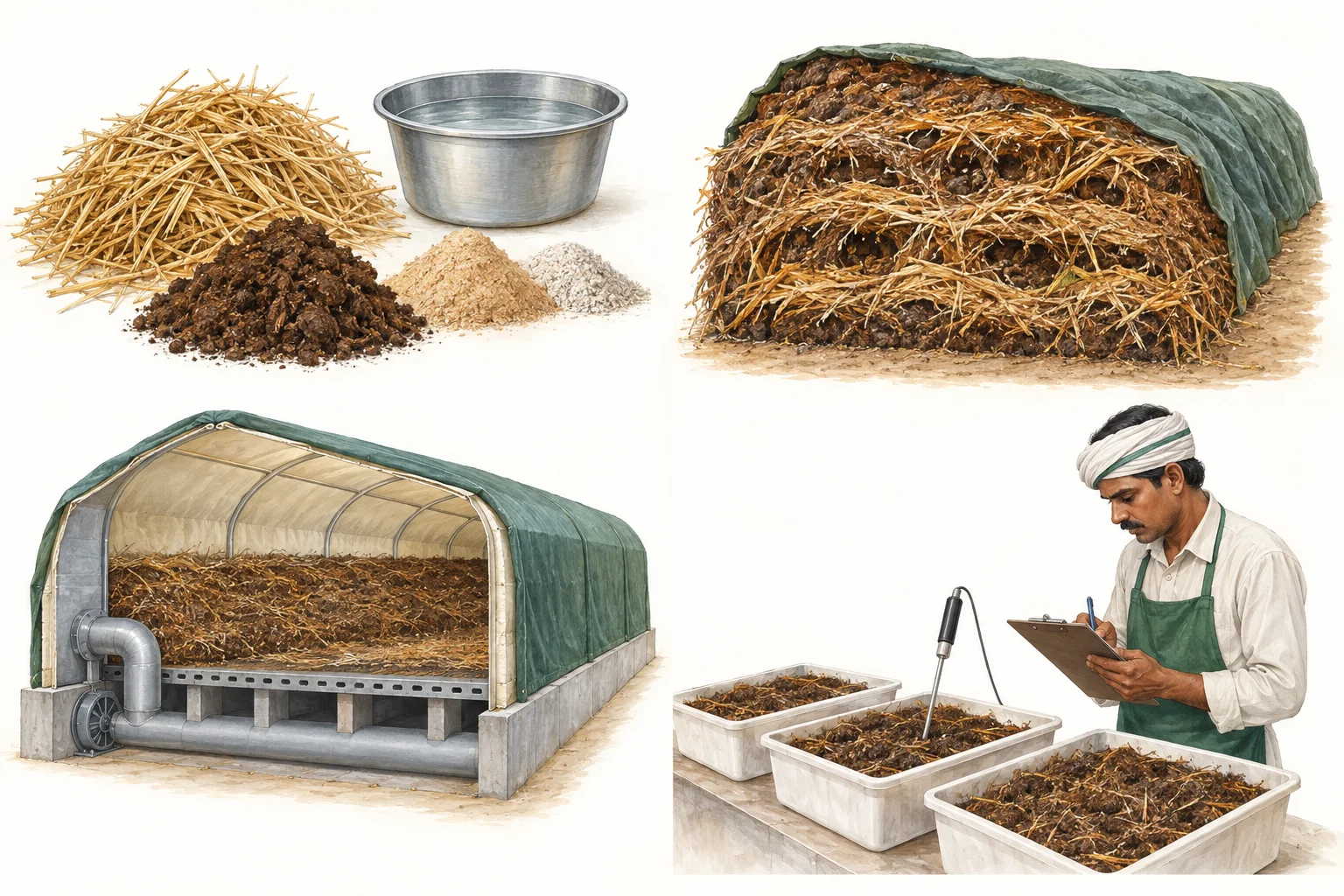
Understand the tunnel
- Notice
- Air must pass through the loaded material.
- Understand
- Pasteurisation, conditioning and cooling have distinct purposes.
- Try it
- Use the validated process and release criteria, not an odour test.
01What the heat is for
Compost arriving from Phase I carries fly eggs, mites, nematodes, and the spores of competitor moulds and weed fungi. A controlled heat treatment kills them. It is not meant to kill everything: the thermophilic fungi and bacteria that convert ammonia in the next stage have to survive, or the compost will never become selective.
That is the whole balance of the operation. Too little heat and the competitors ride into the growing room with the compost. Too much and you sterilise away the organisms that make Phase II work at all.
02A narrow window
DMR is specific: compost is pasteurised properly when held at 58 to 59 degrees Celsius for 4 to 6 hours. The temperature is reached by narrowing the dampers and letting the mass heat itself at about 1 degree per hour, which takes roughly 10 to 12 hours.
The ceiling is firm. Above 60 degrees, DMR warns, all kinds of organisms are killed, including the thermophilic fungi essential for Phase II. The same manual lists temperature above 60 degrees during pasteurisation, together with poor aeration, as the trigger for olive green mould.
03Where you measure decides everything
A hold is only real at the coldest point of the mass. Air temperature in the tunnel reaches the target long before the compost does, and a probe near the door reads differently from one in the middle.
DMR keeps the difference between air, compost and plenum within 3 degrees Celsius, which is itself a check on whether any single probe can be trusted.
- Probe the compost, never the air, for the hold.
- Both ends and the centre, at two depths.
- Start the clock on the coldest probe.
- Log every probe every hour through the hold.
04When there is no steam line
Seasonal growers using long method compost often have no boiler. DMR publishes a chemical alternative applied at the last turning, after which the compost is heaped and covered with a polythene sheet for two days. Products and approvals change, so read the current label before using anything and never scale a published figure yourself.
DMR trial data on that treatment is useful context: 18.1 kg of mushrooms per 100 kg compost against 10.5 kg for a water sprayed control. Casing soil is a separate job, steamed at 60 to 65 degrees for 6 to 8 hours.
Prove your hold on the next batch
- Place four compost probes: both ends, centre, two depths.
- Write the time the coldest probe first reads 58 degrees.
- Log all probes hourly and mark anything above 60 degrees.
- Stop the hold only after the coldest probe completes its hours.
- Record the cooling rate as you move into conditioning.
Write in your farm diary: Probe positions, hourly readings, hold start and end by the coldest probe, excursions and cooling rate.
Mistakes that cost a crop
- Using the tunnel air reading as proof while the compost core lags behind.
- Pushing to 62 or 63 degrees for safety, killing the flora Phase II needs.
- Copying a chemical treatment strength from an old bulletin without checking approval.
Check yourself
Three questions, instant answersThe hold time is counted from when:
Compost held at 63 degrees for six hours is:
Steaming at 60 to 65 degrees for 6 to 8 hours is DMR guidance for:
An editorial self-check, not a certificate. Answers are not stored, not even on this device.
Words used in this lesson
- Pasteurisation
- Controlled heating that kills pests and competitors while sparing useful thermophiles.
- Sterilisation
- Killing every living thing, which is not what compost needs.
- Hold time
- How long the coldest part of the mass stays at the target temperature.
- Weed fungus
- Any mould competing with the mushroom for the same compost.
References & further reading
A lesson cannot replace batch measurements or plant-specific procedures.
Open current reference