


Batch Records
Every crop failure is investigated backwards. If the batch record stops at the tunnel door, the investigation stops there, and the batch comes back next month.
- By the end you can list what belongs in a compost batch record.
- By the end you can write an entry that someone else can act on.
- By the end you can carry a batch number forward into the crop.
The record follows the batch from raw lots to the cropping room.
- IdentifyGive the batch a number before mixing starts.
- Log inputsRecord lots, weights and every substitution.
- Log processNote states, deviations, actions and results.
- Hand overCarry the number into the cropping record.
Read numerical examples with their source, method and crop context. They are not universal operating instructions. Historical prices are not current quotations.
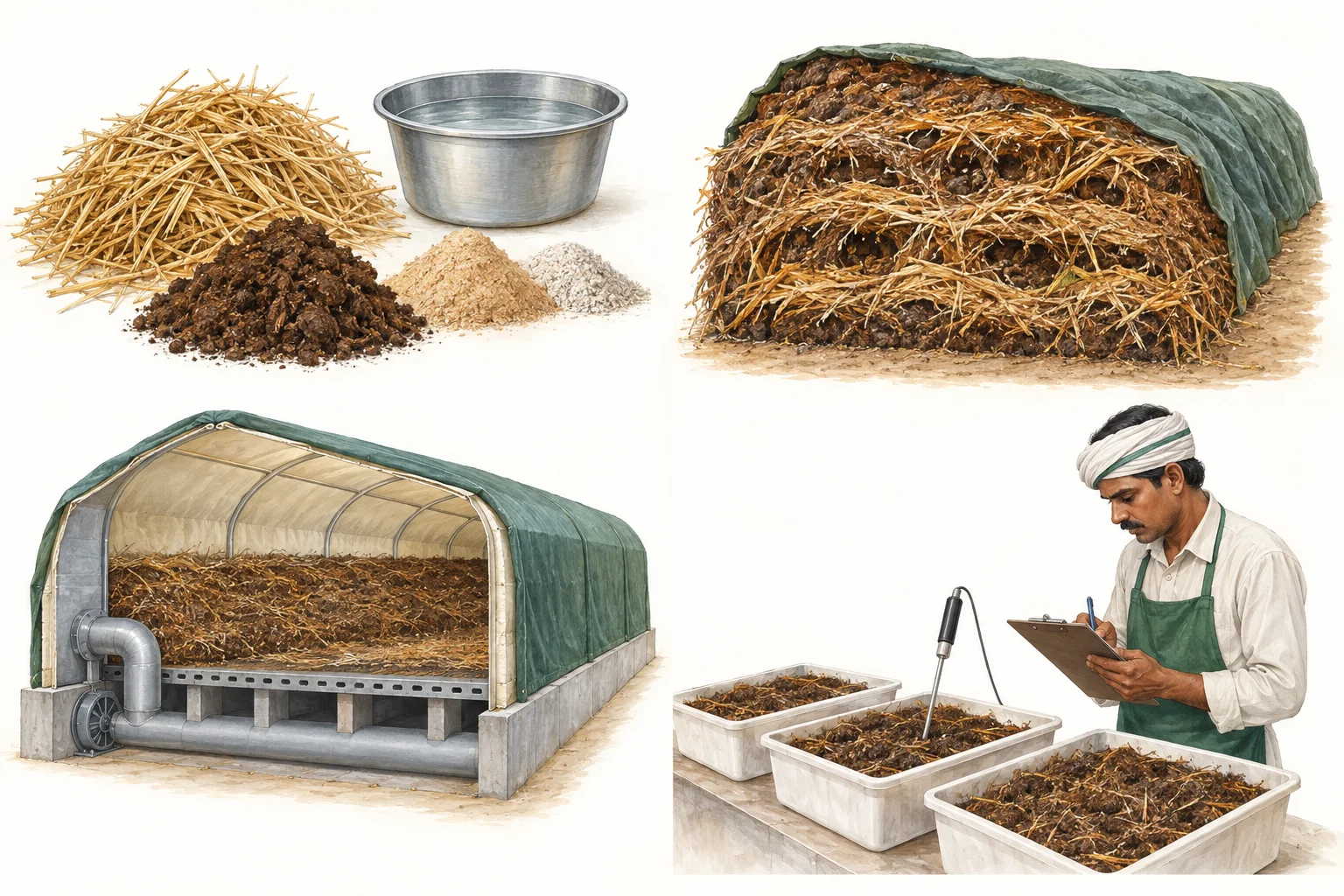
Release with evidence
- Notice
- The batch record brings measurements and observations together.
- Understand
- The calendar alone cannot prove compost is ready for spawning.
- Try it
- Hold unresolved batches for a competent release assessment.
01What a batch record holds
A batch record is not a temperature chart. It holds five things: the identity of the batch, the inputs that went into it, the process it passed through, every deviation from plan, and the decisions people took.
Each entry carries the same fields, and the last two are the ones farms skip. Stage. Measurement, with its point. Equipment state, meaning what the fan and dampers were doing. The deviation. The action. The reason for it. And the result, written later when you went back and looked. A record with actions but no results teaches nobody anything.
02Start with what you actually used
Write down the lots, not the recipe. Which straw, from which supplier, how many bales and how old. Which manure, from where, arriving when. The weights you actually put on the heap, including the substitution you made when the cotton seed cake did not arrive.
Mass tells the truth later. DMR reports that a tonne of straw yields about 1.75 to 2.0 tonnes of long method compost, 2.0 to 2.5 by short method and 3.0 to 3.5 by indoor bunker. If your ratio drifts far from the method you ran, either the water or the record is wrong.
03The process states worth logging
Log the states a decision hangs on rather than everything a controller can print. The fill, in tonnes and kilograms per square metre, since DMR works to 900 to 1,000 kg. The levelling off at 45 to 48 °C. The peak at 58 to 59 °C and the hours held there. The conditioning hold, the days it ran, and the ammonia evidence that ended it.
Beside each, write the fan and damper state and the initials of the person on shift. Two identical curves with different people and weather are not the same batch.
- Fill
- Levelling
- Peak
- Conditioning
- Release
04Carry the number forward
The batch number should not die at spawning. It belongs on the room sheet, the spawn lot and the yield record, because that is the only way a third flush problem traces back to a formulation change six weeks earlier.
Paper is fine for a small unit if it is complete and legible and kept where the next shift can read it. What matters is that the record was written while the work happened. A record filled in from memory on Sunday evening is a story, and stories cannot be investigated.
Rebuild your batch sheet
- Print one sheet per batch with a number at the top.
- Add rows for lots and weights actually used, not the standard recipe.
- Add a deviation column beside every process row.
- Write the result of each action a day later, in the same row.
Write in your farm diary: Batch number, input lots and weights, process states with times, deviations, actions with reasons, results.
Mistakes that cost a crop
- Recording the recipe instead of the weights and substitutions actually used.
- Filling the sheet from memory at the end of the week, when the detail has gone.
- Ending the record at spawning, so no crop problem traces back to the compost.
Check yourself
Three questions, instant answersThe field most often missing from a farm record is:
DMR reports that one tonne of straw yields, by long method:
A batch number should be carried:
An editorial self-check, not a certificate. Answers are not stored, not even on this device.
Words used in this lesson
- Deviation
- Any point where the batch did not follow the plan.
- Batch identity
- The number that ties inputs, process, release and crop together.
- Mass balance
- Comparing compost produced against straw used, as a check.
References & further reading
A lesson cannot replace batch measurements or plant-specific procedures.
Open current reference