


Sampling
A laboratory can report a number to two decimal places from a sample that never represented your batch. Precision on a bad sample is only confident error.
- By the end you can say what question a sample is meant to answer.
- By the end you can choose points that represent a whole tunnel.
- By the end you can label a sample so its result stays usable.
Sampling in four steps, from the question to a filed result.
- DefineState the decision the sample must support.
- SelectPick points across length, width and depth.
- SeparateComposite for the batch, keep suspect zones apart.
- SealLabel, close and record the sample at once.
Read numerical examples with their source, method and crop context. They are not universal operating instructions. Historical prices are not current quotations.
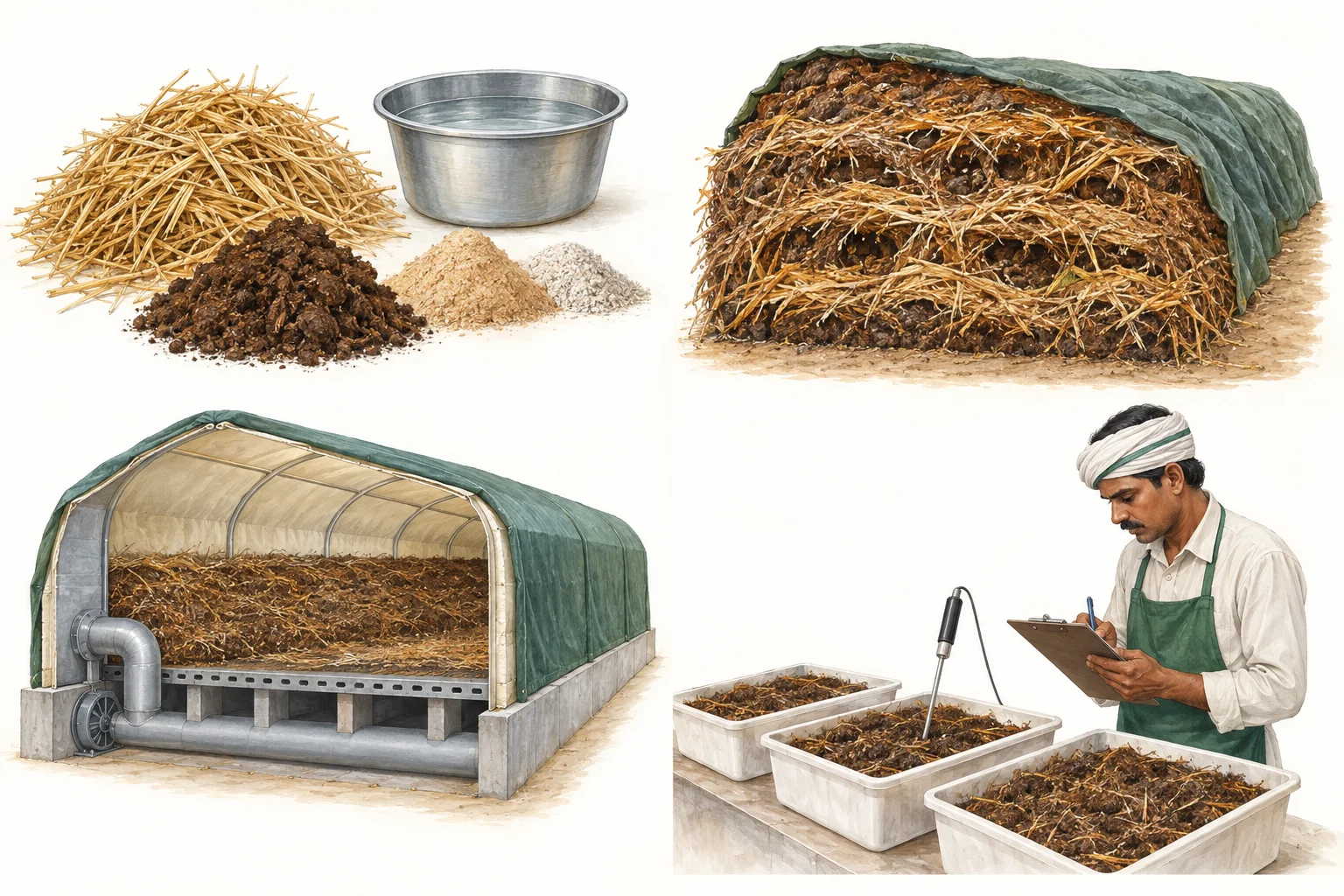
Release with evidence
- Notice
- The batch record brings measurements and observations together.
- Understand
- The calendar alone cannot prove compost is ready for spawning.
- Try it
- Hold unresolved batches for a competent release assessment.
01Ask the question first
Two different jobs get called sampling. One asks whether the batch may be released. The other asks why one corner behaves badly. They are not taken the same way.
For a release question you want a composite, a single mixed sample built from equal amounts taken all over the load, because you want the batch average. For a diagnosis you want the suspect zone kept separate and labelled, because the whole point is the difference. Mix a bad zone into the composite and it disappears into an average that looks acceptable while the crop fails.
02Where the variation lives
DMR fills a bulk tunnel to 2 to 2.2 metres, so depth alone creates three different environments, and the far end rarely matches the door end. Take from front, middle and back, at top, middle and bottom, before calling a sample representative.
Timing matters as much as position. Moisture and ammonia both change while the mass is cooling, so a sample taken at noon and one taken at midnight answer different questions. Fix the stage at which you sample, write it down, and keep it the same for every batch so the numbers can be compared.
03Composite without hiding a failure
Build a composite properly. Take an equal amount from every chosen point, empty them into one clean container, mix by hand with a clean tool, then reduce the pile by quartering until you have the quantity the method needs.
Three habits ruin it. A larger scoop from the easy points weights the result toward them. The loader bucket adds whatever it carried last. A sample left open while you finish the round loses the very moisture you are testing. Keep any suspect zone out of the composite and send it as its own labelled sample.
04Label, seal and record
A sample without a label is compost in a bag. Write batch number, point, depth, date, time, stage and compost temperature on the container, not only in a notebook, and seal it at once.
Record what you asked the laboratory for and by which method, because a pH figure depends on the water ratio and the procedure. When the result returns, file it against the same batch number as the process curve. A result that cannot be traced to a batch, a point and a stage teaches you nothing for the next fill.
Sample one batch properly
- Write the decision the sample must support before you touch the compost.
- Mark nine points on your tunnel sketch: three positions at three depths.
- Take equal scoops with a clean tool and mix in a clean container.
- Seal, label with batch, point, depth, stage and time, and send the same day.
Write in your farm diary: Sample identity, the nine points, stage and time, method requested, and the result.
Mistakes that cost a crop
- Taking one convenient grab near the door and reporting it as the batch.
- Mixing a known bad zone into the composite so the average looks acceptable.
- Leaving samples open or unlabelled, which destroys the moisture result first.
Check yourself
Three questions, instant answersA cold corner is suspected. The right sample is:
A composite sample is built from:
How many sampling points does a tunnel need?
An editorial self-check, not a certificate. Answers are not stored, not even on this device.
Words used in this lesson
- Composite sample
- One sample mixed from equal amounts taken at many points.
- Grab sample
- A single scoop from one point, useful only for that point.
- Quartering
- Reducing a mixed pile by halving it repeatedly, keeping it representative.
References & further reading
A lesson cannot replace batch measurements or plant-specific procedures.
Open current reference