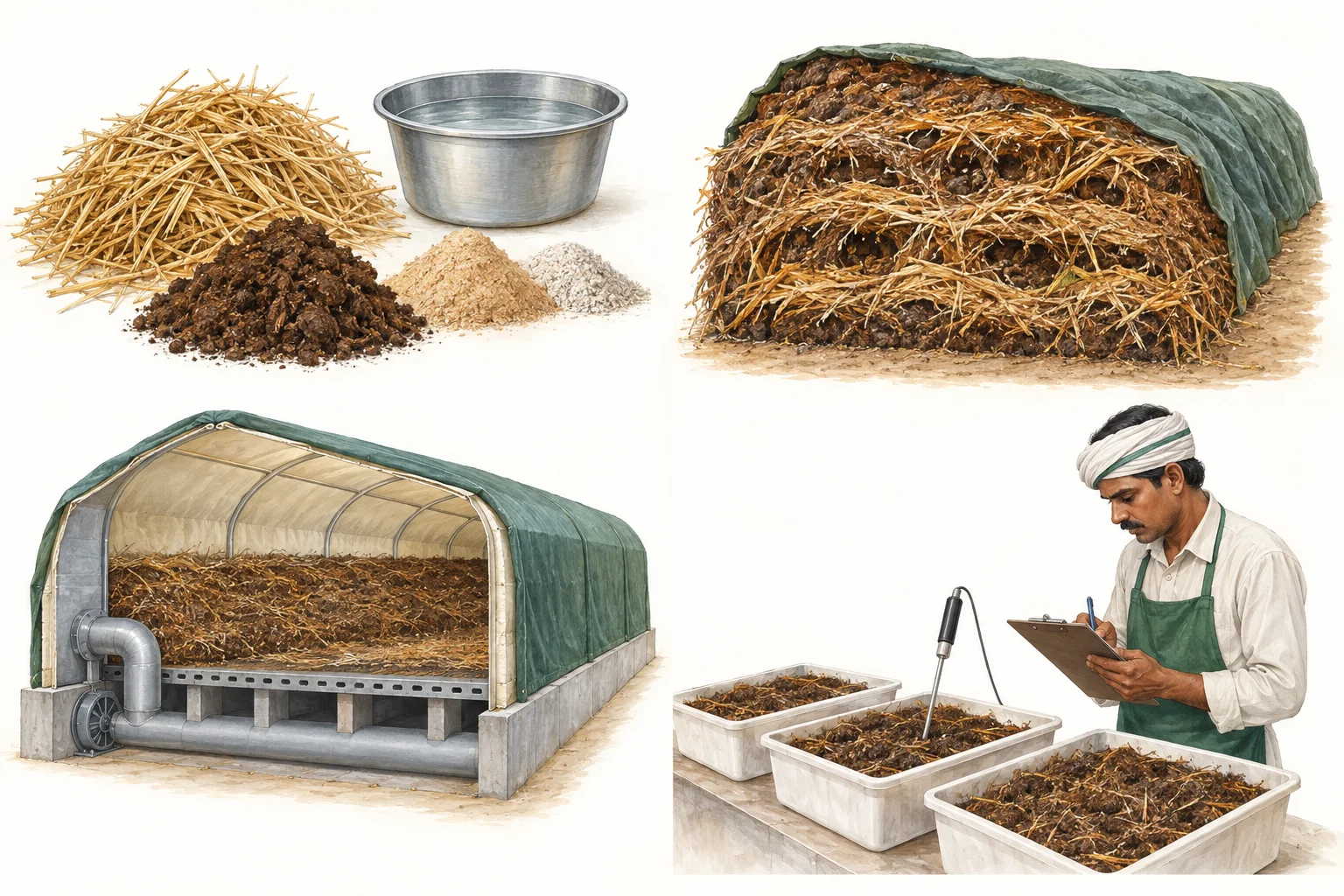
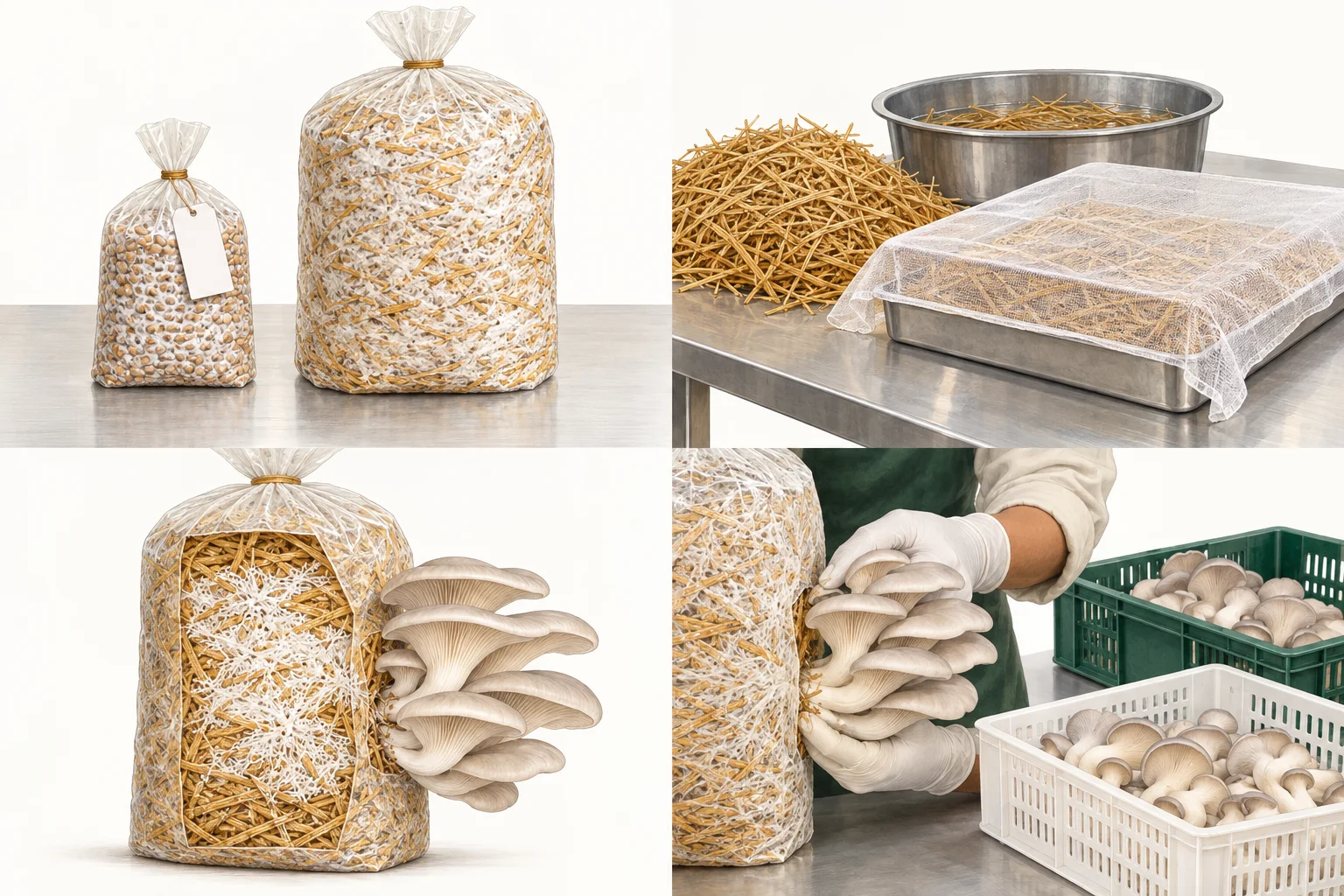
Choose the exact Pleurotus species and method, then connect substrate preparation, inoculation, bag development and harvesting. The three pictured stages explain a sequence, not a fixed number of days.
Read one page, study its picture, then turn to the next. Use Contents whenever you want a particular topic.
Start here
Practical workbook
What you need before starting
Keep these beside you while you learn. You do not need to buy equipment just to read this book.
01
Species/strain identity and applicable supplier protocol
02
One chosen substrate-treatment and bag method
03
Clean work area, batch labels and buyer specification
Understand the basics
Look closely
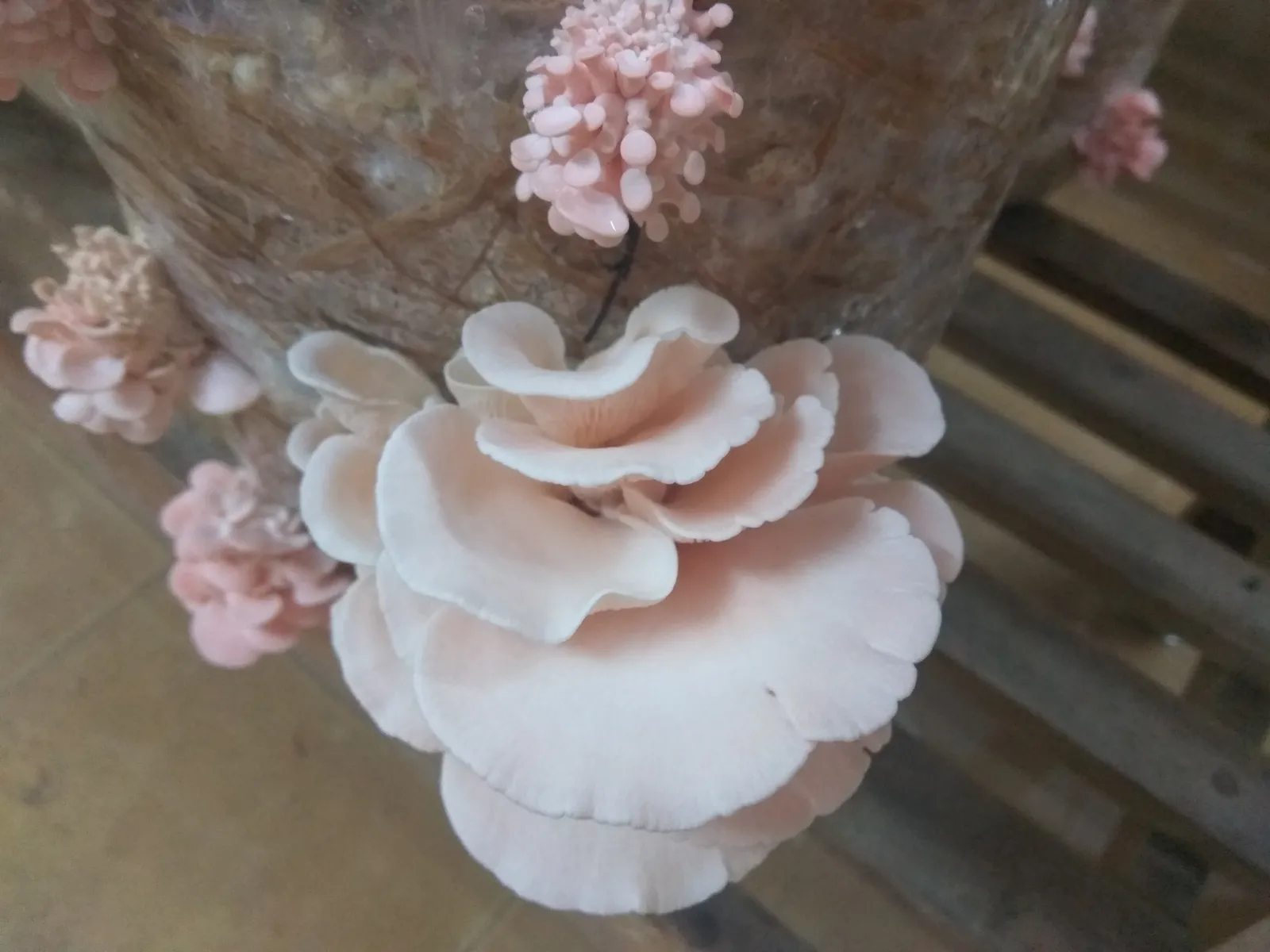
Three mushrooms, three different crop arrangements
The picture compares cultivation arrangements, not three versions of the same recipe. Oyster clusters can develop from openings in colonised bags. A common Milky method adds a casing layer after straw colonisation. Paddy Straw methods can use prepared straw beds. Each requires its own material preparation and crop management.
Before following an instruction, write its crop and method at the top of your notes. A direction about casing a Milky bed is not automatically a direction for an Oyster bag. Equally, a Button compost schedule does not describe every straw-based method.
Confirm the scientific species and supplied strain with the supplier. Common market names may cover different production choices. The illustration helps you compare arrangements; it cannot identify an unknown or wild specimen.
A preparation method includes what happens after treatment: cooling, moisture adjustment where applicable, handling, inoculation and containment. Treated material placed back beside dirty tools or raw inputs can be exposed again before the intended fungus establishes.
Plan the next container, work surface, tools and staff movements before starting. Follow the selected method for release and handling conditions; a container that is covered is not necessarily sterile, cool enough or suitable for inoculation.
Pasteurisation and sterilisation describe different process objectives. Neither word supplies a complete operating procedure. Do not improvise a pressure vessel or borrow a heating schedule from another load size, material or crop.
The three lots show why one harvest can have different outcomes. Intact compact clusters, broad fragile clusters and broken pieces may not meet the same buyer specification. Agree the crop, maturity, pack and quality requirements before the harvesting shift.
Keep weights separate for each accepted grade, rejects, unsold stock and returns. Do not quietly place every kilogram into the highest-price category. Handle gently and follow the applicable hygiene and temperature-control procedure; the illustration is not a safety assessment of any product.
For an invented record, suppose 20 kg is picked, 16 kg meets the agreed grade, 2 kg is damaged and 2 kg remains unsold. The production sheet shows 20 kg; the accepted-sale sheet does not. Costs were incurred for the full crop, including the portion not sold.
Start with what you can show: crop and stage, date first noticed, number or area affected, location, recent operations and whether the pattern is spreading. Photograph a whole-room view, an affected area, an unaffected comparison and a close detail.
A brown mark, slow patch or unusual shape can have more than one explanation. Record relevant material lots, watering, environment and insect observations. Keep the distinction between “I saw this” and “I think this caused it”.
Follow the farm’s containment procedure while seeking qualified advice. Do not open suspect material just to smell it, move it through clean work, or choose a pesticide from a photograph. A specialist may require samples, records or testing before recommending action.
Buying spawn means you will prepare and inoculate growing material. Buying colonised blocks transfers some of that work to the supplier. Compare the work and risk remaining on your farm, not just the price per kilogram.
The process
Practical workbook
Protect material after treatment
Preparation, treatment, draining or moisture adjustment, cooling and inoculation are connected operations. A treated batch can be compromised by dirty handling afterwards. Do not blend treatment times from one system with loading conditions from another.
The process
Practical workbook
Observe colonisation before fruiting
The white growth shown in the illustration represents the intended cultivated mycelium. In a real bag, colour alone does not establish identity or readiness. Read development, distribution and abnormalities using the specific method.
The process
Practical workbook
Harvest for the buyer
Oyster clusters need gentle handling and suitable clean containers. Harvest timing, accepted size and packing depend on the buyer and method. Record a complete batch rather than multiplying the best bag by all bags.
In the field
Field notes
Decide which part of production you will operate
A beginner can buy ready-to-fruit bags, buy spawn and make bags, or eventually produce spawn. These are different businesses with different clean-work requirements. Buying prepared bags helps you learn fruiting, harvest and selling, but transfers part of your quality control to a supplier. Making bags adds substrate procurement, treatment, cooling and inoculation. Spawn production adds another specialised operation; it is not an automatic first step toward independence.
Write the scientific species name and strain on the order. Oyster is a group of cultivated mushrooms, not one universal temperature programme. Ask for the incubation and fruiting requirements, recommended opening method, expected maturity at delivery and storage guidance. Compare these with measurements in your room. A bag that performs in a supplier's room may respond differently under your roof or ventilation system.
In the field
Compare the evidence
Choose your starting boundary
Choose your starting boundary
Model
You need to learn
Supplier evidence
Buy fruiting-ready bags
Receipt, room management, harvest and sales
Species, inoculation date, readiness and delivery conditions
Make bags from purchased spawn
All of the above plus substrate treatment and clean inoculation
Spawn identity, lot, storage and substrate protocol
Produce spawn
Culture quality control and laboratory workflow as a separate enterprise
Traceable mother culture and a validated production system
In the field
Field notes
Treat substrate preparation as a recorded batch
Inspect straw or other approved substrate before using it. Record where it came from and whether storage has allowed rain, visible mould, soil or chemical contamination. A low purchase price is not a saving if preparation losses or crop failures increase. Use a crop-specific treatment method taught by a competent institution; treatment time and temperature belong to the method and load, not to a generic internet recipe.
The treated material must cool under protected conditions before spawn is added. Mixing hot material with spawn, draining on a dirty floor or handling treated and untreated straw with the same equipment creates different failure routes. Identify the transition from raw to treated material physically. Label each treatment load so that later contamination can be traced to preparation, spawn or handling rather than blamed on the whole room.
In the field
Field notes
Write it in your farm notebook
Record dry substrate mass, substrate source, treatment method and log, cooling location, spawn lot, inoculation date, bag count, operators and any deviation.
In the field
Field notes
Read colonisation and fruiting separately
During colonisation, compare bags from the same batch at the same age. Note the progress of mycelium, stalled areas, damage to packaging and abnormal colour. Keep questionable bags out of routine opening or handling; follow your containment procedure and obtain advice. Opening a suspect bag to smell it spreads material and exposes the operator without reliably identifying the cause.
When the bag is ready, follow the opening and fruiting method for that species. Light, air exchange and moisture management must work together. Long stems or small caps are reasons to inspect crop identity, light and air distribution, not proof of a single cause. Dry margins near a fan and persistently wet clusters elsewhere can coexist in one room; raising the room's humidity setting alone may not solve that distribution problem.
In the field
Field notes
Compare a location problem with a batch problem
If affected bags from several preparation dates cluster beside one inlet, investigate that location. If one preparation batch performs poorly across several shelves while neighbouring batches grow normally, investigate its materials and treatment record. Both patterns can overlap; map them before changing the whole room.
In the field
Field notes
Schedule bags around harvest and sales capacity
Agree the maturity and cluster size your buyer accepts, then harvest and handle consistently. Separate trimming waste, saleable grades, rejects and unsold product in the records. Keep clean food-contact containers ready before picking. A busy harvest morning is a poor time to discover that packaging or transport is unavailable.
Staggering bag preparation can spread work, but a fixed number of new bags each week does not guarantee equal daily harvests. Compare actual flush dates and quantities across several batches. Use those observations to plan labour and buyer deliveries. At crop end, remove spent material through the dirty route and reset the area before bringing in fresh bags. Review kilograms sold per batch alongside lost bags, labour and cash received.
In the field
Practical workbook
Schedule bags around harvest and sales capacity · practical sequence
01
Receive or prepare: Identify species, stage and batch.
02
Incubate: Compare development and record abnormalities.
03
Fruit: Open according to the species protocol and observe room distribution.
04
Harvest and reset: Grade, reconcile sales, remove spent material and clean.
In the field
Sources & further reading
Where the field guidance comes from
ICAR-IIHR cultivation publications: Crop-specific Indian training publications; obtain the protocol for your species, strain and method.
Cornell indoor mushroom production: Enterprise boundaries: spawn, substrate production, fruiting and distribution. US cost examples are not Indian quotations.
Oyster mushroom, dhingri, is not one mushroom but a family. Pick the wrong member for your month and the bags stay white or fruit brown and thin.
By the end you can name the main Pleurotus species grown in India and their fruiting bands.
By the end you can place an oyster crop in the DMR calendar for your region.
By the end you can decide seasonal or controlled before buying spawn.
Species Selection
Field notes
Dhingri is a family, not one mushroom
Different cultivated Oyster forms
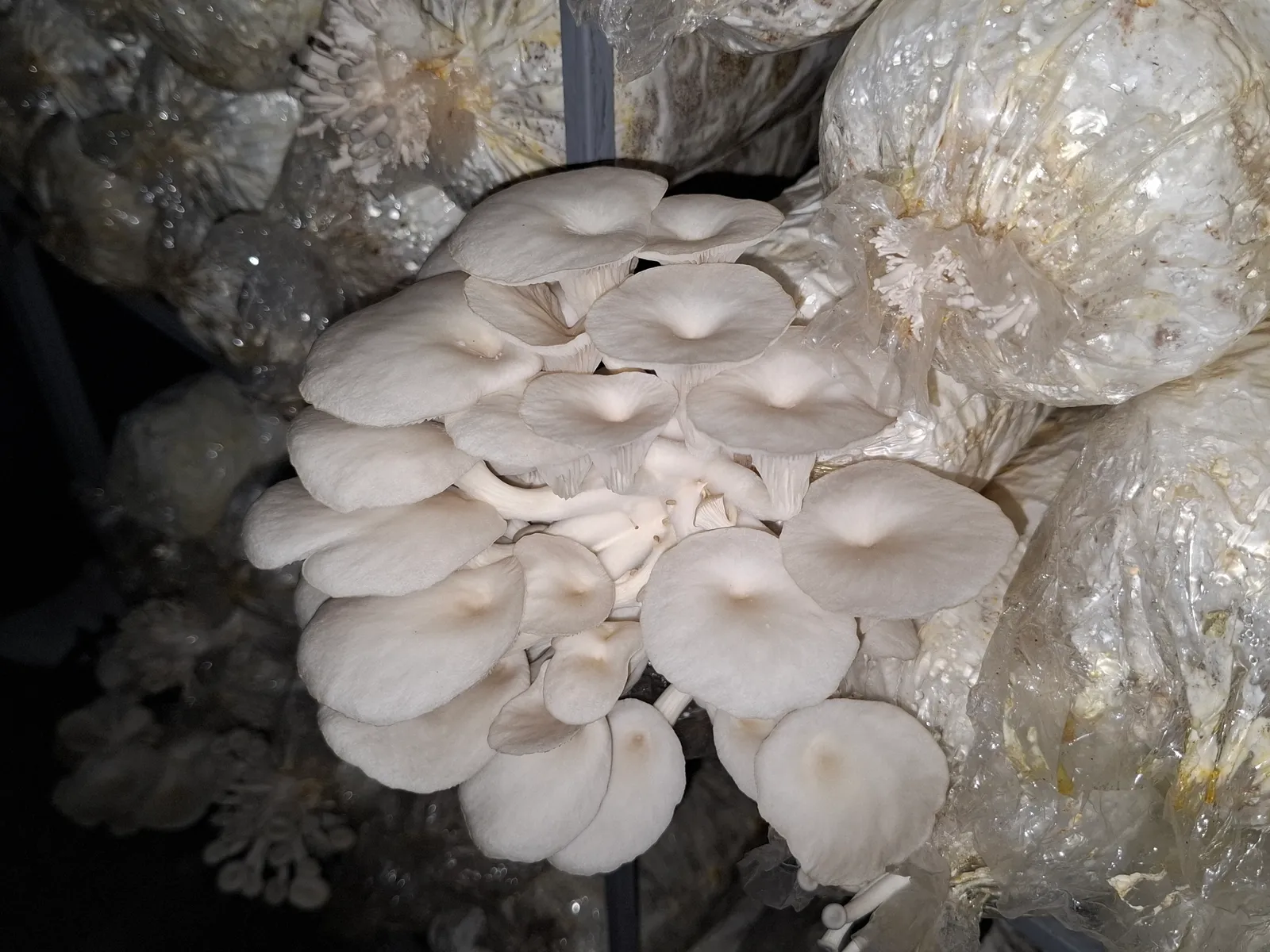
White Oyster clusterPhoto credit & full view
White oyster mushroom cluster fruiting from a bag on a rack (Philippines). Context photograph, not a prescribed layout, diagnostic result or performance standard.
Oyster mushroom, dhingri in Hindi, is the common name for a group of fungi in the genus Pleurotus. Each species has its own fruiting temperature, the air temperature at which mushroom bodies form on the bag.
ICAR-DMR sorts them into two groups. Winter or low temperature species fruit at 10-20 C: Pleurotus ostreatus, P. florida, P. eryngii, P. fossulatus and P. cornucopiae. Summer or moderate temperature species fruit at 16-30 C: P. flabellatus, P. sapidus, P. citrinopileatus and P. sajor-caju.
Species Selection
Field notes
Dhingri is a family, not one mushroom · continued
So the first question is not 'how do I grow oyster' but 'which oyster, in which month, in which room'.
Species Selection
Field notes
Read the DMR temperature table
DMR's species table gives two numbers per species: the spawn-run temperature, when white mycelium spreads through the straw, and the fruiting temperature.
P. florida runs at 25-30 C and fruits at 18-22 C. P. sajor-caju runs at 25-32 C and fruits at 22-26 C. P. flabellatus runs at 25-30 C and fruits at 22-26 C. P. eryngii, the Kabuli dhingri, runs at 18-22 C and fruits at 14-18 C.
Species Selection
Field notes
Read the DMR temperature table · continued
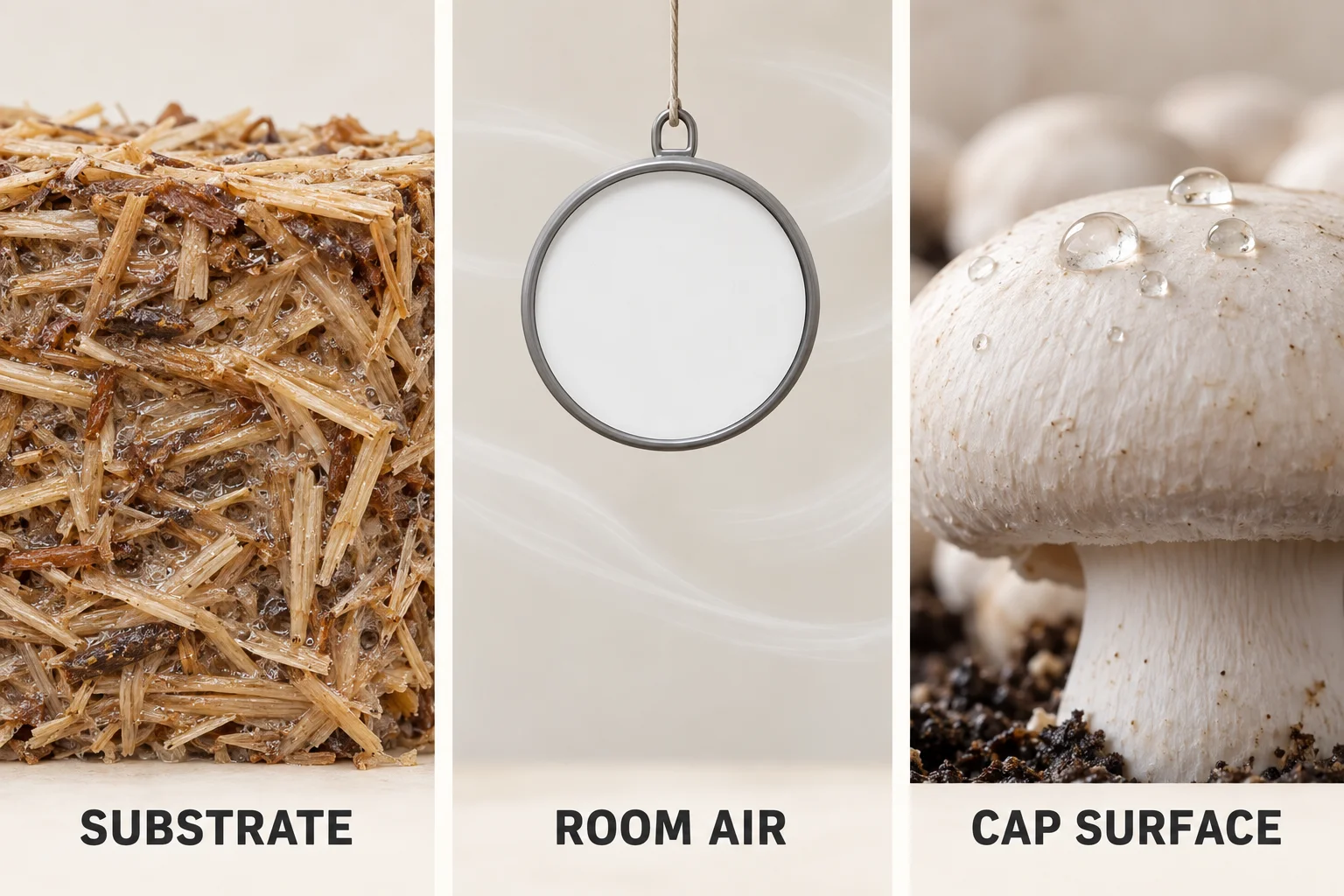
These are source-specific examples, not a universal relationship between stages. Match the supplier's strain protocol to the measured room conditions. Active substrate can differ from room air; measure both instead of assuming a fixed temperature offset.
Species Selection
Field notes
Season by region in India
The DMR seasonal folder gives a calendar. On the north Indian plains dhingri grows from September to May. In the mid-hills it grows all year. In the high hills it grows from May to August. Coastal states can grow oyster, paddy straw and milky mushroom in the natural climate all year; central and western India can grow dhingri in every season except summer.
Within that calendar, switch species. The oyster folder says: in summer grow P. sajor-caju, P. flabellatus, P. sapidus, P. djamor or P. citrinopileatus; in winter, when air falls below 20 C, choose P. florida or P. cornucopiae.
Species Selection
Field notes
Colour, grade and the unit you build
Temperature also sets colour. DMR reports P. florida caps light brown at 10-15 C but white to pale yellowish at 20-25 C; P. sajor-caju at 15-19 C is white with high dry matter, at 25-30 C brown with less. Below 100 lux of light caps go pale yellow; in bright light dark brown. Buyer preferences vary with market and product. Agree colour, cluster size and maturity with the intended buyer instead of assuming all buyers want white mushrooms.
Then settle the unit. A seasonal room follows the weather and changes species by season. A controlled room holds one band all year at much higher cost. The folder says an 18 x 15 x 10 foot room holds about 300 bags; start with one room and one species.
Species Selection
Compare the evidence
Read the numbers in context
These figures belong to the named source and method. Historical costs are not current quotations. A value without its stage, material basis or measurement location is not a farm instruction.
These figures belong to the named source and method. Historical costs are not current quotations. A value without its stage, material basis or measurement location is not a farm instruction.
Source-specific reference figures
What is measured
Value and basis
Source and limitation
P. florida fruiting
18-22 °C
ICAR-DMR seasonal folder. spawn run 25-30 C
P. sajor-caju fruiting
22-26 °C
ICAR-DMR seasonal folder. spawn run 25-32 C; flabellatus also 22-26
These figures belong to the named source and method. Historical costs are not current quotations. A value without its stage, material basis or measurement location is not a farm instruction.
Record: Species, strain, spawn date, daily high and low at bag level, date of first pinheads.
01
Hang a min-max thermometer at bag height and record the room's high and low daily for a week.
02
Pick a species whose DMR fruiting band sits inside that range on most days.
03
Ask the supplier for species, strain, batch date, storage conditions and the stated use-by guidance. Resolve condition or handling concerns before accepting the lot; do not impose a universal age limit across products.
04
If the room cannot hold the band, change species with the season or plan cooling first.
Species Selection
Pause and recall
Avoid these mistakes
Buying oyster spawn without identifying species and strain; the chosen crop may not suit the measured room conditions.
Reading temperature at the door; bags run 2-4 C warmer than room air.
Copying a Coimbatore calendar in Solan; DMR's calendar changes with region.
Species Selection
Pause and recall
Check your understanding
Choose your answer before opening the explanation. This is a learning exercise, not a competency assessment.
A room reaches 28 C, but a source gives a candidate strain a 22-26 C fruiting band. What can you conclude?
The room exceeds that example band; confirm strain guidance and control needs
P. eryngii (14-18 C)
P. ostreatus (10-20 C)
All fruit the same
See the answer and why
The room exceeds that example band; confirm strain guidance and control needs Partial overlap does not establish suitability. The upper room reading exceeds the example band; evaluate the whole daily pattern and applicable strain guidance.
Species Selection
Pause and recall
Check your understanding
Choose your answer before opening the explanation. This is a learning exercise, not a competency assessment.
P. florida grown at 10-15 C gives caps that are:
Light brown
Pure white
Pink
Black
See the answer and why
Light brown DMR reports light brown at 10-15 C and white to yellowish at 20-25 C.
Species Selection
Pause and recall
Check your understanding
Choose your answer before opening the explanation. This is a learning exercise, not a competency assessment.
DMR's oyster months on the north Indian plains are:
September to May
May to August
All year
July to September
See the answer and why
September to May May to August is the high hills; all year is the mid-hills.
The weeks when mycelium grows through the straw before mushrooms appear.
04Seasonal unit
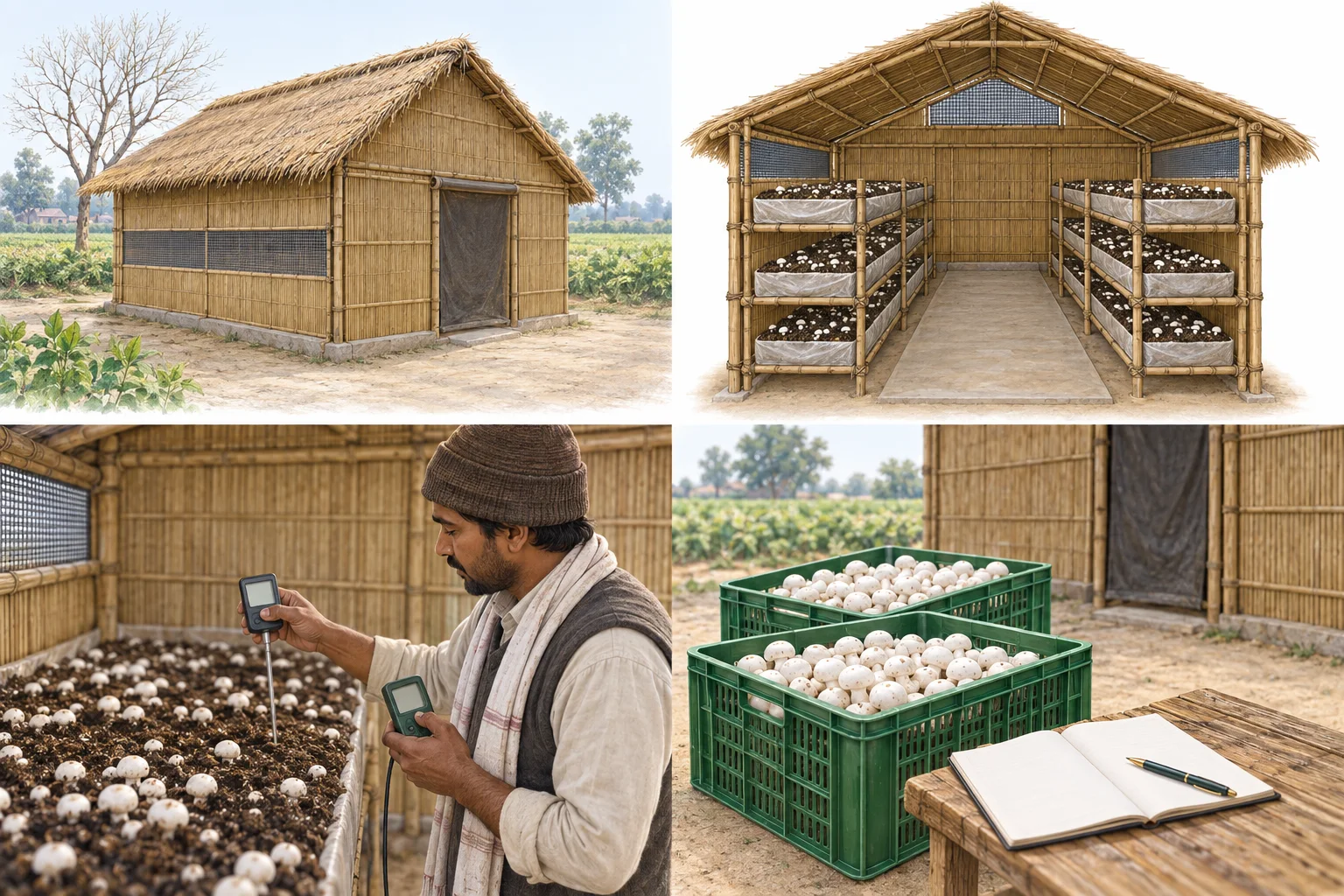
AI illustration · details
AI teaching illustration. People need room to load, inspect, harvest and remove spent material. Low-cost construction still needs safe structure, drainage and access.
Straw is cheap, but untreated straw is a race between your mushroom and every mould in the field. The treatment you choose decides who wins.
By the end you can choose straw, chop length and moisture for oyster bags.
By the end you can compare hot water, steam, chemical and sterile methods by cost and risk.
By the end you can list the free hygiene steps that stop contamination before spawning.
Substrate & Preparation
Field notes
What the straw gives the mushroom
The substrate is the material the mycelium eats. For oyster in India it is usually wheat or paddy straw; DMR notes most such substrates hold 0.5-0.8 per cent nitrogen, enough without additives. Use fresh, dry straw from the current season, stored under cover; old or rain-wet straw brings ink caps and moulds.
Chop so it packs evenly. The DMR folder machine-cuts hard residues to about 2-3 cm; the 2011 manual chops 5-10 cm for hot water; TNAU uses 5 cm. DMR allows wheat or rice bran as a supplement but warns it raises bag temperature by 2-3 C or more, so not in summer.
Substrate & Preparation
Field notes
Hot water: the small grower's method
Pasteurisation means heating straw enough to kill or weaken competitor moulds without sterilising it. Hot water is the simplest route.
The DMR folder soaks straw overnight, then heats the water to 60-65 C and holds the straw in it for 20-30 minutes. The 2011 manual gives longer schedules: 65-70 C for one hour, or 60-120 minutes at 80 C, or paddy straw at 85 C for 30-45 minutes. Both are DMR; the folder is the seasonal grower protocol.
Substrate & Preparation
Field notes
Hot water: the small grower's method · continued
Drain until the straw holds about 65-70 per cent moisture, a figure DMR gives in its milky folder for the same treatment. Squeeze test: no drip, palm just damp.
Substrate & Preparation
Field notes
Steam, chemical and sterile methods
Larger units use steam. The manual packs pre-wetted straw in trays and holds a pasteurisation room at 58-62 C for four hours; the whole cycle takes 3-5 days. The folder's tunnel holds 60-65 C for about four hours.
DMR also describes chemical steeping: straw soaked 12-18 hours in water with a fungicide and formalin, which suppresses competitor moulds for 25-40 days after spawning. This lesson gives no doses; both chemicals carry regulatory and residue conditions, so check current label approval and prefer hot water if unsure.
Substrate & Preparation
Field notes
Steam, chemical and sterile methods · continued
The sterile method autoclaves soaked straw in polypropylene bags at 20 psi for 1-2 hours. It suits laboratories, not a first farm.
Substrate & Preparation
Field notes
Contamination controls that cost nothing
Competitor moulds can cut oyster yield by up to 70 per cent, so prevention beats any cure. DMR asks for the spawning room to be disinfected two days before spawning and kept closed. Wash the draining floor; keep hands, buckets and knives clean.
The opening and drainage pattern belongs to the chosen bag method. It does not by itself guarantee substrate temperature; inspect drainage and measure conditions. Use the supplied product's batch-specific storage and use-by instructions; age alone does not establish quality. Keep flies out with fine net on doors and windows. Keep suspect bags closed and limit movement. Follow a competent containment and locally appropriate disposal procedure rather than dumping material in an outdoor pit.
Substrate & Preparation
Compare the evidence
Read the numbers in context
These figures belong to the named source and method. Historical costs are not current quotations. A value without its stage, material basis or measurement location is not a farm instruction.
Source-specific reference figures
What is measured
Value and basis
Source and limitation
Hot-water treatment, farmer folder
60-65 °C for 20-30 minutes
ICAR-DMR oyster folder. manual gives 65-70 C for one hour
These figures belong to the named source and method. Historical costs are not current quotations. A value without its stage, material basis or measurement location is not a farm instruction.
Source-specific reference figures
What is measured
Value and basis
Source and limitation
Substrate moisture at spawning
65-70 %
ICAR-DMR milky folder. milky folder, same treatment; no oyster-specific figure published
For two to three weeks the bag looks like nothing is happening. Reading a bag in that silence separates a full room from a pit of green straw.
By the end you can fill and spawn a bag at the DMR rate and size.
By the end you can hold spawn-run conditions and say what the bag does not need.
By the end you can read a bag day by day and decide to open, wait or discard.
Bag Preparation & Spawn Run
Field notes
Filling and spawning the bag
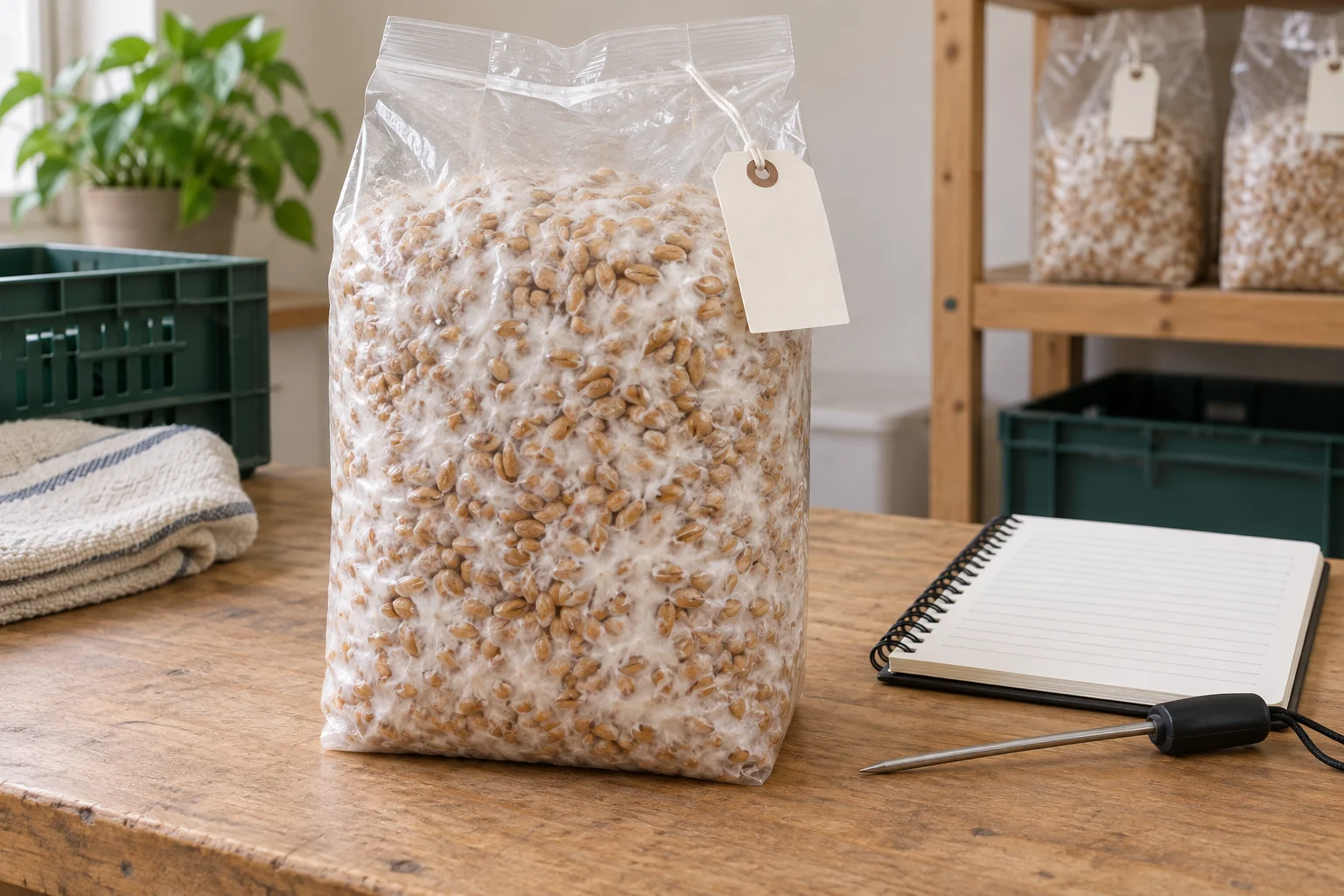
Spawn is the seed material: grain fully covered in mycelium. Use it fresh. Historical publications give age examples, but product, strain, carrier and storage conditions differ. Use traceable supplier guidance and receiving checks; these examples are not a universal expiry rule.
The manual mixes spawn at 2-3 per cent of wet substrate weight; one 300 g bottle serves 10-12 kg of wet straw. The folder says about 100 g per 4 kg wet straw.
Bag Preparation & Spawn Run
Field notes
Filling and spawning the bag · continued
Bag sizes differ by institute: the folder uses 40-45 by 30-35 cm polythene; the manual 60 x 45 cm of 125-150 gauge; TNAU 60 x 30 cm of 80 gauge. Follow the chosen bag system's opening and drainage method. Holes do not guarantee a safe substrate temperature; check conditions with suitable measurements.
Bag Preparation & Spawn Run
Field notes
What a spawn run needs, and what it does not
Mycelium grows between 10 and 30 C, best at 22-26 C. Above 30 C in the room it stops and dies, and the bag runs 2-4 C warmer than the room. If the bag climbs past 30 C, the folder says to splash water on walls and roof two or three times a day or run an air cooler.
The folder is blunt: during the run the bags need no water, no air and no light. The manual agrees: bags stay closed, no ventilation, no spraying. The mycelium tolerates carbon dioxide up to about 2 per cent, so a closed dark room is fine. TNAU instead asks for 22-25 C with 85-90 per cent humidity in a dark shed.
Bag Preparation & Spawn Run
Field notes
Reading the bag day by day
Days 1-5: white threads spread from each grain. Days 5-12: threads meet and the straw colour fades. The folder expects the whole bag white in 15-25 days. The manual sets a hard rule: never open before 16-18 days, except P. membranaceus and P. djamor var. roseus, which fruit through the holes within 10 days.
Trouble signs: green patches (Trichoderma), black spots, a sour smell, or a wet grey mass at the bottom from excess water. Slow, thin growth points to cold or old spawn. A bag hot to the palm is packed too tight or the room is too warm. Remove a contaminated bag at once and bury it in a deep pit away from the room.
Bag Preparation & Spawn Run
Field notes
Space, flies and hygiene
Stack loosely. The manual sets 15-20 cm between bags so heat escapes; tight stacks push centre bags over 30 C. Racks with a gap under each bag drain better than a floor pile.
NHB repeats the ICAR advice to screen doors and ventilators with nylon net of 35 mesh or finer so flies cannot lay eggs in the bags. Keep the room closed; the manual wants it pre-fumigated before spawning and a closed room stays that way.
Bag Preparation & Spawn Run
Field notes
Space, flies and hygiene · continued
Work from clean to dirty: good bags first, suspect bags last, wash hands between. The diary tells you next batch whether the straw, the spawn or the room was at fault.
Bag Preparation & Spawn Run
Compare the evidence
Read the numbers in context
These figures belong to the named source and method. Historical costs are not current quotations. A value without its stage, material basis or measurement location is not a farm instruction.
Source-specific reference figures
What is measured
Value and basis
Source and limitation
Spawn rate
2-3 % of wet substrate
ICAR-DMR manual, 2011. one 300 g bottle for 10-12 kg wet straw
Spawn-run optimum
22-26 °C
ICAR-DMR manual, 2011. grows 10-30 C; above 30 C the mycelium dies
These figures belong to the named source and method. Historical costs are not current quotations. A value without its stage, material basis or measurement location is not a farm instruction.
Source-specific reference figures
What is measured
Value and basis
Source and limitation
Spawn-run duration
15-25 days
ICAR-DMR oyster folder. manual: never open before 16-18 days
Bag holes
10-12 holes of about 5 mm
ICAR-DMR oyster folder. manual: 10-15 holes of 0.5-1 cm, mostly at the bottom
These figures belong to the named source and method. Historical costs are not current quotations. A value without its stage, material basis or measurement location is not a farm instruction.
Source-specific reference figures
What is measured
Value and basis
Source and limitation
Historical folder age example
30 days
ICAR-DMR oyster folder. Not a universal expiry limit. Confirm the supplied product's storage and use-by guidance.
Record: Bag number, spawn date, daily bag-level temperature, colonisation stage on check days, bags discarded and why.
01
Number every bag and write the spawning date on it.
02
Each morning note the temperature at bag level; act the same day if it passes 30 C.
03
On days 3, 7, 12 and 18 describe three bags: no white, patches, half, full.
04
Keep unexpected growth or suspect bags closed, mark the batch and follow the farm's containment and authorised disposal procedure. Do not deliberately smell or open material to identify a problem.
05
Open only after day 16-18 and only when fully white; log the date.
Bag Preparation & Spawn Run
Pause and recall
Avoid these mistakes
Opening bags at day 10 because they look white; the manual sets 16-18 days minimum.
Packing bags tight and stacking them touching; the centre passes 30 C and dies.
Using a 40-day-old bottle because it was cheap; old spawn colonises slowly.
Bag Preparation & Spawn Run
Pause and recall
Check your understanding
Choose your answer before opening the explanation. This is a learning exercise, not a competency assessment.
During the spawn run the DMR folder says bags need:
No water, air or light
A light spray daily
Bright light 12 hours
Fresh air hourly
See the answer and why
No water, air or light Water, air and light are for fruiting; the run wants a closed dark bag.
Bag Preparation & Spawn Run
Pause and recall
Check your understanding
Choose your answer before opening the explanation. This is a learning exercise, not a competency assessment.
Compared with room air, bag temperature is generally:
2-4 C higher
The same
5 C lower
Unrelated
See the answer and why
2-4 C higher Mycelium makes heat, so measure at bag level.
Bag Preparation & Spawn Run
Pause and recall
Check your understanding
Choose your answer before opening the explanation. This is a learning exercise, not a competency assessment.
A bag shows green patches on day 10. Best action:
Remove and bury it
Open it early to air it
Spray water on it
Wait, it will turn white
See the answer and why
Remove and bury it Green mould spreads spores to its neighbours.
Bag Preparation & Spawn Run
Visual glossary
Words used in this lesson
01Spawn
AI illustration · details
AI teaching illustration. Receiving concept; not proof of purity or spawn quality.
An oyster mushroom with a long stalk and a tiny cap is not a variety. It is a message about the air in your room.
By the end you can set fruiting temperature, humidity, light and CO2 from DMR bands.
By the end you can read stalk length, cap size and colour as a report on air and light.
By the end you can space bags and water the room rather than the mushrooms.
Fruiting Environment
Field notes
Opening the bags
Once a bag is fully white and at least 16-18 days old, cut away or remove the polythene; TNAU cuts round openings of 5 cm. Arrange bags on shelves or hang them with 15-20 cm between each so air reaches every surface.
The folder says small buds, called pinheads, appear about a week after opening and reach full size in 4-5 more days. TNAU reports pinheads in 2-3 days and harvest 4 days later; climate and species explain the gap, so record your own.
Fruiting Environment
Field notes
Opening the bags · continued
Everything the bag did not need during the run, it needs now: water in the air, fresh air and light.
Fruiting Environment
Field notes
Temperature and humidity
Fruit at the band for your species: 18-22 C for P. florida, 22-26 C for P. sajor-caju and P. flabellatus, 14-18 C for P. eryngii. Warmer than its band, sajor-caju turns brown and thin.
Relative humidity, RH, is the water in the air as a share of the most it could hold. The manual says all Pleurotus need 75-85 per cent RH during fruiting; TNAU gives 80-85 per cent at 23-25 C. Raise it by spraying floor, walls and air two or three times a day and hanging wet gunny at windows.
Fruiting Environment
Field notes
Temperature and humidity · continued
Never leave water standing on caps; a water film in warm air lets bacteria spot and rot them.
Fruiting Environment
Field notes
Fresh air and CO2
Mushrooms breathe out carbon dioxide, CO2, and a closed room fills with it. The manual wants less than 600 ppm during cropping; the folder allows up to 800 ppm. Both are DMR; without a meter, work to the stricter one.
The folder's method is to open windows or run exhaust fans two or three times a day. DMR describes the symptom of too much CO2 exactly: long stalk, small cap, a mushroom like the mouth of a trumpet. The mushroom is your meter.
Fruiting Environment
Field notes
Fresh air and CO2 · continued
Move air without blowing on the caps, which dries their edges. More air lowers RH, so spray again after venting.
Fruiting Environment
Field notes
Light
Oyster needs light to form pinheads. The manual gives 200 lux for 8-12 hours a day; the folder asks for 6-8 hours from glazed windows or tube lights. A lux is a unit of light on a surface; 200 lux is a bright room, far below sunlight, and direct sun heats and dries bags.
Too little light looks like too much CO2: long stalk, small cap, poor yield. Below 100 lux the caps go pale yellowish; in very bright light they turn dark brown or grey. When you see long stalks, add air time first, then check light hours before blaming the spawn.
Fruiting Environment
Compare the evidence
Read the numbers in context
These figures belong to the named source and method. Historical costs are not current quotations. A value without its stage, material basis or measurement location is not a farm instruction.
Source-specific reference figures
What is measured
Value and basis
Source and limitation
RH during fruiting
75-85 %
ICAR-DMR manual, 2011. TNAU 80-85; measure at bag level
CO2 during cropping
below 600 ppm
ICAR-DMR manual, 2011. folder allows up to 800 ppm
These figures belong to the named source and method. Historical costs are not current quotations. A value without its stage, material basis or measurement location is not a farm instruction.
Source-specific reference figures
What is measured
Value and basis
Source and limitation
Light for pinheads
200 lux for 8-12 hours per day
ICAR-DMR manual, 2011. folder 6-8 hours; under 100 lux caps go pale
These figures belong to the named source and method. Historical costs are not current quotations. A value without its stage, material basis or measurement location is not a farm instruction.
Record: Temperature and RH morning and evening, venting minutes, light hours, stalk and cap sizes, pinhead date.
01
Hang a thermometer and hygrometer at bag height in the middle of the room.
02
Vent for a fixed time morning, noon and evening; write the minutes.
03
Spray floor and walls, never caps; check RH an hour later.
04
Give 6-12 hours of light from a window or tube light.
05
Measure stalk length and cap width on five mushrooms daily; if stalks lengthen, add air first.
Fruiting Environment
Pause and recall
Avoid these mistakes
Spraying water onto caps to raise humidity; a water film invites bacterial blotch.
Sealing the room to hold humidity; CO2 climbs and you harvest stalks.
Judging humidity by feel at the door; measure at bag level mid-room.
Fruiting Environment
Pause and recall
Check your understanding
Choose your answer before opening the explanation. This is a learning exercise, not a competency assessment.
Long stalk, small cap, trumpet shape mainly means:
Too much CO2
Too much light
Too cold
Wrong spawn
See the answer and why
Too much CO2 DMR names the trumpet shape as the high-CO2 sign; low light looks similar, so check both.
Fruiting Environment
Pause and recall
Check your understanding
Choose your answer before opening the explanation. This is a learning exercise, not a competency assessment.
DMR says Pleurotus need an RH during fruiting of:
75-85 per cent
40-50 per cent
95-100 per cent
About 60 per cent
See the answer and why
75-85 per cent Higher RH with still air invites bacterial spotting.
Fruiting Environment
Pause and recall
Check your understanding
Choose your answer before opening the explanation. This is a learning exercise, not a competency assessment.
If light is below 100 lux the caps turn:
Pale yellowish
Dark brown
Pink
No change
See the answer and why
Pale yellowish DMR links pale caps to low light and dark caps to bright light.
Fruiting Environment
Visual glossary
Words used in this lesson
01Pinhead
AI illustration · details
AI teaching illustration. Mycelium grows through the food before the visible harvest forms. Colonisation and fruiting require stage-specific management.
Water in the air as a percentage of the most it could hold at that temperature.
CO₂CO2
AI illustration · details
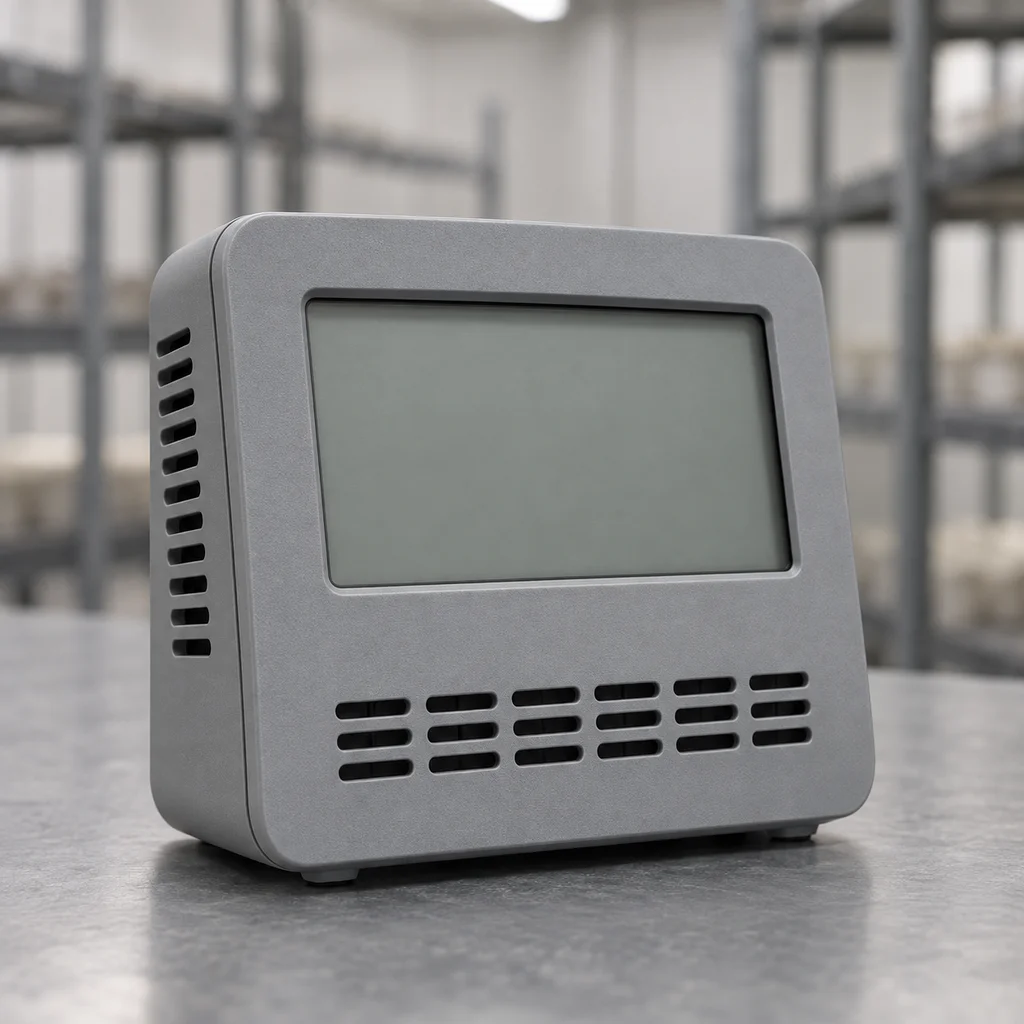
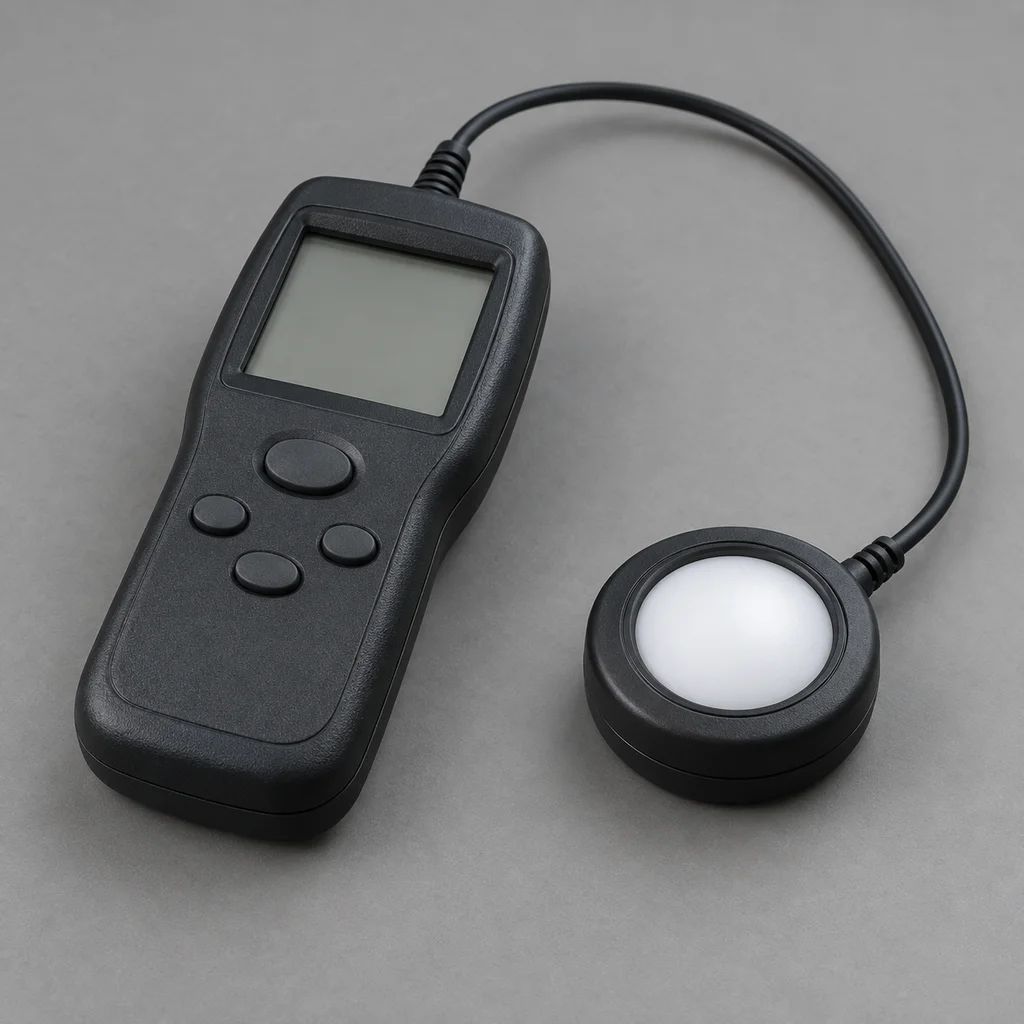
AI teaching illustration. Instrument concept for discussing CO2 measurement; not a verified product, calibration, sensor location or ventilation prescription.
The mushroom you pick at six in the morning is worth the most it will ever be. Every hour after that you are selling a fading product.
By the end you can harvest by twisting at the right stage and plan three flushes.
By the end you can pack, cool and sell within the shelf life DMR reports.
By the end you can keep DMR's dated cost figures apart from your own numbers.
Harvest, Problems & Business
Field notes
Harvest and flushes
Twist the whole cluster off at the base before the cap edges flatten and curl; a flat cap is shedding spores and tears easily. The DMR folder adds a health rule: open doors and windows two hours before harvesting and wear a mask, because oyster spores cause allergy.
A flush is one wave of mushrooms. The folder says the first flush gives about half or more of the total, the second comes 8-10 days later, and three flushes are worth keeping; then the bags go to a deep pit.
Harvest, Problems & Business
Field notes
Harvest and flushes · continued
The folder reports 700-800 g fresh mushroom per kg dry straw; the manual states a minimum of 500-700 kg per tonne in 45-60 days. Reports, not promises.
Harvest, Problems & Business
Field notes
Packing and shelf life
Fresh oyster keeps 24-48 hours at room temperature, so plan the sale before the pick. The folder's method: spread the mushrooms on a cloth for about two hours so surface water dries, then pack in perforated polythene; in a refrigerator they hold 2-4 days.
The DMR post-harvest bulletin specifies polythene under 100 gauge with holes giving about 5 per cent vent area. TNAU packs 200 g per bag for retail.
Harvest, Problems & Business
Field notes
Packing and shelf life · continued
If you cannot sell fresh, dry. The manual says dried oyster at 2-4 per cent moisture keeps 3-4 months when sealed. Drying is a second product, not a rescue for spoiled mushrooms.
Harvest, Problems & Business
Field notes
Problems you will meet
Match the symptom to the cause before acting. Green mould in bags: poor straw treatment, old spawn or low pH. Long stalks, small caps: high CO2 or low light. Pale yellow caps: light under 100 lux. Brown caps in sajor-caju: temperature above its band. Wet, rotting caps: water left on the surface. Larvae in stalks: flies got in; screen with 35 mesh net, use a light trap, and cover spent bags in the pit with at least 10 cm of manure.
This course gives no spray recipes. Hygiene, air, light and temperature fix most of the above. If a product is used, check current label approval and keep the 48-hour gap between spraying and picking that NHB requires.
Harvest, Problems & Business
Field notes
Business: what DMR's numbers are and are not
The DMR folder puts the cost of producing a kilogram of dhingri at 10-15 rupees. It is undated, from the early 2010s, and marked medium confidence. The 2011 manual's model assumes 70 per cent biological efficiency and a sale price of 50 rupees per kg. Use these to learn the shape of a budget, never as today's prices.
Your numbers come from your diary: straw, spawn, polythene, labour and power for one batch; kilograms sold, not picked; the price each buyer actually paid; kilograms thrown away. Divide cost by kilograms sold. The folder itself prints two cycle lengths, 45-60 days in its introduction and 40-50 in its economics, so measure yours.
Harvest, Problems & Business
Compare the evidence
Read the numbers in context
These figures belong to the named source and method. Historical costs are not current quotations. A value without its stage, material basis or measurement location is not a farm instruction.
Source-specific reference figures
What is measured
Value and basis
Source and limitation
Shelf life at room temperature
24-48 hours
ICAR-DMR manual, 2011. 2-4 days in a refrigerator, folder
Interval to second flush
8-10 days
ICAR-DMR oyster folder. TNAU 7-10 days; three flushes
These figures belong to the named source and method. Historical costs are not current quotations. A value without its stage, material basis or measurement location is not a farm instruction.
Source-specific reference figures
What is measured
Value and basis
Source and limitation
Fresh yield per kg dry straw
700-800 g
ICAR-DMR oyster folder. manual: minimum 500-700 kg per tonne; a report, not a promise
Cost of production, dated
10-15 INR per kg
ICAR-DMR oyster folder. undated early-2010s folder, medium confidence
These figures belong to the named source and method. Historical costs are not current quotations. A value without its stage, material basis or measurement location is not a farm instruction.
Source-specific reference figures
What is measured
Value and basis
Source and limitation
Spray to picking gap
48 hours
NHB DPR model, 2018. if any approved product is used
All oyster species suit the same room. Confirm species and strain before applying environmental guidance.
Holes guarantee a safe bag temperature. Opening pattern is not a substitute for measuring the crop.
Practise and review
Practical workbook
Read three bags without guessing
For three marked bags, record the supplied stage, observations, next permitted operation and evidence still missing. Use photographs without opening suspect material.
Sources and next steps
Sources & further reading
Keep learning with the field guides
English editorial teaching material. Independent technical review and full Hindi translation remain pending. Reading or completing an exercise is not proof of practical competence.
Illustrations are not diagnostic evidence, construction drawings or operating specifications. Use species-, strain- and method-specific guidance for practical work.
English learning edition · Independent technical review pending. Keyboard: focus the reading page and use ← / →. Page turning does not mark practical competence.
Oyster mushrooms: understand the whole bag cycle | MushroomFarming.in