


Substrate & Preparation
Straw is cheap, but untreated straw is a race between your mushroom and every mould in the field. The treatment you choose decides who wins.
- By the end you can choose straw, chop length and moisture for oyster bags.
- By the end you can compare hot water, steam, chemical and sterile methods by cost and risk.
- By the end you can list the free hygiene steps that stop contamination before spawning.
Four ways to treat straw before spawning
Source: ICAR-DMR 2011 manual and oyster folder. Chemical doses are deliberately not printed here.
| Method | Conditions | Best for | Limit |
|---|---|---|---|
| Hot water | 60 to 65 °C for 20 to 30 minutes | Cheap, small batches | Fuel and labour |
| Chemical soak | 10 to 12 kg straw in 90 litres water, DMR method | No heat, larger batches | Check current label approval and safety |
| Steam (pasteurisation) | 58 to 62 °C for several hours | Uniform, commercial scale | Needs a boiler and tunnel |
| Autoclave (sterilisation) | 20 psi for 1 to 2 hours | Shiitake blocks, spawn | Costly equipment |
Read numerical examples with their source, method and crop context. They are not universal operating instructions. Historical prices are not current quotations.
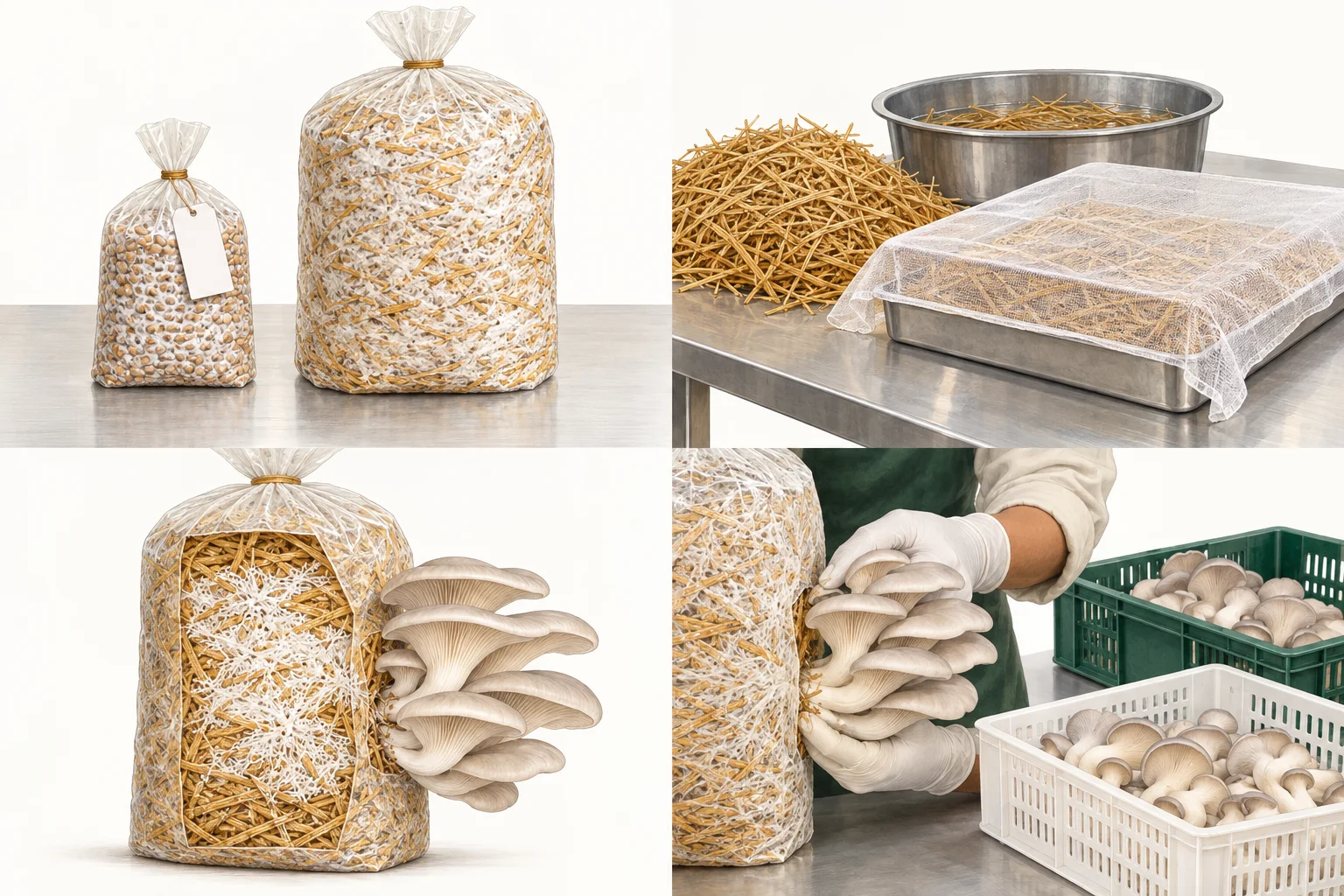
Prepare and protect
- Notice
- Treated material must remain protected during cooling and handling.
- Understand
- Recontamination can happen after an otherwise adequate treatment.
- Try it
- Label treatment batches and separate treated material from raw inputs.
01What the straw gives the mushroom
The substrate is the material the mycelium eats. For oyster in India it is usually wheat or paddy straw; DMR notes most such substrates hold 0.5-0.8 per cent nitrogen, enough without additives. Use fresh, dry straw from the current season, stored under cover; old or rain-wet straw brings ink caps and moulds.
Chop so it packs evenly. The DMR folder machine-cuts hard residues to about 2-3 cm; the 2011 manual chops 5-10 cm for hot water; TNAU uses 5 cm. DMR allows wheat or rice bran as a supplement but warns it raises bag temperature by 2-3 C or more, so not in summer.
02Hot water: the small grower's method
Pasteurisation means heating straw enough to kill or weaken competitor moulds without sterilising it. Hot water is the simplest route.
The DMR folder soaks straw overnight, then heats the water to 60-65 C and holds the straw in it for 20-30 minutes. The 2011 manual gives longer schedules: 65-70 C for one hour, or 60-120 minutes at 80 C, or paddy straw at 85 C for 30-45 minutes. Both are DMR; the folder is the seasonal grower protocol.
Drain until the straw holds about 65-70 per cent moisture, a figure DMR gives in its milky folder for the same treatment. Squeeze test: no drip, palm just damp.
03Steam, chemical and sterile methods
Larger units use steam. The manual packs pre-wetted straw in trays and holds a pasteurisation room at 58-62 C for four hours; the whole cycle takes 3-5 days. The folder's tunnel holds 60-65 C for about four hours.
DMR also describes chemical steeping: straw soaked 12-18 hours in water with a fungicide and formalin, which suppresses competitor moulds for 25-40 days after spawning. This lesson gives no doses; both chemicals carry regulatory and residue conditions, so check current label approval and prefer hot water if unsure.
The sterile method autoclaves soaked straw in polypropylene bags at 20 psi for 1-2 hours. It suits laboratories, not a first farm.
04Contamination controls that cost nothing
Competitor moulds can cut oyster yield by up to 70 per cent, so prevention beats any cure. DMR asks for the spawning room to be disinfected two days before spawning and kept closed. Wash the draining floor; keep hands, buckets and knives clean.
The opening and drainage pattern belongs to the chosen bag method. It does not by itself guarantee substrate temperature; inspect drainage and measure conditions. Use the supplied product's batch-specific storage and use-by instructions; age alone does not establish quality. Keep flies out with fine net on doors and windows. Keep suspect bags closed and limit movement. Follow a competent containment and locally appropriate disposal procedure rather than dumping material in an outdoor pit.
Treat one batch of straw by hot water this week
- Chop fresh, dry straw and soak it overnight in clean water.
- Heat water to 60-65 C on a thermometer and hold the straw in it 20-30 minutes.
- Drain on a washed floor until the squeeze test passes: no drip, palm just damp.
- Cool below 30 C before mixing spawn; hot straw kills spawn.
- Watch the batch for green or black patches for 25 days.
Write in your farm diary: Straw source and age, chop length, water temperature and time, squeeze result, spawning date.
Mistakes that cost a crop
- Using last year's straw stored in the open; it brings ink caps and moulds into every bag.
- Spawning straw that is still warm; above 30 C the mycelium dies.
- Judging 'hot enough' by hand; under-treatment shows as green mould three weeks later.
Check yourself
Three questions, instant answersSqueezed straw drips water between your fingers. What next?
Why does DMR advise against bran in summer?
Which method needs an autoclave?
An editorial self-check, not a certificate. Answers are not stored, not even on this device.
Words used in this lesson
- Substrate
- The straw or other material the mycelium feeds on.
- Pasteurisation
- Heating to kill most competitors while sparing helpful organisms.
- Competitor mould
- A fungus such as green Trichoderma that eats the straw faster than the mushroom.
- Squeeze test
- Press a handful: right moisture leaves the palm damp with no drip.
References & further reading
Species, strain, climate and production method must remain explicit.
Open current reference