


Bag Preparation & Spawn Run
For two to three weeks the bag looks like nothing is happening. Reading a bag in that silence separates a full room from a pit of green straw.
- By the end you can fill and spawn a bag at the DMR rate and size.
- By the end you can hold spawn-run conditions and say what the bag does not need.
- By the end you can read a bag day by day and decide to open, wait or discard.
The oyster bag method in six steps
Source: ICAR-DMR oyster folder and the 2011 manual.
- Chop the strawWheat or paddy straw cut to 2 to 3 cm (manual method uses 5 to 10 cm).Day 0
- Hot-water treatmentSoak at 60 to 65 °C for 20 to 30 minutes, then drain to 65 to 70 percent moisture.Day 0
- Spawn and fill bags2 to 3 percent spawn on wet-straw weight, in layers; 10 to 12 holes per bag.Day 0
- Spawn run22 to 26 °C in the dark for 15 to 25 days until the bag is white through.Day 1-20
- Open the bag and fruitLight, fresh air, 75 to 85 percent humidity, CO₂ under 600 to 800 ppm. Pins in 5 to 7 days.Day 20-27
- Harvest and next flushThree flushes 8 to 10 days apart; 60 to 100 kg from 100 kg dry straw.Day 27-60
Read numerical examples with their source, method and crop context. They are not universal operating instructions. Historical prices are not current quotations.
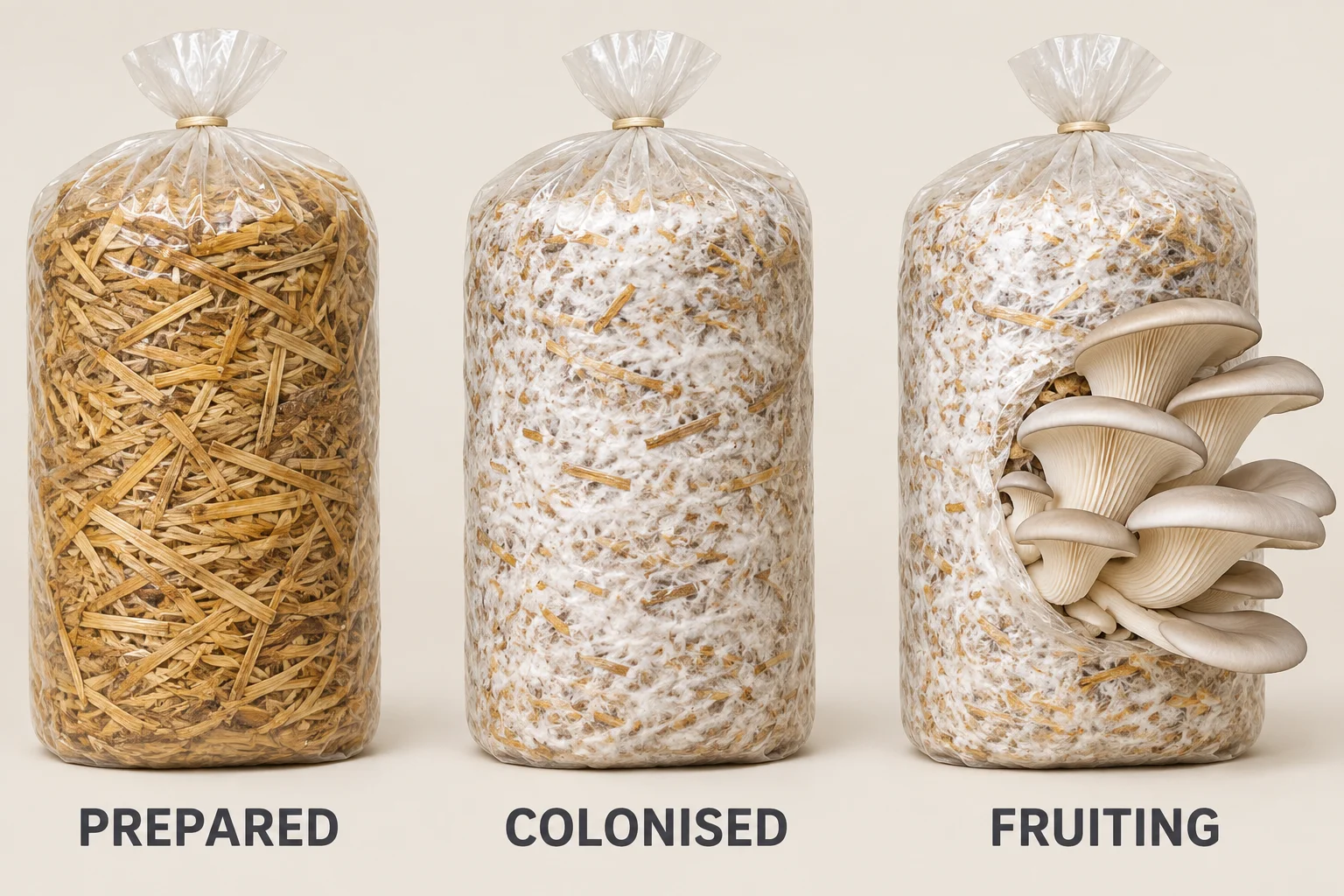
Look, explain, then apply
A conceptual stage sequence, not three guaranteed dates or a visual test for healthy mycelium. Use the applicable species, strain and bag method.
See where this fits in the full workflow →01Filling and spawning the bag
Spawn is the seed material: grain fully covered in mycelium. Use it fresh. Historical publications give age examples, but product, strain, carrier and storage conditions differ. Use traceable supplier guidance and receiving checks; these examples are not a universal expiry rule.
The manual mixes spawn at 2-3 per cent of wet substrate weight; one 300 g bottle serves 10-12 kg of wet straw. The folder says about 100 g per 4 kg wet straw.
Bag sizes differ by institute: the folder uses 40-45 by 30-35 cm polythene; the manual 60 x 45 cm of 125-150 gauge; TNAU 60 x 30 cm of 80 gauge. Follow the chosen bag system's opening and drainage method. Holes do not guarantee a safe substrate temperature; check conditions with suitable measurements.
02What a spawn run needs, and what it does not
Mycelium grows between 10 and 30 C, best at 22-26 C. Above 30 C in the room it stops and dies, and the bag runs 2-4 C warmer than the room. If the bag climbs past 30 C, the folder says to splash water on walls and roof two or three times a day or run an air cooler.
The folder is blunt: during the run the bags need no water, no air and no light. The manual agrees: bags stay closed, no ventilation, no spraying. The mycelium tolerates carbon dioxide up to about 2 per cent, so a closed dark room is fine. TNAU instead asks for 22-25 C with 85-90 per cent humidity in a dark shed.
03Reading the bag day by day
Days 1-5: white threads spread from each grain. Days 5-12: threads meet and the straw colour fades. The folder expects the whole bag white in 15-25 days. The manual sets a hard rule: never open before 16-18 days, except P. membranaceus and P. djamor var. roseus, which fruit through the holes within 10 days.
Trouble signs: green patches (Trichoderma), black spots, a sour smell, or a wet grey mass at the bottom from excess water. Slow, thin growth points to cold or old spawn. A bag hot to the palm is packed too tight or the room is too warm. Remove a contaminated bag at once and bury it in a deep pit away from the room.
04Space, flies and hygiene
Stack loosely. The manual sets 15-20 cm between bags so heat escapes; tight stacks push centre bags over 30 C. Racks with a gap under each bag drain better than a floor pile.
NHB repeats the ICAR advice to screen doors and ventilators with nylon net of 35 mesh or finer so flies cannot lay eggs in the bags. Keep the room closed; the manual wants it pre-fumigated before spawning and a closed room stays that way.
Work from clean to dirty: good bags first, suspect bags last, wash hands between. The diary tells you next batch whether the straw, the spawn or the room was at fault.
Keep a bag diary for one batch
- Number every bag and write the spawning date on it.
- Each morning note the temperature at bag level; act the same day if it passes 30 C.
- On days 3, 7, 12 and 18 describe three bags: no white, patches, half, full.
- Keep unexpected growth or suspect bags closed, mark the batch and follow the farm's containment and authorised disposal procedure. Do not deliberately smell or open material to identify a problem.
- Open only after day 16-18 and only when fully white; log the date.
Write in your farm diary: Bag number, spawn date, daily bag-level temperature, colonisation stage on check days, bags discarded and why.
Mistakes that cost a crop
- Opening bags at day 10 because they look white; the manual sets 16-18 days minimum.
- Packing bags tight and stacking them touching; the centre passes 30 C and dies.
- Using a 40-day-old bottle because it was cheap; old spawn colonises slowly.
Check yourself
Three questions, instant answersDuring the spawn run the DMR folder says bags need:
Compared with room air, bag temperature is generally:
A bag shows green patches on day 10. Best action:
An editorial self-check, not a certificate. Answers are not stored, not even on this device.
Words used in this lesson
- Spawn
- Grain covered in mushroom mycelium, used as seed to start a bag.
- Colonisation
- The spread of white mycelium through the whole substrate.
- Gauge
- A measure of polythene thickness; 80 gauge is thinner than 125-150 gauge.
- Contamination
- Any unwanted mould, bacteria or pest growing in the bag instead of the mushroom.
References & further reading
Species, strain, climate and production method must remain explicit.
Open current reference