

Fruiting Environment
An oyster mushroom with a long stalk and a tiny cap is not a variety. It is a message about the air in your room.
- By the end you can set fruiting temperature, humidity, light and CO2 from DMR bands.
- By the end you can read stalk length, cap size and colour as a report on air and light.
- By the end you can space bags and water the room rather than the mushrooms.
Room climate by crop stage
A white oyster cluster with short stalks and broad caps, the shape of a room with enough fresh air and light.
Read numerical examples with their source, method and crop context. They are not universal operating instructions. Historical prices are not current quotations.
Look, explain, then apply
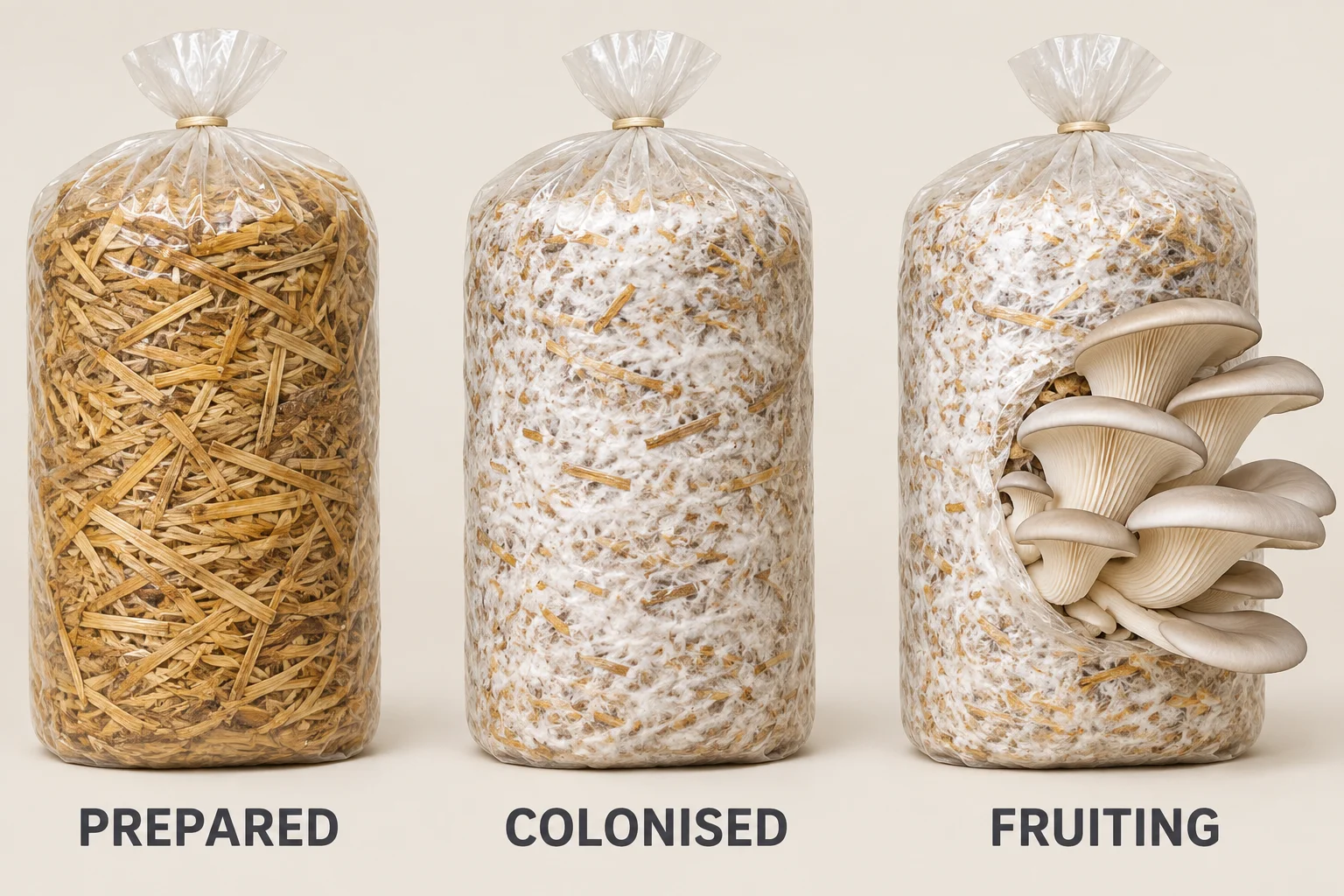
A conceptual stage sequence, not three guaranteed dates or a visual test for healthy mycelium. Use the applicable species, strain and bag method.
See where this fits in the full workflow →01Opening the bags
Once a bag is fully white and at least 16-18 days old, cut away or remove the polythene; TNAU cuts round openings of 5 cm. Arrange bags on shelves or hang them with 15-20 cm between each so air reaches every surface.
The folder says small buds, called pinheads, appear about a week after opening and reach full size in 4-5 more days. TNAU reports pinheads in 2-3 days and harvest 4 days later; climate and species explain the gap, so record your own.
Everything the bag did not need during the run, it needs now: water in the air, fresh air and light.
02Temperature and humidity
Fruit at the band for your species: 18-22 C for P. florida, 22-26 C for P. sajor-caju and P. flabellatus, 14-18 C for P. eryngii. Warmer than its band, sajor-caju turns brown and thin.
Relative humidity, RH, is the water in the air as a share of the most it could hold. The manual says all Pleurotus need 75-85 per cent RH during fruiting; TNAU gives 80-85 per cent at 23-25 C. Raise it by spraying floor, walls and air two or three times a day and hanging wet gunny at windows.
Never leave water standing on caps; a water film in warm air lets bacteria spot and rot them.
03Fresh air and CO2
Mushrooms breathe out carbon dioxide, CO2, and a closed room fills with it. The manual wants less than 600 ppm during cropping; the folder allows up to 800 ppm. Both are DMR; without a meter, work to the stricter one.
The folder's method is to open windows or run exhaust fans two or three times a day. DMR describes the symptom of too much CO2 exactly: long stalk, small cap, a mushroom like the mouth of a trumpet. The mushroom is your meter.
Move air without blowing on the caps, which dries their edges. More air lowers RH, so spray again after venting.
04Light
Oyster needs light to form pinheads. The manual gives 200 lux for 8-12 hours a day; the folder asks for 6-8 hours from glazed windows or tube lights. A lux is a unit of light on a surface; 200 lux is a bright room, far below sunlight, and direct sun heats and dries bags.
Too little light looks like too much CO2: long stalk, small cap, poor yield. Below 100 lux the caps go pale yellowish; in very bright light they turn dark brown or grey. When you see long stalks, add air time first, then check light hours before blaming the spawn.
Tune one room by watching the mushrooms
- Hang a thermometer and hygrometer at bag height in the middle of the room.
- Vent for a fixed time morning, noon and evening; write the minutes.
- Spray floor and walls, never caps; check RH an hour later.
- Give 6-12 hours of light from a window or tube light.
- Measure stalk length and cap width on five mushrooms daily; if stalks lengthen, add air first.
Write in your farm diary: Temperature and RH morning and evening, venting minutes, light hours, stalk and cap sizes, pinhead date.
Mistakes that cost a crop
- Spraying water onto caps to raise humidity; a water film invites bacterial blotch.
- Sealing the room to hold humidity; CO2 climbs and you harvest stalks.
- Judging humidity by feel at the door; measure at bag level mid-room.
Check yourself
Three questions, instant answersLong stalk, small cap, trumpet shape mainly means:
DMR says Pleurotus need an RH during fruiting of:
If light is below 100 lux the caps turn:
An editorial self-check, not a certificate. Answers are not stored, not even on this device.
Words used in this lesson
- Pinhead
- The first tiny bud of a mushroom, also called a primordium.
- Relative humidity (RH)
- Water in the air as a percentage of the most it could hold at that temperature.
- CO2
- Carbon dioxide, the gas mushrooms breathe out; too much makes long stalks and small caps.
- Lux
- A unit of light falling on a surface; 200 lux is a well-lit room.
References & further reading
Species, strain, climate and production method must remain explicit.
Open current reference