


A practical guide to growing mushrooms in IndiaA joint educational initiative by MushroomWale & DMR Solan ↗
MushroomFarming.in

A joint educational initiative by

MushroomWale.com
ICAR–Directorate of Mushroom Research, Solan logoICAR–DMRSolan

MushroomFarming / article

Oyster mushroom climate

Interpret environment by Pleurotus species, strain, crop stage, crop load and room system. Evidence, method and India-context boundaries remain visible.

Practical explanation + detailed referenceSources & review ↓
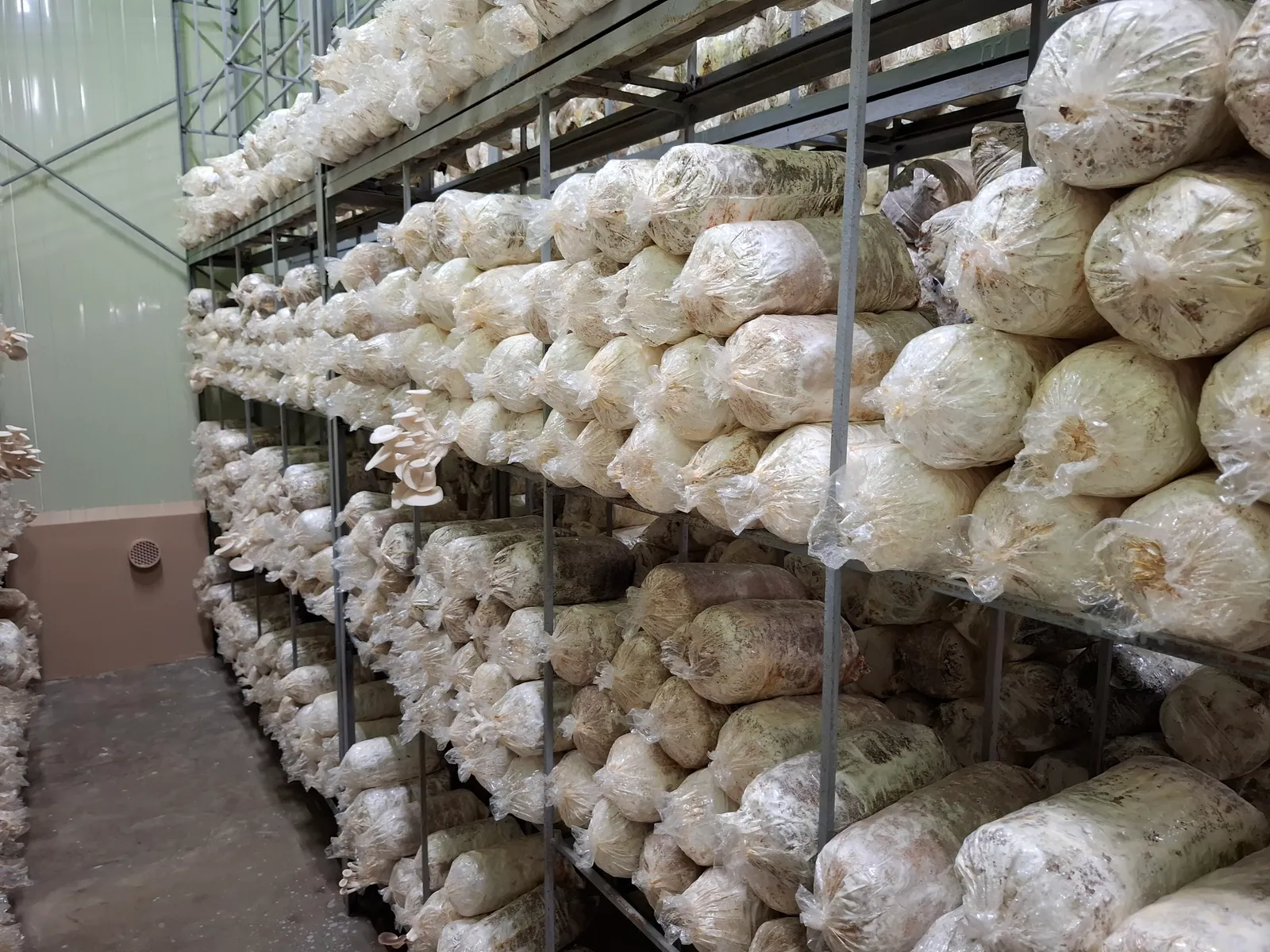
Long tiered metal racks packed with colonised oyster-mushroom fruiting bags inside a grow room, Bicol, Philippines.
Real cultivation photograph. Read its source for location and context; it is not a universal operating specification.MarvinBikolano · CC BY-SA 4.0View full photograph ↗
On this pageChoose a section, or keep reading below

Read this in the full guide: Understand the whole Oyster mushroom bag cycle →

Understand the topic

What you need to know.

The ICAR-DMR manual calls oyster cultivation simple, partly because most species tolerate wide ranges of temperature, humidity and carbon dioxide. Simple does not mean the room can be left alone. This page shows how the room has to change between spawn run and fruiting, how spraying, airing and cooling pull against each other, how to measure the room, and how to read the crop as a record of its climate. Species temperature bands and carbon dioxide limits have their own pages.

Teaching revised 2026-09-24. Source-linked editorial synthesis; this date does not imply independent technical review.

Part 01

One room, two climates: closed and dark, then open and lit

The manual says oyster does not need the controlled rooms that button mushroom needs, because most species tolerate wide ranges of temperature, humidity and carbon dioxide. What it does need is for the room to change at the right moment.

During spawn run the bags stay closed. The manual needs no ventilation and no high humidity at this stage, so no water is sprayed. The mycelium tolerates carbon dioxide levels that would ruin a fruiting crop, and it grows best at 22 to 26 °C.

Once the polythene comes off, the needs reverse. All Pleurotus species need 75 to 85 percent relative humidity while fruiting. The bags need light to start fruit bodies, and the room needs enough ventilation to keep carbon dioxide low.

The manual allows spawned bags to be kept or hung in the cropping room itself during spawn run. If you work that way, the room's routine has to switch on the day the bags are opened.

Source: ICAR-DMR manual, 2011

How the room changes from spawn run to fruiting

  1. Spawn runBags closed. No ventilation, no spraying; mycelium grows best at 22 to 26 °C (manual).
  2. Opening dayPolythene comes off and the room routine switches the same day.
  3. Fruiting75 to 85 percent humidity, light to start fruit bodies, and airing to keep carbon dioxide low (manual).
Part 02

Spraying, airing and cooling pull against each other

Every action in an oyster room changes more than one thing.

Spraying raises humidity, but water that stays on the caps is a problem. The manual links an offensive smell from the crop to bacteria growing on wet cap surfaces. So it asks for ventilators and exhaust fans to run, letting the extra moisture on the caps evaporate, and it asks for mushrooms to be picked before the day's spray.

Airing brings in fresh air and carries carbon dioxide away, but in hot, dry weather it carries moisture away too. That is why the manual calls for two to three sprays a day in dry heat and only one light spray in the humid monsoon.

Cooling works the same way. The manual warns that above 30 °C the mycelium stops growing and is killed. For a hot room the oyster folder suggests spraying the walls and roof, or running an air cooler, while making sure water does not collect on the bags. The same folder suggests an air cooler to hold humidity in the growing room.

So change one thing at a time, and watch the crop before you change the next.

Sources: ICAR-DMR manual, 2011 · ICAR-DMR oyster folder

One hot, dry fruiting day: each action shifts the next

  1. Pick firstHarvest before the day's spray (manual).
  2. SprayA fine mist raises humidity (manual).
  3. Air and fansCarbon dioxide goes out and wet caps dry, but moisture leaves with the air.
  4. Spray againIn dry heat the manual recommends two to three sprays a day.
Part 03

Measure the room with the instruments the manual lists

The manual's equipment list for a small oyster unit includes maximum and minimum thermometers, dry and wet bulb thermometers and bed thermometers. Each one answers a different question about the room.

  1. Record the highs and lowsHang a maximum and minimum thermometer at bag height and write down each day's highest and lowest reading. The manual asks for this daily record for both the room and the beds.
  2. Read the bag, not only the airPush a bed thermometer into a bag. The manual reports that the bed is generally 2 to 4 °C warmer than the room air, so the bag tells you what the crop is living in.
  3. Check humidityUse the dry and wet bulb pair to check the air against the 75 to 85 percent band for fruiting.
  4. Log every actionWrite down each spray and each airing with its time, beside the readings, so a change in the crop can be matched to what was done.
  5. Log the cropNote stalk length, cap size and cap colour on a few clusters each day. The next section explains what they tell you.

Source: ICAR-DMR manual, 2011

Part 04

Read the crop as a record of the room

The manual lists the faults that cut an oyster crop: bad aeration, fluctuating temperature, careless spraying and insufficient light, along with old or contaminated straw and poor hygiene. Most of the room faults leave a visible mark on the mushrooms.

  • Long stalks with small caps, shaped like the mouth of a trumpet: carbon dioxide is too high. Too little light produces the same shape, the manual says, so check both.
  • Pale yellowish caps point to light below 100 lux. Dark brown, grey or blackish caps point to very bright light.
  • Cap colour shifting through the season in the same species: temperature. The temperature page gives the manual's examples.
  • An offensive smell from the caps: bacteria on wet cap surfaces. Water is standing on the caps and the air is not moving it off.
  • Straw surface dry to the touch: the room needs a spray.

Source: ICAR-DMR manual, 2011

Part 05

When two needs clash, which one to serve first

Use these rules when one fix would make another problem worse.

IfThe room is hot and dry during fruiting.
ThenKeep to the airing schedule and make up the lost moisture with more sprays. An air cooler helps hold humidity, the oyster folder suggests.
IfThe room is hot during spawn run.
ThenCool the walls and roof or run an air cooler. Do not open or wet the bags: the manual keeps them closed and unsprayed until fruiting.
IfStalks are long and you cannot tell whether air or light is short.
ThenChange one of them, record it, and compare the next clusters. Changing both at once hides which one was the cause.
IfMushrooms are ready and the day's spray is due.
ThenPick first, then spray.
IfCaps are wet and smell, but the room also needs humidity.
ThenKeep the ventilators and exhaust fans running so the caps dry, and put the next spray on the floor and walls rather than on the clusters.

Sources: ICAR-DMR manual, 2011 · ICAR-DMR oyster folder

Go deeper

Technical reference, records and tools.

Detailed crop-stage information, parameters, diagrams and specialist tools are kept together below. This material retains its source conditions and review limits.

Open the complete technical reference

oyster · environment

Oyster mushroom climate

Interpret environment by Pleurotus species, strain, crop stage, crop load and room system. Evidence, method and India-context boundaries remain visible.

Publication
Public editorial page
Evidence records
5
External review
Not yet recorded
Wild ID
Not provided
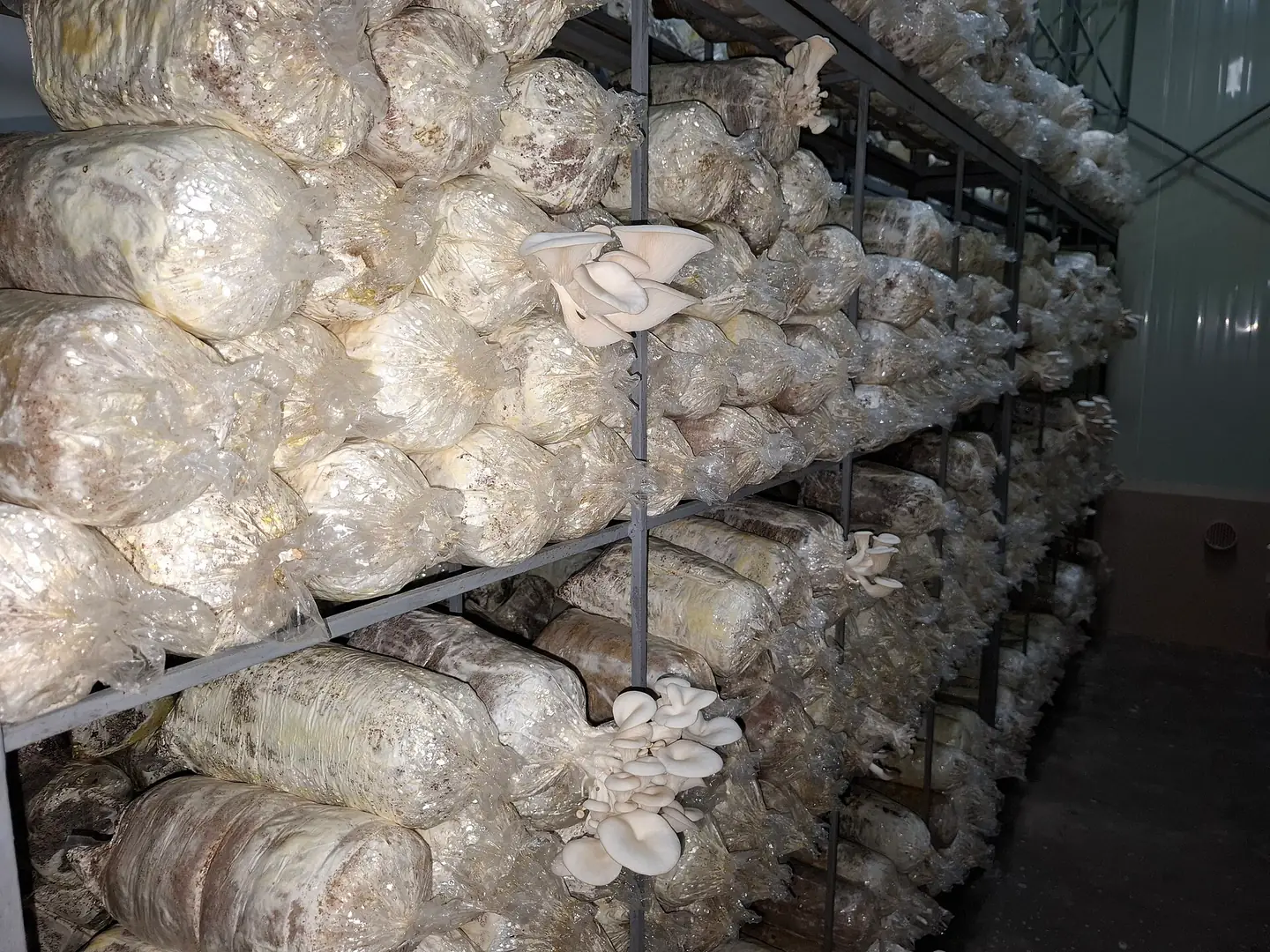
Long metal racks packed with white oyster mushroom bags, some carrying mushroom clusters.
A fruiting room at an oyster mushroom farm in the Philippines, with metal racks of colonised bags and clusters forming along the rows. Photo: MarvinBikolano, CC BY-SA 4.0. Source

The oyster bag method in six steps

Source: ICAR-DMR oyster folder and the 2011 manual.

  1. Chop the strawWheat or paddy straw cut to 2 to 3 cm (manual method uses 5 to 10 cm).Day 0
  2. Hot-water treatmentFolder: 60 to 65 °C for 20 to 30 minutes (manual: 65 to 70 °C for one hour), then drain off the excess water.Day 0
  3. Spawn and fill bags2 to 3 percent spawn on wet-straw weight, in layers; 10 to 12 holes per bag (manual: 10 to 15).Day 0
  4. Spawn run22 to 26 °C in the dark for 15 to 25 days until the bag is white through.Days 1 to 25
  5. Open the bag and fruitLight, fresh air, 75 to 85 percent humidity, CO₂ below 600 ppm (folder: 800 ppm). Pins in about a week.From day 16
  6. Harvest and next flushNext flush 8 to 10 days later. Manual: 500 to 700 kg from one tonne of dry straw in 45 to 60 days.Up to day 60

Quick orientation

Interpret environment by Pleurotus species, strain, crop stage, crop load and room system. This topic belongs to a Pleurotus substrate-bag or validated block system. The species or strain, substrate treatment and fruiting-air context must travel together.

01

Species identity and spore exposure

‘Oyster’ is a Pleurotus group, not one climate programme. ICAR-DMR distinguishes warm-weather P. flabellatus, P. sajor-caju and P. djamor (20–28°C) from lower-temperature P. florida, P. ostreatus, P. eryngii and P. cornucopiae (12–20°C). Record the species and strain before selecting a range.

02

Why this stage matters

Interpret environment by Pleurotus species, strain, crop stage, crop load and room system.

03

Method boundary

This topic belongs to a Pleurotus substrate-bag or validated block system. The species or strain, substrate treatment and fruiting-air context must travel together.

  • Confirm the culture as Pleurotus spp., with strain or variety recorded where available.
  • Confirm one method: straw bag or validated lignocellulosic bag or block.
  • Record substrate source, treatment class, batch and contamination observations.
04

Interpret the environment

Air temperature, substrate or block temperature, humidity, fresh air, light and crop response interact. A number without stage, strain, sensor position and source is not an operating instruction.

05

Evidence status

The page publishes process relationships supported by primary institutional sources. Numeric recipes remain absent where source context, strain identity or specialist review is incomplete.

Production method records

One species can require more than one cultivation model.

OYS-STRAW-BAG

Treated straw bag system

Substrate
clean cereal straw with method evidence
Container
perforated or opened cultivation bag
Treatment
Pasteurization-class treatment or another validated method; not interchangeable with sterilization.
Scale context
home trial to commercial batch, with different hygiene and climate responsibilities
  1. Material check
  2. Treatment
  3. Cooling and moisture check
  4. Spawning
  5. Spawn run
  6. Fruiting transition
  7. Cluster harvest

Governed climate records

Published ranges carry their operating context.

Source-backed records are shown where stage and production method are clear. Empty records remain visibly pending rather than being filled with generic internet values.

CLIMATE-OYSTER-SPAWN-RUNsource-contextual

spawn run

23–27 °C air; species and strain still govern suitability
Season / source context
ICAR-DMR March 2026 crop advisory; use only with identified Pleurotus species and local room observations.
Production
Bag spawn run in the seasonal advisory context; substrate temperature can exceed room air.
Strain
Source did not attach a strain
CLIMATE-OYSTER-FRUITINGsource-contextual

fruiting

Warm group: 20–28 °C; cool group: 12–20 °C — only after recording the Pleurotus species and strain
Season / source context
ICAR-DMR oyster FAQ species grouping; this is not one universal 12–28 °C operating band.
Production
Warm group in the cited FAQ: P. flabellatus, P. sajor-caju and P. djamor. Cool group: P. florida, P. ostreatus, P. eryngii and P. cornucopiae.
Strain
Source did not attach a strain

Trace the boundary

Evidence and limitations

institutional · tier AResearch programmes

Current institutional scope for cultivated and specialty mushroom research in India.

Research scope does not by itself establish a farm recommendation, commercial readiness or strain-specific operating range.

Open primary source
technical-bulletin · tier ATechnologies developed by ICAR-DMR

Institutional method history for oyster, milky, paddy straw, shiitake and selected specialty mushrooms.

Method descriptions are context-specific and contain numeric and broad substrate statements that require independent technical review before operational publication.

Open primary source
current-advisory · tier ACurrent crop advisory

Time-stamped Indian seasonal crop context and the need to choose oyster species for conditions.

Chemical directions are excluded from this platform unless a current label and jurisdiction are independently verified.

Open primary source
technical-bulletin · tier AOyster mushroom cultivation FAQ

Indian institutional distinction between warm- and cool-fruiting Pleurotus species, plus an occupational spore-exposure warning.

The species bands are source context, not a strain guarantee. Generic yield, storage and legacy chemical statements are not carried into operational guidance.

Open primary source
technical-bulletin · tier APost-harvest technology of mushrooms

Species-specific post-harvest deterioration patterns and handling context.

Historic shelf-life statements depend on maturity, handling, packaging and storage conditions and are not reproduced as guarantees.

Open primary source

Read the evidence

Sources & review.

Editorial update: 2026-09-03. Independent technical review is not recorded for this entry.

  1. Research programmes ↗

    ICAR Directorate of Mushroom Research

  2. Technologies developed by ICAR-DMR ↗

    ICAR Directorate of Mushroom Research · 2020

  3. Current crop advisory ↗

    ICAR Directorate of Mushroom Research · 2026

  4. Oyster mushroom cultivation FAQ ↗

    ICAR Directorate of Mushroom Research

  5. Post-harvest technology of mushrooms ↗

    ICAR Directorate of Mushroom Research

Reading a source is not the same as applying its instructions to every farm. Confirm species, strain, crop stage, system, region and publication date. Old chemical recommendations are not current-use instructions.

See something that needs correcting? Tell us →