


A practical guide to growing mushrooms in IndiaA joint educational initiative by MushroomWale & DMR Solan ↗
MushroomFarming.in

A joint educational initiative by

MushroomWale.com
ICAR–Directorate of Mushroom Research, Solan logoICAR–DMRSolan

MushroomFarming / article

Oyster mushroom temperature context

Separate room air, substrate, outdoor condition and crop-stage temperature evidence. Evidence, method and India-context boundaries remain visible.

Practical explanation + detailed referenceSources & review ↓
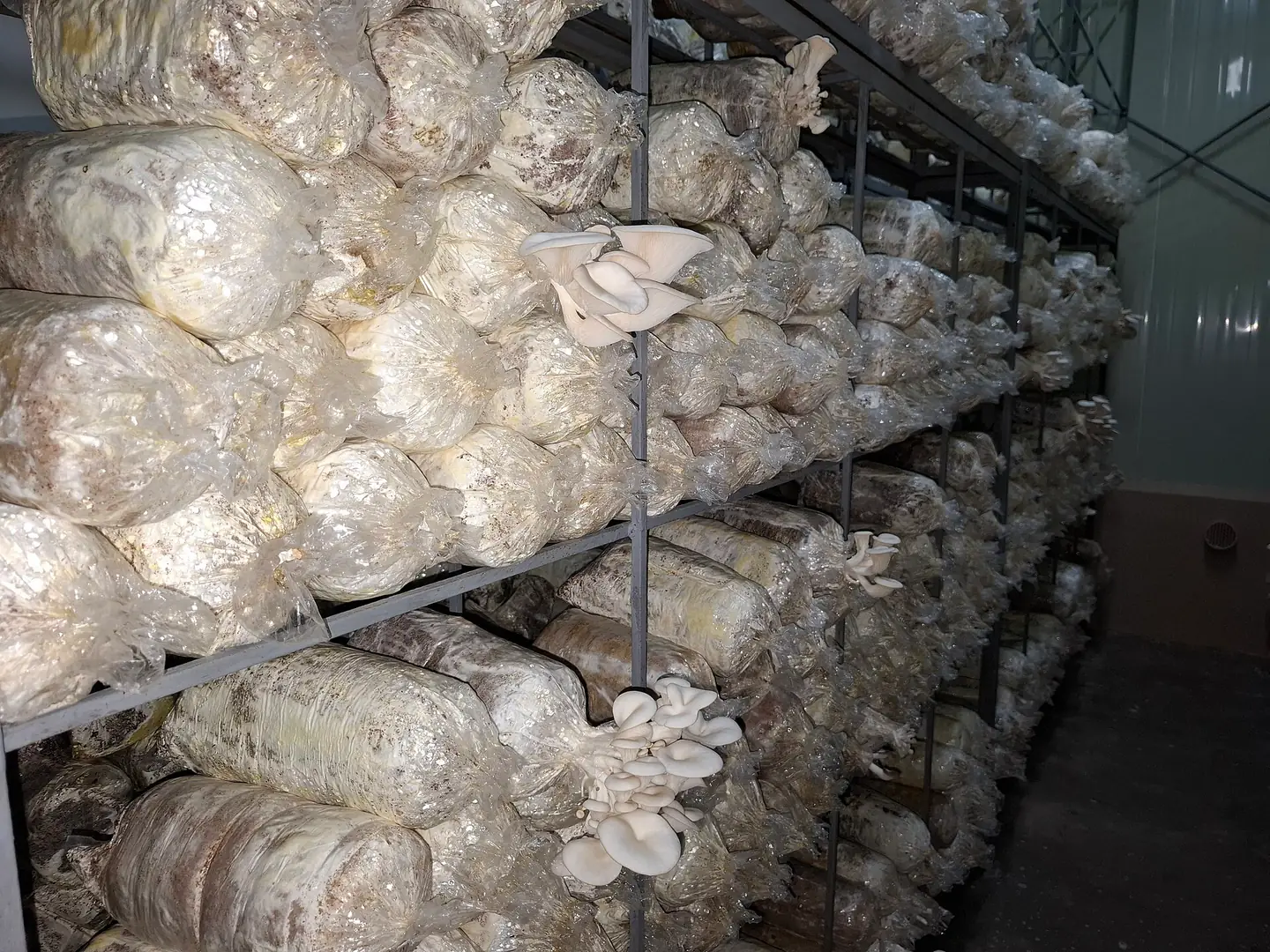
Long metal racks packed with white oyster mushroom bags, some carrying mushroom clusters.
Real cultivation photograph. Read its source for location and context; it is not a universal operating specification.MarvinBikolano · CC BY-SA 4.0View full photograph ↗
On this pageChoose a section, or keep reading below

Read this in the full guide: Understand the whole Oyster mushroom bag cycle →

Understand the topic

What you need to know.

Oyster is a group of species, and each one fruits in its own temperature band. This page sets out the spawn run and fruiting temperatures ICAR-DMR publishes, shows where its documents differ, describes what happens to the crop outside its band, and helps you match the species to the season where you farm. How temperature works together with humidity and air is on the climate page.

Teaching revised 2026-09-24. Source-linked editorial synthesis; this date does not imply independent technical review.

Part 01

Spawn run: a best band, and a ceiling that kills

Spawn run is the most forgiving stage for temperature, but it has a hard upper limit. These figures are for the closed, colonising bag. Note the two ranges for mycelium growth: both come from the same chapter of the manual.

Best for mycelium22 to 26 °CMycelium can grow between 10 and 30 °C; another paragraph of the same chapter gives 20 to 30 °C.
Upper limitabove 30 °CIn the cropping room this stops the mycelium growing and kills it.
Crop advisory, March 202623 to 27 °C airA seasonal advisory figure for bag spawn run. It notes that the substrate can run warmer than the air.
Heat added by supplements2 to 3 °C or moreSupplements mixed into the straw raise its temperature this much, so the manual does not advise them in summer.

Sources: ICAR-DMR manual, 2011 · ICAR Directorate of Mushroom Research: Current crop advisory

Part 02

Warm and cool species, and why cool ones need a cold shock

The manual sorts oyster species by the temperature they fruit at. Winter, or low-temperature, species fruit at 10 to 20 °C. Summer, or moderate-temperature, species fruit at 16 to 30 °C. It lists P. flabellatus, P. sapidus, P. citrinopileatus and P. sajor-caju as summer species, and P. ostreatus, P. florida, P. eryngii, P. fossulatus and P. cornucopiae as low-temperature ones.

The two groups do not behave alike. Summer species can still fruit when it is cool. Winter species will not fruit when it is warm: they need a drop in temperature, a cold shock, to start forming fruit bodies. So a cool species in a warm room can sit fully white and give nothing.

The ICAR-DMR oyster FAQ draws the line differently: 20 to 28 °C for P. flabellatus, P. sajor-caju and P. djamor, and 12 to 20 °C for P. florida, P. ostreatus, P. eryngii and P. cornucopiae. Both come from ICAR-DMR. Treat a band as belonging to the strain you bought, and ask the spawn supplier which group that strain is in.

Sources: ICAR-DMR manual, 2011 · ICAR Directorate of Mushroom Research: Oyster mushroom cultivation FAQ

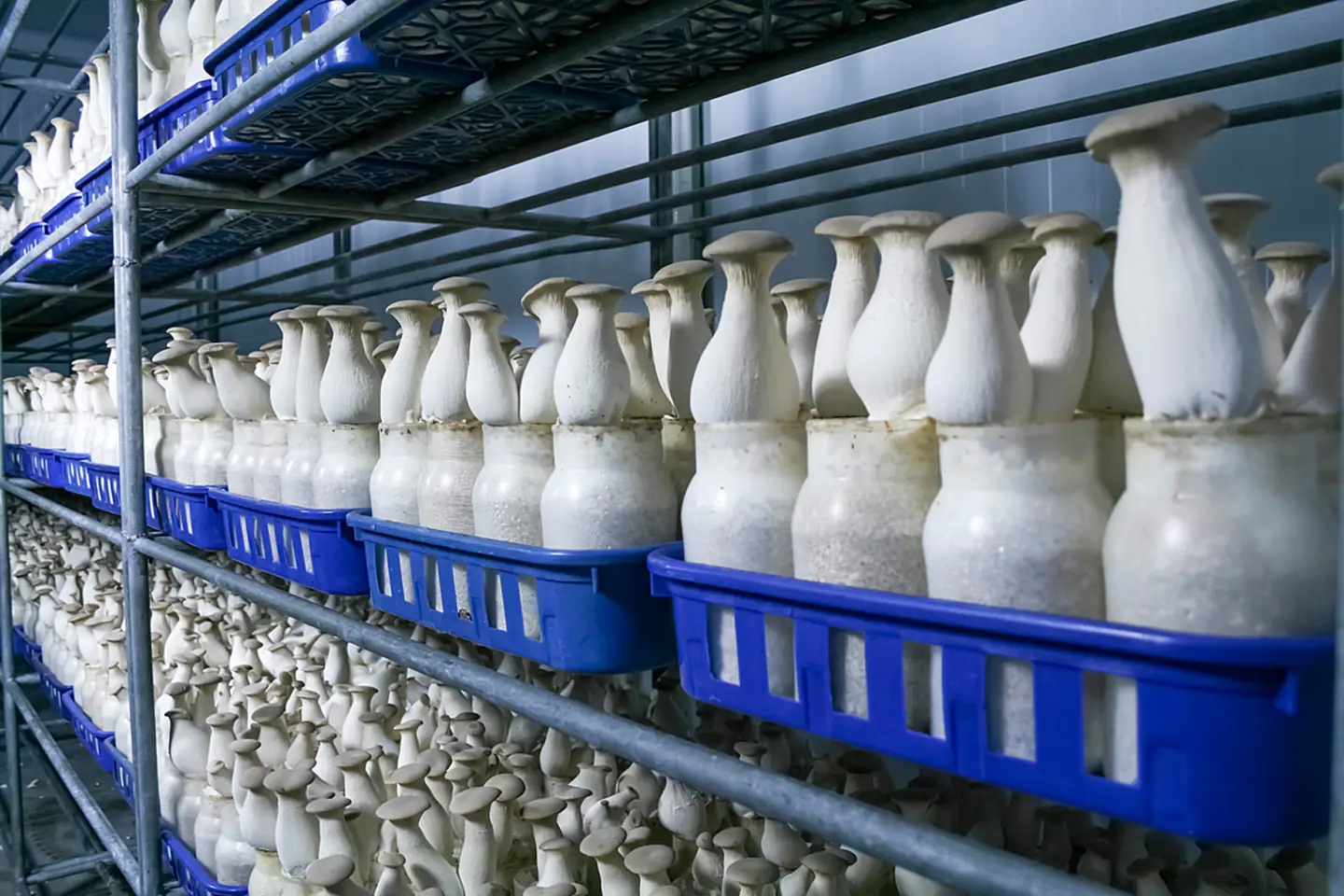
Rows of white king oyster mushrooms with thick stems rising from bottles in blue baskets on metal shelving.
King oyster (P. eryngii) growing from plastic bottles on metal racks in Spain. Every ICAR-DMR list that names this species puts it with the cool-weather oysters. Photo: Pradejoniensis, CC BY-SA 3.0. Source
Part 03

Fruiting bands species by species, and where the documents differ

The ICAR-DMR seasonal folder gives a fruiting band for each species. P. florida is the one to watch. The manual lists it as a low-temperature species and also names a winter strain of it, while its table of strains for India places P. florida in both the winter and the summer season. The strain decides, so record it.

P. florida18 to 22 °CSeasonal folder. The FAQ puts it in the 12 to 20 °C group.
P. sajor-caju22 to 26 °CSeasonal folder. A summer species in the manual.
P. flabellatus22 to 26 °CSeasonal folder. A summer species in the manual.
P. eryngii14 to 18 °CSeasonal folder. In the cool group in the manual and the FAQ.
A wild P. cornucopiae15 to 25 °CA wild isolate the manual reports as suitable across this range.

Sources: ICAR-DMR seasonal folder · ICAR-DMR manual, 2011 · ICAR Directorate of Mushroom Research: Oyster mushroom cultivation FAQ

Part 04

What the crop shows when it is outside its band

The manual says growing temperature changes the quality of the crop as well as its yield. These are the signs it describes.

  • P. sajor-caju grown at 15 to 19 °C is white to dull white, with a high dry matter content.
  • The same species grown at 25 to 30 °C turns whitish brown to dark brown and carries less dry matter.
  • P. florida has a light brown cap at 10 to 15 °C, which changes to pale white or yellowish at 20 to 25 °C.
  • A winter species kept warm stays white and does not fruit, because it has not had its cold shock.
  • A summer species caught in a cool spell can still fruit, the manual says; expect the colour and dry matter changes above.

Source: ICAR-DMR manual, 2011

Part 05

Match the species to the season where you farm

The ICAR-DMR folders turn the bands into a calendar. Choose a species for the temperature your room will actually hold during fruiting, not the one you would like it to hold.

IfIt is summer, or your room stays warm.
ThenGrow a summer species. The oyster folder names P. sajor-caju, P. flabellatus, P. sapidus, P. djamor and P. citrinopileatus.
IfIt is winter and the air has turned cool.
ThenThe oyster folder advises P. florida or P. cornucopiae.
IfYou farm in the north Indian plains.
ThenThe seasonal folder's calendar grows oyster from September to May.
IfYou farm in the mid hills.
ThenThe calendar allows oyster all year round.
IfYou farm in the high hills.
ThenThe calendar limits oyster to May to August.
IfYou farm in central or western India.
ThenPlan oyster for any season but summer, the one season the seasonal folder leaves out there.
IfYou farm in a coastal state.
ThenThe seasonal folder says oyster can be grown all year in natural conditions.

Sources: ICAR-DMR seasonal folder · ICAR-DMR oyster folder

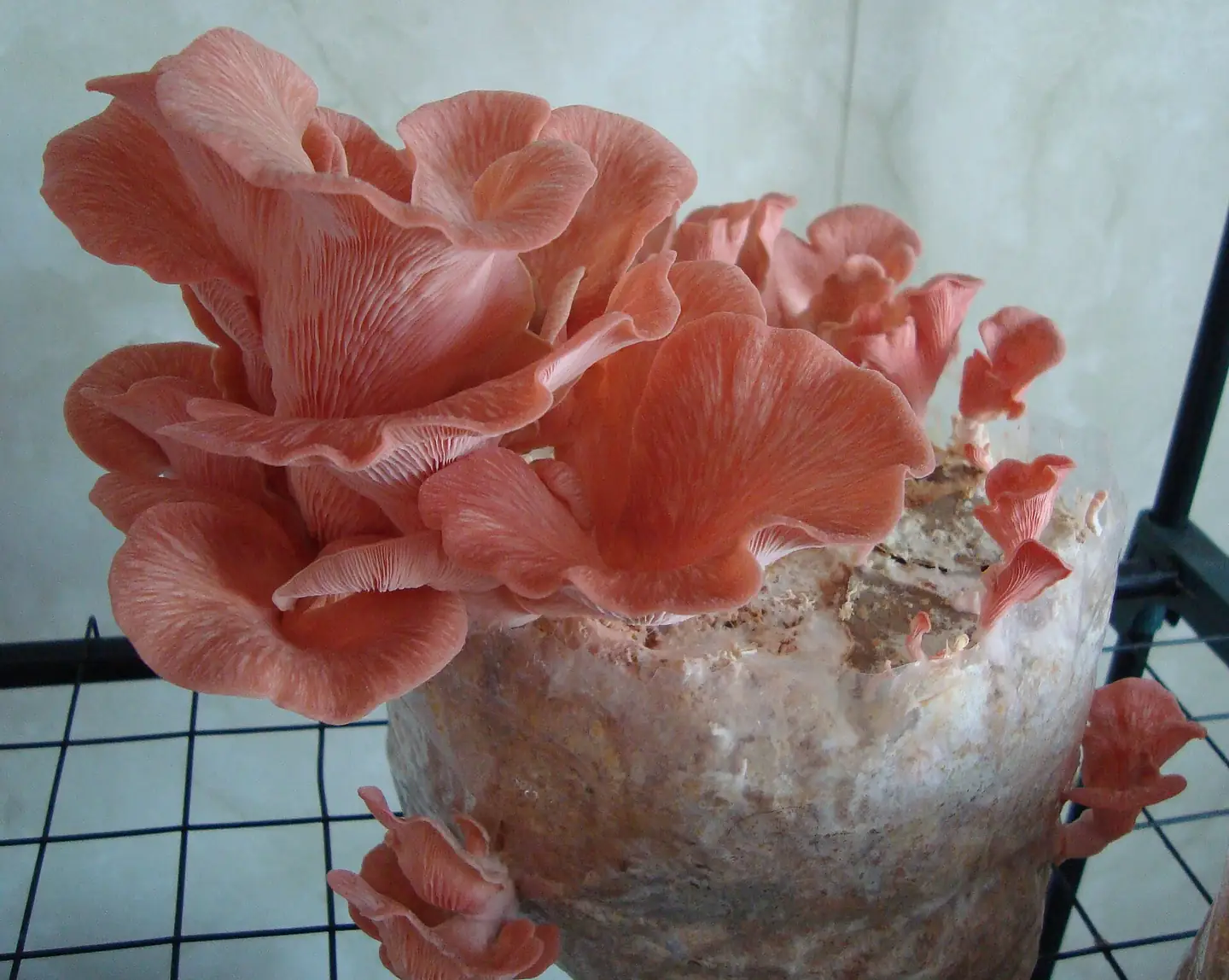
Large frilly pink oyster mushroom caps growing from the top of a plastic substrate bag on a wire shelf.
Pink oyster (P. djamor) fruiting from a substrate bag on a wire rack. The oyster folder lists it among the species to grow in summer. Photo: Gerly123, CC BY-SA 3.0. Source

Go deeper

Technical reference, records and tools.

Detailed crop-stage information, parameters, diagrams and specialist tools are kept together below. This material retains its source conditions and review limits.

Open the complete technical reference

oyster · environment

Oyster mushroom temperature context

Separate room air, substrate, outdoor condition and crop-stage temperature evidence. Evidence, method and India-context boundaries remain visible.

Publication
Public editorial page
Evidence records
5
External review
Not yet recorded
Wild ID
Not provided
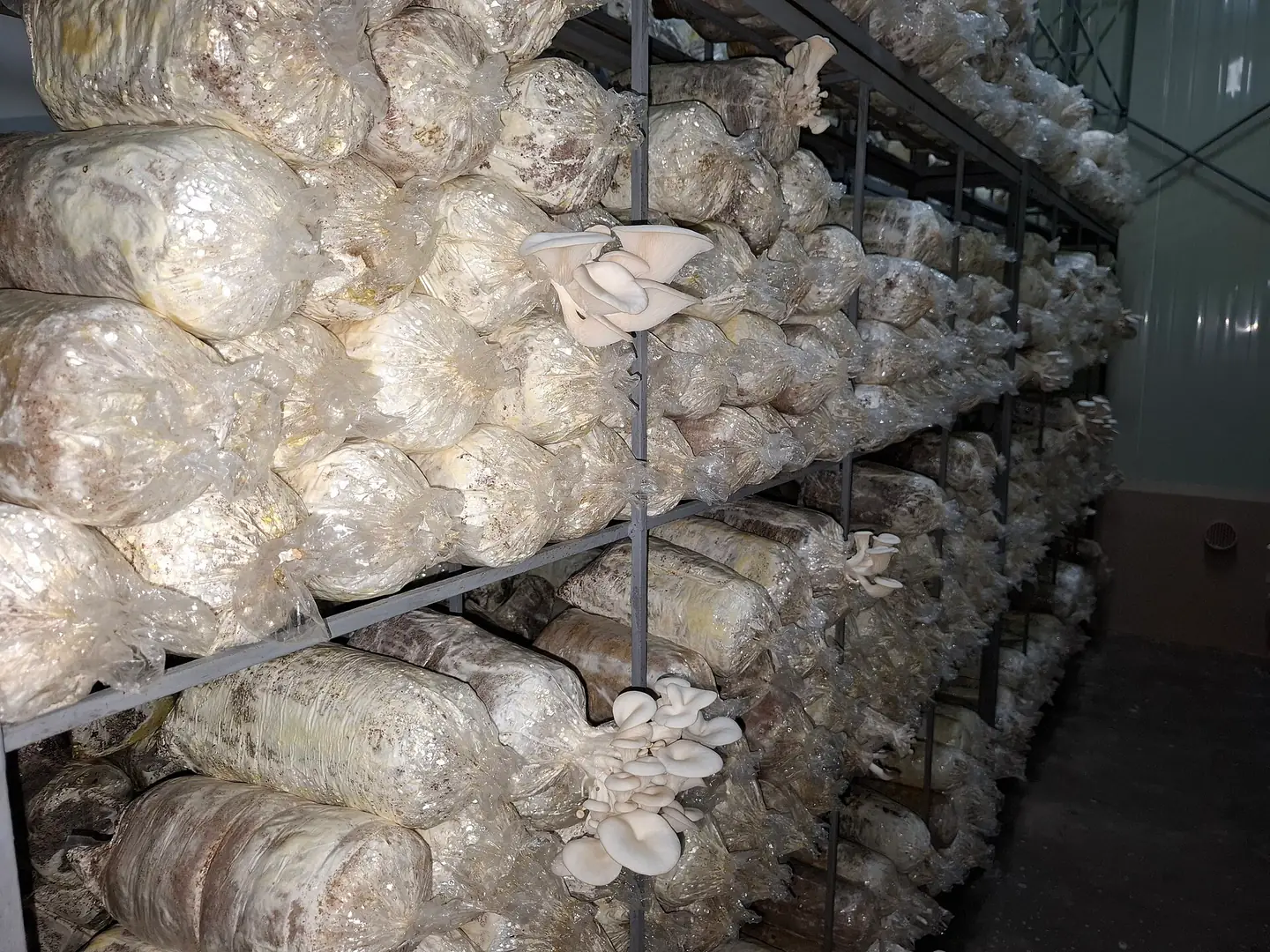
Long metal racks packed with white oyster mushroom bags, some carrying mushroom clusters.
A fruiting room at an oyster mushroom farm in the Philippines, with metal racks of colonised bags and clusters forming along the rows. Photo: MarvinBikolano, CC BY-SA 4.0. Source

The oyster bag method in six steps

Source: ICAR-DMR oyster folder and the 2011 manual.

  1. Chop the strawWheat or paddy straw cut to 2 to 3 cm (manual method uses 5 to 10 cm).Day 0
  2. Hot-water treatmentFolder: 60 to 65 °C for 20 to 30 minutes (manual: 65 to 70 °C for one hour), then drain off the excess water.Day 0
  3. Spawn and fill bags2 to 3 percent spawn on wet-straw weight, in layers; 10 to 12 holes per bag (manual: 10 to 15).Day 0
  4. Spawn run22 to 26 °C in the dark for 15 to 25 days until the bag is white through.Days 1 to 25
  5. Open the bag and fruitLight, fresh air, 75 to 85 percent humidity, CO₂ below 600 ppm (folder: 800 ppm). Pins in about a week.From day 16
  6. Harvest and next flushNext flush 8 to 10 days later. Manual: 500 to 700 kg from one tonne of dry straw in 45 to 60 days.Up to day 60

Quick orientation

Separate room air, substrate, outdoor condition and crop-stage temperature evidence. This topic belongs to a Pleurotus substrate-bag or validated block system. The species or strain, substrate treatment and fruiting-air context must travel together.

01

Species identity and spore exposure

‘Oyster’ is a Pleurotus group, not one climate programme. ICAR-DMR distinguishes warm-weather P. flabellatus, P. sajor-caju and P. djamor (20–28°C) from lower-temperature P. florida, P. ostreatus, P. eryngii and P. cornucopiae (12–20°C). Record the species and strain before selecting a range.

02

Why this stage matters

Separate room air, substrate, outdoor condition and crop-stage temperature evidence.

03

Method boundary

This topic belongs to a Pleurotus substrate-bag or validated block system. The species or strain, substrate treatment and fruiting-air context must travel together.

  • Confirm the culture as Pleurotus spp., with strain or variety recorded where available.
  • Confirm one method: straw bag or validated lignocellulosic bag or block.
  • Record substrate source, treatment class, batch and contamination observations.
04

Interpret the environment

Air temperature, substrate or block temperature, humidity, fresh air, light and crop response interact. A number without stage, strain, sensor position and source is not an operating instruction.

05

Evidence status

The page publishes process relationships supported by primary institutional sources. Numeric recipes remain absent where source context, strain identity or specialist review is incomplete.

Production method records

One species can require more than one cultivation model.

OYS-STRAW-BAG

Treated straw bag system

Substrate
clean cereal straw with method evidence
Container
perforated or opened cultivation bag
Treatment
Pasteurization-class treatment or another validated method; not interchangeable with sterilization.
Scale context
home trial to commercial batch, with different hygiene and climate responsibilities
  1. Material check
  2. Treatment
  3. Cooling and moisture check
  4. Spawning
  5. Spawn run
  6. Fruiting transition
  7. Cluster harvest

Governed climate records

Published ranges carry their operating context.

Source-backed records are shown where stage and production method are clear. Empty records remain visibly pending rather than being filled with generic internet values.

CLIMATE-OYSTER-SPAWN-RUNsource-contextual

spawn run

23–27 °C air; species and strain still govern suitability
Season / source context
ICAR-DMR March 2026 crop advisory; use only with identified Pleurotus species and local room observations.
Production
Bag spawn run in the seasonal advisory context; substrate temperature can exceed room air.
Strain
Source did not attach a strain
CLIMATE-OYSTER-FRUITINGsource-contextual

fruiting

Warm group: 20–28 °C; cool group: 12–20 °C — only after recording the Pleurotus species and strain
Season / source context
ICAR-DMR oyster FAQ species grouping; this is not one universal 12–28 °C operating band.
Production
Warm group in the cited FAQ: P. flabellatus, P. sajor-caju and P. djamor. Cool group: P. florida, P. ostreatus, P. eryngii and P. cornucopiae.
Strain
Source did not attach a strain

Trace the boundary

Evidence and limitations

institutional · tier AResearch programmes

Current institutional scope for cultivated and specialty mushroom research in India.

Research scope does not by itself establish a farm recommendation, commercial readiness or strain-specific operating range.

Open primary source
technical-bulletin · tier ATechnologies developed by ICAR-DMR

Institutional method history for oyster, milky, paddy straw, shiitake and selected specialty mushrooms.

Method descriptions are context-specific and contain numeric and broad substrate statements that require independent technical review before operational publication.

Open primary source
current-advisory · tier ACurrent crop advisory

Time-stamped Indian seasonal crop context and the need to choose oyster species for conditions.

Chemical directions are excluded from this platform unless a current label and jurisdiction are independently verified.

Open primary source
technical-bulletin · tier AOyster mushroom cultivation FAQ

Indian institutional distinction between warm- and cool-fruiting Pleurotus species, plus an occupational spore-exposure warning.

The species bands are source context, not a strain guarantee. Generic yield, storage and legacy chemical statements are not carried into operational guidance.

Open primary source
technical-bulletin · tier APost-harvest technology of mushrooms

Species-specific post-harvest deterioration patterns and handling context.

Historic shelf-life statements depend on maturity, handling, packaging and storage conditions and are not reproduced as guarantees.

Open primary source

Read the evidence

Sources & review.

Editorial update: 2026-09-03. Independent technical review is not recorded for this entry.

  1. Research programmes ↗

    ICAR Directorate of Mushroom Research

  2. Technologies developed by ICAR-DMR ↗

    ICAR Directorate of Mushroom Research · 2020

  3. Current crop advisory ↗

    ICAR Directorate of Mushroom Research · 2026

  4. Oyster mushroom cultivation FAQ ↗

    ICAR Directorate of Mushroom Research

  5. Post-harvest technology of mushrooms ↗

    ICAR Directorate of Mushroom Research

Reading a source is not the same as applying its instructions to every farm. Confirm species, strain, crop stage, system, region and publication date. Old chemical recommendations are not current-use instructions.

See something that needs correcting? Tell us →