Contents · choose a chapter or topic Start here 01 Oyster mushrooms02 What you need before startingUnderstand the basics 03 Three mushrooms, three different crop arrangements04 Preparation is not finished when heating stopsFrom crop to customer 05 Harvest weight and saleable grade are differentWhen something goes wrong 06 Describe the problem before naming a diseaseThe process 07 Choose the starting product08 Protect material after treatment09 Observe colonisation before fruiting10 Harvest for the buyerIn the field 11 Decide which part of production you will operate12 Choose your starting boundary13 Treat substrate preparation as a recorded batch14 Write it in your farm notebook15 Read colonisation and fruiting separately16 Compare a location problem with a batch problem17 Schedule bags around harvest and sales capacity18 Schedule bags around harvest and sales capacity · practical sequence19 Where the field guidance comes fromSpecies Selection 20 Species Selection21 Dhingri is a family, not one mushroom22 Dhingri is a family, not one mushroom · continued23 Read the DMR temperature table24 Read the DMR temperature table · continued25 Season by region in India26 Colour, grade and the unit you build27 Read the numbers in context28 Read the numbers in context29 Read the numbers in context30 Match a species to your next three months31 Avoid these mistakes32 Check your understanding33 Check your understanding34 Check your understanding35 Words used in this lesson36 Sources and field referenceSubstrate & Preparation 37 Substrate & Preparation38 What the straw gives the mushroom39 Hot water: the small grower's method40 Hot water: the small grower's method · continued41 Steam, chemical and sterile methods42 Steam, chemical and sterile methods · continued43 Contamination controls that cost nothing44 Read the numbers in context45 Read the numbers in context46 Treat one batch of straw by hot water this week47 Avoid these mistakes48 Check your understanding49 Check your understanding50 Check your understanding51 Words used in this lesson52 Sources and field referenceBag Preparation & Spawn Run 53 Bag Preparation & Spawn Run54 Filling and spawning the bag55 Filling and spawning the bag · continued56 What a spawn run needs, and what it does not57 Reading the bag day by day58 Space, flies and hygiene59 Space, flies and hygiene · continued60 Read the numbers in context61 Read the numbers in context62 Read the numbers in context63 Keep a bag diary for one batch64 Avoid these mistakes65 Check your understanding66 Check your understanding67 Check your understanding68 Words used in this lesson69 Sources and field referenceFruiting Environment 70 Fruiting Environment71 Opening the bags72 Opening the bags · continued73 Temperature and humidity74 Temperature and humidity · continued75 Fresh air and CO276 Fresh air and CO2 · continued77 Light78 Read the numbers in context79 Read the numbers in context80 Read the numbers in context81 Tune one room by watching the mushrooms82 Avoid these mistakes83 Check your understanding84 Check your understanding85 Check your understanding86 Words used in this lesson87 Sources and field referenceHarvest, Problems & Business 88 Harvest, Problems & Business89 Harvest and flushes90 Harvest and flushes · continued91 Packing and shelf life92 Packing and shelf life · continued93 Problems you will meet94 Business: what DMR's numbers are and are not95 Read the numbers in context96 Read the numbers in context97 Read the numbers in context98 Run one batch as a business test99 Avoid these mistakes100 Check your understanding101 Check your understanding102 Check your understanding103 Words used in this lesson104 Sources and field referencePractise and review 105 Mistakes to avoid106 Read three bags without guessingSources and next steps 107 Keep learning with the field guidesSubstrate & Preparation
Visual glossary Words used in this lesson 01 SubstrateThe straw or other material the mycelium feeds on.
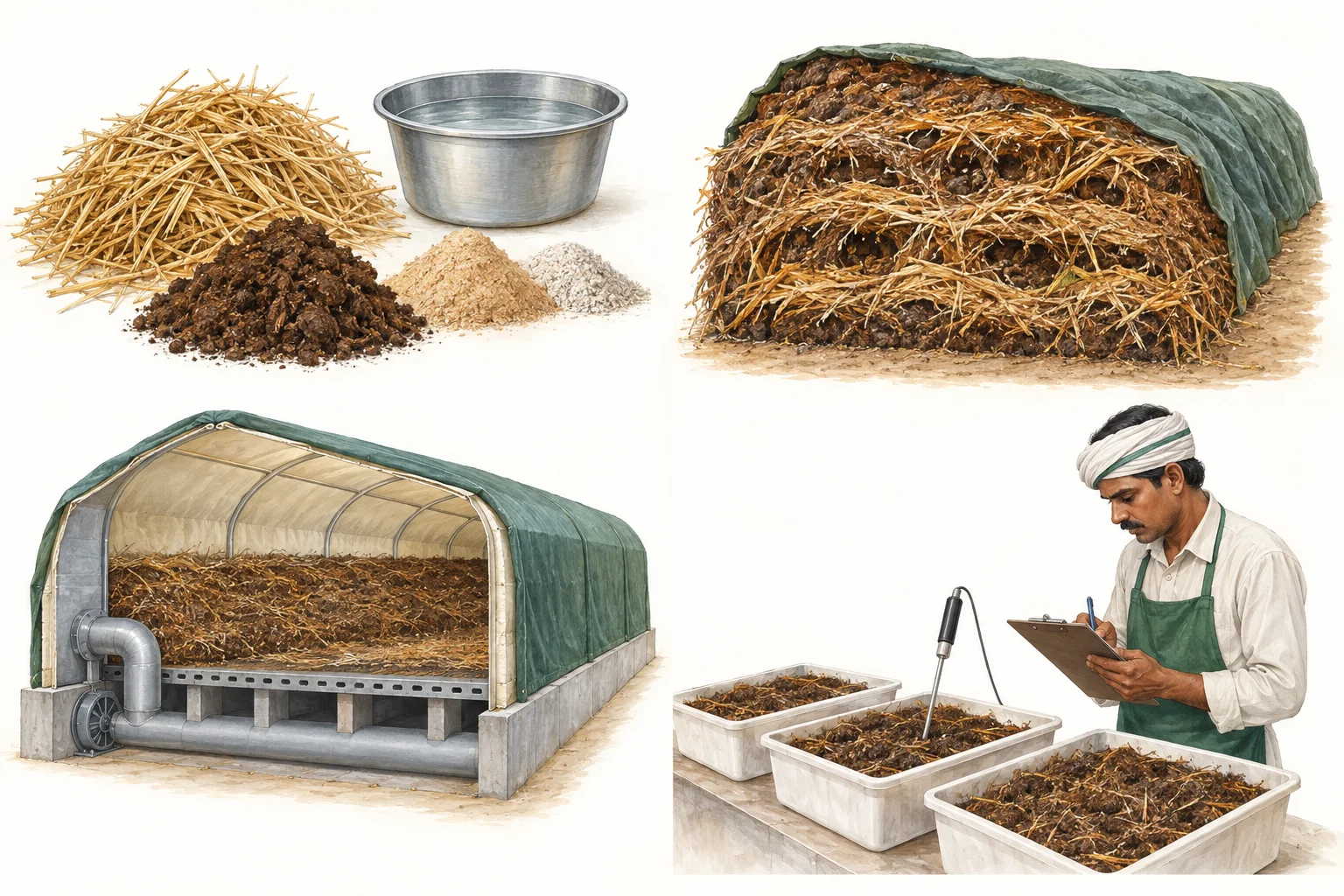
02 PasteurisationAI illustration · details AI teaching illustration. Air must pass through the loaded material. Pasteurisation, conditioning and cooling have distinct purposes.
Open full image ↗ Heating to kill most competitors while sparing helpful organisms.
03 Competitor mouldA fungus such as green Trichoderma that eats the straw faster than the mushroom.
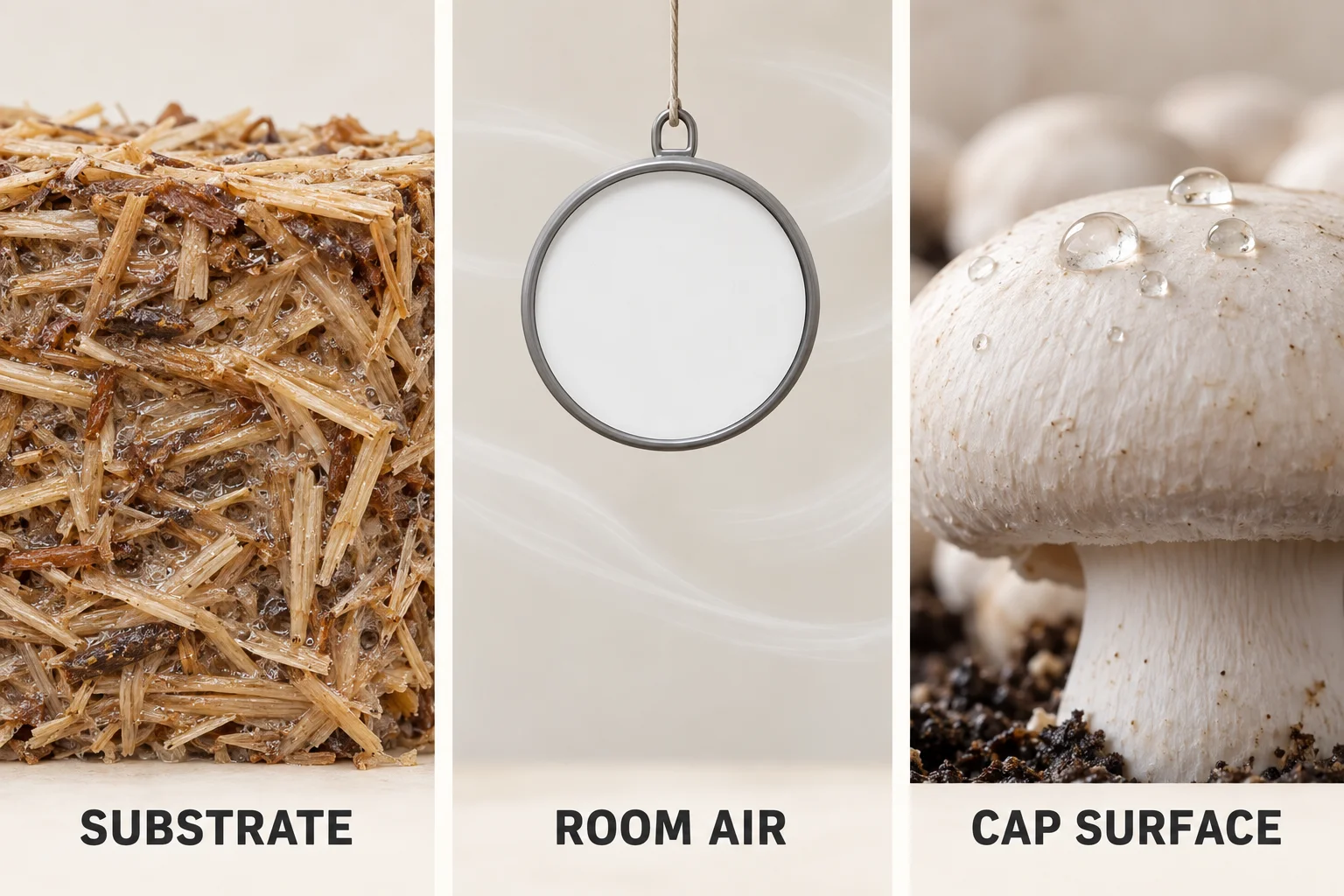
04 Squeeze testAI illustration · details AI teaching illustration. These are different observations, not moisture targets or an instruction to wet the crop.
Open full image ↗ Press a handful: right moisture leaves the palm damp with no drip.
English learning edition · Independent technical review pending. Keyboard: focus the reading page and use ← / →. Page turning does not mark practical competence.
Use Previous and Next to load each page. JavaScript is not required to read the book.