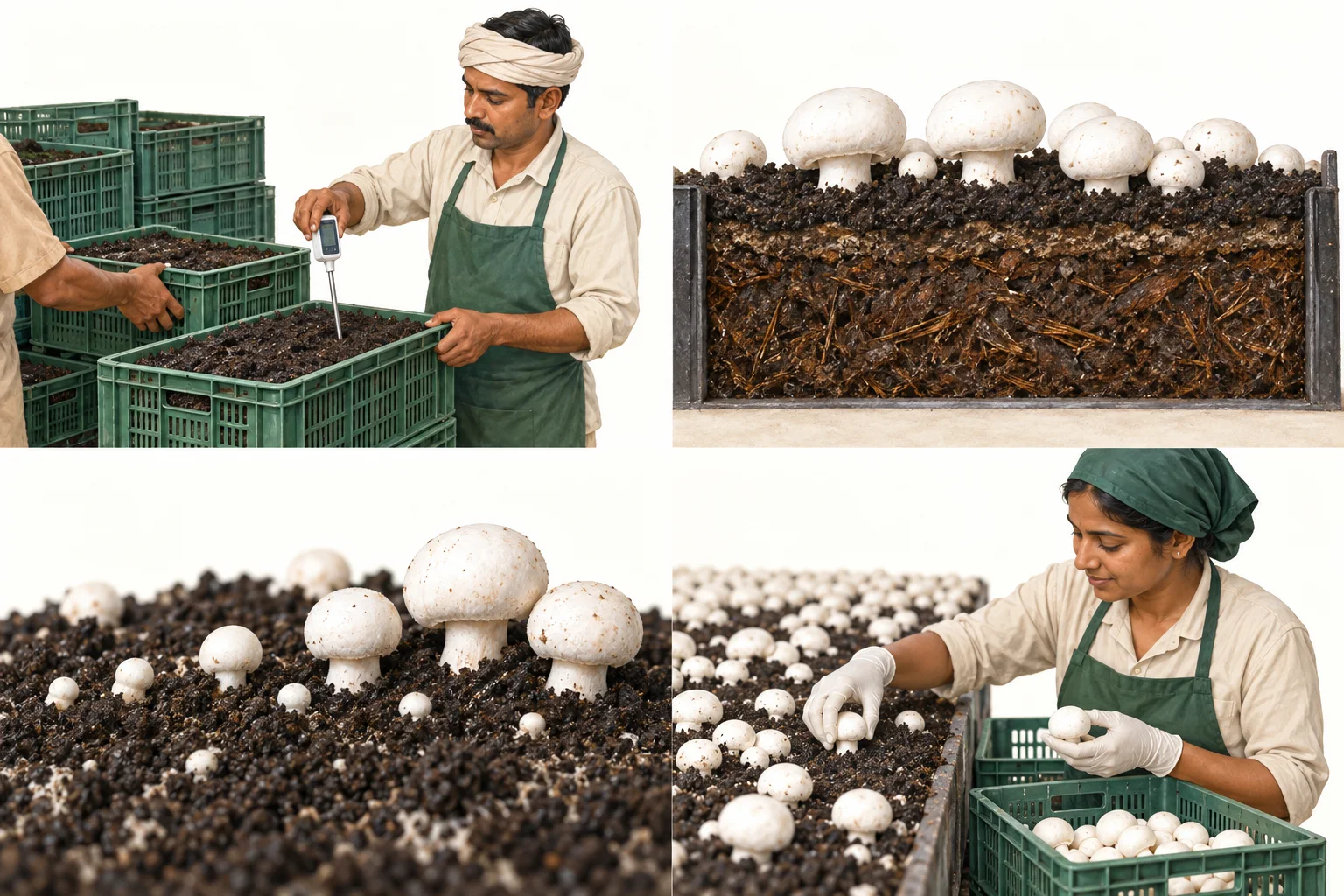
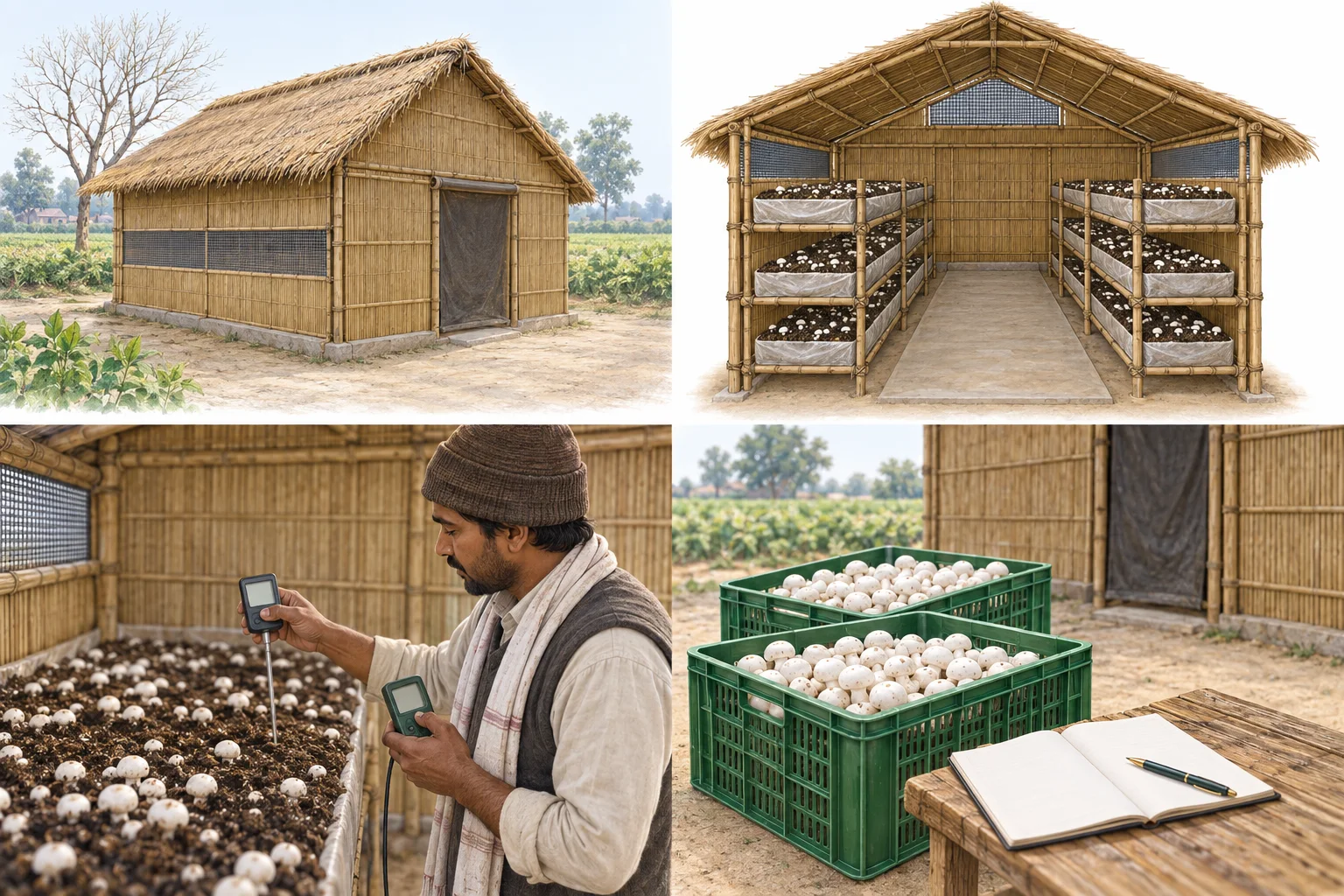
Understand what a mushroom farm actually does before buying equipment. This route connects biology, materials, room conditions, people and buyers. Finish with a small-crop plan that another person can follow.
Read one page, study its picture, then turn to the next. Use Contents whenever you want a particular topic.
Start here
Practical workbook
What you need before starting
Keep these beside you while you learn. You do not need to buy equipment just to read this book.
01
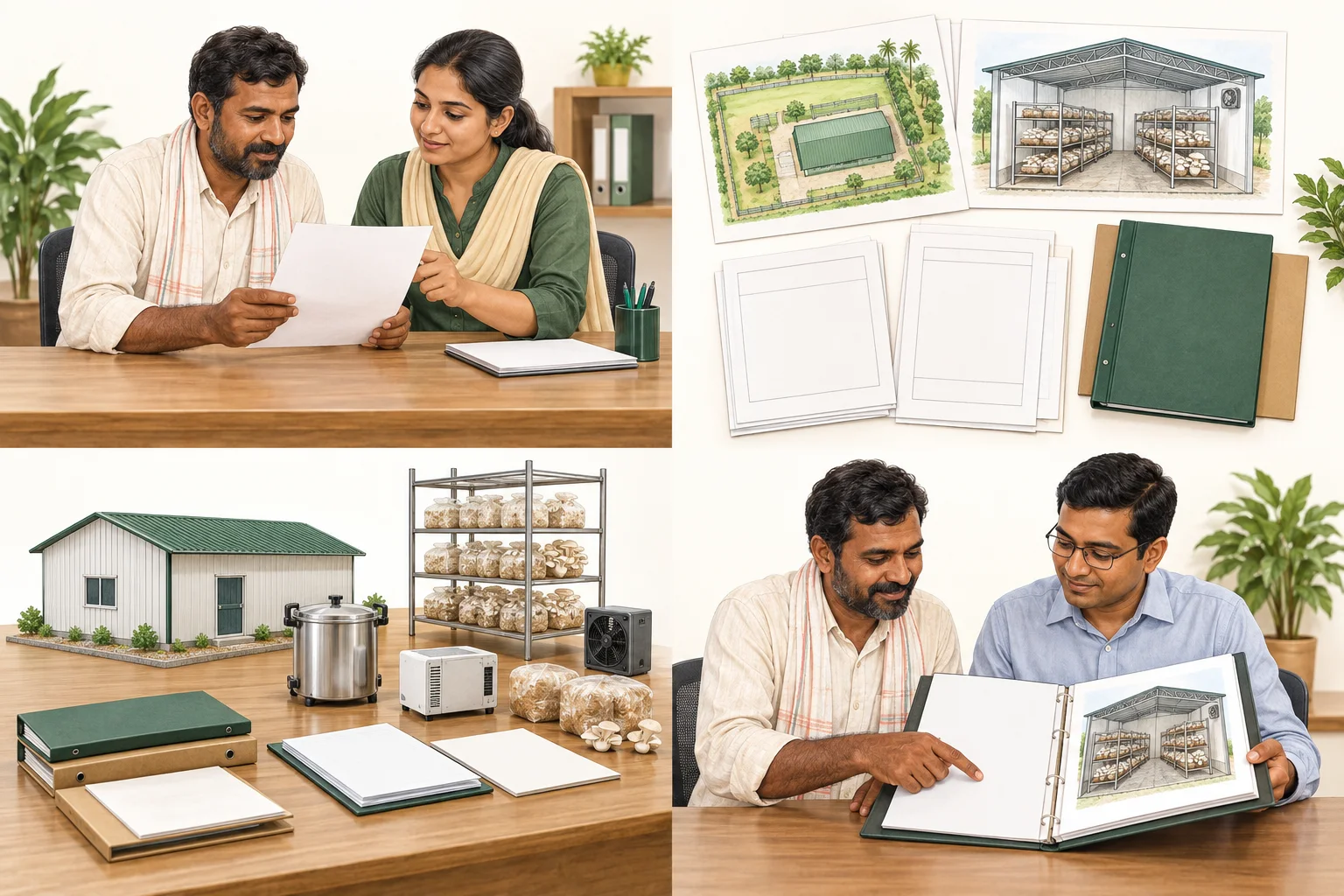
A sketch of the proposed space and a notebook
02
The cultivated species and strain you are considering
03
One supplier conversation and one buyer conversation
Understand the basics
Look closely
The mushroom is not the whole organism
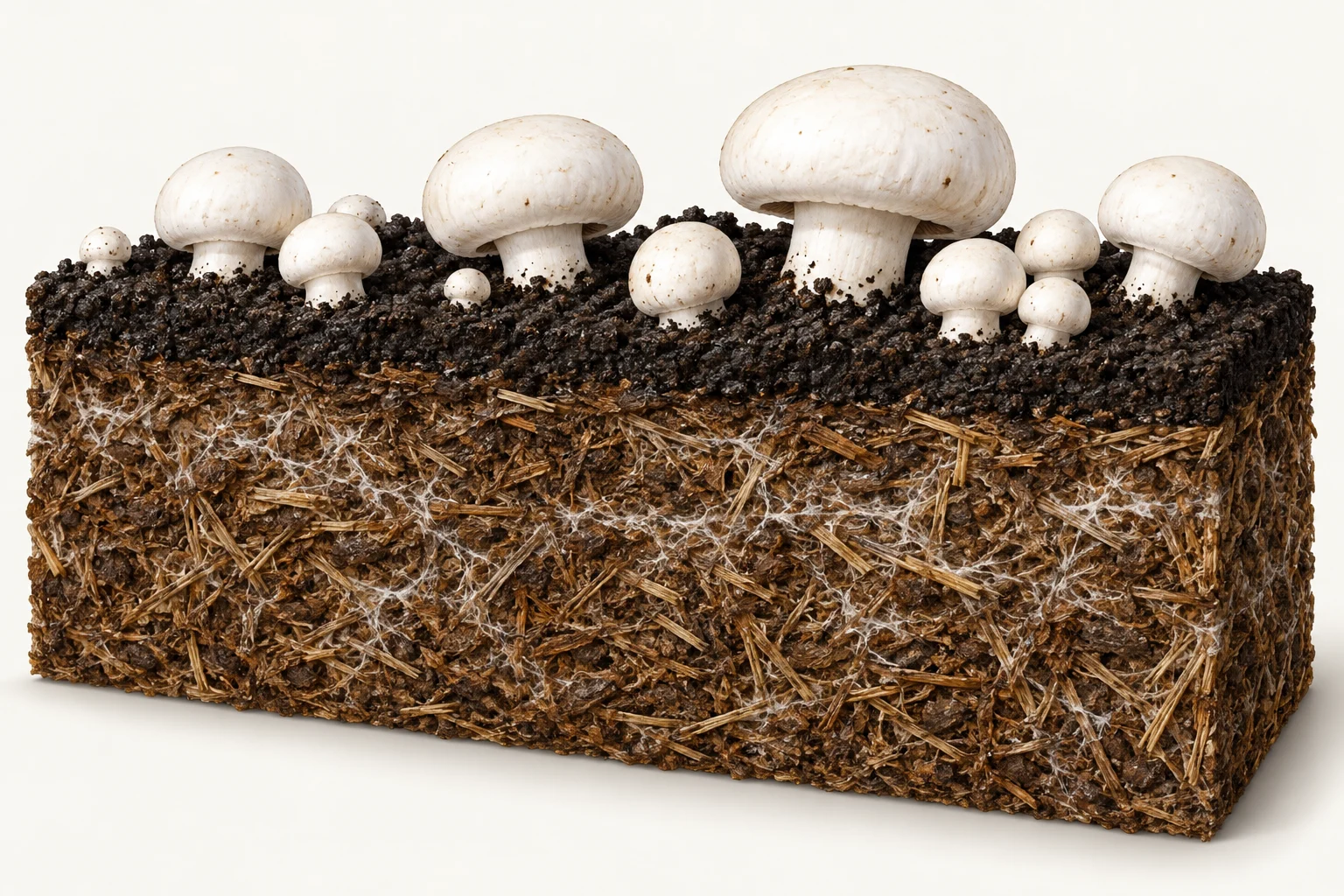
The visible mushroom is a fruiting body. The fungus also grows as mycelium: a network of fine threads through its growing material. A farmer first establishes that growth, then manages conditions in which fruiting bodies can develop. A bag without mushrooms may still be in its growing stage.
In this Button illustration, the cap, gills and stem belong to the fruiting body. The network below represents mycelium in compost. The separate top layer is casing. Other cultivated mushrooms may use different materials and may not need casing.
For your own crop, record two different observations: development of the growing material and development of the mushrooms. Do not describe both simply as “the crop looks white”. A drawing cannot distinguish cultivated mycelium from contamination in your bag.
Three mushrooms, three different crop arrangements
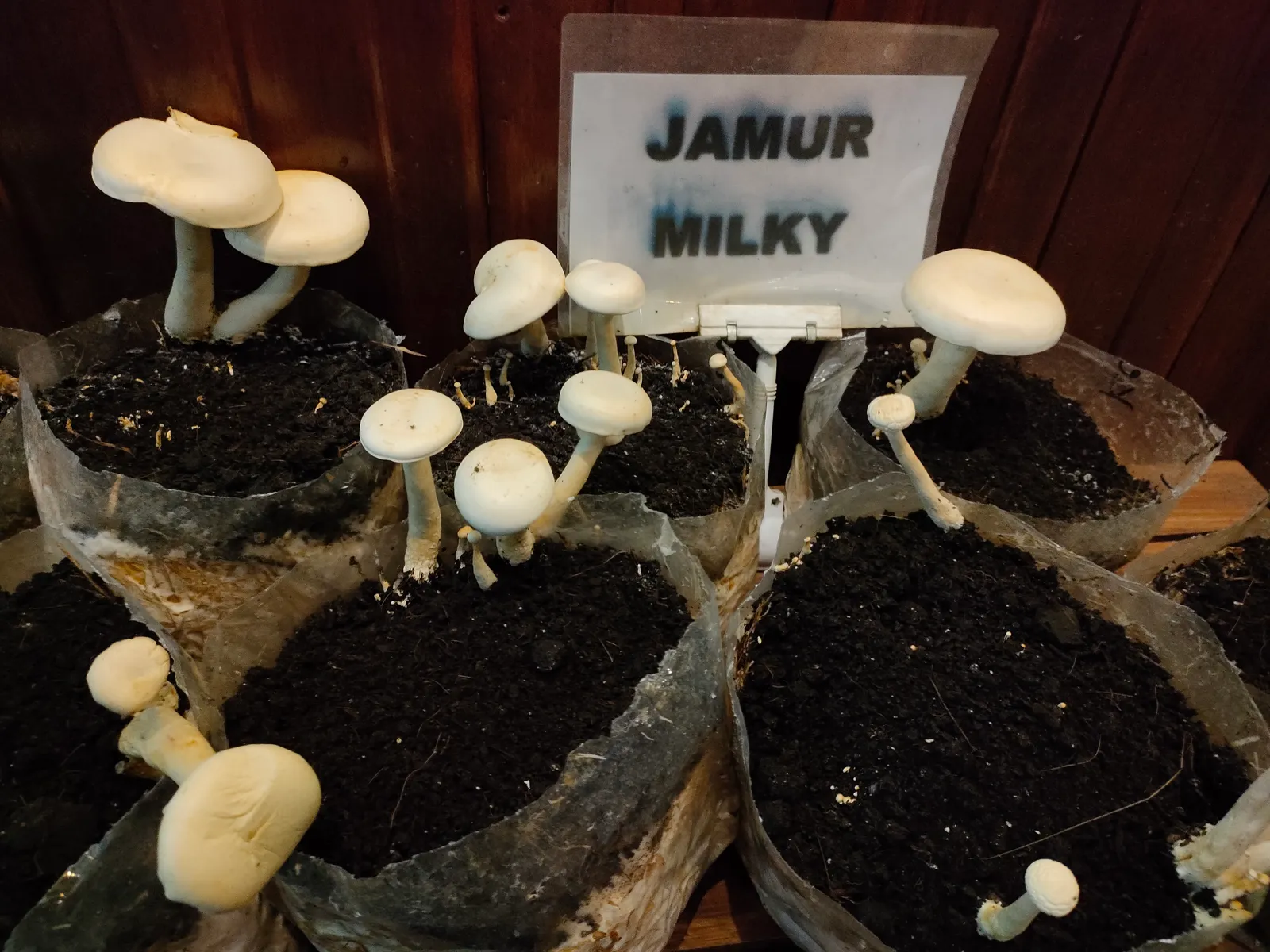
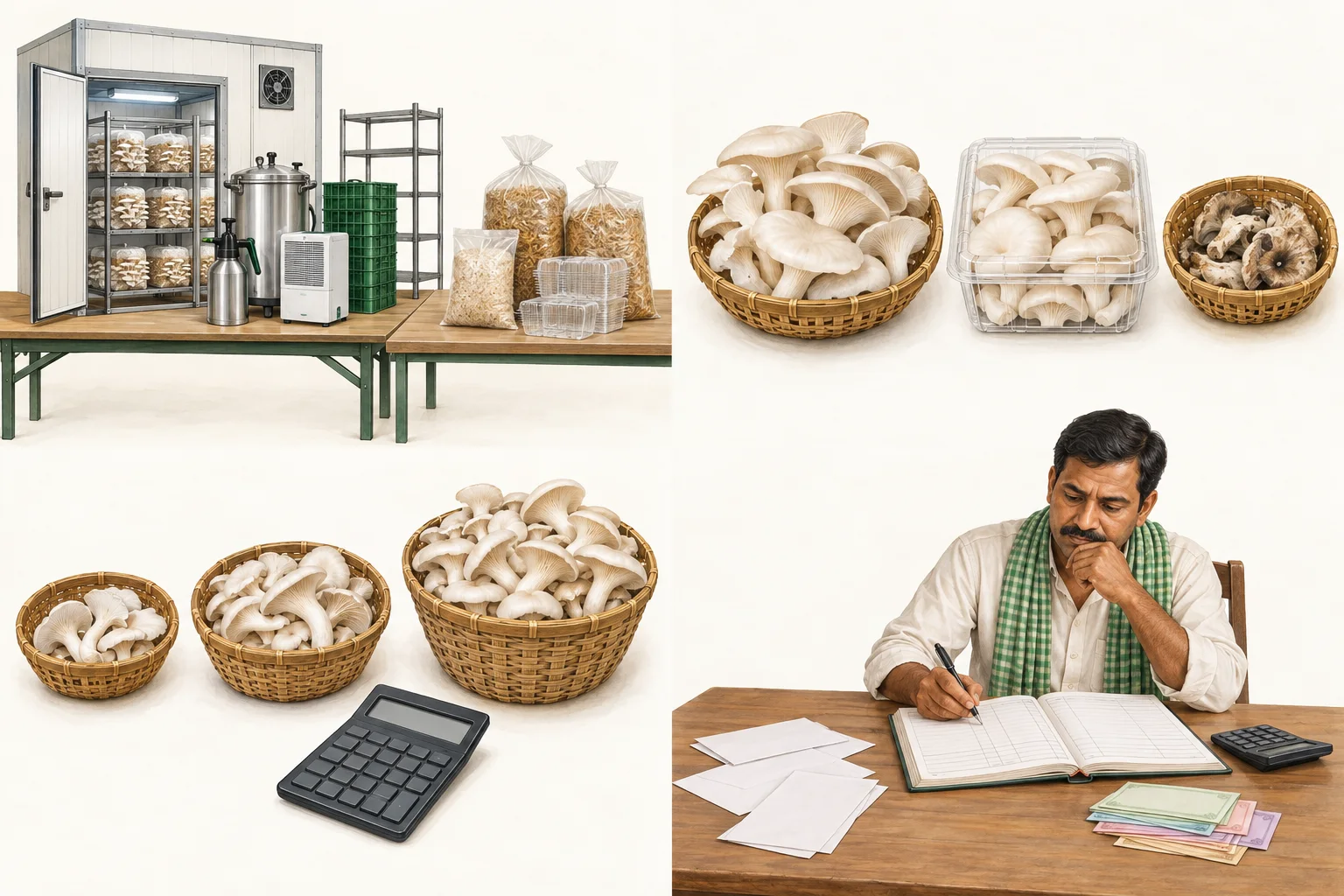
The picture compares cultivation arrangements, not three versions of the same recipe. Oyster clusters can develop from openings in colonised bags. A common Milky method adds a casing layer after straw colonisation. Paddy Straw methods can use prepared straw beds. Each requires its own material preparation and crop management.
Before following an instruction, write its crop and method at the top of your notes. A direction about casing a Milky bed is not automatically a direction for an Oyster bag. Equally, a Button compost schedule does not describe every straw-based method.
Confirm the scientific species and supplied strain with the supplier. Common market names may cover different production choices. The illustration helps you compare arrangements; it cannot identify an unknown or wild specimen.
“Mushroom material” is not a complete product description. Spawn is inoculum used to introduce the chosen fungus. Prepared substrate still needs the next operations for its method. A colonised bag has already undergone growth, but may still need maturation or other preparation before fruiting.
Ask the supplier to state the species, strain where relevant, batch identity, preparation or inoculation date, stage at dispatch, transport conditions, storage instructions and work remaining after receipt. Keep those answers with the order.
On arrival, compare the actual label and package with that agreement. Record receipt time, package integrity and any discrepancy before mixing lots or allocating material. Quarantine unresolved supplies under a suitable procedure and ask for clarification; a healthy-looking photograph is not a purity test.
A batch code connects material to its history. The matching tags in the picture represent that link; the colour alone is not a record. Write an actual identifier and keep the underlying dates, supplier details and operations.
Record which spawn lot went into which substrate batch, where the bags or beds were placed, when they were handled, and which harvest and dispatch lots came from them. If several crop batches enter one dispatch, record each contributing batch.
Worked example: two substrate lots share a room, but slow development occurs mainly in one lot. Keeping their identities allows you to compare preparation, inoculation and transport history. Mixing the records removes that opportunity. This example does not establish what caused the problem.
Choose training for your actual crop and production method. Ask which operations you will observe, which you will practise under supervision, which records you will prepare and how your work will be checked. A presentation and a hands-on session do not provide the same experience.
Request a clear syllabus covering inputs, preparation, crop management, problem investigation, harvest, records and the limits of the method. Ask whether you will see an operating crop or only a demonstration. Confirm dates and current arrangements directly with the organiser.
After training, practise explaining the sequence without notes. Where you cannot name the next check or recognise a reason to stop, seek further instruction before increasing the scale. An attendance certificate alone does not verify operating competence.
Species names are not interchangeable recipes. Write down the species, available growing material, expected growing season and buyer requirement. A crop that grows in another district may need a different room or strain in yours.
The process
Practical workbook
Recognise what each material does
Spawn introduces the cultivated fungus. Substrate is the growing material it colonises. Casing is a separate layer in methods that require it. A ready-to-fruit block has already passed through operations that raw straw has not.
The process
Practical workbook
Walk through the work
A crop needs receiving, preparation, protected handling, growth, harvesting and cleaning. Work routes matter: raw inputs, suspect material and harvested food should not share an uncontrolled handling sequence.
The process
Practical workbook
Learn from the whole cycle
One attractive flush is not the result of the whole crop. Record material used, rejected bags, harvested and sold quantities, labour, costs and cash collected. These explain what can be repeated and what needs changing.
In the field
Field notes
Choose a crop using four pieces of evidence
Start with a room diary and a buyer conversation. Record where the room is, when you plan to grow, how hot and cool it becomes, and what equipment you can reliably operate. A weather app describes outdoor conditions; a roof, packed growing material and poor air movement can create a different environment around the crop. Measure in the proposed growing area before committing to a species or a season.
Next, identify the exact mushroom and strain available from a traceable spawn supplier. Button, oyster, milky, paddy straw and shiitake use different growing methods. Even the name oyster covers several species with different requirements. Ask the supplier for the intended substrate, incubation and fruiting guidance, storage instructions and batch identity. Match those requirements to the conditions you can actually maintain.
In the field
Field notes
Choose a crop using four pieces of evidence · continued
Finally, ask buyers what they purchase, how they grade it, how much they can receive on a harvest day and when they pay. A good growing room cannot solve an absent market. Start with a batch small enough for you to inspect, harvest, pack and sell through the whole cycle. Decide its size from your time and buyers rather than from an online income example.
In the field
Compare the evidence
A first-crop decision sheet
A first-crop decision sheet
Question
Evidence to collect
What the answer changes
Can this room support the crop?
Indoor readings, season, power availability and supplier protocol
Species, sowing window and equipment
Can I obtain dependable inputs?
Spawn batch details and delivered substrate or compost specification
Whether to prepare material or buy prepared bags
Can I perform the work?
Daily attendance, clean work area and harvest help
Manageable batch size
Can I sell the harvest?
Buyer grade, delivery frequency, quantity and payment terms
Planting schedule and cash reserve
In the field
Field notes
Understand what is inside the bag or bed
Spawn is living mushroom mycelium carried on grain, sawdust or another suitable material. It introduces the cultivated fungus into its food. The substrate is that prepared food: straw, wood-based material or selective compost, depending on the mushroom. Casing is a separate surface layer used in crops such as button and milky mushroom. Buying spawn does not mean you have bought a ready-to-fruit bag; ask which stage the supplied material has reached.
Colonisation means the fungus is growing through the substrate. A white surface is only one observation. Compare development across the bag, batch and room, and note any areas that stop advancing. Readings inside growing material and in room air answer different questions because an active crop releases heat. Never interpret a wall thermometer as a direct measurement of the centre of every bag.
In the field
Field notes
Understand what is inside the bag or bed · continued
Fruiting is a later stage in which mushrooms develop from colonised material under suitable conditions. The transition differs by species: button and milky involve casing, while shiitake blocks need a maturation stage. Use the crop-specific sequence. A fixed calendar from another farm is useful for planning questions, but the condition of your own batch determines whether the next operation is appropriate.
In the field
Field notes
Write it in your farm notebook
Keep the crop name, strain, spawn batch, substrate batch, receipt date, preparation date, inoculation date and every transfer together under one crop ID.
In the field
Field notes
Prepare the workflow before opening spawn
Walk through a complete working day on paper. Raw material arrives, is prepared and treated, cools in a protected area, receives spawn, incubates and then fruits. Harvest moves to a clean packing area; used material and waste leave by a route that avoids the clean operation. Mark each location and the people, water, containers and tools needed at that point. A room can look spacious and still have a poor workflow if clean and dirty tasks compete for the same bench.
Prepare labels and a record sheet before the first bag is made. Agree who checks the room when the usual operator is away. Check that water is suitable for its intended use, instruments function, drainage works and electrical equipment is appropriate for a damp agricultural environment. Use trained assistance for electrical, steam and pressure equipment. Training should include watching an entire operation and then performing it under supervision.
In the field
Practical workbook
Prepare the workflow before opening spawn · practical sequence
01
Before receipt: Confirm the species, quantity, delivery stage and what the supplier will replace if the delivered material is unsuitable.
02
Before preparation: Clear and clean the work area, separate raw material from treated material, and prepare a batch label.
03
Before fruiting: Check the crop's readiness and confirm that the room, harvest containers and buyer route are ready.
04
After the crop: Reconcile harvest and sales, remove spent material, clean the area and review what should change in the next batch.
In the field
Field notes
Judge the first crop by records, not by one photograph
Take comparable observations: the same marked locations, similar times and the same measurement method. Record both normal areas and problem areas. When something changes, write what changed before adjusting equipment or adding water. Otherwise, several simultaneous interventions can make it impossible to learn which one helped.
At the end, total the material used, labour time, crop lost, kilograms harvested, kilograms sold and money collected. Keep rejected or unsold mushrooms visible in the calculation. The first crop should tell you whether your supplier, room, routine and buyer work together. Expand only after you can explain the results and repeat the useful parts of the process.
In the field
Field notes
Practice record: harvest is not the same as a sale
Suppose a training batch yields 24 kg, 3 kg are rejected or unsold, and buyers accept 21 kg. At an assumed ₹140/kg, invoiced sales are ₹2,940. If ₹500 remains unpaid, cash collected is ₹2,440. These invented figures demonstrate record keeping; they predict neither yield nor price.
Harvest: 24 kg
Sold: 24 − 3 = 21 kg
Invoiced: 21 × ₹140 = ₹2,940
Cash received: ₹2,940 − ₹500 = ₹2,440
In the field
Sources & further reading
Where the field guidance comes from
Cornell: seven stages of cultivation: Biological sequence and differences between species; US examples need local adaptation.
ICAR-IIHR: cultivation publications: Indian crop-specific learning material and language editions.
A mushroom is not a plant and it does not grow on its own. It is the fruit of a fungus that lives hidden inside straw or compost. Once you see it that way, every rule of mushroom farming makes sense.
By the end you can explain the difference between a fungus, its mycelium and the mushroom you sell.
By the end you can say why a mushroom farm feeds a fungus instead of giving sunlight to a plant.
By the end you can name the parts of a mushroom and say what each part does.
By the end you can use the words spawn, substrate, spawn run and flush correctly.
What Mushrooms Are
Field notes
A fungus, not a plant
Plants make their own food from sunlight. Fungi cannot. A fungus feeds by pushing thin threads into dead plant material and digesting it from the outside. Wheat straw, paddy straw, sawdust, cow dung: these are its food.
This is why mushroom farming needs no field and no sunlight. It needs a clean growing medium, called the substrate, and a room with the right warmth and moisture. The mushroom on the plate is only a small part of the organism. Most of it stays hidden inside the bag.
What Mushrooms Are
Field notes
A fungus, not a plant · continued
The fungus you farm may be eating wheat straw in Haryana, paddy straw in Odisha or sawdust in Himachal. The biology is the same. Only the food changes.
What Mushrooms Are
Field notes
Mycelium: the hidden body
Mycelium is the network of fine threads through which the cultivated fungus grows in its substrate. Visible white growth is useful to observe, but a white surface alone does not prove uniform colonisation or freedom from contamination.
Spawn run is the colonisation stage. Its duration and environmental requirements depend on the species, strain, substrate and method. The fungus respires and releases heat: a closed cultivation bag does not mean the room needs no ventilation. Follow the validated bag design and incubation protocol, and monitor representative substrate and air conditions.
What Mushrooms Are
Field notes
The mushroom: a fruiting body
When the mycelium has eaten enough and the surroundings change, cooler air, more fresh air, more moisture and some light, it forms tiny knots called pinheads. Pinheads grow into mushrooms. The mushroom's only job is to release spores, the fungus's dust-like seeds, from the gills under the cap.
Learn the parts: the cap on top, the gills beneath it, the stem that lifts it. Button mushrooms have a veil, a skin that covers the gills while the cap is closed. Paddy straw mushrooms sit in a cup at the base called the volva.
What Mushrooms Are
Field notes
The mushroom: a fruiting body · continued
Growers pick before spores fly: button with the veil still closed, paddy straw at the egg stage. Oyster spores can cause allergy, so DMR says open the room two hours before entering and wear a mask.
What Mushrooms Are
Field notes
Why this changes how you farm
Because your crop is a fungus, four things follow. First, the substrate must be clean, because other fungi and bacteria want the same food. That is what growers call contamination.
Second, the temperature that matters is inside the bag, not on the wall. Third, a mushroom is mostly water, so humidity in the air and gentle handling decide its quality. Fourth, there are no roots. A dry bag cannot be rescued by watering like a pot plant. The water must be in the substrate from the start.
What Mushrooms Are
Field notes
Why this changes how you farm · continued
One more word you will hear: flush. A flush is one wave of mushrooms. Bags fruit in several flushes, with rest days in between.
What Mushrooms Are
Compare the evidence
Read the numbers in context
These figures belong to the named source and method. Historical costs are not current quotations. A value without its stage, material basis or measurement location is not a farm instruction.
Source-specific reference figures
What is measured
Value and basis
Source and limitation
Oyster spawn run (bag turns white)
15-25 days
ICAR-DMR oyster folder. Seasonal room, bags kept closed and dark; count from spawning day.
Button spawn run in compost
12-14 days
ICAR-DMR manual, 2011. Controlled room at 23 plus or minus 1 degree air; casing follows.
These figures belong to the named source and method. Historical costs are not current quotations. A value without its stage, material basis or measurement location is not a farm instruction.
Source-specific reference figures
What is measured
Value and basis
Source and limitation
Bed warmer than room air (oyster)
2-4 degrees C
ICAR-DMR manual, 2011. Measure with a probe inside the bag, not the wall thermometer.
Spawn use-by period
Supplier protocol
MushroomFarming.in guide. Species, strain, production and storage conditions matter; no universal 30-day limit.
These figures belong to the named source and method. Historical costs are not current quotations. A value without its stage, material basis or measurement location is not a farm instruction.
Source-specific reference figures
What is measured
Value and basis
Source and limitation
Light for oyster pinheads
200 lux for 8-12 hours per day
ICAR-DMR manual, 2011. Only at fruiting; mycelium needs no light at all.
Record: Date, spawn source and packing date, visible development through sealed packaging, bag temperature versus room temperature, and the colour of the spore print.
01
Observe a sealed, labelled spawn bag with your trainer. Identify the mycelium without opening it or deliberately smelling it.
02
Take one fresh mushroom apart. Find the cap, gills and stem. On a button, find the veil; on a paddy straw mushroom, the volva.
03
Lay a cap gills-down on white paper under a glass overnight. In the morning you will see a spore print.
04
Put one thermometer inside a spawned bag and one in the room air. Note the difference morning and evening.
05
Write spawn, substrate, mycelium, pinhead and flush in your diary, each with your own one-line meaning.
What Mushrooms Are
Pause and recall
Avoid these mistakes
Watering a bag during spawn run as if it were a pot plant; DMR says no water is needed then, and wet bags invite moulds.
Buying spawn without identity, production and storage records or a supplier-defined use-by period.
Reading only the wall thermometer; active substrate can be warmer than room air and needs representative monitoring under the strain protocol.
What Mushrooms Are
Pause and recall
Check your understanding
Choose your answer before opening the explanation. This is a learning exercise, not a competency assessment.
What is mycelium?
The roots of a mushroom
The body of the fungus that spreads through the substrate
The spores released from the gills
Another word for compost
See the answer and why
The body of the fungus that spreads through the substrate Mycelium is the living network of threads; the mushroom is only its fruit.
What Mushrooms Are
Pause and recall
Check your understanding
Choose your answer before opening the explanation. This is a learning exercise, not a competency assessment.
Which stage needs light?
Spawn run inside the closed bag
Pinhead formation and fruiting
Spawn storage
Straw soaking
See the answer and why
Pinhead formation and fruiting DMR says no light during spawn run; oyster pinheads need about 200 lux for 8 to 12 hours a day.
What Mushrooms Are
Pause and recall
Check your understanding
Choose your answer before opening the explanation. This is a learning exercise, not a competency assessment.
Why must the substrate be clean?
Because mushrooms need sunlight
Because other fungi and bacteria compete for the same food
Because mycelium dislikes water
Because spores are poisonous
See the answer and why
Because other fungi and bacteria compete for the same food Contamination is competition for food; clean substrate gives your fungus a head start.
Mycelium grown on sterilised grain, used as the seed of a mushroom crop.
04Substrate
The prepared material the fungus eats: straw, compost or sawdust.
05Flush
AI illustration · details
AI teaching illustration. Tiny pins develop at the casing surface before visible mushrooms enlarge. The condition of the crop matters alongside the planned transition date.
India grows five mushrooms on a commercial scale, and each one wants a different temperature, a different food and a different level of skill. Choose by biology and season, not by which one shows the highest price online.
By the end you can name the five main cultivated mushrooms of India with their Hindi names.
By the end you can read each species' spawn-run and fruiting temperature band from the DMR table.
By the end you can explain why button needs compost while oyster, milky and paddy straw grow on treated straw.
By the end you can say which species suit the plains, the hills and the coast, and in which months.
Major Cultivated Mushrooms
Field notes
Five mushrooms, two kinds of food
Compare cultivated forms
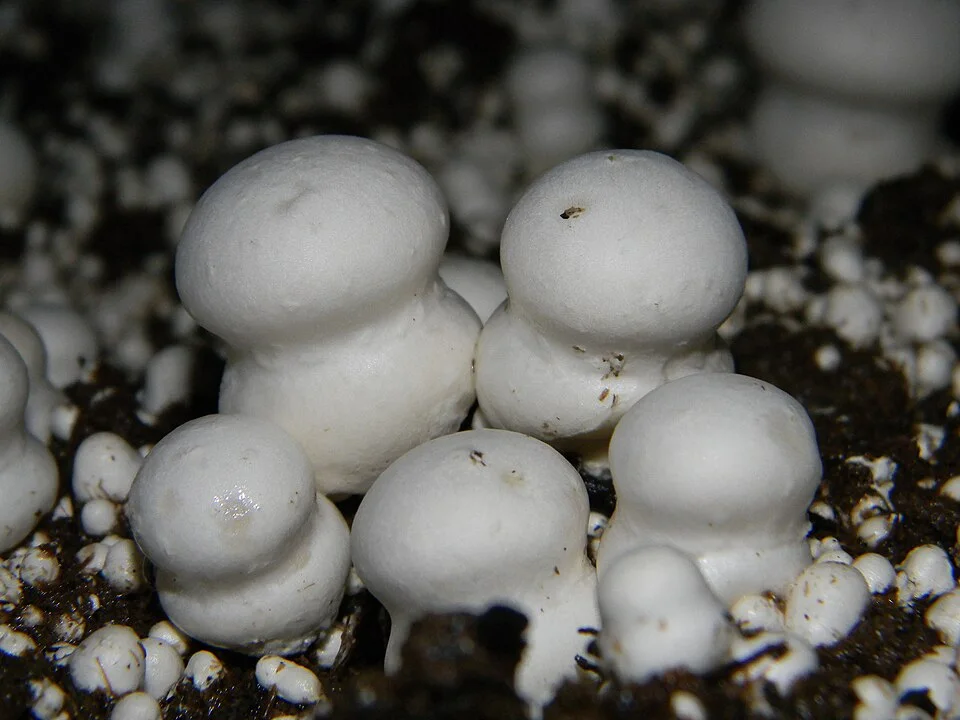
ButtonPhoto credit & full view
Real photograph of cultivated Button Mushrooms. It provides crop context, not proof of a particular farm, yield, climate setpoint or diagnosis. Context photograph, not a prescribed layout, diagnostic result or performance standard.
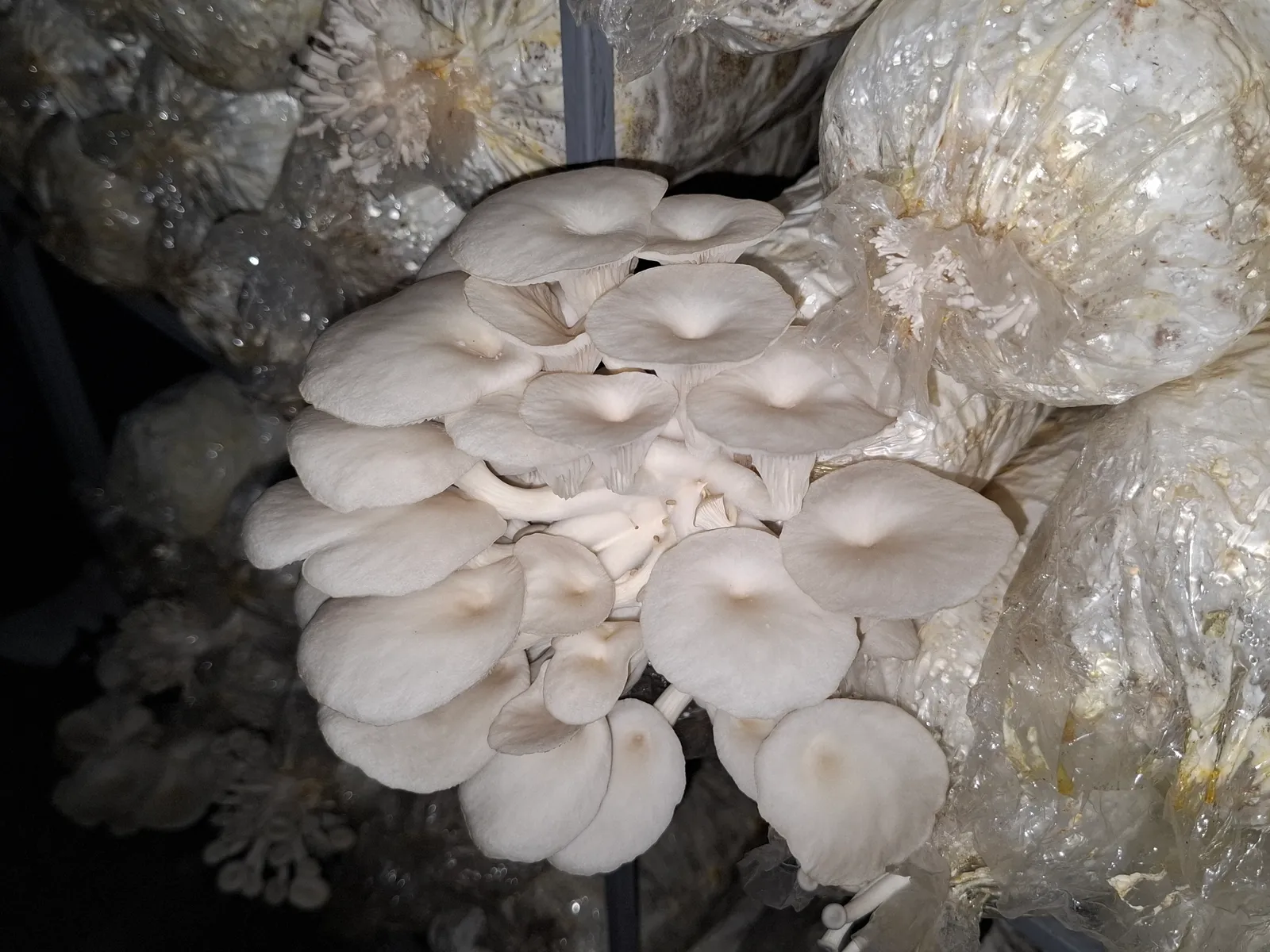
White oyster mushroom cluster fruiting from a bag on a rack (Philippines). Context photograph, not a prescribed layout, diagnostic result or performance standard.
Milky mushroom (Calocybe indica) fruiting from casing in bags/pots (Indonesia). Context photograph, not a prescribed layout, diagnostic result or performance standard.
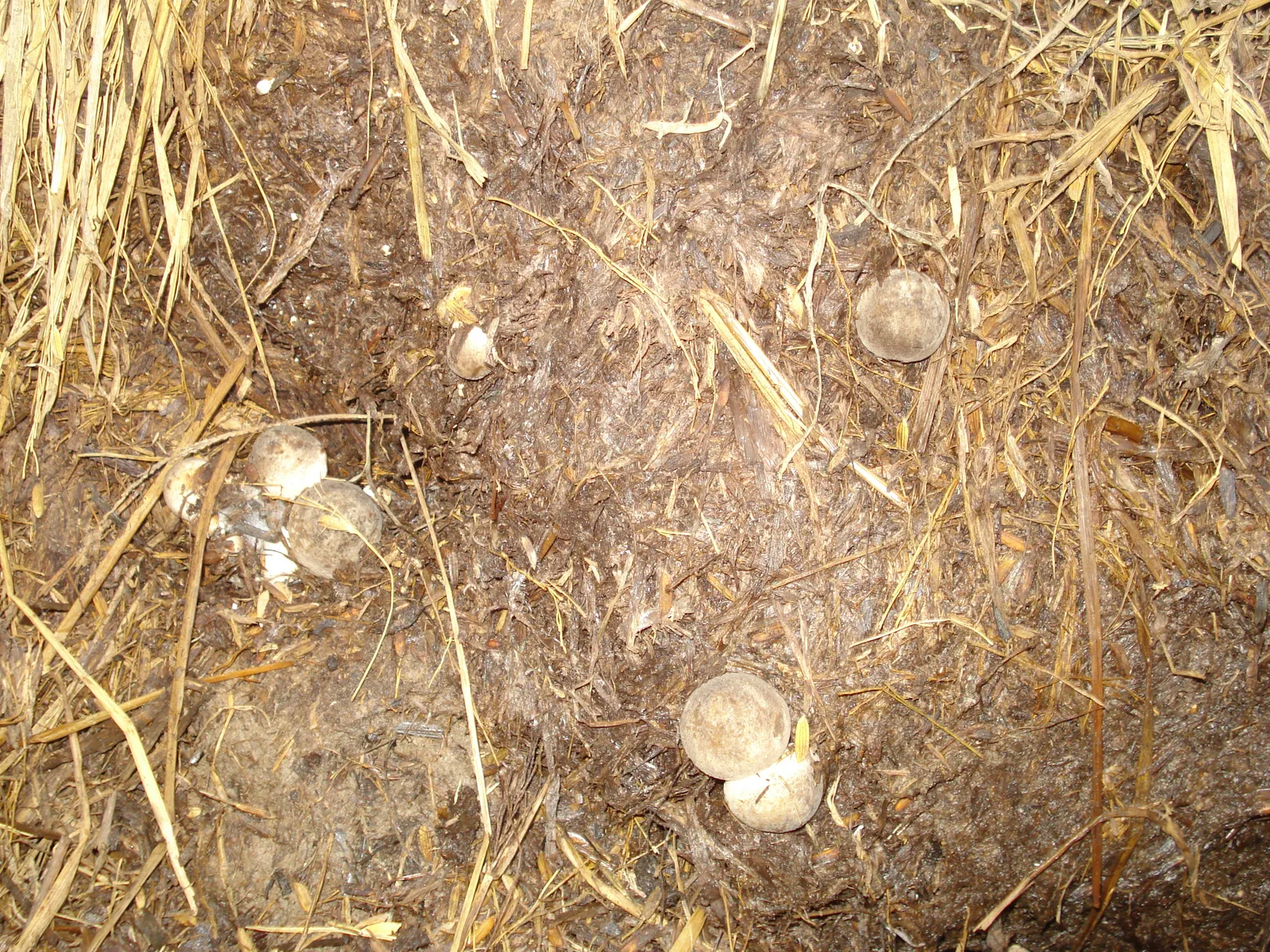
Paddy straw mushroom (Volvariella volvacea) fruiting on a straw bed. Context photograph, not a prescribed layout, diagnostic result or performance standard.
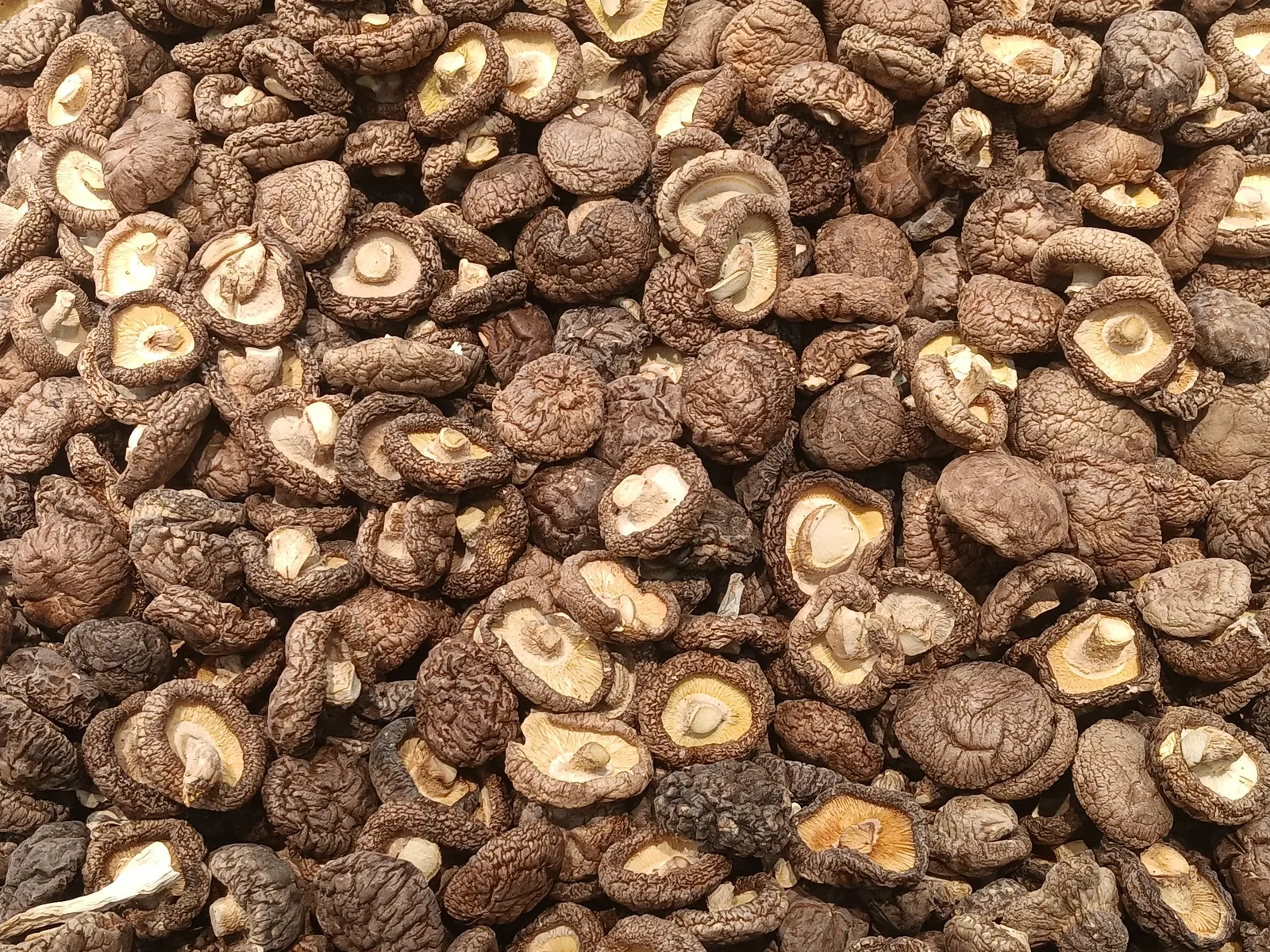
The five are white button (Agaricus bisporus, बटन), oyster (Pleurotus species, ढींगरी), milky (Calocybe indica, दूधिया), paddy straw (Volvariella volvacea, पराली) and shiitake (Lentinula edodes).
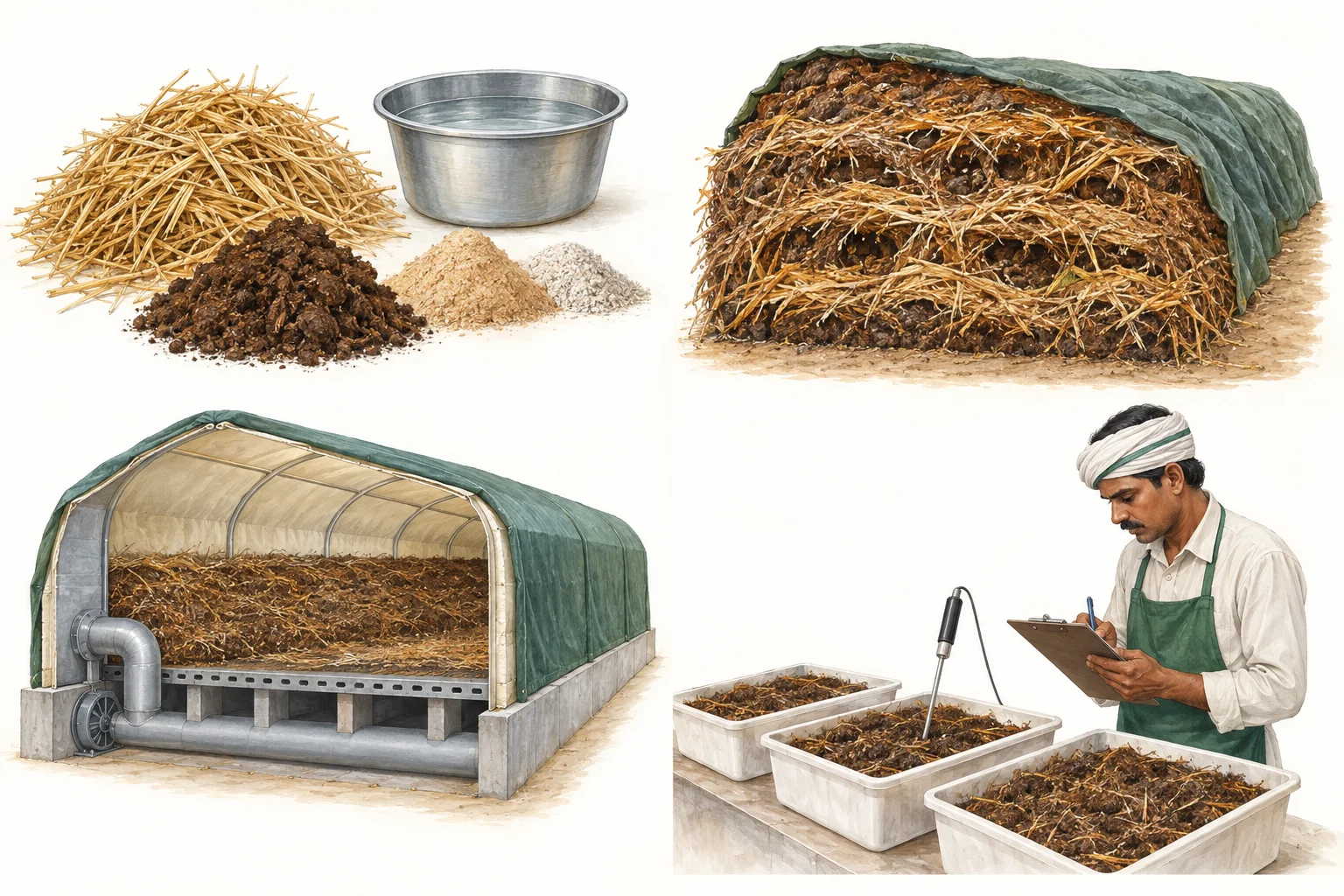
They fall into two groups by food. Button eats straw that has first been composted: heaped, wetted and turned until it has partly rotted. DMR gives 28 to 30 days for the long composting method and 10 to 12 days for the indoor method. Oyster, milky and paddy straw eat straw that has only been pasteurised, that is heated enough to kill competitors but not rotted. Shiitake eats wood: sawdust blocks or logs.
Major Cultivated Mushrooms
Field notes
Five mushrooms, two kinds of food · continued
The food decides the infrastructure. Composting needs a yard and weeks of labour. Pasteurising needs a drum and a fire.
Major Cultivated Mushrooms
Field notes
Temperature is the first filter
DMR's species table gives two bands for each mushroom: one for spawn run, one for fruiting. Button: 22 to 25 then 14 to 18. Oyster Pleurotus florida: 25 to 30 then 18 to 22. Pleurotus sajor-caju: 25 to 32 then 22 to 26. Milky: 25 to 30 then 30 to 35. Paddy straw: 32 to 34 then 28 to 32. Shiitake: 22 to 27 then 15 to 20, all in degrees Celsius.
Read the table twice. Milky and paddy straw fruit in heat that would kill a button crop. Shiitake and button want cool rooms that a plains farmer only gets in winter.
Major Cultivated Mushrooms
Field notes
Temperature is the first filter · continued
This is why a grower in Bhubaneswar and a grower in Solan should not copy each other's protocol.
Major Cultivated Mushrooms
Field notes
Season and region
Without air conditioning, the calendar is the farm plan. DMR's seasonal folder gives it by region.
North Indian plains: button November to February (the 2011 manual says October to February), oyster September to May, milky February to April and again July to September, paddy straw July to September. Mid-hills: button September to March, oyster all year, milky April to June, shiitake October to February. High hills: button March to November, oyster May to August, shiitake December to April.
Major Cultivated Mushrooms
Field notes
Season and region · continued
Coastal states can grow oyster, paddy straw and milky in natural conditions all year, and DMR names Odisha, Andhra Pradesh, Tamil Nadu, Kerala and West Bengal as the paddy straw heartland.
Major Cultivated Mushrooms
Field notes
Speed, cycle and skill
Crop cycles differ a lot. Paddy straw finishes in 4 to 5 weeks. Oyster takes 45 to 60 days. Button needs 80 to 100 days on the same straw once composting is counted. Shiitake blocks need 60 to 80 days of spawn run before the first mushroom.
Skill rises in steps. Oyster is the usual first crop: no compost, no casing. Milky adds a casing layer of soil. Button adds composting, casing and a cold room. Shiitake adds sterile bag filling and patience. Paddy straw is fast but the most perishable: DMR says it cannot be kept at 4 degrees because it breaks down, and is sold on the day of harvest.
Major Cultivated Mushrooms
Field notes
Speed, cycle and skill · continued
DMR's yield figures are institute results under institute conditions. Treat them as reference, never as your farm's number.
Major Cultivated Mushrooms
Compare the evidence
Read the numbers in context
These figures belong to the named source and method. Historical costs are not current quotations. A value without its stage, material basis or measurement location is not a farm instruction.
Source-specific reference figures
What is measured
Value and basis
Source and limitation
Button fruiting temperature
14-18 degrees C
ICAR-DMR seasonal folder. Room air; the manual's tables give 14-16 and 15-17 for controlled rooms.
Milky fruiting temperature
30-35 degrees C
ICAR-DMR seasonal folder. Same band from casing to harvest in the milky folder.
These figures belong to the named source and method. Historical costs are not current quotations. A value without its stage, material basis or measurement location is not a farm instruction.
Source-specific reference figures
What is measured
Value and basis
Source and limitation
Paddy straw fruiting temperature
28-32 degrees C
ICAR-DMR seasonal folder. Spawn run is even warmer at 32-34.
Shiitake fruiting temperature
15-20 degrees C
ICAR-DMR seasonal folder. Strain dependent; DMR's shiitake folder gives 12-25 and its manual 12-18.
These figures belong to the named source and method. Historical costs are not current quotations. A value without its stage, material basis or measurement location is not a farm instruction.
Source-specific reference figures
What is measured
Value and basis
Source and limitation
Oyster crop cycle
45-60 days
ICAR-DMR manual, 2011. Spawning to last flush; button on the same straw takes 80-100 days including composting.
Paddy straw crop cycle
4-5 weeks
ICAR-DMR paddy straw bulletin, 2007. Under favourable warm conditions.
Spawn is the one input you cannot make on the farm and cannot fully check by eye. Everything you grow starts from its quality, and from how well the straw under it was prepared.
By the end you can explain what spawn is, how a laboratory makes it, and why it is called seed but is not one.
By the end you can describe what a good substrate gives the fungus: food, water, air and freedom from competitors.
By the end you can apply DMR spawn rates by species instead of guessing.
By the end you can judge spawn and straw with simple farm checks.
Mycelium, Spawn & Substrate
Field notes
What spawn is and where it comes from
Spawn is mycelium grown on sterilised grain, usually wheat, in bottles or bags. The grain is only a carrier. The living part is the white mycelium wrapped around each grain.
A laboratory keeps a pure culture of the fungus on a jelly called agar. From that it grows mother spawn on grain, then multiplies it into the commercial spawn you buy. This needs a pressure steriliser called an autoclave and a clean-air cabinet. The MIDH spawn unit norm lists sterilisation, inoculation and incubation rooms, an autoclave and a laminar flow chamber. NHB gives 25 to 27 degrees for incubation and cold storage for finished spawn.
Mycelium, Spawn & Substrate
Field notes
What spawn is and where it comes from · continued
So buy spawn from a laboratory. Kitchen spawn is the commonest source of a failed first crop.
Mycelium, Spawn & Substrate
Field notes
Judging spawn on arrival
Inspect sealed spawn packaging, its label, lot identity, production date, integrity and visible abnormalities. Appearance alone cannot establish purity or performance. Do not open or deliberately smell suspect spawn; keep it separate and contact the supplier.
Ask for species- and strain-specific storage conditions and the validated use-by period. There is no single age limit or refrigeration rule for all mushroom spawn. Record transport conditions and use the supplier protocol rather than a universal 30-day rule.
Mycelium, Spawn & Substrate
Field notes
What a substrate must do
The substrate is the food, but it must also hold water, let air in, have the right acidity and be free of competitors.
Water: DMR's straw treatment aims at 65 to 70 percent moisture. The farm test is a squeeze: no drops fall and the palm feels slightly damp. Air: straw is chopped, 2 to 3 cm in the oyster folder or 5 to 10 cm in the manual, so the mycelium can breathe. Acidity: oyster mycelium likes pH 6 to 7, button compost 7.2 to 7.8, shiitake sawdust 5.5 to 6.
Mycelium, Spawn & Substrate
Field notes
What a substrate must do · continued
Freshness: straw must be dry, this season's, and never rained on. DMR lists old wheat straw and high moisture among the triggers for ink cap weeds.
Mycelium, Spawn & Substrate
Field notes
Three ways to prepare it, and the spawn rate
Pasteurise for straw mushrooms: hot water at 60 to 65 degrees for 20 to 30 minutes in the oyster folder, or 65 to 70 degrees for one hour in the manual. Sterilise for shiitake and specialty species: bags in an autoclave. Compost for button: weeks of heaps and turnings, then Phase II heat. DMR also describes a chemical steeping method using a fungicide and formalin; label approval changes, so check it and use hot water if unsure.
Spawn rate is spawn weight per substrate weight. DMR: oyster 2 to 3 percent of wet straw, one 300 g bottle for 10 to 12 kg wet straw; milky 4 to 5 percent; button 0.5 to 0.7 percent of compost; shiitake 3 percent of dry weight.
Mycelium, Spawn & Substrate
Field notes
Three ways to prepare it, and the spawn rate · continued
More spawn runs faster and leaves less room for competitors, but costs more.
Mycelium, Spawn & Substrate
Compare the evidence
Read the numbers in context
These figures belong to the named source and method. Historical costs are not current quotations. A value without its stage, material basis or measurement location is not a farm instruction.
Source-specific reference figures
What is measured
Value and basis
Source and limitation
Oyster spawn rate
2-3 % of wet substrate
ICAR-DMR manual, 2011. One 300 g bottle for 10-12 kg wet straw; the folder gives 10 kg spawn per quintal dry straw.
Milky spawn rate
4-5 % of wet substrate
ICAR-DMR milky folder. Deliberately higher than oyster; 40-50 g per kg wet straw.
These figures belong to the named source and method. Historical costs are not current quotations. A value without its stage, material basis or measurement location is not a farm instruction.
Source-specific reference figures
What is measured
Value and basis
Source and limitation
Button spawn rate
0.5-0.7 % of wet compost
ICAR-DMR manual, 2011. The farmer folder says 500-750 g per 100 kg compost.
Shiitake grain spawn rate
3 % of dry weight
ICAR-DMR shiitake folder. Added under sterile conditions after autoclaving the bag.
These figures belong to the named source and method. Historical costs are not current quotations. A value without its stage, material basis or measurement location is not a farm instruction.
Source-specific reference figures
What is measured
Value and basis
Source and limitation
Straw moisture after treatment
65-70 %
ICAR-DMR milky folder. Milky folder figure; DMR gives no separate oyster figure, so treat it as provisional for oyster.
Spawn age and storage
Verify the lot
MushroomFarming.in guide. Use the supplier's validated period and storage conditions for the exact species and strain.
Record: Laboratory name, strain, packing date, condition on arrival, straw dry and wet weight, and your squeeze-test verdict.
01
Ask two laboratories for a quote. Note species, strain, packing date, how they store it and how it will travel.
02
On arrival, inspect sealed packaging, identity, age under the supplier protocol and visible abnormalities. Quarantine suspect material and contact the supplier.
03
Weigh 1 kg of dry straw, soak it, drain it and weigh it again to learn how much water your straw takes.
04
Do the squeeze test after draining and write down what you felt.
05
Calculate spawn needed for your batch from the DMR rate for your species.
06
Store spawn cool and use it within a week.
Mycelium, Spawn & Substrate
Pause and recall
Avoid these mistakes
Using old or patchy spawn to save money; a weak run gives competitors weeks to take over the bag.
Over-wet straw that drips when squeezed; it turns airless and sour and the mycelium stalls.
Skipping or shortening heat treatment because the fire was slow; under-treated straw is the commonest cause of green mould.
Mycelium, Spawn & Substrate
Pause and recall
Check your understanding
Choose your answer before opening the explanation. This is a learning exercise, not a competency assessment.
Spawn is
Mushroom spores mixed in water
Mycelium grown on sterilised grain
Dried mushroom powder
A sample of finished compost
See the answer and why
Mycelium grown on sterilised grain The grain carries living mycelium; that is the seed of the crop.
Mycelium, Spawn & Substrate
Pause and recall
Check your understanding
Choose your answer before opening the explanation. This is a learning exercise, not a competency assessment.
DMR's oyster spawn rate is
0.5 to 0.7 percent
2 to 3 percent of wet substrate
10 percent of dry weight
25 percent
See the answer and why
2 to 3 percent of wet substrate The 2011 manual gives 2-3 percent, about one 300 g bottle for 10-12 kg wet straw.
Mycelium, Spawn & Substrate
Pause and recall
Check your understanding
Choose your answer before opening the explanation. This is a learning exercise, not a competency assessment.
The squeeze-test result you want is
Water streams out between the fingers
No drops fall and the palm is slightly damp
The straw is dry and crackly
The straw feels warm
See the answer and why
No drops fall and the palm is slightly damp That is DMR's farm sign of about 65-70 percent moisture.
A mushroom room has no single correct temperature. The number that matters depends on the species, the stage and where you measure it, and the four factors push each other around all day.
By the end you can explain how temperature, humidity, fresh air and light each act on the crop.
By the end you can tell bed temperature from air temperature and know which to record.
By the end you can read stage-by-stage bands for oyster, button and milky from DMR.
By the end you can recognise the crop's own signals that the environment is wrong.
Environment
Field notes
Temperature: the bed, not only the air
Measure room air and representative growing material separately. Active mycelium releases heat, so the centre of a bag or bed may differ from the wall thermometer. Record the measurement location, crop stage and time before comparing readings.
Temperature requirements vary by species, strain and growth stage. Oyster is a group of species; there is no universal 30-degree death threshold for all oyster mycelium. Use the supplier or institutional protocol for the actual strain and distinguish air targets from substrate limits.
Environment
Field notes
Temperature: the bed, not only the air · continued
For a seasonal room, compare indoor trends with the chosen crop programme and available control. Shading, air exchange, cooling and water management have different effects. Investigate the cause and safe response rather than applying one watering rule to every hot room.
Environment
Field notes
Humidity: keeping water inside the mushroom
Relative humidity, written RH, is how much water the air holds compared with the most it could hold at that temperature. A mushroom is mostly water and loses it fast to dry air, so caps crack and edges curl.
DMR gives 75 to 85 percent RH for oyster fruiting, 80 to 85 for button cropping and 80 to 90 for milky. But wet is also a disease. A film of water lying on caps at 20 degrees or more lets bacterial blotch spread, and NHB says to avoid more than 85 percent RH together with more than 20 degrees.
Environment
Field notes
Humidity: keeping water inside the mushroom · continued
The rule is: wet the floor and the walls, not the mushrooms, and make sure caps dry within a few hours.
Environment
Field notes
Fresh air and carbon dioxide
The fungus breathes. It takes oxygen and gives out carbon dioxide, CO2. During spawn run high CO2 is tolerated and even useful: oyster up to 2 percent, button 10,000 to 15,000 ppm, with no fresh air at all.
At fruiting, CO2 must fall. DMR's manual asks for under 600 ppm for oyster cropping and the Hindi folder under 800; button pinning wants 800 to 1,000 ppm; milky needs 3 to 4 air changes an hour. Too much CO2 shows on the mushroom: long stems and small caps, oysters shaped like a trumpet mouth, onion-shaped buttons.
Environment
Field notes
Fresh air and carbon dioxide · continued
Fresh air also dries the room, so ventilation and humidity fight each other and have to be balanced by stage.
Environment
Field notes
Light, and reading the crop
Mycelium needs no light. Fruiting does. DMR gives oyster pinheads 200 lux for 8 to 12 hours a day, and notes that under 100 lux caps go pale yellow. TNAU gives milky 2,500 to 3,000 lux. Shiitake incubation and fruiting use 500 to 1,000 lux. For button no Indian primary source gives a figure, so do not copy one: measure and note what works.
The crop is your best sensor. Long stem and small cap means CO2. Pale colour means low light. Cracked dry caps mean low RH. Sticky brown spots mean water lay on the cap too long. No pinheads after the switch usually means the temperature drop or fresh air never happened.
Environment
Field notes
Light, and reading the crop · continued
Keep one thermometer in the bed and one in the air, and write both down twice a day.
Environment
Compare the evidence
Read the numbers in context
These figures belong to the named source and method. Historical costs are not current quotations. A value without its stage, material basis or measurement location is not a farm instruction.
Source-specific reference figures
What is measured
Value and basis
Source and limitation
Oyster incubation target
Strain-specific
MushroomFarming.in guide. Use the actual species and strain protocol, with separate air and substrate measurements.
Oyster fruiting humidity
75-85 % RH
ICAR-DMR manual, 2011. TNAU gives 80-85 at 23-25 degrees for the same stage.
These figures belong to the named source and method. Historical costs are not current quotations. A value without its stage, material basis or measurement location is not a farm instruction.
Source-specific reference figures
What is measured
Value and basis
Source and limitation
Oyster CO2 ceiling during cropping
under 600 (manual) or under 800 (folder) ppm
ICAR-DMR manual, 2011. Two DMR figures; both mean ventilate two or three times a day.
Button CO2 for pinning
800-1000 ppm
ICAR-DMR manual, 2011. After venting; up to 1,500 ppm during cropping.
These figures belong to the named source and method. Historical costs are not current quotations. A value without its stage, material basis or measurement location is not a farm instruction.
How full the air is of water compared with the most it can hold at that temperature.
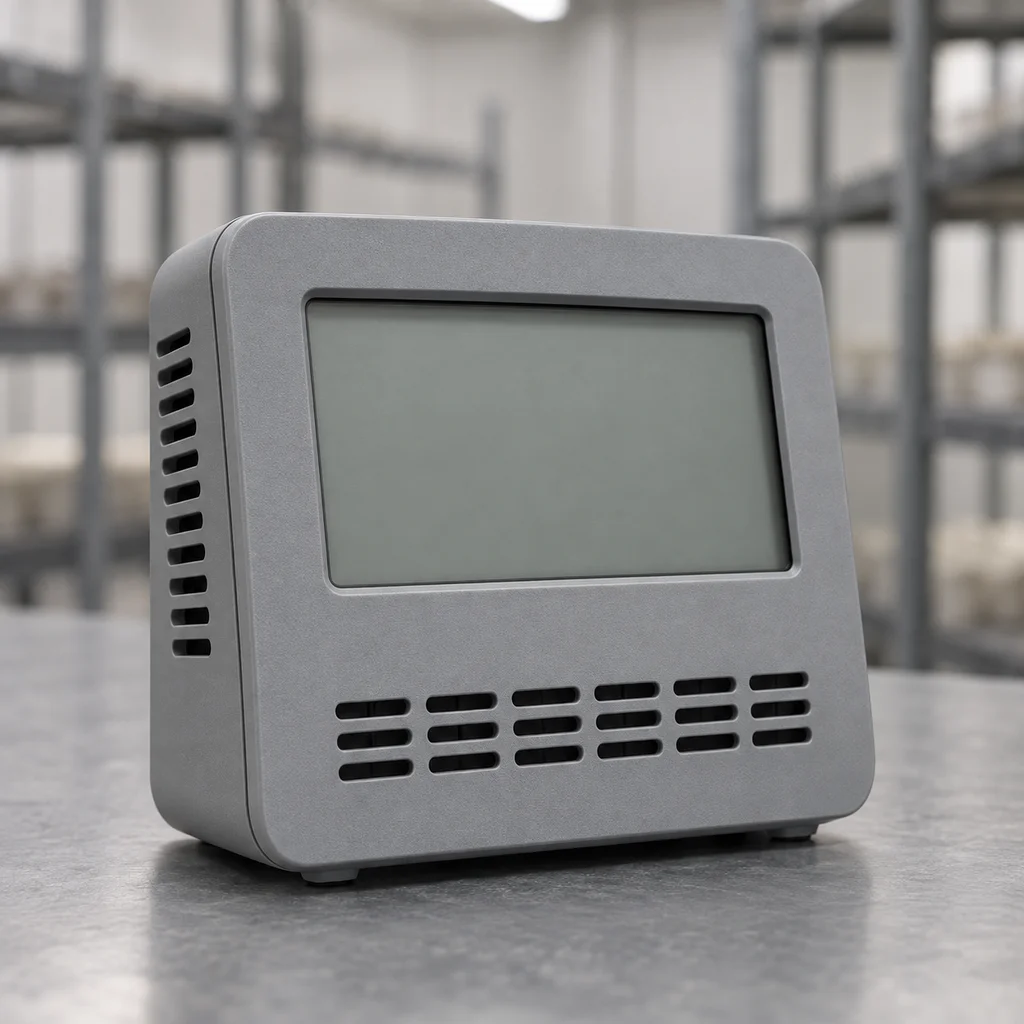
CO₂CO2 (carbon dioxide)
AI illustration · details
AI teaching illustration. Instrument concept for discussing CO2 measurement; not a verified product, calibration, sensor location or ventilation prescription.
Most losses on a small Indian mushroom farm are not diseases that need a chemical. They are competitors that came in through dirty hands, old straw, a wet floor or an open door, and prevention costs almost nothing.
By the end you can tell competitor moulds, diseases, pests and environmental disorders apart.
By the end you can set up the basic hygiene rules for a small unit.
By the end you can observe and record a problem before deciding on any treatment.
By the end you can say when a chemical is not the answer and whom to ask.
Hygiene & Contamination
Field notes
Who wants your straw
Competitor moulds are fungi that eat the same straw as your crop. Green mould (Trichoderma), ink caps (Coprinus), plaster moulds and yellow moulds are the common ones. DMR reports yield losses of up to 70 percent in oyster from competitor moulds.
Each has a cause upstream. DMR's table lists green mould with low pH and immature spawn, ink caps with ammonia, old wheat straw and too much moisture, and olive green mould with pasteurising above 60 degrees. Fix the cause and the mould stops returning.
Hygiene & Contamination
Field notes
Who wants your straw · continued
Diseases attack the mushroom itself. Wet bubble leaves spores that survive three years in casing soil. Dry bubble can destroy a crop in two to three weeks. Bacterial blotch spreads where water lies on caps.
Hygiene & Contamination
Field notes
Pests and disorders
Pests are mostly small flies whose maggots eat mycelium and tunnel into stems. DMR's action threshold after the second flush is more than 20 flies per trap per week. NHB says screen doors and vents with nylon net of 35 mesh or finer, and use a 15 watt yellow light trap with an oiled sheet to monitor them.
Disorders are not caused by any organism. Long stems from CO2, cracked caps from dry air, a sealed casing from high CO2 during pinning: these look like disease but are the room talking.
Hygiene & Contamination
Field notes
Pests and disorders · continued
So diagnosis is four questions: where in the room, when since spawning, in what pattern, and what changed just before.
Hygiene & Contamination
Field notes
Prevention: the cheap rules
Draw a line between dirty and clean. Straw storage and soaking are dirty. Spawning and growing are clean. Wash hands and change footwear when you cross the line.
Use fresh straw that has not been rained on. Heat treatment must reach its temperature for its full time. DMR spawns in a room fumigated 48 hours earlier; a well washed and dried room with the door kept shut is the small grower's version. Space bags 15 to 20 cm apart on shelves so air moves.
Hygiene & Contamination
Field notes
Prevention: the cheap rules · continued
Spent bags go to a pit away from the unit, and NHB says cover such material with at least 10 cm of manure to stop flies breeding. At the end of a button crop NHB asks for a cook-out of the compost at 70 degrees for 12 hours.
Hygiene & Contamination
Field notes
Observe before you act
When something looks wrong, record the crop, batch, location, stage, first signs and affected quantity. Photograph the problem without opening suspect bags or spreading material through clean areas. Follow the farm containment procedure and seek a competent assessment.
Do not spray by habit. Chemical legality, crop approval, label instructions, worker protection and the required pre-harvest interval must be verified for the exact product and use. No generic 48-hour interval can replace that check.
Hygiene & Contamination
Field notes
Observe before you act · continued
Review substrate preparation, hygiene, water management and airflow alongside biological causes. A photograph alone does not establish a diagnosis.
Hygiene & Contamination
Compare the evidence
Read the numbers in context
These figures belong to the named source and method. Historical costs are not current quotations. A value without its stage, material basis or measurement location is not a farm instruction.
Source-specific reference figures
What is measured
Value and basis
Source and limitation
Yield loss from competitor moulds in oyster
up to 70 %
ICAR-DMR manual, 2011. Reported upper limit, not a typical loss.
Wet bubble spore survival in casing soil
3 years
ICAR-DMR wet bubble folder. Casing material is the control point; steam treatment is described by DMR.
These figures belong to the named source and method. Historical costs are not current quotations. A value without its stage, material basis or measurement location is not a farm instruction.
Source-specific reference figures
What is measured
Value and basis
Source and limitation
Dry bubble time to destroy a crop
2-3 weeks
ICAR-DMR manual, 2011. If left uncontrolled; isolate early.
Fly screen mesh on doors and vents
35 or finer mesh
NHB DPR model, 2018. Nylon net; check for tears weekly.
These figures belong to the named source and method. Historical costs are not current quotations. A value without its stage, material basis or measurement location is not a farm instruction.
Source-specific reference figures
What is measured
Value and basis
Source and limitation
Minimum gap between any spray and picking
48 hours
NHB DPR model, 2018. Applies to any approved product; check the label first.
Fly action threshold after second flush
more than 20 flies per trap per week
ICAR-DMR manual, 2011. Medium confidence; the printed table is partly garbled.
Record: Weekly fly count, every bag removed with the reason and days since spawning, and the date of each floor wash.
01
Sketch the unit. Mark the dirty area (straw store, soaking drum) and the clean area (spawning, growing) and the door between them.
02
Put a hand-wash bucket and a change of footwear at that door.
03
Fit 35-mesh nylon net over every vent and door gap and check it for tears.
04
Hang a yellow light trap with an oiled sheet and count flies once a week.
05
Move all spent bags to a pit at least a field away and cover them.
06
Start a symptom page in the diary with the four questions: where, when, pattern, what changed.
Hygiene & Contamination
Pause and recall
Avoid these mistakes
Spraying by habit at the first spot; it hides the cause, breaks the 48-hour rule and may use a product no longer approved.
Using straw that got rained on in the stack; DMR lists old and wet straw among the triggers for ink caps and moulds.
Leaving spent bags beside the unit; they breed flies and shed spores into the next crop.
Hygiene & Contamination
Pause and recall
Check your understanding
Choose your answer before opening the explanation. This is a learning exercise, not a competency assessment.
A green patch appears on one bag. The first step is
Spray a fungicide over the shelf
Remove that bag from the room and record the details
Raise the humidity
Wait and see
See the answer and why
Remove that bag from the room and record the details Isolation stops spores spreading; the record lets you find the cause.
Hygiene & Contamination
Pause and recall
Check your understanding
Choose your answer before opening the explanation. This is a learning exercise, not a competency assessment.
What determines the interval between an authorised chemical treatment and harvest?
A universal 4-hour rule
The next picking shift
The current approved product label and applicable requirements
A generic number from an old project report
See the answer and why
The current approved product label and applicable requirements Verify the exact product, legal crop use, label directions and required interval. A generic 48-hour rule is not valid for all products.
Hygiene & Contamination
Pause and recall
Check your understanding
Choose your answer before opening the explanation. This is a learning exercise, not a competency assessment.
Which of these is a disorder, not a disease?
Wet bubble
Long stems caused by high CO2
Green mould
Fly maggots in the stem
See the answer and why
Long stems caused by high CO2 No organism is involved; fresh air fixes it.
Hygiene & Contamination
Visual glossary
Words used in this lesson
01Competitor mould
A fungus that eats the substrate in place of your crop, such as green mould.
02Contamination
Any unwanted organism getting into spawn, substrate or the room.
03Disorder
A crop fault caused by the environment, not by a disease or pest.
04Isolation
Taking an affected bag out of the room so it cannot infect the rest.
05Cook-out
Heating spent compost at the end of a crop to kill pests and spores before it leaves the room.
Hygiene & Contamination
Sources & further reading
Sources and field reference
MushroomFarming.in foundational knowledge system: Course completion does not establish practical competence.
Every mushroom crop follows the same six steps, whatever the species. Once you can name the step you are in and the one that comes next, you stop guessing and start planning rooms, labour and cash.
By the end you can list the six stages of a mushroom crop in order and say what changes at each.
By the end you can put DMR durations on each stage for oyster and button.
By the end you can explain why the room must change between colonisation and fruiting.
By the end you can plan the reset between crops so the next crop does not inherit the last one's problems.
Cultivation Cycle
Field notes
Stage 1: prepare the substrate
Collect, chop, wet and treat. For oyster and milky the straw is soaked and then heated: 60 to 65 degrees for 20 to 30 minutes in DMR's oyster folder, or 65 to 70 degrees for one hour in the manual. It is drained to about 65 to 70 percent moisture.
For button, straw is composted: 28 to 30 days by the long method or 10 to 12 days indoors, then given a Phase II heat treatment at 58 to 59 degrees. For paddy straw, bundles are soaked 12 to 18 hours.
Cultivation Cycle
Field notes
Stage 1: prepare the substrate · continued
This stage decides most of the contamination risk of the whole crop. Rushing it is the most expensive shortcut on the farm.
Cultivation Cycle
Field notes
Stages 2 and 3: spawn and colonise
Spawning is mixing spawn into cooled substrate in a clean room. Oyster uses 2 to 3 percent of wet weight in polythene bags of 40 to 45 by 30 to 35 cm with 10 to 12 small holes, according to the folder.
Colonisation, or spawn run, is the wait while the bag turns white. Follow the species-specific bag and incubation protocol. The crop respires and releases heat; room ventilation and monitoring remain necessary. Oyster takes 15 to 25 days and DMR says never open bags before 16 to 18 days. Button takes 12 to 14 days, then a 3 to 4 cm casing layer of soil is laid on top and a further week of case run follows. Milky takes 15 to 20 days, then casing and 10 to 12 days of case run.
Cultivation Cycle
Field notes
Stages 2 and 3: spawn and colonise · continued
During this stage the diary entry is short: bed temperature and any coloured patch.
Cultivation Cycle
Field notes
Stage 4: switch the room to fruiting
Fruiting does not start by itself. The fungus needs a signal that its food is ending and conditions outside are good. The grower gives that signal by changing the room: open or cut the bags, drop the temperature, bring in fresh air, raise humidity and give light.
Oyster pinheads appear about a week after bags are opened and reach full size four to five days later. Button pins come 3 to 4 days after venting and become solid buttons in another 3 to 4 days. Milky pins appear 3 to 5 days after the case run ends.
Cultivation Cycle
Field notes
Stage 4: switch the room to fruiting · continued
If pins do not come, the switch was not sharp enough. Check that the drop in temperature and the fresh air really happened at bag height.
Cultivation Cycle
Field notes
Stages 5 and 6: harvest in flushes, then reset
Mushrooms come in waves called flushes. DMR's oyster folder counts three productive flushes with 8 to 10 days between them, and says the first is half the total or more. Paddy straw gives 70 to 90 percent of its yield in a first flush lasting three days. Button is picked almost daily for 8 to 10 weeks in seasonal rooms, or on a 60-day cycle giving six crops a year in controlled rooms.
Reset means emptying, cleaning and starting again. Spent bags go to a pit; a button room gets NHB's cook-out at 70 degrees for 12 hours; the room is washed and dried before refilling.
Cultivation Cycle
Field notes
Stages 5 and 6: harvest in flushes, then reset · continued
Plan reset days into the calendar. An oyster cycle of 45 to 60 days is not six crops a year unless the reset is fast and the season allows.
Cultivation Cycle
Compare the evidence
Read the numbers in context
These figures belong to the named source and method. Historical costs are not current quotations. A value without its stage, material basis or measurement location is not a farm instruction.
Source-specific reference figures
What is measured
Value and basis
Source and limitation
Oyster: earliest day to open bags
16-18 days after spawning
ICAR-DMR manual, 2011. Some pink and other fast species fruit earlier through the holes.
Oyster: bags opened to pinheads
about 7 days
ICAR-DMR oyster folder. Full size 4-5 days later; TNAU reports pins in 2-3 days in its rooms.
These figures belong to the named source and method. Historical costs are not current quotations. A value without its stage, material basis or measurement location is not a farm instruction.
Source-specific reference figures
What is measured
Value and basis
Source and limitation
Button spawn run
12-14 days
ICAR-DMR manual, 2011. Then casing; the farmer folder says 12-15.
Button case run
about 7 days
ICAR-DMR manual, 2011. Mycelium seen in the casing valleys marks the end.
These figures belong to the named source and method. Historical costs are not current quotations. A value without its stage, material basis or measurement location is not a farm instruction.
Source-specific reference figures
What is measured
Value and basis
Source and limitation
Oyster gap between flushes
8-10 days
ICAR-DMR oyster folder. TNAU gives 7-10; three flushes are worth picking.
Button controlled-room cycle
60 days, 6 crops per year
ICAR-DMR manual, 2011. 2011 planning assumption for environment-controlled rooms only.
Prepare, spawn, colonise, induce fruiting, harvest, reset Substrate must be ready before spawning, and the room switch comes only after colonisation.
Cultivation Cycle
Pause and recall
Check your understanding
Choose your answer before opening the explanation. This is a learning exercise, not a competency assessment.
What should determine whether an oyster bag is ready for its fruiting operation?
The cheapest bag size
Readiness checks in the applicable method
A fixed universal date
The appearance of a different species
See the answer and why
Readiness checks in the applicable method Check the chosen method and the condition of the colonised material. A fixed number of days alone cannot establish readiness.
Cultivation Cycle
Pause and recall
Check your understanding
Choose your answer before opening the explanation. This is a learning exercise, not a competency assessment.
Which species gives most of its yield in a first flush lasting three days?
Button
Shiitake
Paddy straw
Milky
See the answer and why
Paddy straw DMR's bulletin gives 70-90 percent in the first flush for Volvariella.
Cultivation Cycle
Visual glossary
Words used in this lesson
01Colonisation (spawn run)
AI illustration · details
AI teaching illustration. Layers explain their different jobs, not prescribed dimensions or diagnosis.
A mushroom starts losing value the minute it is picked. It breathes, sweats and browns. How you pick, cool and pack in the first hour decides whether the buyer pays for the top grade or refuses the lot.
By the end you can pick each species at the stage the market wants.
By the end you can handle and grade without bruising or browning.
By the end you can cool and pack using DMR's temperature bands, and state the paddy straw exception.
By the end you can match the sales channel to the shelf life you actually have.
Harvest & Post-Harvest
Field notes
When to pick
Each species has a stage the buyer wants. Button: a firm cap of 4 to 5 cm with the veil still closed in DMR's manual, 3 to 4 cm in the farmer folder. Milky: a cap of 5 to 6 cm in the folder, 7 to 8 cm in the manual. Paddy straw: at the button or egg stage before the volva breaks, picked two or three times a day. Shiitake: early, broken from the block by the stalk, never torn.
Oyster is picked before the cap edge flattens and starts to curl up; the site guide treats that as the sign, since DMR gives no cap size.
Harvest & Post-Harvest
Field notes
When to pick · continued
Twist gently and lift. For button, cut the soil off the base straight away.
Harvest & Post-Harvest
Field notes
Handling and grading
Mushrooms bruise like ripe fruit. Handle each one once. Harvest into shallow trays, never deep sacks, and keep trays out of the sun.
Grade on a clean table by size and by whether the cap is closed or open. Trim stems level. DMR's oyster folder says spread the mushrooms on a cloth for about two hours so surface moisture evaporates before packing. Never wash mushrooms: a water film on the cap is where bacterial blotch spots start.
Harvest & Post-Harvest
Field notes
Handling and grading · continued
Weigh each grade separately. Rejected mushrooms are a number to write down, not a number to hide, because the cost of the crop is spread over what you actually sell.
Harvest & Post-Harvest
Field notes
Cooling: the cold chain
A picked mushroom keeps breathing. DMR's post-harvest bulletin says respiration at 10 degrees is 3.5 times that at 0 degrees, so heat must leave fast. The target is to bring the mushroom itself to 4 to 5 degrees as quickly as possible. The manual asks for button to be chilled at 4 degrees for 6 to 8 hours before it goes to market. Household refrigerators run at 4 to 7 degrees; chill stores at minus 1 to minus 4; freezing below minus 18.
Shelf life without cold is short. Oyster keeps 24 to 48 hours at room temperature and 2 to 4 days in a refrigerator. Milky keeps 3 to 4 days. Button keeps about 12 hours at ambient and 2 to 3 days in a fridge.
Harvest & Post-Harvest
Field notes
Cooling: the cold chain · continued
The exception: paddy straw mushroom breaks down at 4 degrees. Hold it at 10 to 15 degrees for up to three days, and sell it the same day if you can.
Harvest & Post-Harvest
Field notes
Packing and choosing the channel
Indian retail packs are 200 g or 400 g in thin polythene under 100 gauge, with holes giving about 5 percent vent area, according to DMR. Humidity inside the pack of 87 to 90 percent gives the best colour. Unpacked paddy straw loses 40 to 50 percent of its weight in four days; packed, about 10 percent.
Channels differ by speed. A local shop or a WhatsApp group of households pays fastest. A mandi or wholesaler takes volume but pays less and later. Hotels want a steady grade. Dried oyster at 2 to 4 percent moisture keeps 3 to 4 months in sealed packs and turns a glut into a shelf product.
Harvest & Post-Harvest
Field notes
Packing and choosing the channel · continued
This lesson gives no prices. Record the price you were actually paid, by grade and date.
Harvest & Post-Harvest
Compare the evidence
Read the numbers in context
These figures belong to the named source and method. Historical costs are not current quotations. A value without its stage, material basis or measurement location is not a farm instruction.
Source-specific reference figures
What is measured
Value and basis
Source and limitation
Button harvest cap size
4-5 cm, veil closed
ICAR-DMR manual, 2011. The farmer folder says 3-4 cm; both insist on a closed veil.
Button pre-market chilling
4 degrees C for 6-8 hours
ICAR-DMR manual, 2011. After grading and packing, before dispatch.
These figures belong to the named source and method. Historical costs are not current quotations. A value without its stage, material basis or measurement location is not a farm instruction.
Source-specific reference figures
What is measured
Value and basis
Source and limitation
Target mushroom temperature after pre-cooling
4-5 degrees C
ICAR-DMR post-harvest bulletin, 2008. As quickly as possible; not for paddy straw.
Paddy straw storage
10-15 degrees C for 3 days
ICAR-DMR paddy straw bulletin, 2007. It autolyses at 4 degrees; sell on the day of harvest.
These figures belong to the named source and method. Historical costs are not current quotations. A value without its stage, material basis or measurement location is not a farm instruction.
Source-specific reference figures
What is measured
Value and basis
Source and limitation
Oyster shelf life at room temperature
24-48 hours
ICAR-DMR manual, 2011. 2-4 days in a refrigerator in a perforated bag.
Vent area of a retail pack
about 5 % of bag surface
ICAR-DMR post-harvest bulletin, 2008. Polythene under 100 gauge; 200 g or 400 g packs.
A mushroom project can show a profit on paper and still run out of cash before the second crop. Learn to keep apart the four numbers that every bank, buyer and relative mixes up.
By the end you can define revenue, cost, cash flow and profit in mushroom terms.
By the end you can trace cost to the unit that matters: a kilogram sold, not a kilogram grown.
By the end you can list the assumptions in any project report that only your own farm can prove.
By the end you can use MIDH cost norms as a structure, not as a quotation.
Business Reality
Field notes
Four numbers, not one
Sales revenue is based on accepted sales, prices, returns and deductions. Money collected is a separate cash-flow measure: credit sales can create receivables before payment arrives. Record harvested, sold and paid quantities without treating them as interchangeable.
Profit compares revenue with the relevant costs over a defined period. Cash flow tracks actual receipts and payments. Keep asset purchases, operating expenses, depreciation and loan cash flows clearly labelled to avoid double counting.
Business Reality
Field notes
What the institutes actually give you
DMR's 2011 manual built its models on 70 percent biological efficiency for oyster and 18 kg per 100 kg compost with six crops a year for button in controlled rooms. Its undated folders put the cost of producing a kilogram at 10 to 15 rupees for oyster, 20 to 25 for button and 20 to 25 for milky, with milky selling at 60 to 80.
Every one of those is a dated reference from 2011 or the early 2010s, marked medium confidence in this course's fact base. Use them to learn the shape of the sums, never as today's numbers.
Business Reality
Field notes
What the institutes actually give you · continued
NHB's model report page returns an error and its DPR template leaves the financial cells empty. Nobody in Delhi or Solan has a current price for your district.
Business Reality
Field notes
Cost per saleable kilogram
Divide total cost by kilograms sold, after rejection, unsold lots and failed bags. That is the only cost that matters. A yield measured in Solan is not a sales figure in your block.
The downside is real. DMR reports competitor moulds taking up to 70 percent of an oyster yield. Unpacked paddy straw mushrooms lose 40 to 50 percent of their weight in four days. A buyer can refuse a lot.
Business Reality
Field notes
Cost per saleable kilogram · continued
So run a sensitivity: redo the sum with yield 30 percent lower, price 20 percent lower, and one crop lost. If the project only works in the best case, it is not yet a business.
Business Reality
Field notes
Capital, schemes and the assumptions you must prove
MIDH's 2025 cost norms: production unit 30 lakh rupees, spawn unit 20 lakh, compost unit 30 lakh, each with 40 percent assistance for private growers and 50 percent in north-eastern and Himalayan states and scheduled areas. The low-cost unit is 2 lakh for a 200 square foot structure at 50 percent, up to five units per beneficiary. Assistance is credit-linked and back-ended: a bank loan is mandatory and the money arrives after the build. A cost norm is a ceiling for subsidy, not the price of a unit. Get local quotations.
Write down what only you can prove: straw price by month, spawn price and the laboratory's reliability, a named buyer and weekly volume, price by grade, rejection percent, hours of power, labour, and how many days a year the room is actually full.
Business Reality
Compare the evidence
Read the numbers in context
These figures belong to the named source and method. Historical costs are not current quotations. A value without its stage, material basis or measurement location is not a farm instruction.
Source-specific reference figures
What is measured
Value and basis
Source and limitation
MIDH low-cost mushroom unit
2 lakh rupees for 200 sq ft, 50 % assistance
MIDH guidelines, 2025. Maximum five units per beneficiary; infrastructure and inputs.
MIDH production unit cost norm
30 lakh rupees per unit
MIDH guidelines, 2025. 40 percent private, 50 percent in NE and Himalayan states; credit-linked back-ended.
These figures belong to the named source and method. Historical costs are not current quotations. A value without its stage, material basis or measurement location is not a farm instruction.
Source-specific reference figures
What is measured
Value and basis
Source and limitation
DMR 2011 button planning yield
18 kg per 100 kg compost, 6 crops per year
ICAR-DMR manual, 2011. Controlled rooms, indoor compost; a 2011 assumption, not a promise.
Oyster cost of production (dated)
10-15 rupees per kg
ICAR-DMR oyster folder. Undated early-2010s folder, medium confidence; not a current cost.
These figures belong to the named source and method. Historical costs are not current quotations. A value without its stage, material basis or measurement location is not a farm instruction.
Source-specific reference figures
What is measured
Value and basis
Source and limitation
Milky cost and market price (dated)
20-25 cost, 60-80 market rupees per kg
ICAR-DMR milky folder. Undated folder, medium confidence; structure only.
Possible yield loss to competitor moulds
up to 70 %
ICAR-DMR manual, 2011. Use as the downside case in a sensitivity test.
The right first mushroom is the one your climate already grows, your local straw feeds, your skill can manage and a buyer within an hour's drive will take. Here is an honest way to shortlist.
By the end you can score your situation on five constraints: climate, materials, skill, market and control.
By the end you can shortlist one or two species using DMR's temperature and season tables.
By the end you can recognise when a fashionable species is a bad fit.
By the end you can plan a small first batch and decide what to measure.
Which Mushroom Fits Me?
Field notes
Constraint 1: climate and season
Without cooling, count the months when both day and night stay inside a species' fruiting band: 18 to 26 degrees for the common oysters, 14 to 18 for button, 30 to 35 for milky, 28 to 32 for paddy straw, 15 to 20 for shiitake.
Then check DMR's regional calendar. Plains: oyster September to May, milky February to April and July to September, paddy straw July to September, button November to February. Mid-hills: shiitake October to February, button September to March, oyster all year. Coast: oyster, paddy straw and milky in natural conditions all year.
Which Mushroom Fits Me?
Field notes
Constraint 1: climate and season · continued
A species with no window on your calendar needs a controlled room, which is a different business.
Which Mushroom Fits Me?
Field notes
Constraints 2 and 3: materials, skill and control
Materials: wheat straw in the north, paddy straw in the east and south, sugarcane bagasse and maize or jowar stalks for milky, sawdust of broadleaf trees such as mango, poplar or oak for shiitake, two-year-old farmyard manure and loam for casing. Straw must be fresh, dry and never rained on.
Skill rises by species. Oyster first: no casing, no compost. Then milky, which adds casing, or paddy straw, which adds speed. Button adds composting and cold. Shiitake blocks add sterile filling and a 60 to 80 day wait.
Which Mushroom Fits Me?
Field notes
Constraints 2 and 3: materials, skill and control · continued
Control multiplies crops, DMR plans six button crops a year in controlled rooms, but adds capital and power dependence.
Which Mushroom Fits Me?
Field notes
Constraint 4: market and shelf life
Match distance to the buyer against shelf life. Paddy straw is sold the same day and cannot be refrigerated below 10 degrees. Oyster keeps 24 to 48 hours at room temperature. Milky keeps 3 to 4 days. Button keeps a few days chilled. Shiitake can be dried.
A buyer three hours away therefore rules out paddy straw and makes oyster risky without cold. Buyers also know different mushrooms: northern cities know button; eastern and southern markets know oyster, paddy straw and milky. Walk the mandi before you buy spawn.
Which Mushroom Fits Me?
Field notes
Constraint 4: market and shelf life · continued
A DMR seasonal room of 18 by 15 by 10 feet holds about 300 oyster bags. Your first batch should be a fraction of that.
Which Mushroom Fits Me?
Field notes
Three Indian cases and a first batch
Rohtak, wheat straw, winter nights of 10 to 15 degrees, no cooling: seasonal button from November to February, or the cold-loving oyster Pleurotus florida in the same months.
Cuttack, paddy straw everywhere, 28 to 35 degrees from July to September, buyers in the town market: paddy straw mushroom in the monsoon, milky from February to April.
Which Mushroom Fits Me?
Field notes
Three Indian cases and a first batch · continued
Solan or Shimla mid-hills, sawdust from local mills, 15 to 20 degrees from October to February: shiitake blocks or button, with oyster in the warmer months.
In every case the first batch is small, one shelf, one species, one buyer, with bed temperature, dates, kilograms sold and rejections written down. That record is worth more than any project report.
Which Mushroom Fits Me?
Compare the evidence
Read the numbers in context
These figures belong to the named source and method. Historical costs are not current quotations. A value without its stage, material basis or measurement location is not a farm instruction.
Source-specific reference figures
What is measured
Value and basis
Source and limitation
Oyster bags in a DMR seasonal room
about 300 in 18 x 15 x 10 bags per room, feet
ICAR-DMR oyster folder. Start with a fraction of a room.
Oyster shelf life at room temperature
24-48 hours
ICAR-DMR manual, 2011. Sets the maximum distance to a buyer without cold.
These figures belong to the named source and method. Historical costs are not current quotations. A value without its stage, material basis or measurement location is not a farm instruction.
Source-specific reference figures
What is measured
Value and basis
Source and limitation
Milky shelf life
3-4 days
ICAR-DMR manual, 2011. Better than oyster; a reason milky suits distant markets.
Paddy straw holding temperature
10-15 degrees C for 3 days
ICAR-DMR paddy straw bulletin, 2007. Never 4 degrees; plan same-day sale.
These figures belong to the named source and method. Historical costs are not current quotations. A value without its stage, material basis or measurement location is not a farm instruction.
Source-specific reference figures
What is measured
Value and basis
Source and limitation
Ambient window for a milky crop
25-40 degrees C
ICAR-DMR milky folder. Plains months only; hills are too cool.
Shiitake season in the mid-hills
October to February months
ICAR-DMR seasonal folder. December to April in the high hills.
Record: The five scores per species, the species chosen, the planned spawning date, the buyer names, and the batch size.
01
Write your twelve months with the usual day and night temperatures.
02
List the straw or sawdust available within 20 km and the months it is available.
03
Tick what you can already do: hot-water treatment, casing, composting, sterile bag filling.
04
Name two buyers, their distance, and what mushrooms they buy today.
05
Give each of the five species a score from 0 to 2 on climate, materials, skill, market and control, and add them up.
06
Pick the top scorer, set a spawning date inside its window, and plan a batch of one shelf.
Which Mushroom Fits Me?
Pause and recall
Avoid these mistakes
Choosing the species with the highest online price; it is usually the one your climate and skill fit least.
Starting with shiitake in the plains; it wants 15 to 20 degrees and sterile technique, and waits 60 to 80 days to fruit.
Ignoring buyer distance; a perfect crop of paddy straw mushroom spoils on the road.
Which Mushroom Fits Me?
Pause and recall
Check your understanding
Choose your answer before opening the explanation. This is a learning exercise, not a competency assessment.
The usual first crop for a beginner is
Shiitake
Button
Oyster
Paddy straw
See the answer and why
Oyster No composting, no casing, and a wide temperature band.
Which Mushroom Fits Me?
Pause and recall
Check your understanding
Choose your answer before opening the explanation. This is a learning exercise, not a competency assessment.
A buyer three hours away, no cold chain, hot wet July in Odisha: which species is the risky choice?
Oyster
Paddy straw
Milky
None of them
See the answer and why
Paddy straw Paddy straw must be sold the same day and cannot go below 10 degrees.
Which Mushroom Fits Me?
Pause and recall
Check your understanding
Choose your answer before opening the explanation. This is a learning exercise, not a competency assessment.
Which species does DMR's calendar allow all year in the mid-hills?
Oyster
Milky
Paddy straw
Button
See the answer and why
Oyster The seasonal folder lists oyster for the whole year at mid elevations.
Which Mushroom Fits Me?
Visual glossary
Words used in this lesson
01Constraint
A limit you cannot change quickly, such as climate or the nearest buyer.
02Seasonal cultivation
AI illustration · details
AI teaching illustration. People need room to load, inspect, harvest and remove spent material. Low-cost construction still needs safe structure, drainage and access.
Buying before choosing the method. Identify the starting material and remaining operations first.
Copying a calendar without observing the crop. Use the chosen method’s readiness checks alongside dates.
Practise and review
Practical workbook
Teach the process back
Explain the route from purchased material to buyer delivery to someone who has never grown mushrooms. Ask them to identify where spawn, substrate and harvest appear.
Sources and next steps
Sources & further reading
Keep learning with the field guides
English editorial teaching material. Independent technical review and full Hindi translation remain pending. Reading or completing an exercise is not proof of practical competence.
Illustrations are not diagnostic evidence, construction drawings or operating specifications. Use species-, strain- and method-specific guidance for practical work.
English learning edition · Independent technical review pending. Keyboard: focus the reading page and use ← / →. Page turning does not mark practical competence.
Your first crop: from an idea to a workable routine | MushroomFarming.in