

Hygiene & Contamination
Most losses on a small Indian mushroom farm are not diseases that need a chemical. They are competitors that came in through dirty hands, old straw, a wet floor or an open door, and prevention costs almost nothing.
- By the end you can tell competitor moulds, diseases, pests and environmental disorders apart.
- By the end you can set up the basic hygiene rules for a small unit.
- By the end you can observe and record a problem before deciding on any treatment.
- By the end you can say when a chemical is not the answer and whom to ask.
From symptom to cause
A first look, not a diagnosis. Source: ICAR-DMR manual and disease bulletin.
| What you see | Likely cause | First step |
|---|---|---|
| Long stems, small caps | CO₂ too high (above about 1,500 ppm) | More fresh air |
| Green patches on compost | Trichoderma; low pH or leftover ammonia | Isolate, remove; check next batch |
| No pins after casing | Room not aired and cooled | 16 to 18 °C, ventilate |
| Brown sunken spots on caps | Bacterial blotch; wet caps | Dry the surface, humidity under 85% |
| White wet lumps | Wet bubble from casing | Salt, remove; steam next casing |
| Small flies | Sciarid or phorid flies | Screens, light traps, hygiene |
Read numerical examples with their source, method and crop context. They are not universal operating instructions. Historical prices are not current quotations.
Limit movement
- Notice
- Suspect material and shared tools can create movement risks.
- Understand
- Opening bags to smell them is not a reliable diagnostic method.
- Try it
- Follow containment procedures and avoid carrying material through clean areas.
01Who wants your straw
Competitor moulds are fungi that eat the same straw as your crop. Green mould (Trichoderma), ink caps (Coprinus), plaster moulds and yellow moulds are the common ones. DMR reports yield losses of up to 70 percent in oyster from competitor moulds.
Each has a cause upstream. DMR's table lists green mould with low pH and immature spawn, ink caps with ammonia, old wheat straw and too much moisture, and olive green mould with pasteurising above 60 degrees. Fix the cause and the mould stops returning.
Diseases attack the mushroom itself. Wet bubble leaves spores that survive three years in casing soil. Dry bubble can destroy a crop in two to three weeks. Bacterial blotch spreads where water lies on caps.
02Pests and disorders
Pests are mostly small flies whose maggots eat mycelium and tunnel into stems. DMR's action threshold after the second flush is more than 20 flies per trap per week. NHB says screen doors and vents with nylon net of 35 mesh or finer, and use a 15 watt yellow light trap with an oiled sheet to monitor them.
Disorders are not caused by any organism. Long stems from CO2, cracked caps from dry air, a sealed casing from high CO2 during pinning: these look like disease but are the room talking.
So diagnosis is four questions: where in the room, when since spawning, in what pattern, and what changed just before.
03Prevention: the cheap rules
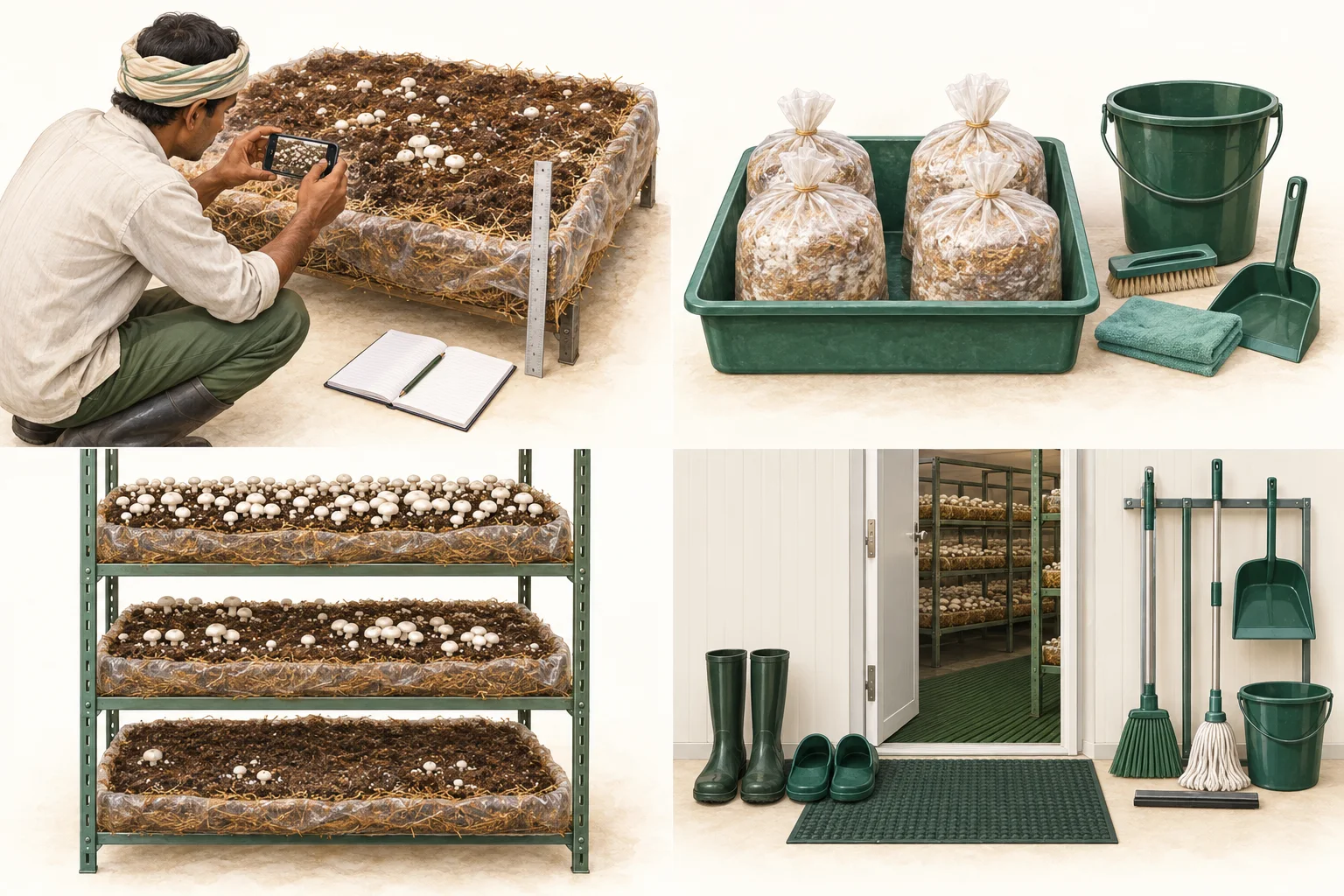
Draw a line between dirty and clean. Straw storage and soaking are dirty. Spawning and growing are clean. Wash hands and change footwear when you cross the line.
Use fresh straw that has not been rained on. Heat treatment must reach its temperature for its full time. DMR spawns in a room fumigated 48 hours earlier; a well washed and dried room with the door kept shut is the small grower's version. Space bags 15 to 20 cm apart on shelves so air moves.
Spent bags go to a pit away from the unit, and NHB says cover such material with at least 10 cm of manure to stop flies breeding. At the end of a button crop NHB asks for a cook-out of the compost at 70 degrees for 12 hours.
04Observe before you act
When something looks wrong, record the crop, batch, location, stage, first signs and affected quantity. Photograph the problem without opening suspect bags or spreading material through clean areas. Follow the farm containment procedure and seek a competent assessment.
Do not spray by habit. Chemical legality, crop approval, label instructions, worker protection and the required pre-harvest interval must be verified for the exact product and use. No generic 48-hour interval can replace that check.
Review substrate preparation, hygiene, water management and airflow alongside biological causes. A photograph alone does not establish a diagnosis.
Draw your clean line this week
- Sketch the unit. Mark the dirty area (straw store, soaking drum) and the clean area (spawning, growing) and the door between them.
- Put a hand-wash bucket and a change of footwear at that door.
- Fit 35-mesh nylon net over every vent and door gap and check it for tears.
- Hang a yellow light trap with an oiled sheet and count flies once a week.
- Move all spent bags to a pit at least a field away and cover them.
- Start a symptom page in the diary with the four questions: where, when, pattern, what changed.
Write in your farm diary: Weekly fly count, every bag removed with the reason and days since spawning, and the date of each floor wash.
Mistakes that cost a crop
- Spraying by habit at the first spot; it hides the cause, breaks the 48-hour rule and may use a product no longer approved.
- Using straw that got rained on in the stack; DMR lists old and wet straw among the triggers for ink caps and moulds.
- Leaving spent bags beside the unit; they breed flies and shed spores into the next crop.
Check yourself
Three questions, instant answersA green patch appears on one bag. The first step is
What determines the interval between an authorised chemical treatment and harvest?
Which of these is a disorder, not a disease?
An editorial self-check, not a certificate. Answers are not stored, not even on this device.
Words used in this lesson
- Competitor mould
- A fungus that eats the substrate in place of your crop, such as green mould.
- Contamination
- Any unwanted organism getting into spawn, substrate or the room.
- Disorder
- A crop fault caused by the environment, not by a disease or pest.
- Isolation
- Taking an affected bag out of the room so it cannot infect the rest.
- Cook-out
- Heating spent compost at the end of a crop to kill pests and spores before it leaves the room.
References & further reading
Course completion does not establish practical competence.
Open current reference