


Environment
A mushroom room has no single correct temperature. The number that matters depends on the species, the stage and where you measure it, and the four factors push each other around all day.
- By the end you can explain how temperature, humidity, fresh air and light each act on the crop.
- By the end you can tell bed temperature from air temperature and know which to record.
- By the end you can read stage-by-stage bands for oyster, button and milky from DMR.
- By the end you can recognise the crop's own signals that the environment is wrong.
Room climate by crop stage
Tiered racks with space between bags so fresh air and humidity reach every bag.
Read numerical examples with their source, method and crop context. They are not universal operating instructions. Historical prices are not current quotations.
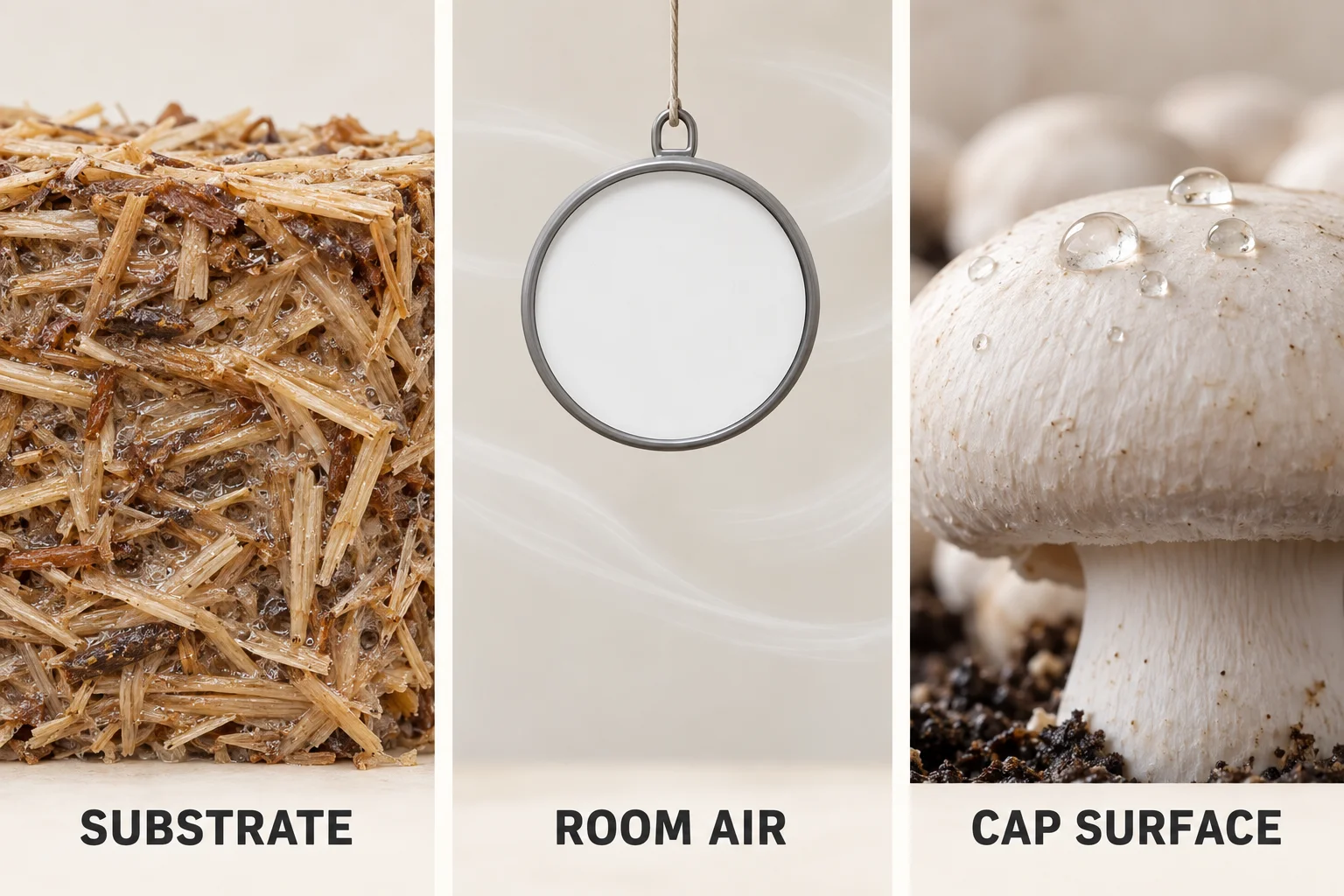
Look, explain, then apply
Three different water observations. The blank dial is symbolic, not a measurement, and the pictured wet substrate and cap are not target conditions.
See where this fits in the full workflow →01Temperature: the bed, not only the air
Measure room air and representative growing material separately. Active mycelium releases heat, so the centre of a bag or bed may differ from the wall thermometer. Record the measurement location, crop stage and time before comparing readings.
Temperature requirements vary by species, strain and growth stage. Oyster is a group of species; there is no universal 30-degree death threshold for all oyster mycelium. Use the supplier or institutional protocol for the actual strain and distinguish air targets from substrate limits.
For a seasonal room, compare indoor trends with the chosen crop programme and available control. Shading, air exchange, cooling and water management have different effects. Investigate the cause and safe response rather than applying one watering rule to every hot room.
02Humidity: keeping water inside the mushroom
Relative humidity, written RH, is how much water the air holds compared with the most it could hold at that temperature. A mushroom is mostly water and loses it fast to dry air, so caps crack and edges curl.
DMR gives 75 to 85 percent RH for oyster fruiting, 80 to 85 for button cropping and 80 to 90 for milky. But wet is also a disease. A film of water lying on caps at 20 degrees or more lets bacterial blotch spread, and NHB says to avoid more than 85 percent RH together with more than 20 degrees.
The rule is: wet the floor and the walls, not the mushrooms, and make sure caps dry within a few hours.
03Fresh air and carbon dioxide
The fungus breathes. It takes oxygen and gives out carbon dioxide, CO2. During spawn run high CO2 is tolerated and even useful: oyster up to 2 percent, button 10,000 to 15,000 ppm, with no fresh air at all.
At fruiting, CO2 must fall. DMR's manual asks for under 600 ppm for oyster cropping and the Hindi folder under 800; button pinning wants 800 to 1,000 ppm; milky needs 3 to 4 air changes an hour. Too much CO2 shows on the mushroom: long stems and small caps, oysters shaped like a trumpet mouth, onion-shaped buttons.
Fresh air also dries the room, so ventilation and humidity fight each other and have to be balanced by stage.
04Light, and reading the crop
Mycelium needs no light. Fruiting does. DMR gives oyster pinheads 200 lux for 8 to 12 hours a day, and notes that under 100 lux caps go pale yellow. TNAU gives milky 2,500 to 3,000 lux. Shiitake incubation and fruiting use 500 to 1,000 lux. For button no Indian primary source gives a figure, so do not copy one: measure and note what works.
The crop is your best sensor. Long stem and small cap means CO2. Pale colour means low light. Cracked dry caps mean low RH. Sticky brown spots mean water lay on the cap too long. No pinheads after the switch usually means the temperature drop or fresh air never happened.
Keep one thermometer in the bed and one in the air, and write both down twice a day.
The two-thermometer week
- Push one thermometer probe into the centre of a bag and hang one in the air at bag height.
- Read both at 7 am and 4 pm for seven days and write them side by side.
- Hang a cheap humidity meter at bag height and read it at the same times.
- Note when doors or fans were opened and for how long.
- Once a day, look at stem length and cap colour and write one line.
- At the end of the week compare your readings with the DMR band for your species and stage.
Write in your farm diary: Date and time, bed temperature, air temperature, RH, minutes of ventilation, and one line on how the crop looks.
Mistakes that cost a crop
- Spraying water straight onto mushrooms to raise humidity; the water film invites bacterial blotch.
- Sealing the room to hold humidity during fruiting; CO2 climbs and the crop grows long stems.
- Using one setpoint for the whole crop; spawn run and fruiting need different temperature, air and light.
Check yourself
Three questions, instant answersOyster mushrooms with long stems and tiny caps usually mean
Which stage needs no light at all?
Compared with the room air, the oyster bed is
An editorial self-check, not a certificate. Answers are not stored, not even on this device.
Words used in this lesson
- Relative humidity (RH)
- How full the air is of water compared with the most it can hold at that temperature.
- CO2 (carbon dioxide)
- The gas the fungus breathes out; high during spawn run, must be low during fruiting.
- Air change
- Replacing the whole volume of room air with outside air once.
- Lux
- A unit of light brightness; 200 lux is a dim but readable room.
- Bed temperature
- Temperature measured inside the growing material; biological activity and heat transfer can make it differ from room air.
References & further reading
Course completion does not establish practical competence.
Open current reference