


Which Mushroom Fits Me?
The right first mushroom is the one your climate already grows, your local straw feeds, your skill can manage and a buyer within an hour's drive will take. Here is an honest way to shortlist.
- By the end you can score your situation on five constraints: climate, materials, skill, market and control.
- By the end you can shortlist one or two species using DMR's temperature and season tables.
- By the end you can recognise when a fashionable species is a bad fit.
- By the end you can plan a small first batch and decide what to measure.
Five mushrooms side by side
Green band = fruiting temperature. Source: ICAR-DMR seasonal folder and manual.
Read numerical examples with their source, method and crop context. They are not universal operating instructions. Historical prices are not current quotations.
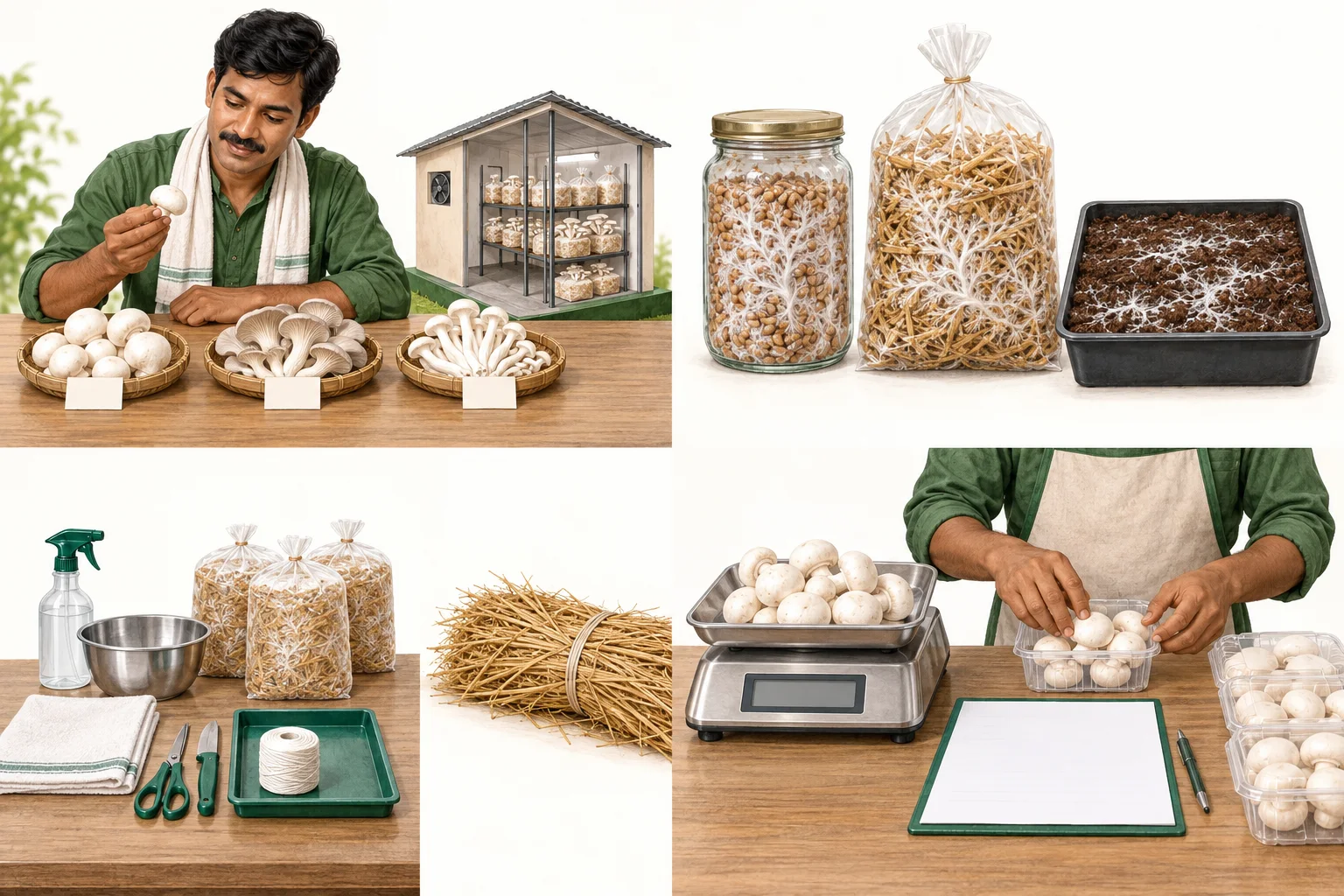
Choose your crop
- Notice
- Crop, room, season and buyer belong in one decision.
- Understand
- A popular mushroom is not automatically the best fit for your room.
- Try it
- Record indoor conditions and ask a buyer what they will accept.
01Constraint 1: climate and season
Without cooling, count the months when both day and night stay inside a species' fruiting band: 18 to 26 degrees for the common oysters, 14 to 18 for button, 30 to 35 for milky, 28 to 32 for paddy straw, 15 to 20 for shiitake.
Then check DMR's regional calendar. Plains: oyster September to May, milky February to April and July to September, paddy straw July to September, button November to February. Mid-hills: shiitake October to February, button September to March, oyster all year. Coast: oyster, paddy straw and milky in natural conditions all year.
A species with no window on your calendar needs a controlled room, which is a different business.
02Constraints 2 and 3: materials, skill and control
Materials: wheat straw in the north, paddy straw in the east and south, sugarcane bagasse and maize or jowar stalks for milky, sawdust of broadleaf trees such as mango, poplar or oak for shiitake, two-year-old farmyard manure and loam for casing. Straw must be fresh, dry and never rained on.
Skill rises by species. Oyster first: no casing, no compost. Then milky, which adds casing, or paddy straw, which adds speed. Button adds composting and cold. Shiitake blocks add sterile filling and a 60 to 80 day wait.
Control multiplies crops, DMR plans six button crops a year in controlled rooms, but adds capital and power dependence.
03Constraint 4: market and shelf life
Match distance to the buyer against shelf life. Paddy straw is sold the same day and cannot be refrigerated below 10 degrees. Oyster keeps 24 to 48 hours at room temperature. Milky keeps 3 to 4 days. Button keeps a few days chilled. Shiitake can be dried.
A buyer three hours away therefore rules out paddy straw and makes oyster risky without cold. Buyers also know different mushrooms: northern cities know button; eastern and southern markets know oyster, paddy straw and milky. Walk the mandi before you buy spawn.
A DMR seasonal room of 18 by 15 by 10 feet holds about 300 oyster bags. Your first batch should be a fraction of that.
04Three Indian cases and a first batch
Rohtak, wheat straw, winter nights of 10 to 15 degrees, no cooling: seasonal button from November to February, or the cold-loving oyster Pleurotus florida in the same months.
Cuttack, paddy straw everywhere, 28 to 35 degrees from July to September, buyers in the town market: paddy straw mushroom in the monsoon, milky from February to April.
Solan or Shimla mid-hills, sawdust from local mills, 15 to 20 degrees from October to February: shiitake blocks or button, with oyster in the warmer months.
In every case the first batch is small, one shelf, one species, one buyer, with bed temperature, dates, kilograms sold and rejections written down. That record is worth more than any project report.
Score your fit on one page
- Write your twelve months with the usual day and night temperatures.
- List the straw or sawdust available within 20 km and the months it is available.
- Tick what you can already do: hot-water treatment, casing, composting, sterile bag filling.
- Name two buyers, their distance, and what mushrooms they buy today.
- Give each of the five species a score from 0 to 2 on climate, materials, skill, market and control, and add them up.
- Pick the top scorer, set a spawning date inside its window, and plan a batch of one shelf.
Write in your farm diary: The five scores per species, the species chosen, the planned spawning date, the buyer names, and the batch size.
Mistakes that cost a crop
- Choosing the species with the highest online price; it is usually the one your climate and skill fit least.
- Starting with shiitake in the plains; it wants 15 to 20 degrees and sterile technique, and waits 60 to 80 days to fruit.
- Ignoring buyer distance; a perfect crop of paddy straw mushroom spoils on the road.
Check yourself
Three questions, instant answersThe usual first crop for a beginner is
A buyer three hours away, no cold chain, hot wet July in Odisha: which species is the risky choice?
Which species does DMR's calendar allow all year in the mid-hills?
An editorial self-check, not a certificate. Answers are not stored, not even on this device.
Words used in this lesson
- Constraint
- A limit you cannot change quickly, such as climate or the nearest buyer.
- Seasonal cultivation
- Growing only in the months when natural temperature fits the species.
- Controlled cultivation
- Growing in insulated rooms with cooling and air handling, in any month.
- Shortlist
- The one or two species that pass all five constraints.
- Pilot batch
- A small first crop run to collect records before any investment.
References & further reading
Course completion does not establish practical competence.
Open current reference