


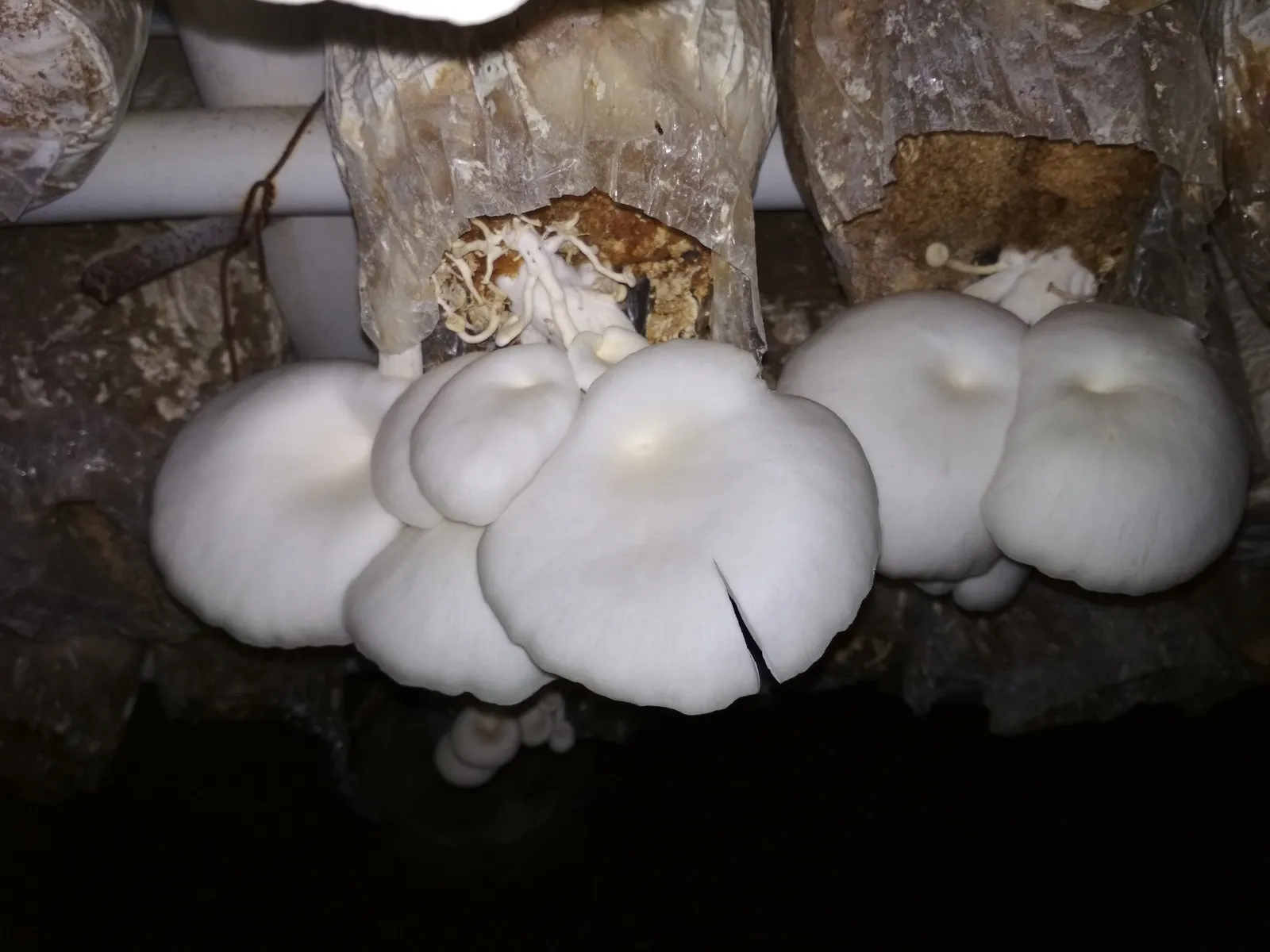
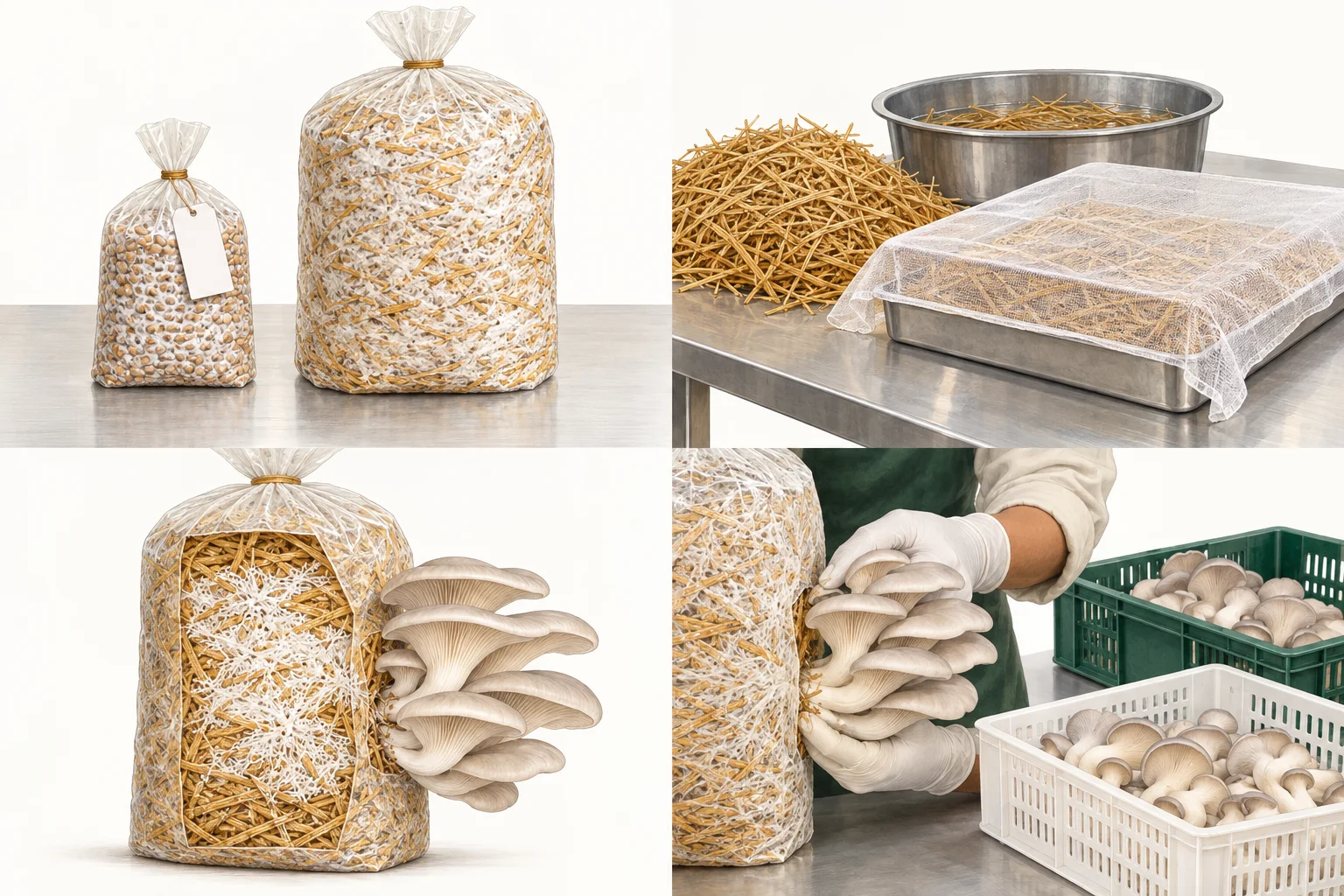

Quick orientation
Distribute conditioned air through the crop zone while watching clusters, surfaces and room uniformity. This topic belongs to a Pleurotus substrate-bag or validated block system. The species or strain, substrate treatment and fruiting-air context must travel together.
Species identity and spore exposure
‘Oyster’ is a Pleurotus group, not one climate programme. ICAR-DMR distinguishes warm-weather P. flabellatus, P. sajor-caju and P. djamor (20–28°C) from lower-temperature P. florida, P. ostreatus, P. eryngii and P. cornucopiae (12–20°C). Record the species and strain before selecting a range.
Why this stage matters
Distribute conditioned air through the crop zone while watching clusters, surfaces and room uniformity.
Method boundary
This topic belongs to a Pleurotus substrate-bag or validated block system. The species or strain, substrate treatment and fruiting-air context must travel together.
- Confirm the culture as Pleurotus spp., with strain or variety recorded where available.
- Confirm one method: straw bag or validated lignocellulosic bag or block.
- Record substrate source, treatment class, batch and contamination observations.
Interpret the environment
Air temperature, substrate or block temperature, humidity, fresh air, light and crop response interact. A number without stage, strain, sensor position and source is not an operating instruction.
Evidence status
The page publishes process relationships supported by primary institutional sources. Numeric recipes remain absent where source context, strain identity or specialist review is incomplete.
Production method records
One species can require more than one cultivation model.
OYS-STRAW-BAGTreated straw bag system
- Substrate
- clean cereal straw with method evidence
- Container
- perforated or opened cultivation bag
- Treatment
- Pasteurization-class treatment or another validated method; not interchangeable with sterilization.
- Scale context
- home trial to commercial batch, with different hygiene and climate responsibilities
- Material check
- Treatment
- Cooling and moisture check
- Spawning
- Spawn run
- Fruiting transition
- Cluster harvest
System relationships
Conceptual crop diagrams
Each diagram shows sequence and boundaries without inventing dimensions, setpoints or wild-species identification cues.
- 01Outdoor air
Stage 1 has its own material, hygiene, environment and evidence checks.
- 02Conditioning
Stage 2 has its own material, hygiene, environment and evidence checks.
- 03Distribution
Stage 3 has its own material, hygiene, environment and evidence checks.
- 04Cluster zone
Stage 4 has its own material, hygiene, environment and evidence checks.
- 05Return or exhaust
Stage 5 has its own material, hygiene, environment and evidence checks.
Governed climate records
Published ranges carry their operating context.
Source-backed records are shown where stage and production method are clear. Empty records remain visibly pending rather than being filled with generic internet values.
CLIMATE-OYSTER-SPAWN-RUNsource-contextualspawn run
23–27 °C air; species and strain still govern suitability- Season / source context
- ICAR-DMR March 2026 crop advisory; use only with identified Pleurotus species and local room observations.
- Production
- Bag spawn run in the seasonal advisory context; substrate temperature can exceed room air.
- Strain
- Source did not attach a strain
CLIMATE-OYSTER-FRUITINGsource-contextualfruiting
Warm group: 20–28 °C; cool group: 12–20 °C — only after recording the Pleurotus species and strain- Season / source context
- ICAR-DMR oyster FAQ species grouping; this is not one universal 12–28 °C operating band.
- Production
- Warm group in the cited FAQ: P. flabellatus, P. sajor-caju and P. djamor. Cool group: P. florida, P. ostreatus, P. eryngii and P. cornucopiae.
- Strain
- Source did not attach a strain
Trace the boundary
Evidence and limitations
institutional · tier AResearch programmes
Current institutional scope for cultivated and specialty mushroom research in India.
Research scope does not by itself establish a farm recommendation, commercial readiness or strain-specific operating range.
Open primary sourcetechnical-bulletin · tier ATechnologies developed by ICAR-DMR
Institutional method history for oyster, milky, paddy straw, shiitake and selected specialty mushrooms.
Method descriptions are context-specific and contain numeric and broad substrate statements that require independent technical review before operational publication.
Open primary sourcecurrent-advisory · tier ACurrent crop advisory
Time-stamped Indian seasonal crop context and the need to choose oyster species for conditions.
Chemical directions are excluded from this platform unless a current label and jurisdiction are independently verified.
Open primary sourcetechnical-bulletin · tier AOyster mushroom cultivation FAQ
Indian institutional distinction between warm- and cool-fruiting Pleurotus species, plus an occupational spore-exposure warning.
The species bands are source context, not a strain guarantee. Generic yield, storage and legacy chemical statements are not carried into operational guidance.
Open primary sourcetechnical-bulletin · tier APost-harvest technology of mushrooms
Species-specific post-harvest deterioration patterns and handling context.
Historic shelf-life statements depend on maturity, handling, packaging and storage conditions and are not reproduced as guarantees.
Open primary source