


Bacterial Blotch
An evidence-led guide to differentiate superficial blotch from fungal spotting, bruising and post-harvest browning.
See the symptom. Check the cause. Act carefully.
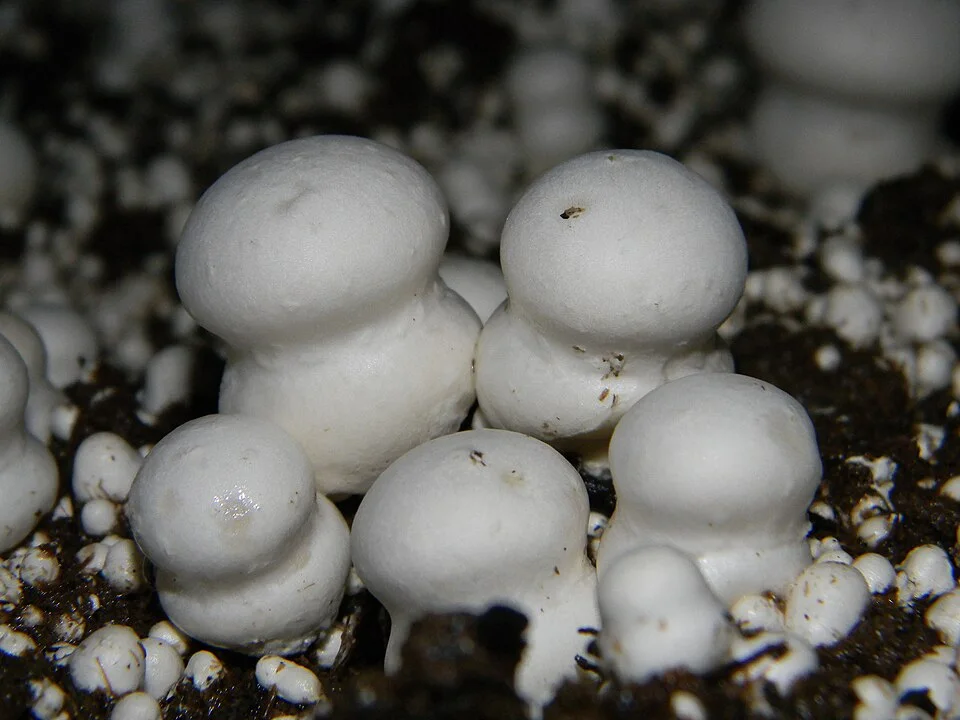
Real research photographs with practical, nonchemical first steps. These examples come from published studies, not MushroomWale farms. Resemblance is a clue, not confirmation of disease in your crop.
- 01Observe the crop and record the pattern
- 02Limit transfer to clean areas
- 03Check the diagnosis and follow a response plan
- 04Review the next crop for recurrence
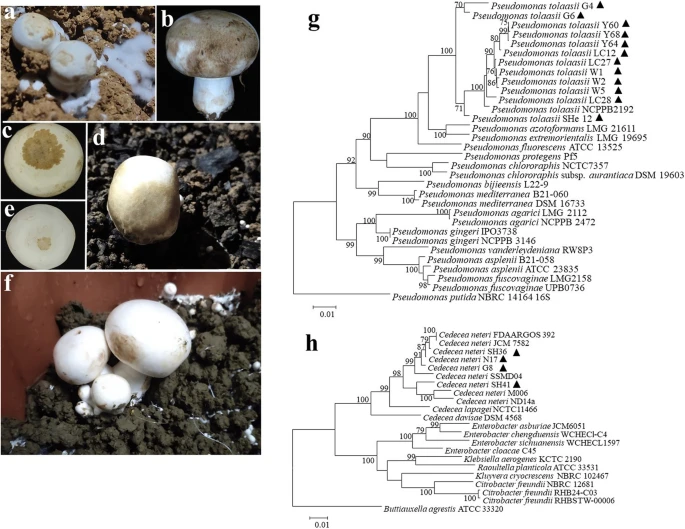
Bacterial blotch
Yellow-brown to dark brown superficial patches may occur on caps, including places where mushrooms touch or surfaces remain wet.
- What to do first
- Check actual cap wetness after watering and look for condensation. Correct water timing and air distribution with the crop supervisor so surfaces can dry without desiccating the crop.
- Reduce the chance of recurrence
- Avoid persistent wet surfaces, uncontrolled temperature swings and splash transfer. Clean handling equipment and compare conditions across the room, not only at the wall sensor.
- What can look similar?
- Bruising, fungal spots and other bacteria can produce browning. The photographed study found more than one bacterial cause; matching a picture is not a species diagnosis.
- What to record
- Note when spotting appears relative to watering, picking and packing. Record wetness, condensation and affected positions before changing settings.
From symptom to cause
A first look, not a diagnosis. Source: ICAR-DMR manual and disease bulletin.
| What you see | Likely cause | First step |
|---|---|---|
| Long stems, small caps | CO₂ too high (above about 1,500 ppm) | More fresh air |
| Green patches on compost | Trichoderma; low pH or leftover ammonia | Isolate, remove; check next batch |
| No pins after casing | Room not aired and cooled | 16 to 18 °C, ventilate |
| Brown sunken spots on caps | Bacterial blotch; wet caps | Dry the surface, humidity under 85% |
| White wet lumps | Wet bubble from casing | Salt, remove; steam next casing |
| Small flies | Sciarid or phorid flies | Screens, light traps, hygiene |
Keep clean and suspect work separate
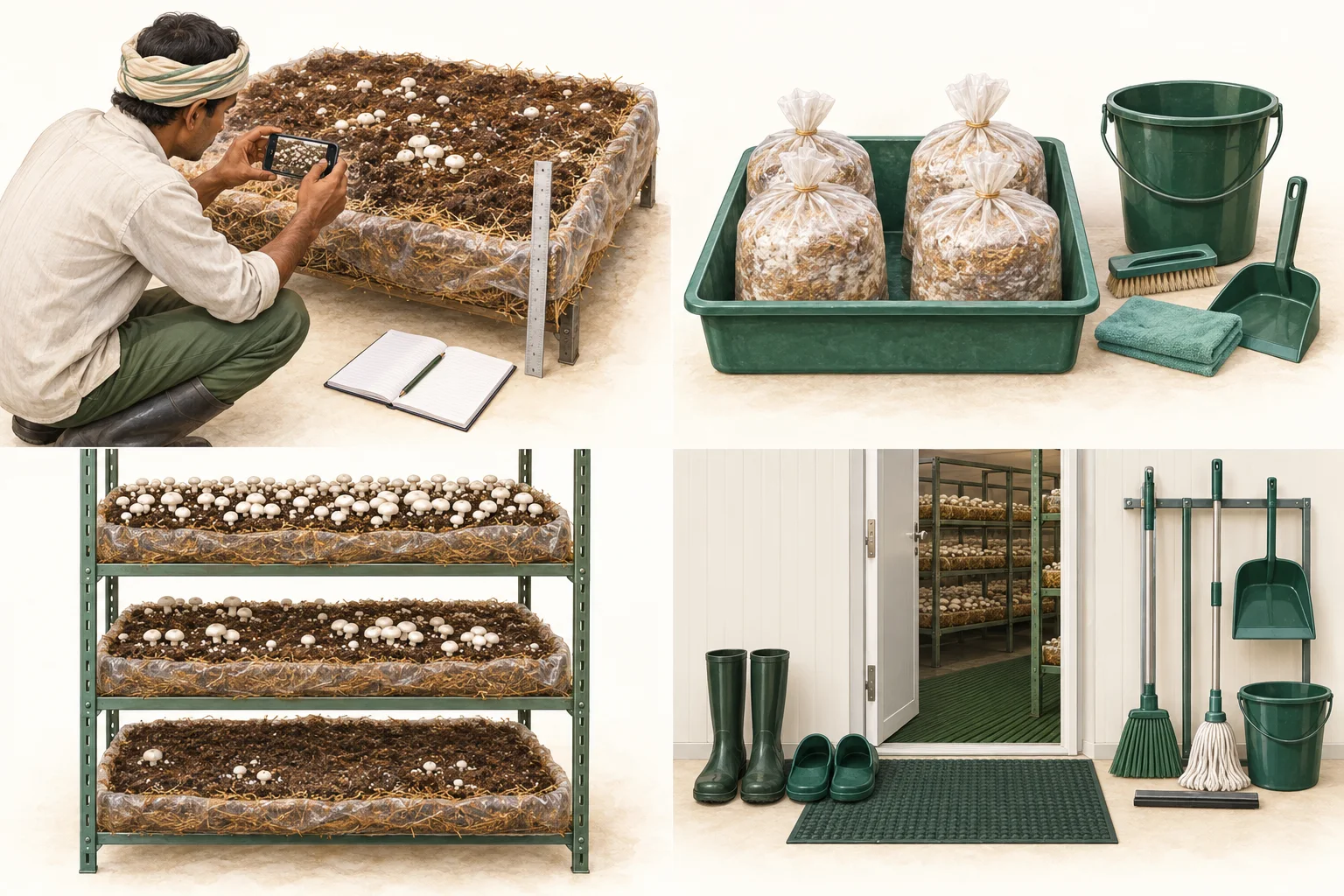
AI-generated educational illustrations. Not actual farm photographs, diagnostic evidence or construction specifications.
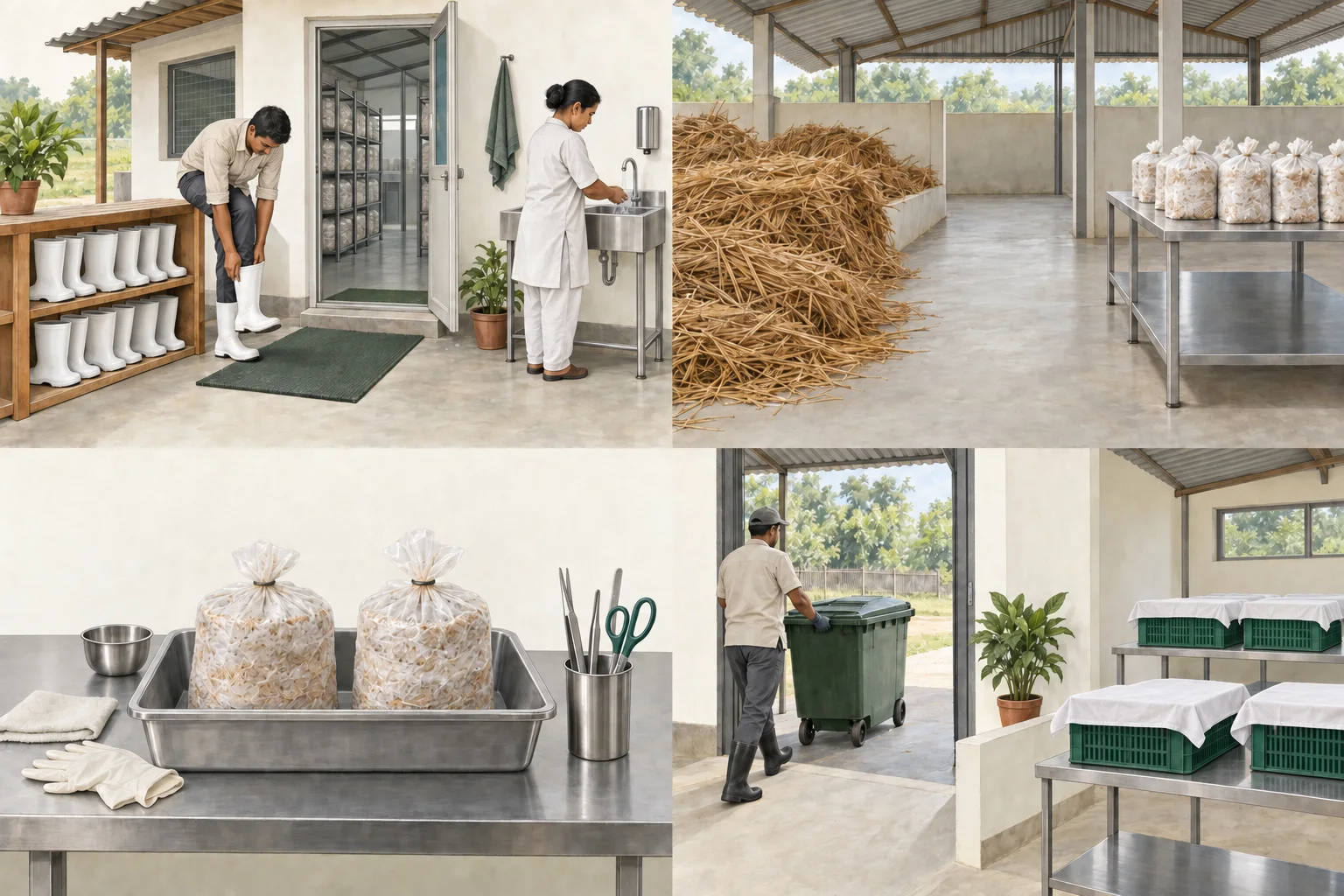
Make clean entry a routine
Clean entry has a place and a repeatable sequence. Footwear, hands and movement between areas are part of farm hygiene. The illustration does not demonstrate a validated disinfection process.
Assign the entry routine, provide suitable facilities and check that visitors and workers follow it.
Protect prepared material
Raw inputs and protected prepared material are separated. Treatment does not protect a substrate indefinitely. Handling afterwards can introduce contamination.
Keep work areas, tools and movement routes separated. Label batches so a later problem can be traced to its preparation history.
Keep suspect bags closed
A separate tray helps identify material being held for investigation. The bags are illustrative and not diagnosed. Opening, shaking or smelling suspect material is not a confirmation method.
Mark the batch, limit movement and seek qualified advice on sampling or disposal. Do not return dedicated tools to clean work without the appropriate procedure.
Plan the spent-material route
Used material and saleable harvest follow different handling paths. A disposal route can undo clean-work separation if it crosses incoming materials or harvest handling.
Map the exit route and cleaning responsibility. Check the actual workflow during a busy room turnaround, not only on a drawing.
Bacterial blotch
Current causal description: Pseudomonas tolaasii complex and other blotch-associated bacteria
Symptom progression
Timing of infection can change what appears.
Pale yellow superficial lesions
Spotting where cap surfaces remain wet or touch
Golden-yellow to chocolate-brown superficial blotches
Spots enlarge or coalesce while wetness persists
Large cap areas may be affected
Cracking can follow later drying
Quality deterioration may continue after harvest
Could it be something else?
Retain alternatives until discriminating evidence is present.
Patterns to map
- Contact points and crevices
- Wet rack or layer zones
- Clusters linked to splash or handling
Confused with
- Dry-bubble spots
- Mechanical bruising
- Chemical injury
- Post-harvest browning
How to confirm
- Assess lesion depth, wetness history and spatial pattern
- Bacterial isolation or molecular work by a qualified laboratory
- Compare affected and healthy mushrooms from the same zone
Integrated management hierarchy
Prevention and verified root-cause correction come before chemical action.
- 1
Record wetness, watering and room distribution
- 2
Correct confirmed evaporation or condensation mechanisms
- 3
Reduce splash and contaminated movement
- 4
Escalate persistent, spreading or post-harvest cases
Follow the chain upstream
A name is not a root cause.
- Visible superficial spotting
- Confirm susceptible crop plus plausible bacterial inoculum
- Check persistent cap wetness / low evaporation
- Trace water, condensation, splash, handling, casing, dust and vectors
- Verify lesion differential and correct the supported pathway
Quick recognition
Use bacterial blotch to differentiate superficial blotch from fungal spotting, bruising and post-harvest browning. Recognition begins the investigation; it does not confirm a cause.
- Observe early, developing and advanced signs
- Map distribution and progression
- Compare biological and abiotic causes
- Confirm before high-risk action
What to record
Capture crop stage, crop day, room, rack, layer, pattern, first observation, progression, compost and casing batches, watering, chemistry, pests and timestamped environmental readings.
Could it be something else?
Compare visual appearance with spatial pattern, progression, environmental history, process history and missing expected signs. Colour or one photograph is weak evidence.
Evidence still needed
State the unanswered questions and next measurement. Useful evidence can be visual, environmental, spatial, temporal, microscopic, laboratory, molecular, trap-based or process-history based.
Immediate safe direction
Document the affected area, avoid unnecessary disturbance or cross-room movement, isolate suspect tools, inspect adjacent areas and preserve representative evidence. Do not spray automatically.
Root-cause review
Trace the visible problem through water, evaporation, airflow, sensor placement, compost, casing, staff movement, flies, tools or room design where evidence supports the connection.
Chemical and regulatory boundary
Historical management literature is separated from current practice. No crop-protection dose is published unless the exact product, formulation, mushroom crop label, target, method, harvest interval, worker-safety information and current Indian status are verified.
When remote guidance is inadequate
Seek technical inspection or laboratory support for rapid unexplained loss, repeated outbreaks, suspected virus, unknown mould, severe pests, chemical injury, multiple affected rooms or unresolved contradictions.
Trace the claim and its limits.
Pathogen biology, dated advisories and current regulatory status are stored separately.
Bacterial Blotch Disease
Symptom progression, surface-water association, spread pathways and differential clues.
Open sourceDiseases and Competitor Moulds of Mushrooms and their Management
Indian mushroom disease descriptions, symptoms, epidemiology, historical taxonomy and competitor-mould records.
Open sourceDirectorate of Plant Protection, Quarantine and Storage regulatory functions
Indian pesticide registration and regulatory-governance context under the Insecticides Act and Rules.
Open sourceChemical governance is a publication gate.
No operational pesticide, fungicide, insecticide, disinfectant or fumigant dose is published. Historical references are not current labels.
- Current operational dose
- Not published
- Mushroom crop label
- Not established by this record
- Review status
- Regulatory review required