

Environmental Disorders
An evidence-led guide to investigate carbon dioxide, temperature, humidity, evaporation, condensation, drafts and stagnant zones.
Room climate by crop stage
Source: ICAR-DMR manual
Explore this system
Move from the hub to the most specific evidence record.
Excess Carbon Dioxide Pattern
An evidence-led guide to connect long stems and cap development to mapped carbon dioxide, crop stage and fresh-air delivery.
Open resource Environmental or handling disorderInsufficient Evaporation
An evidence-led guide to connect persistent surface wetness to air state, movement, watering and crop activity.
Open resource Environmental or handling disorderCondensation Injury Risk
An evidence-led guide to compare dew point, surface temperature and local airflow before assigning a disease.
Open resourceQuick recognition
Use environmental disorders to investigate carbon dioxide, temperature, humidity, evaporation, condensation, drafts and stagnant zones. Recognition begins the investigation; it does not confirm a cause.
- Look for rack or room pattern
- Compare the affected zone with a healthy zone
- Check sensor identity and timing
- Test response to a controlled correction
What to record
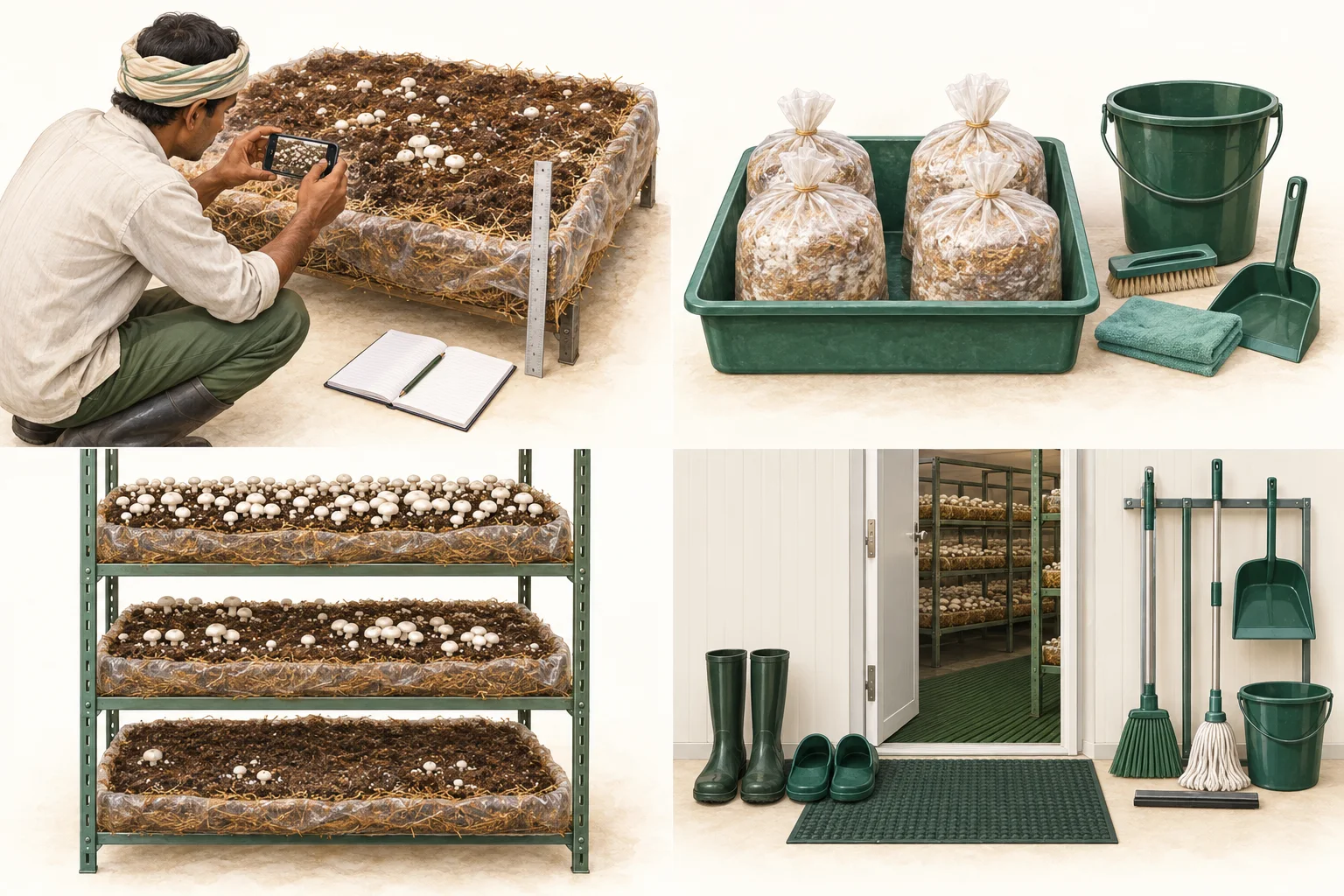
Capture crop stage, crop day, room, rack, layer, pattern, first observation, progression, compost and casing batches, watering, chemistry, pests and timestamped environmental readings.
Could it be something else?
Compare visual appearance with spatial pattern, progression, environmental history, process history and missing expected signs. Colour or one photograph is weak evidence.
Evidence still needed
State the unanswered questions and next measurement. Useful evidence can be visual, environmental, spatial, temporal, microscopic, laboratory, molecular, trap-based or process-history based.
Immediate safe direction
Document the affected area, avoid unnecessary disturbance or cross-room movement, isolate suspect tools, inspect adjacent areas and preserve representative evidence. Do not spray automatically.
Root-cause review
Trace the visible problem through water, evaporation, airflow, sensor placement, compost, casing, staff movement, flies, tools or room design where evidence supports the connection.
Chemical and regulatory boundary
Historical management literature is separated from current practice. No crop-protection dose is published unless the exact product, formulation, mushroom crop label, target, method, harvest interval, worker-safety information and current Indian status are verified.
When remote guidance is inadequate
Seek technical inspection or laboratory support for rapid unexplained loss, repeated outbreaks, suspected virus, unknown mould, severe pests, chemical injury, multiple affected rooms or unresolved contradictions.
Trace the claim and its limits.
Pathogen biology, dated advisories and current regulatory status are stored separately.
ICAR-DMR Technical Bulletin Library
Institutional publication index for disease, farm-design, post-harvest and spent-substrate references.
Open sourceICAR-DMR Crop Advisory
Dated Indian seasonal crop-health, hygiene and pest observations.
Open sourceDirectorate of Plant Protection, Quarantine and Storage regulatory functions
Indian pesticide registration and regulatory-governance context under the Insecticides Act and Rules.
Open sourceChemical governance is a publication gate.
No operational pesticide, fungicide, insecticide, disinfectant or fumigant dose is published. Historical references are not current labels.
- Current operational dose
- Not published
- Mushroom crop label
- Not established by this record
- Review status
- Regulatory review required