

A practical guide to growing mushrooms in IndiaA joint educational initiative by MushroomWale & DMR Solan
MushroomFarming.in

A joint educational initiative by

MushroomWale.com
ICAR–Directorate of Mushroom Research, Solan logoICAR–DMRSolan

MushroomFarming / guide

Physiological Disorders

An evidence-led guide to describe supported crop-response mechanisms and distinguish them from pathogens.

Practical explanation + detailed referenceSources & review ↓
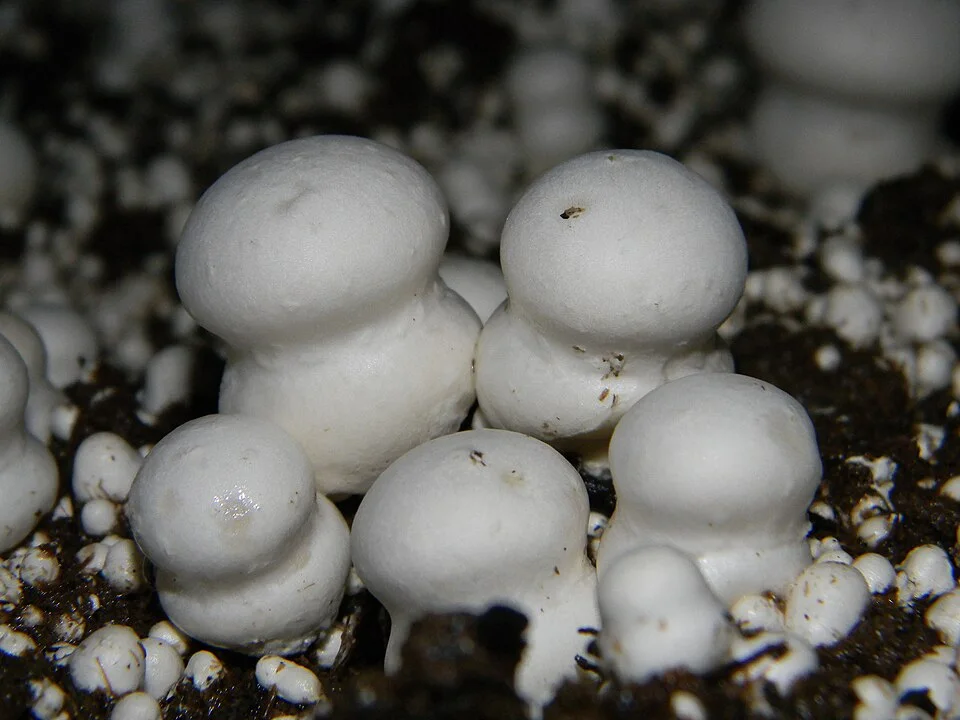
Real close photograph of white Button Mushrooms growing on a dark casing surface.
Cultivation context—not a diagnostic photograph. See the labelled symptom references below.I. G. Safonov (IGSafonov) · CC BY-SA 3.0View full photograph ↗
On this pageChoose a section, or keep reading below

Read this in the full guide: Investigate a crop problem without losing the evidence

Understand the topic

Start with the explanation.

Use this resource to describe supported crop-response mechanisms and distinguish them from pathogens.

Part 01

Quick recognition

Use physiological disorders to describe supported crop-response mechanisms and distinguish them from pathogens. Recognition begins the investigation; it does not confirm a cause.

  • Look for rack or room pattern
  • Compare the affected zone with a healthy zone
  • Check sensor identity and timing
  • Test response to a controlled correction
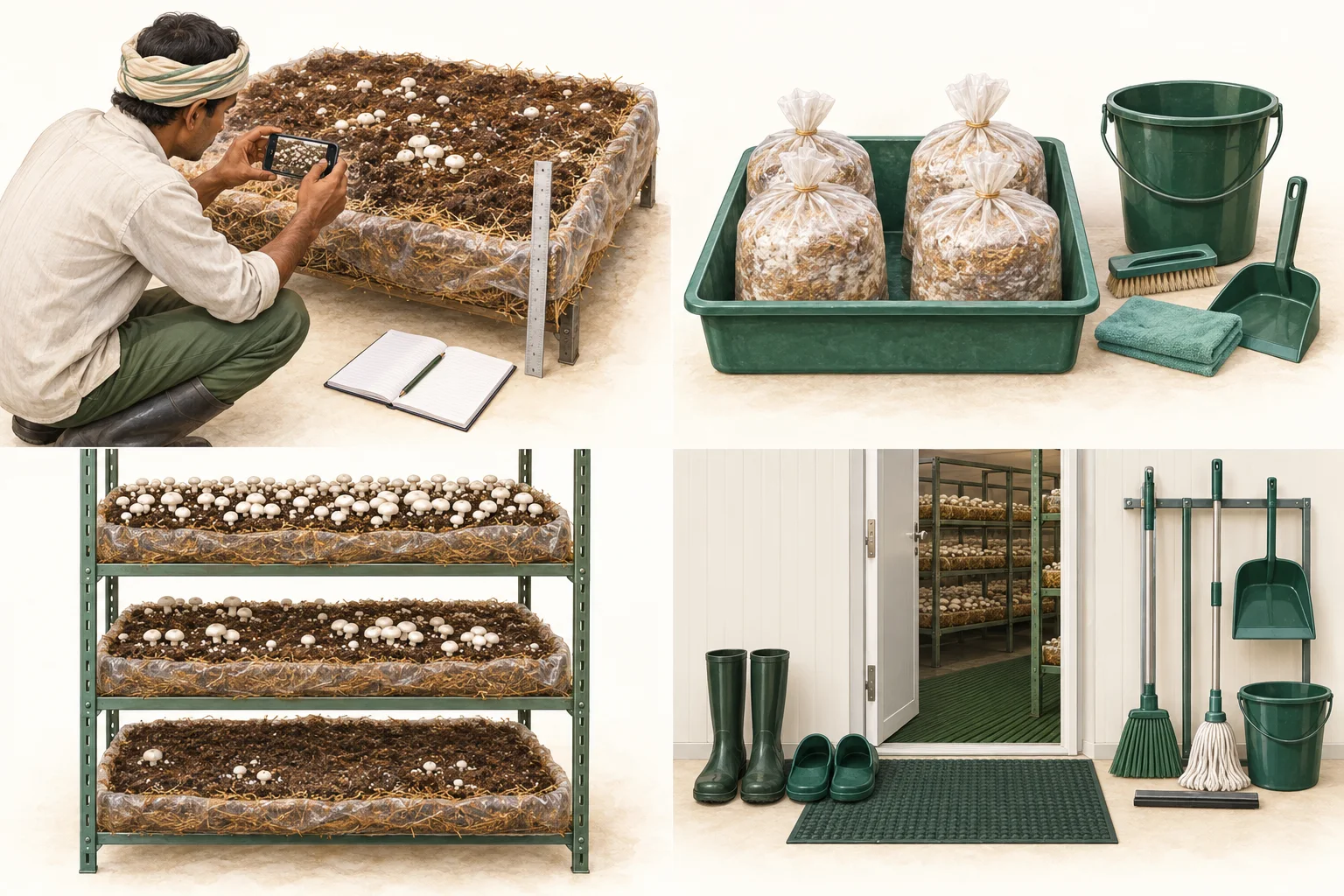
Illustration of an operator photographing an uneven crop beside a record sheet.
AI teaching illustrationCapture the pattern

The location and pattern of symptoms are useful evidence. A close-up alone leaves out the batch, room and timeline.

Conceptual explanation—not a real farm photograph, diagnostic finding or construction specification.
Part 02

What to record

Capture crop stage, crop day, room, rack, layer, pattern, first observation, progression, compost and casing batches, watering, chemistry, pests and timestamped environmental readings.

Illustration of organised cleaning tools and an entry-footwear area.
AI teaching illustrationClose the loop

Entry routines and dedicated tools are part of prevention. A written procedure only helps when people actually follow it.

Conceptual explanation—not a real farm photograph, diagnostic finding or construction specification.
Part 03

Could it be something else?

Compare visual appearance with spatial pattern, progression, environmental history, process history and missing expected signs. Colour or one photograph is weak evidence.

Part 04

Evidence still needed

State the unanswered questions and next measurement. Useful evidence can be visual, environmental, spatial, temporal, microscopic, laboratory, molecular, trap-based or process-history based.

Part 05

Immediate safe direction

Document the affected area, avoid unnecessary disturbance or cross-room movement, isolate suspect tools, inspect adjacent areas and preserve representative evidence. Do not spray automatically.

Part 06

Root-cause review

Trace the visible problem through water, evaporation, airflow, sensor placement, compost, casing, staff movement, flies, tools or room design where evidence supports the connection.

Part 07

Chemical and regulatory boundary

Historical management literature is separated from current practice. No crop-protection dose is published unless the exact product, formulation, mushroom crop label, target, method, harvest interval, worker-safety information and current Indian status are verified.

Part 08

When remote guidance is inadequate

Seek technical inspection or laboratory support for rapid unexplained loss, repeated outbreaks, suspected virus, unknown mould, severe pests, chemical injury, multiple affected rooms or unresolved contradictions.

Go deeper

Technical reference, records and tools.

Detailed crop-stage information, parameters, diagrams and specialist tools are kept together below. This material retains its source conditions and review limits.

Open the complete technical reference
Environmental or handling disorder

Physiological Disorders

An evidence-led guide to describe supported crop-response mechanisms and distinguish them from pathogens.

Evidence postureExternal specialist review not recordedNo single-photo diagnosisNo operational chemical doseEditorially published

From symptom to cause

A first look, not a diagnosis. Source: ICAR-DMR manual and disease bulletin.

What you seeLikely causeFirst step
Long stems, small capsCO₂ too high (above about 1,500 ppm)More fresh air
Green patches on compostTrichoderma; low pH or leftover ammoniaIsolate, remove; check next batch
No pins after casingRoom not aired and cooled16 to 18 °C, ventilate
Brown sunken spots on capsBacterial blotch; wet capsDry the surface, humidity under 85%
White wet lumpsWet bubble from casingSalt, remove; steam next casing
Small fliesSciarid or phorid fliesScreens, light traps, hygiene
01

Quick recognition

Use physiological disorders to describe supported crop-response mechanisms and distinguish them from pathogens. Recognition begins the investigation; it does not confirm a cause.

  • Look for rack or room pattern
  • Compare the affected zone with a healthy zone
  • Check sensor identity and timing
  • Test response to a controlled correction
02

What to record

Capture crop stage, crop day, room, rack, layer, pattern, first observation, progression, compost and casing batches, watering, chemistry, pests and timestamped environmental readings.

03

Could it be something else?

Compare visual appearance with spatial pattern, progression, environmental history, process history and missing expected signs. Colour or one photograph is weak evidence.

04

Evidence still needed

State the unanswered questions and next measurement. Useful evidence can be visual, environmental, spatial, temporal, microscopic, laboratory, molecular, trap-based or process-history based.

05

Immediate safe direction

Document the affected area, avoid unnecessary disturbance or cross-room movement, isolate suspect tools, inspect adjacent areas and preserve representative evidence. Do not spray automatically.

06

Root-cause review

Trace the visible problem through water, evaporation, airflow, sensor placement, compost, casing, staff movement, flies, tools or room design where evidence supports the connection.

07

Chemical and regulatory boundary

Historical management literature is separated from current practice. No crop-protection dose is published unless the exact product, formulation, mushroom crop label, target, method, harvest interval, worker-safety information and current Indian status are verified.

08

When remote guidance is inadequate

Seek technical inspection or laboratory support for rapid unexplained loss, repeated outbreaks, suspected virus, unknown mould, severe pests, chemical injury, multiple affected rooms or unresolved contradictions.

Evidence and review

Trace the claim and its limits.

Pathogen biology, dated advisories and current regulatory status are stored separately.

Institutional Reference

ICAR-DMR Technical Bulletin Library

Institutional publication index for disease, farm-design, post-harvest and spent-substrate references.

Open source
Current Advisory

ICAR-DMR Crop Advisory

Dated Indian seasonal crop-health, hygiene and pest observations.

Open source
Institutional Reference

Directorate of Plant Protection, Quarantine and Storage regulatory functions

Indian pesticide registration and regulatory-governance context under the Insecticides Act and Rules.

Open source

Historical management reference: old disease literature may describe treatments that are no longer authorised, labelled or appropriate. It is never an operational instruction here.

Chemical governance is a publication gate.

No operational pesticide, fungicide, insecticide, disinfectant or fumigant dose is published. Historical references are not current labels.

Current operational dose
Not published
Mushroom crop label
Not established by this record
Review status
Regulatory review required

Read the evidence

Sources & review.

Editorial update: 2026-08-23. Independent technical review is not recorded for this entry.

  1. ICAR-DMR Technical Bulletin Library

    ICAR-Directorate of Mushroom Research

  2. ICAR-DMR Crop Advisory

    ICAR-Directorate of Mushroom Research · 2026

  3. Directorate of Plant Protection, Quarantine and Storage regulatory functions

    Directorate of Plant Protection, Quarantine and Storage · 2024

Reading a source is not the same as applying its instructions to every farm. Confirm species, strain, crop stage, system, region and publication date. Old chemical recommendations are not current-use instructions.

See something that needs correcting? Tell us →