

Mites in Mushroom Farms
An evidence-led guide to distinguish harmful, indicator, predatory and incidental mites before control.
From symptom to cause
A first look, not a diagnosis. Source: ICAR-DMR manual and disease bulletin.
| What you see | Likely cause | First step |
|---|---|---|
| Long stems, small caps | CO₂ too high (above about 1,500 ppm) | More fresh air |
| Green patches on compost | Trichoderma; low pH or leftover ammonia | Isolate, remove; check next batch |
| No pins after casing | Room not aired and cooled | 16 to 18 °C, ventilate |
| Brown sunken spots on caps | Bacterial blotch; wet caps | Dry the surface, humidity under 85% |
| White wet lumps | Wet bubble from casing | Salt, remove; steam next casing |
| Small flies | Sciarid or phorid flies | Screens, light traps, hygiene |
Mites in mushroom production
Multiple mite families and functional groups
Identification boundary
- Very small arachnids
- Group-level visual observation is often insufficient
- Some mites are harmful, some are indicators, and some are predatory or incidental
Lifecycle and intervention points
Target pathways and life stages instead of spraying indiscriminately.
Direct damage evidence
- Depends on mite identity
- Some may feed on crop or mycelium
- Presence can indicate a contamination or fly pathway without proving direct damage
Vector potential
- Some mites can be transported by flies or materials
Only make a vector claim when the organism and pathway are supported.
Exclusion
- Control material, pest and waste routes
- Keep old crop movement away from clean production
Pest trend, without a fake threshold
Use the same numbered trap, interval and room context. A trend triggers investigation, not an invented universal action point.
- Day A
- T-01, Demo room, count 3
- Day B
- T-01, Demo room, count 5
- Day C
- T-01, Demo room, count 4
- Day D
- T-01, Demo room, count 8
Integrated management hierarchy
Prevention and verified root-cause correction come before chemical action.
- 1
identify functional group
- 2
correct pathways
- 3
hygiene and exclusion
- 4
validate direct damage
- 5
regulatory review before control product
Quick recognition
Use mites in mushroom farms to distinguish harmful, indicator, predatory and incidental mites before control. Recognition begins the investigation; it does not confirm a cause.
- Identify the organism or group
- Separate adults from larvae and damage
- Use repeated trap counts
- Map entry and breeding routes
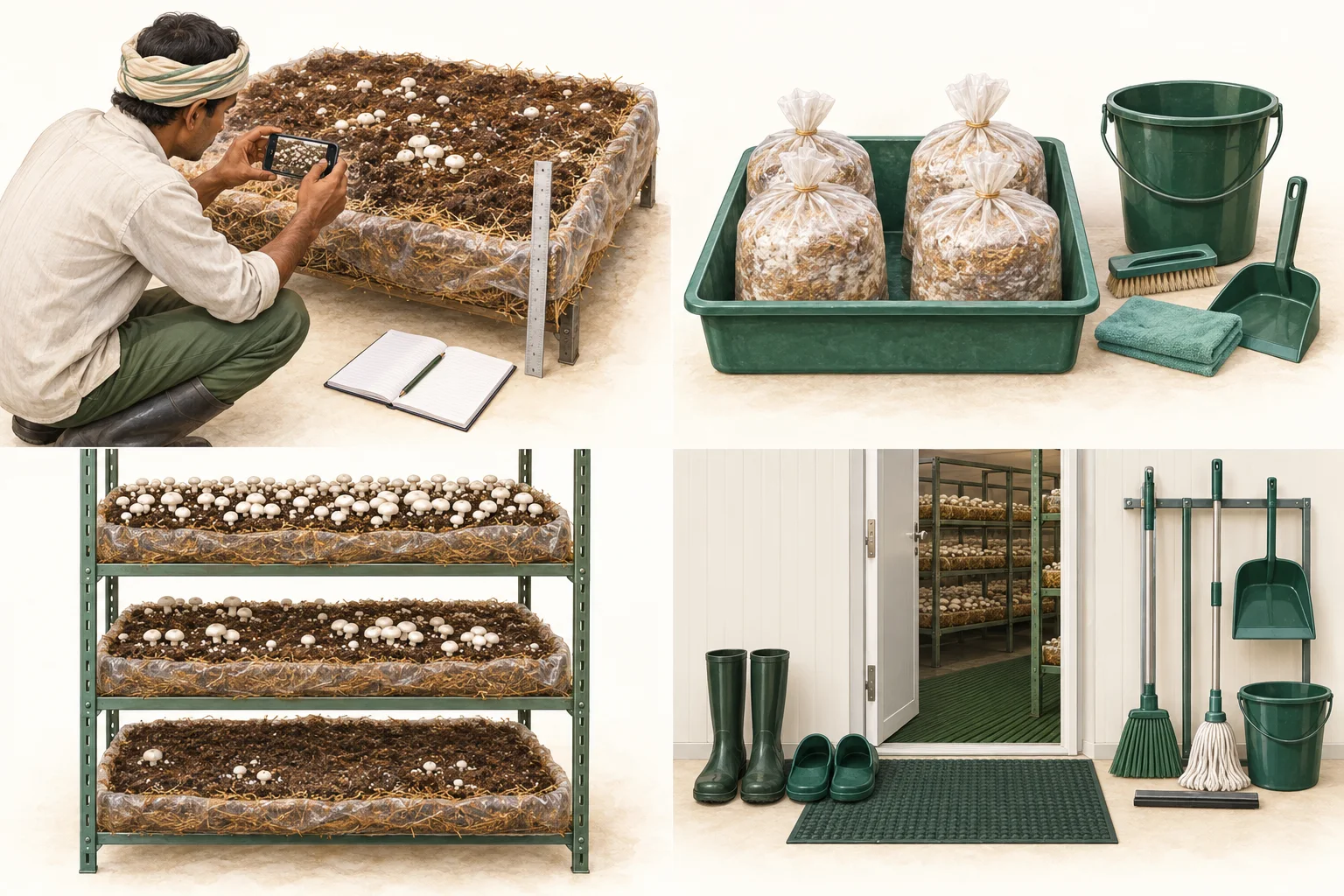
What to record
Capture crop stage, crop day, room, rack, layer, pattern, first observation, progression, compost and casing batches, watering, chemistry, pests and timestamped environmental readings.
Could it be something else?
Compare visual appearance with spatial pattern, progression, environmental history, process history and missing expected signs. Colour or one photograph is weak evidence.
Evidence still needed
State the unanswered questions and next measurement. Useful evidence can be visual, environmental, spatial, temporal, microscopic, laboratory, molecular, trap-based or process-history based.
Immediate safe direction
Document the affected area, avoid unnecessary disturbance or cross-room movement, isolate suspect tools, inspect adjacent areas and preserve representative evidence. Do not spray automatically.
Root-cause review
Trace the visible problem through water, evaporation, airflow, sensor placement, compost, casing, staff movement, flies, tools or room design where evidence supports the connection.
Chemical and regulatory boundary
Historical management literature is separated from current practice. No crop-protection dose is published unless the exact product, formulation, mushroom crop label, target, method, harvest interval, worker-safety information and current Indian status are verified.
When remote guidance is inadequate
Seek technical inspection or laboratory support for rapid unexplained loss, repeated outbreaks, suspected virus, unknown mould, severe pests, chemical injury, multiple affected rooms or unresolved contradictions.
Trace the claim and its limits.
Pathogen biology, dated advisories and current regulatory status are stored separately.
Diseases and Competitor Moulds of Mushrooms and their Management
Indian mushroom disease descriptions, symptoms, epidemiology, historical taxonomy and competitor-mould records.
Open sourceMushroom Pests and Diseases
Current extension descriptions of Button Mushroom pests, diseases, hygiene and integrated management.
Open sourceIntegrated disease and pest control in Irish mushroom tunnels
Fly, mite and nematode group distinctions, life cycles, monitoring and hygiene pathways.
Open sourceDirectorate of Plant Protection, Quarantine and Storage regulatory functions
Indian pesticide registration and regulatory-governance context under the Insecticides Act and Rules.
Open sourceChemical governance is a publication gate.
No operational pesticide, fungicide, insecticide, disinfectant or fumigant dose is published. Historical references are not current labels.
- Current operational dose
- Not published
- Mushroom crop label
- Not established by this record
- Review status
- Regulatory review required