


Substrate & Spawn Run
Milky mushroom needs no compost, only clean straw, hot water and patience. The crop is decided in the two days before spawning.
- By the end you can choose and treat straw for a milky crop.
- By the end you can judge substrate moisture by hand.
- By the end you can set the spawn rate and run bags to full colonisation.
Straw to colonised bag, with the check to make at each step.
- Chop and soakStraw at 2 to 4 cm, under water 6 hours.
- PasteuriseBoiling water 40 minutes, or steam at 65 C.
- Drain and coolUntil moisture is 65 to 70 percent.
- Spawn and run40 to 50 g per kg, dark, 15 to 20 days.
Read numerical examples with their source, method and crop context. They are not universal operating instructions. Historical prices are not current quotations.
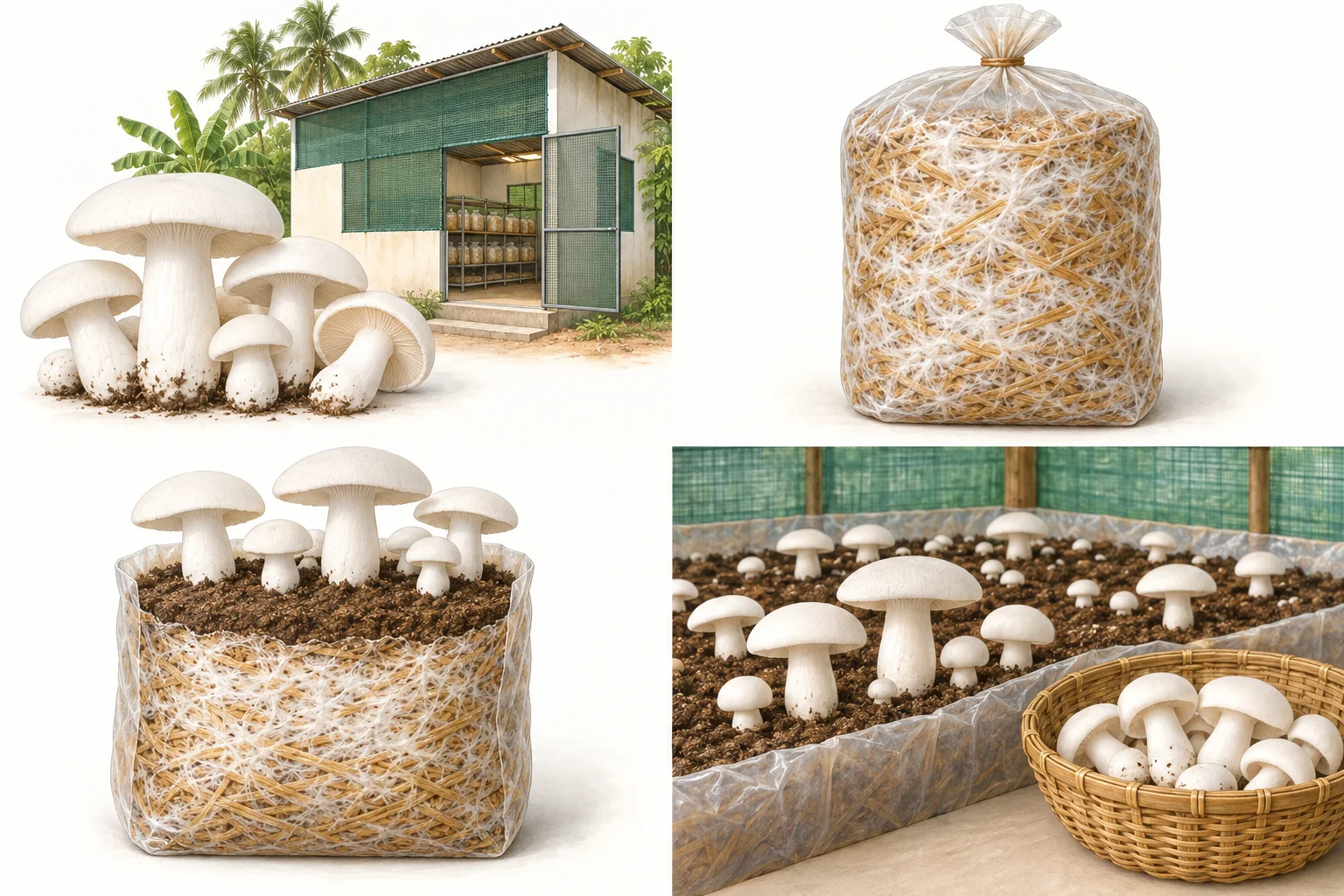
Check colonisation
- Notice
- White development must be assessed across the material, not one patch.
- Understand
- The next operation depends on batch readiness, not only elapsed days.
- Try it
- Record uneven or stalled development before applying casing.
01Which straw, and in what condition
ICAR-DMR lists wheat straw, paddy straw, sorghum, pearl millet and maize stalks and sugarcane bagasse as milky substrates. Cereal straw is what most growers use.
Condition matters more than choice. DMR is blunt: the material must be new, dry and not soaked by rain. Straw stacked through a monsoon already carries moulds, and pasteurisation kills only what it reaches.
Chop the straw. The 2011 manual works with pieces of 2 to 4 cm, which pack evenly and hold water without becoming a wet mat.
- New season straw, stored under cover and dry to the hand.
02Soak, then pasteurise
Soaking comes first. The farmer folder keeps chaffed straw in gunny bags under clean water for at least 6 hours; the 2011 manual gives 8 to 16 hours. The straw must be wet through, not wet outside.
Then kill the competitors. The folder method is hot water: the filled bag goes into boiling water for 40 minutes, and the water must keep boiling the whole time. The manual states the same 40 minutes at 80 to 90 C. On a larger unit, steam raises the substrate to 65 C for 5 to 6 hours.
DMR also describes chemical steeping. It uses fungicide and formalin, so check current label approval and state rules first.
03The squeeze test
Drain the treated straw on a clean floor and let it cool to hand temperature. Target moisture is 65 to 70 percent.
DMR gives the field test in plain words: press a handful hard. If no water runs out and your palm is only slightly damp, the moisture is right. If water drips, the bag will sour and mycelium will not run.
Do not spread hot straw on bare earth. The folder washes and disinfects the cooling floor first. Work on a swept, washed surface with clean hands, and cover the straw if the yard is dusty.
04Spawning and the run
Milky takes a heavy dose: 4 to 5 percent of the wet substrate weight, which is 40 to 50 g of spawn per kilogram of wet straw. Folder and manual agree here.
The folder fills a polythene bag about 15 to 16 inch wide and 20 to 21 inch high with 4 to 5 kg of treated substrate, spreading spawn in layers 3 to 4 inch apart. TNAU uses a 60 by 30 cm bag with five straw layers.
Then leave them alone. Dark room, 15 to 20 days, bags closed. The manual says about 20 days to full colonisation, after which the bag is ready for casing.
Run one trial batch first
- Weigh 10 kg of dry chopped straw and note it.
- Soak, treat and drain, then weigh the wet straw.
- Do the squeeze test and write what your palm felt.
- Spawn at 4 to 5 percent of wet weight and fill two bags.
- Open the room on day 15 and note how white each bag is.
Write in your farm diary: Straw source, soak hours, boiling time, wet weight, spawn grams, day bag turned white.
Mistakes that cost a crop
- Using rain soaked straw, which carries mould that pasteurisation cannot undo.
- Spawning hot straw, which kills the spawn and wastes the bag.
- Opening bags during the run to check, which lets contamination in.
Check yourself
Three questions, instant answersHow much spawn does DMR use for milky?
Water drips when you squeeze treated straw. What now?
How long must the water keep boiling?
An editorial self-check, not a certificate. Answers are not stored, not even on this device.
Words used in this lesson
- Pasteurisation
- Heating substrate enough to kill competitors without sterilising it.
- Substrate
- The treated straw the mushroom feeds on.
- Colonisation
- Mycelium spreading until it holds the whole bag.
References & further reading
Species, strain, climate and production method must remain explicit.
Open current reference