


Warm-Climate Context
Milky mushroom welcomes the heat that ruins a button crop. In the months when a button room needs a chiller, dudhiya keeps cropping in an ordinary shed.
- By the end you can say which temperature window suits Calocybe indica.
- By the end you can place a milky crop in the ICAR-DMR calendar.
- By the end you can explain why button rules do not carry over.
Five mushrooms side by side
Green band = fruiting temperature. Source: ICAR-DMR seasonal folder and manual.
Read numerical examples with their source, method and crop context. They are not universal operating instructions. Historical prices are not current quotations.
Match crop and room
- Notice
- Milky mushroom uses its own cultivation sequence.
- Understand
- Its warm-condition suitability does not make every hot room suitable.
- Try it
- Confirm species identity, stage requirements and local buyer acceptance.
01A mushroom that likes the heat
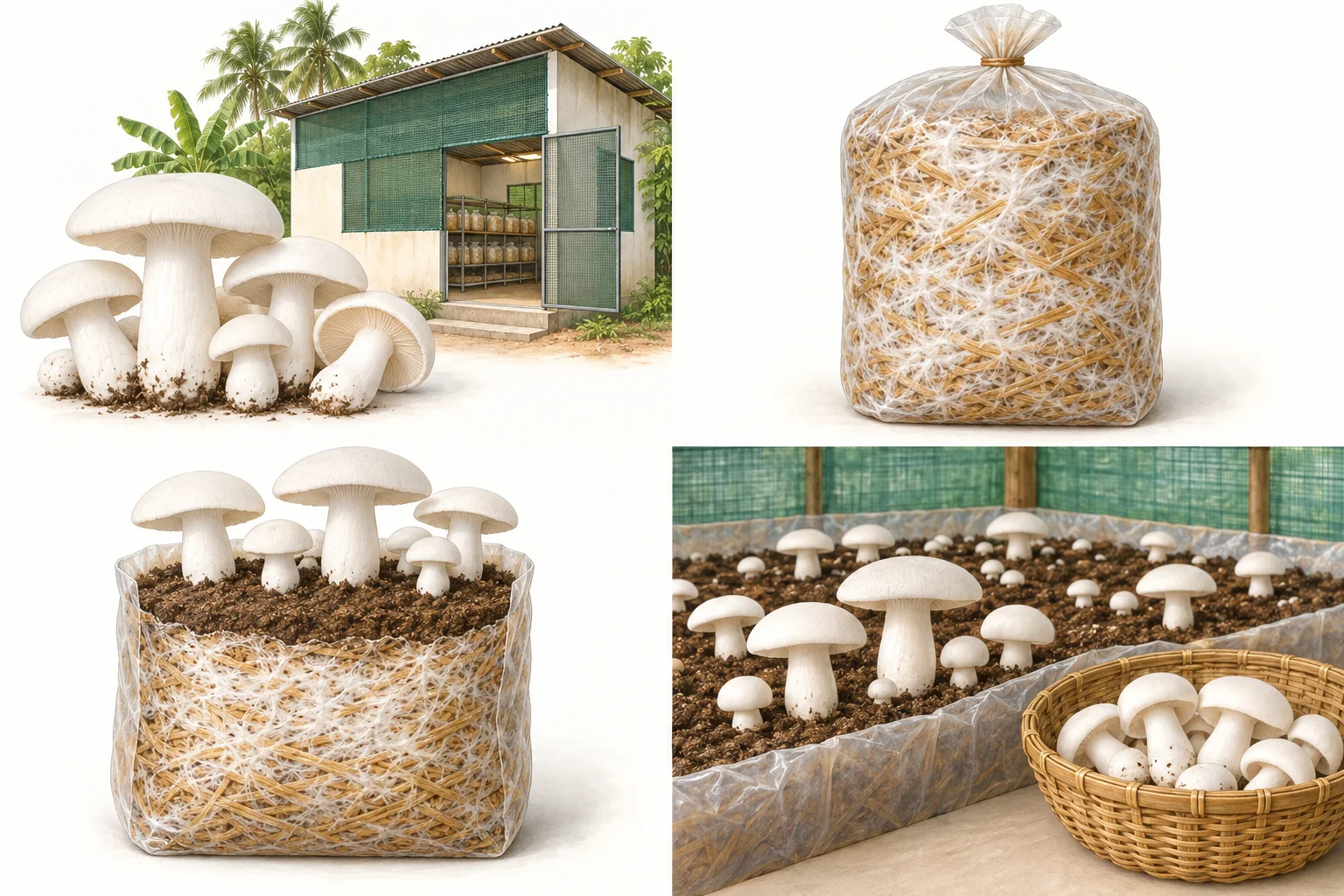
Milky mushroom is Calocybe indica, called dudhiya because the young mushroom is milk white. ICAR-DMR says one milky crop can be taken in almost all the plains of the country, leaving out the hills, wherever temperature stays between 25 and 40 C for some months.
That sentence is the whole species argument. White button fruits at 15 to 17 C air, which on a plain in April means a refrigeration plant. Milky fruits at 30 to 35 C and, in DMR's words, keeps producing even at 30 to 40 C. It matches weather you already have.
02Where the calendar puts it
The DMR seasonal folder gives months. On the north Indian plains a milky crop runs February to April and again July to September. In the mid hills it runs April to June. The high hills are not milky country.
The same folder places whole regions. In the coastal states oyster, paddy straw and milky grow in the natural climate all year, and central and western India can grow milky all year.
Read your district into that. A summer maximum near 35 C sits inside the band. Above 40 C for weeks you need shade, wet walls and early morning work.
03Two Indian answers on spawn run
Here the sources disagree, and you should know it before fixing a room temperature.
The DMR Hindi folder holds spawned bags in a dark room at 25 to 35 C with 80 to 90 percent humidity. TNAU Coimbatore specifies 22 to 25 C and 85 to 90 percent for the same stage. DMR's own species table gives 25 to 30 C.
Treat the wide DMR band as what the fungus tolerates and the narrow TNAU band as what it prefers. Note what catches button growers: in milky the fruiting temperature is higher than the spawn run temperature. In most cultivated mushrooms it is the other way round.
04What the crop asks before you buy spawn
A milky crop is a chain of waits: 15 to 20 days of spawn run, 10 to 12 days of case run, then pinheads 3 to 5 days after mycelium reaches the casing top.
You need a dark room for the run and a lit room for cropping, clean chopped straw, a drum for hot water treatment, and casing soil prepared a week ahead. ICAR-DMR reports a biological efficiency near 100 percent, about one kilogram of fresh mushroom per kilogram of dry straw.
The last question is the buyer. Shelf life is 3 to 4 days without a cold chain.
Test your months before ordering spawn
- Hang a maximum and minimum thermometer in the shed you plan to use.
- Write the daily maximum and minimum for four weeks.
- Mark every day whose maximum falls between 30 and 35 C.
- Compare that count with the DMR months for your region.
- Ask two nearby buyers what they pay for milky mushroom.
Write in your farm diary: Date, shed maximum and minimum, humidity if measured, and buyer quotes with names.
Mistakes that cost a crop
- Copying button temperatures, which leaves the room too cold for pins.
- Starting when nights fall well below 25 C, so the case run stalls.
- Buying spawn before a buyer exists, then selling a three day crop in panic.
Check yourself
Three questions, instant answersWhich band does ICAR-DMR give for milky fruiting?
Why is milky unusual among cultivated mushrooms?
DMR says 25 to 35 C, TNAU says 22 to 25 C. What do you do?
An editorial self-check, not a certificate. Answers are not stored, not even on this device.
Words used in this lesson
- Calocybe indica
- The scientific name of milky or dudhiya mushroom.
- Spawn run
- The stage when white mycelium spreads through the straw.
- Biological efficiency
- Fresh mushroom weight as a percentage of dry substrate weight.
References & further reading
Species, strain, climate and production method must remain explicit.
Open current reference