


A practical guide to growing mushrooms in IndiaA joint educational initiative by MushroomWale & DMR Solan
MushroomFarming.in

A joint educational initiative by

MushroomWale.com
ICAR–Directorate of Mushroom Research, Solan logoICAR–DMRSolan

MushroomFarming / species profile

Milky mushroom knowledge system

Learn Calocybe indica as a distinct warm-season, cased cultivation system. Evidence, method and India-context boundaries remain visible.
4 full chapters + technical referenceSources & review ↓
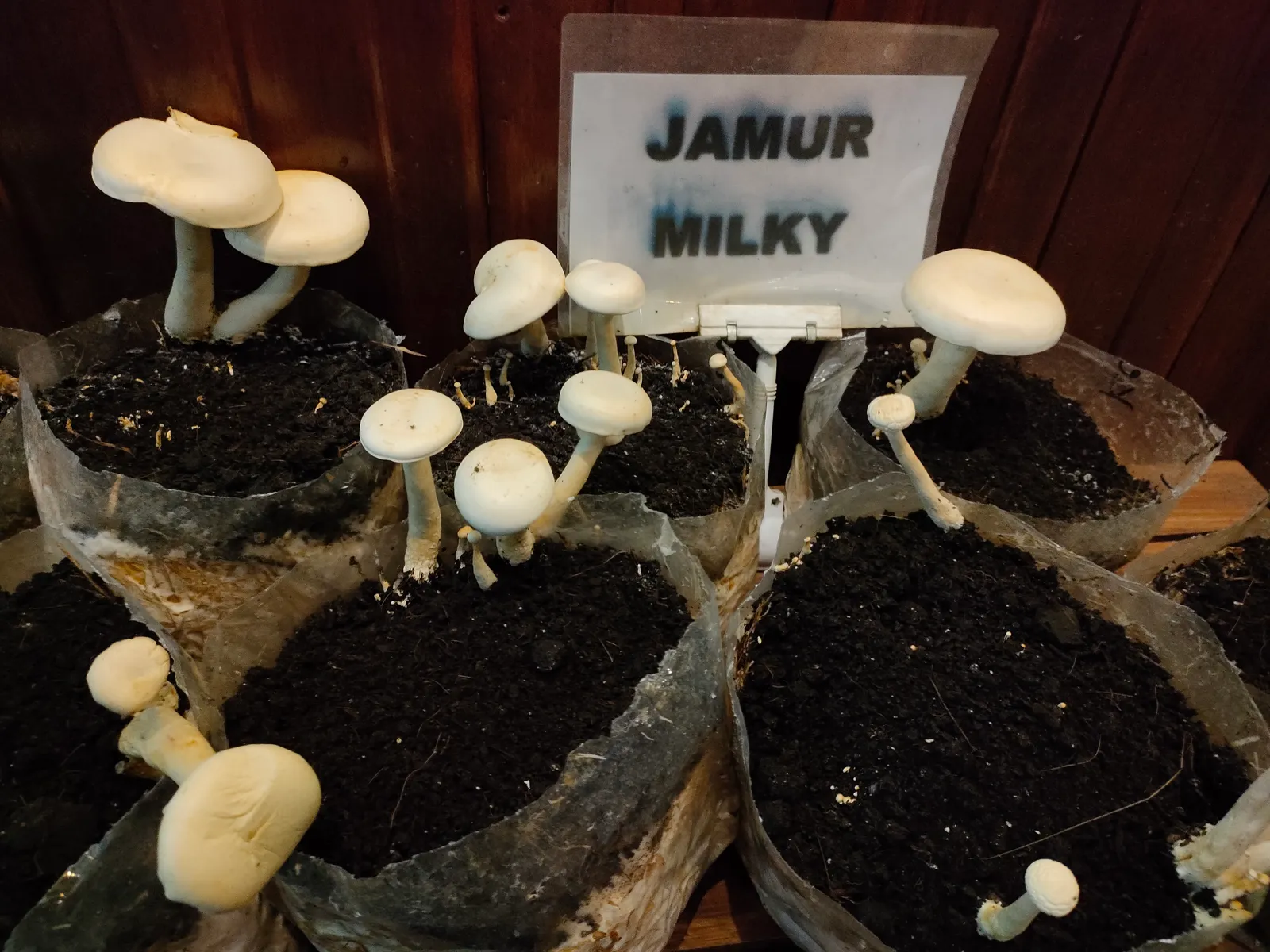
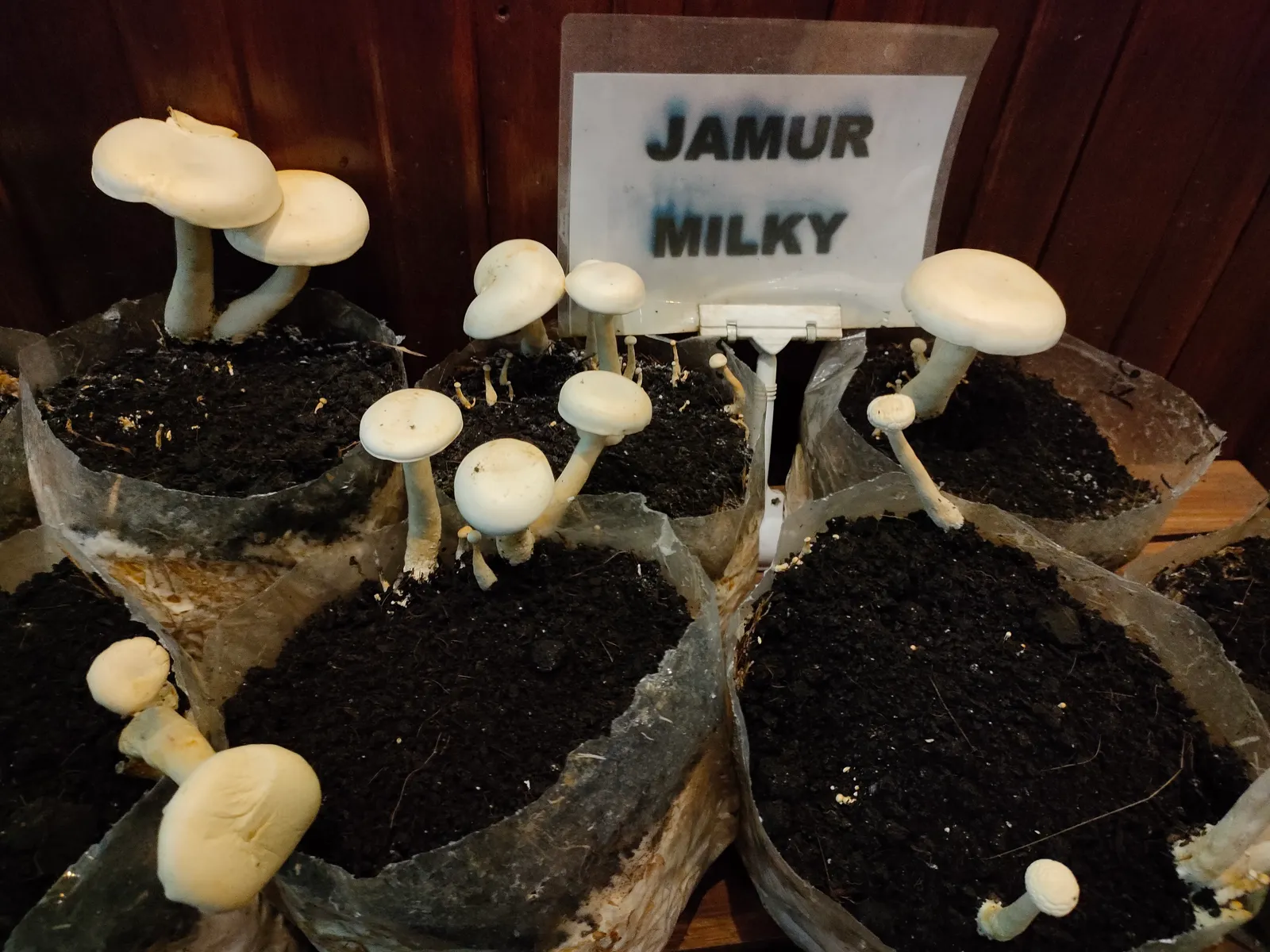
Tall white milky mushrooms (Calocybe indica) fruiting from cased substrate in bags, labelled 'Jamur Milky' at a display, Indonesia.
Real cultivation photograph. Read its source for location and context; it is not a universal operating specification.Astari28 · CC BY-SA 4.0View full photograph ↗
On this pageChoose a section, or keep reading below
The full field guide

Manage Milky mushroom from substrate to casing and harvest

Understand the additional casing operation and learn to distinguish substrate moisture, casing moisture and room humidity.

Choose a picture to understand that part of the process.

  1. 01Match crop and room
  2. 02Check colonisation
  3. 03Add a distinct layer
  4. 04Watch the crop develop

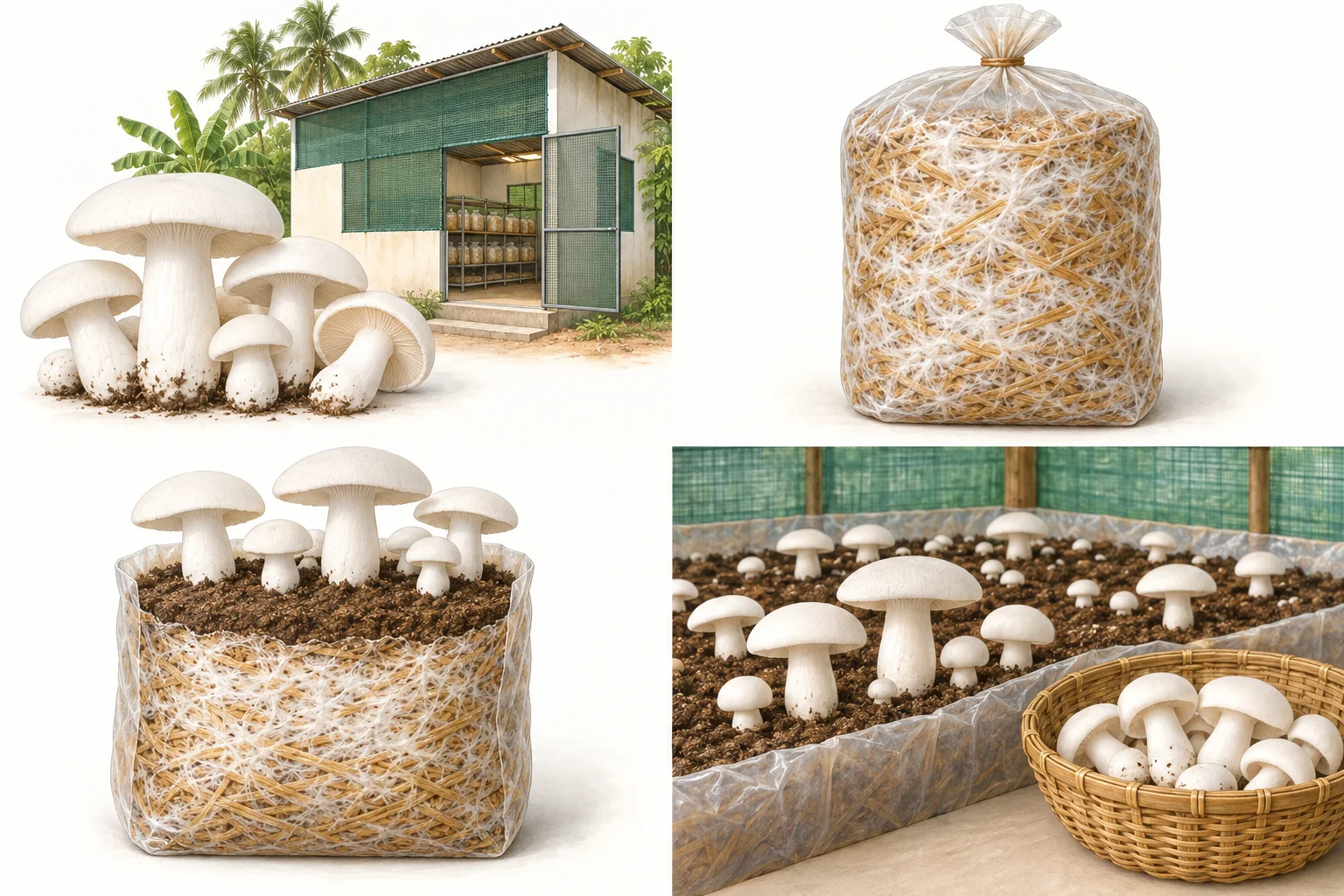
AI-generated teaching illustrations · Not photographs of actual farms

Chapter 01

Check the crop, climate and buyer together

Milky mushroom, Calocybe indica, is a warm-condition crop with a casing stage. It should not be managed by copying the opening instructions for an oyster bag. Confirm species identity with the spawn supplier and obtain their stage-specific cultivation protocol. A warm regional climate does not prove that every room is suitable: a sun-heated roof, dense bag loading or a stagnant corner can create conditions unlike the outdoor weather.

Ask local buyers to evaluate the actual product, size and preparation they expect. Do not infer demand from button mushroom sales. Record whether buyers accept both caps and stems, the maturity they prefer, packaging, delivery quantity and payment period. Use a small complete crop to test these requirements before enlarging the room.

Chapter 02

Finish substrate colonisation before the next operation

Use a validated preparation and inoculation procedure for your substrate. Keep treatment, cooling and spawning records separate enough to trace a failed batch. When comparing colonisation, observe bags of the same age and material batch. A white patch at one edge does not establish that the whole substrate is ready for casing.

Before opening the bags, check development and arrange the clean work area, casing material and labels. Record abnormalities before disturbing the crop. Do not use an arbitrary number of days as the sole release rule; strain, substrate and actual conditions influence development. Escalate stalled or abnormal bags rather than casing over a problem to keep to the schedule.

Chapter 03

Treat casing as its own material and operation

Casing is a distinct surface layer, with its own preparation, physical structure and hygiene requirements. Keep its source, treatment and application records. Apply using the crop-specific method taught for that material. Uneven depth or unintended compaction changes the surface environment and makes later comparisons difficult.

Room relative humidity and casing water content are not interchangeable. Examine the layer and the developing crop, not only the controller. Record watering timing, method and affected areas. If only part of a bed dries, compare distribution, air exposure and layer uniformity before adding more water everywhere. Avoid treating standing water as evidence of good moisture management.

Three different places to investigate moisture
LocationUseful observationDo not assume
SubstratePreparation record and development through the bagA wet casing proves adequate substrate moisture
CasingUniformity, physical condition and watering historyThe room humidity reading describes water in the layer
Room and crop surfaceAir distribution, condensation and pin conditionHigher humidity always solves a moisture problem
Chapter 04

Follow pin development through to a paid sale

Mark representative bags and compare where pins begin, how they develop and where losses occur. Photograph the same locations with a date and scale. When development is uneven, compare casing lot and application, watering, light and local air conditions. Several factors can produce similar visible symptoms, so preserve the observations and seek help with a specific question.

Harvest to the agreed buyer specification and keep grade weights separate. Review each batch using saleable kilograms, rejects, unsold quantity and payment records. If a new casing material is trialled, change it in a small labelled comparison under competent guidance while keeping other practices consistent. An uncontrolled whole-room change cannot show whether the material or another change caused the result.

Chapter sources & scope

These are educational explanations, not an independently reviewed operating protocol. Worked examples do not predict your yield or income.

Back to the chapter list ↑

Understand the topic

The key ideas, at a glance.

Learn Calocybe indica as a distinct warm-season, cased cultivation system. This topic belongs to the Calocybe indica sequence of treated substrate, spawn run, casing, case development and warm-season fruiting.

Part 01

Why this stage matters

Learn Calocybe indica as a distinct warm-season, cased cultivation system.

Illustration of robust white Milky mushrooms and a shaded growing-room setting.
AI teaching illustrationMatch crop and room

Milky mushroom uses its own cultivation sequence. Its warm-condition suitability does not make every hot room suitable.

Conceptual explanation—not a real farm photograph, diagnostic finding or construction specification.
Part 02

Method boundary

This topic belongs to the Calocybe indica sequence of treated substrate, spawn run, casing, case development and warm-season fruiting.

  • Confirm the culture as Calocybe indica, with strain or variety recorded where available.
  • Confirm one method: treated straw bag followed by casing.
  • Record substrate source, treatment class, batch and contamination observations.
Part 03

Observe and record

Use batch records, stage dates, room observations and contamination patterns. Compare the crop with its own prior condition before changing several variables at once.

Illustration of developing and mature Milky mushrooms beside a clean harvest basket.
AI teaching illustrationWatch the crop develop

Compare development from pins to accepted harvest. Uneven results need investigation of materials and local conditions.

Conceptual explanation—not a real farm photograph, diagnostic finding or construction specification.
Part 04

Evidence status

The page publishes process relationships supported by primary institutional sources. Numeric recipes remain absent where source context, strain identity or specialist review is incomplete.

Keep exploring

Every part of this topic.

Choose the stage, material or decision you need to understand next.

01

Milky mushroom cultivation overview

Follow treated substrate, spawn run, casing, case development, fruiting and harvest in crop-cycle order. Evidence, method and India-context boundaries remain visible.

02

Milky mushroom biology

Connect Calocybe indica identity and mycelial development to its cased production method. Evidence, method and India-context boundaries remain visible.

03

Milky mushroom varieties

Preserve official variety names, release context, spawn provenance and regional verification without rankings. Evidence, method and India-context boundaries remain visible.

04

Milky mushroom substrates

Evaluate validated cereal straws by source, condition, residue risk and method evidence. Evidence, method and India-context boundaries remain visible.

05

Milky substrate preparation

Create a clean, treated substrate batch that can support colonization before the separate casing stage. Evidence, method and India-context boundaries remain visible.

06

Milky substrate pasteurization

Treat pasteurization as a validated process class with clean cooling and handling. Evidence, method and India-context boundaries remain visible.

07

Milky mushroom spawning

Introduce traceable spawn into a cooled prepared substrate with batch and hygiene records. Evidence, method and India-context boundaries remain visible.

08

Milky mushroom spawn run

Observe colonization before casing and keep this stage separate from fruiting conditions. Evidence, method and India-context boundaries remain visible.

09

Milky mushroom casing

Understand why the crop uses a casing layer and how material quality and preparation affect the next stage. Evidence, method and India-context boundaries remain visible.

10

Milky mushroom case development

Read colonized substrate, casing condition and room response before pushing toward fruiting. Evidence, method and India-context boundaries remain visible.

11

Milky mushroom pinning

Interpret initiation through casing condition and the full fruiting environment. Evidence, method and India-context boundaries remain visible.

12

Milky mushroom cropping

Coordinate crop-room observations, surface condition, harvest pattern and hygiene across the production period. Evidence, method and India-context boundaries remain visible.

13

Milky mushroom climate

Treat warm-growing suitability as a species-stage context rather than permission for uncontrolled heat or stagnant air. Evidence, method and India-context boundaries remain visible.

14

Light in milky mushroom cultivation

Place light inside the post-casing fruiting system and verify it with crop response. Evidence, method and India-context boundaries remain visible.

15

Watering milky mushroom casing

Decide water from casing depth, moisture profile, crop stage and room evaporation. Evidence, method and India-context boundaries remain visible.

16

Milky mushroom harvest

Choose maturity, trimming and handling based on quality and the intended sales channel. Evidence, method and India-context boundaries remain visible.

17

Milky mushroom post-harvest

Use its relatively robust character responsibly while still controlling hygiene, maturity and temperature. Evidence, method and India-context boundaries remain visible.

18

Milky mushroom diseases

Investigate crop-stage, casing, substrate and hygiene context before naming a disease. Evidence, method and India-context boundaries remain visible.

19

Milky mushroom pests

Record the pest, damage, material route and room distribution separately. Evidence, method and India-context boundaries remain visible.

20

Milky crop troubleshooting

Keep casing-related, environmental and biological candidates distinct. Evidence, method and India-context boundaries remain visible.

21

Milky mushroom business context

Test seasonal fit, casing labour, reliable buyers, quality loss and process capacity before investment. Evidence, method and India-context boundaries remain visible.

22

Commercial milky mushroom farming

Design rooms and workflow around a cased Calocybe crop rather than reusing a Button or Oyster project model. Evidence, method and India-context boundaries remain visible.

Go deeper

Technical reference, records and tools.

Detailed crop-stage information, parameters, diagrams and specialist tools are kept together below. This material retains its source conditions and review limits.

Open the complete technical reference

Crop guide

Milky mushroom knowledge system

Learn Calocybe indica as a distinct warm-season, cased cultivation system. Evidence, method and India-context boundaries remain visible.

Tall white milky mushrooms (Calocybe indica) fruiting from cased substrate in bags, labelled 'Jamur Milky' at a display, Indonesia.
Milky mushrooms (Calocybe indica) fruiting through casing. Photo: Astari28, CC BY-SA 4.0. Source

The crop at a glance

Published ICAR-DMR reference values for Indian conditions. Species, strain and your room decide the final numbers.

Spawn run25-35°C15 to 20 days in the dark before casing.Source: ICAR-DMR
Fruiting30-35°CA warm-season crop; humidity 80 to 90 percent with light after casing.Source: ICAR-DMR
Crop cycle50-60daysIncludes a 1 inch casing layer after spawn run.Source: ICAR-DMR
Yield80-100kg / 100 kg dry strawLarge, firm, long-shelf-life fruit bodies.Source: ICAR-DMR
  • No context-free setpoints
  • No profit promises
  • Species comes first
  • No medical marketing

Identity before method

Milky mushroom

Calocybe indica

Taxonomy note
Cultivated Calocybe indica; variety identity must remain attached to source records.
India readiness
establishedAn India-developed warm-season crop system with a distinct casing stage.
Method difficulty
intermediate
Casing
yes
Production systems
treated straw bag followed by casing
Post-harvest
Relatively robust handling compared with several mushrooms, while hygiene, maturity and cooling still govern quality.

Production method records

One species can require more than one cultivation model.

MIL-STRAW-CASE

Treated straw bag plus casing

Substrate
validated cereal straw
Container
cultivation bag followed by exposed or opened cased block
Treatment
Validated heat treatment with clean cooling and handling.
Scale context
seasonal or controlled production after casing capability is established
  1. Material check
  2. Treatment
  3. Spawning
  4. Spawn run
  5. Casing
  6. Case development
  7. Fruiting
  8. Harvest

Canonical learning map

22 distinct routes for this crop system.

01
Milky mushroom cultivation overview

Follow treated substrate, spawn run, casing, case development, fruiting and harvest in crop-cycle order. Evidence, method and India-context boundaries remain visible.

02
Milky mushroom biology

Connect Calocybe indica identity and mycelial development to its cased production method. Evidence, method and India-context boundaries remain visible.

03
Milky mushroom varieties

Preserve official variety names, release context, spawn provenance and regional verification without rankings. Evidence, method and India-context boundaries remain visible.

04
Milky mushroom substrates

Evaluate validated cereal straws by source, condition, residue risk and method evidence. Evidence, method and India-context boundaries remain visible.

05
Milky substrate preparation

Create a clean, treated substrate batch that can support colonization before the separate casing stage. Evidence, method and India-context boundaries remain visible.

06
Milky substrate pasteurization

Treat pasteurization as a validated process class with clean cooling and handling. Evidence, method and India-context boundaries remain visible.

07
Milky mushroom spawning

Introduce traceable spawn into a cooled prepared substrate with batch and hygiene records. Evidence, method and India-context boundaries remain visible.

08
Milky mushroom spawn run

Observe colonization before casing and keep this stage separate from fruiting conditions. Evidence, method and India-context boundaries remain visible.

09
Milky mushroom casing

Understand why the crop uses a casing layer and how material quality and preparation affect the next stage. Evidence, method and India-context boundaries remain visible.

10
Milky mushroom case development

Read colonized substrate, casing condition and room response before pushing toward fruiting. Evidence, method and India-context boundaries remain visible.

11
Milky mushroom pinning

Interpret initiation through casing condition and the full fruiting environment. Evidence, method and India-context boundaries remain visible.

12
Milky mushroom cropping

Coordinate crop-room observations, surface condition, harvest pattern and hygiene across the production period. Evidence, method and India-context boundaries remain visible.

13
Milky mushroom climate

Treat warm-growing suitability as a species-stage context rather than permission for uncontrolled heat or stagnant air. Evidence, method and India-context boundaries remain visible.

14
Light in milky mushroom cultivation

Place light inside the post-casing fruiting system and verify it with crop response. Evidence, method and India-context boundaries remain visible.

15
Watering milky mushroom casing

Decide water from casing depth, moisture profile, crop stage and room evaporation. Evidence, method and India-context boundaries remain visible.

16
Milky mushroom harvest

Choose maturity, trimming and handling based on quality and the intended sales channel. Evidence, method and India-context boundaries remain visible.

17
Milky mushroom post-harvest

Use its relatively robust character responsibly while still controlling hygiene, maturity and temperature. Evidence, method and India-context boundaries remain visible.

18
Milky mushroom diseases

Investigate crop-stage, casing, substrate and hygiene context before naming a disease. Evidence, method and India-context boundaries remain visible.

19
Milky mushroom pests

Record the pest, damage, material route and room distribution separately. Evidence, method and India-context boundaries remain visible.

20
Milky crop troubleshooting

Keep casing-related, environmental and biological candidates distinct. Evidence, method and India-context boundaries remain visible.

21
Milky mushroom business context

Test seasonal fit, casing labour, reliable buyers, quality loss and process capacity before investment. Evidence, method and India-context boundaries remain visible.

22
Commercial milky mushroom farming

Design rooms and workflow around a cased Calocybe crop rather than reusing a Button or Oyster project model. Evidence, method and India-context boundaries remain visible.

Trace the boundary

Evidence and limitations

institutional · tier AResearch programmes

Current institutional scope for cultivated and specialty mushroom research in India.

Research scope does not by itself establish a farm recommendation, commercial readiness or strain-specific operating range.

Open primary source
technical-bulletin · tier ATechnologies developed by ICAR-DMR

Institutional method history for oyster, milky, paddy straw, shiitake and selected specialty mushrooms.

Method descriptions are context-specific and contain numeric and broad substrate statements that require independent technical review before operational publication.

Open primary source
institutional · tier AVarieties and germplasm

Official names and release context for Indian mushroom varieties.

A listed variety is not automatically available, suitable for every region or superior for every farm.

Open primary source
current-advisory · tier ACurrent crop advisory

Time-stamped Indian seasonal crop context and the need to choose oyster species for conditions.

Chemical directions are excluded from this platform unless a current label and jurisdiction are independently verified.

Open primary source
technical-bulletin · tier APost-harvest technology of mushrooms

Species-specific post-harvest deterioration patterns and handling context.

Historic shelf-life statements depend on maturity, handling, packaging and storage conditions and are not reproduced as guarantees.

Open primary source

Read the evidence

Sources & review.

Editorial update: 2026-09-03. Independent technical review is not recorded for this entry.

  1. Research programmes

    ICAR Directorate of Mushroom Research

  2. Technologies developed by ICAR-DMR

    ICAR Directorate of Mushroom Research · 2020

  3. Varieties and germplasm

    ICAR Directorate of Mushroom Research

  4. Current crop advisory

    ICAR Directorate of Mushroom Research · 2026

  5. Post-harvest technology of mushrooms

    ICAR Directorate of Mushroom Research

Reading a source is not the same as applying its instructions to every farm. Confirm species, strain, crop stage, system, region and publication date. Old chemical recommendations are not current-use instructions.

See something that needs correcting? Tell us →