


Casing & Case Development
A fully white bag of milky mushroom will sit for weeks and give nothing. The casing layer is what turns colonised straw into mushrooms.
- By the end you can prepare and disinfect a casing mixture.
- By the end you can choose a casing depth and defend it.
- By the end you can run the case run through to first pinheads.
Room climate by crop stage
Temperature, humidity and days for each milky stage from spawn run to first pins.
Read numerical examples with their source, method and crop context. They are not universal operating instructions. Historical prices are not current quotations.
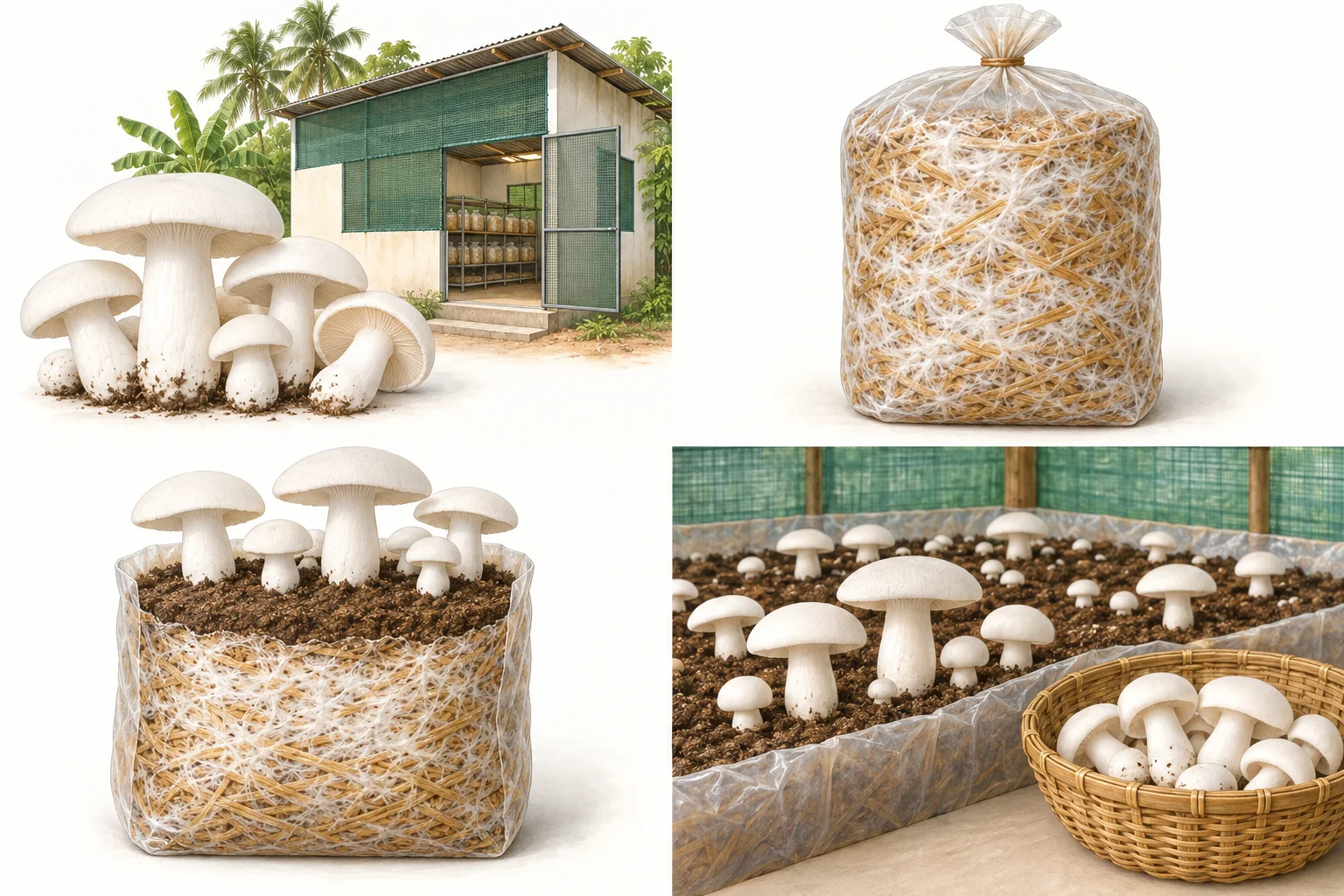
Add a distinct layer
- Notice
- Casing is a separate material with its own preparation and structure.
- Understand
- Room humidity cannot tell you how much water the casing holds.
- Try it
- Track the casing lot, application and watering history.
01Why a casing layer at all
Casing is a layer of treated soil spread over colonised substrate. The 2011 manual states its three jobs plainly: physical support, moisture, and a path for gases to escape from the substrate below.
For milky it is not optional. Without casing the mycelium keeps growing sideways and never switches to making fruit bodies. The stage that follows is the case run, when mycelium climbs into the soil layer.
Think of casing as a change of instruction, not as feeding. It carries almost no nutrition. It changes what the fungus is being asked to do.
02The mixture and its pH
The DMR Hindi folder mixes three quarters loam soil with one quarter sand by volume, then adds chalk powder at 10 percent of the mixture weight. The 2011 manual prefers soil 75 percent plus sand 25 percent, and accepts coir pith with soil or farmyard manure with soil.
The chalk is not decoration. DMR sets milky casing pH at 7.8 to 7.9, adjusted with chalk. That is more alkaline than the 7.0 to 7.5 the same institute sets for button casing, so soil from the button shed is the wrong soil here.
Prepare the mixture about a week ahead, not on the morning of casing.
03Disinfect the soil, whatever method you pick
Casing soil is the main doorway for wet bubble disease. DMR records that its spores survive up to three years in casing soil, so last season's soil is a risk, not a saving.
The heat route is one every grower can check: steam treatment of casing soil at 54.4 C for 15 minutes. TNAU steams casing soil in a pressure cooker for 45 minutes. The manual also allows autoclaving at 15 psi for one hour.
DMR's folder describes a chemical route using formalin and a fungicide under a polythene sheet. Approvals change, so confirm current label approval and state rules before using any chemical.
04Depth, then the case run
Three Indian documents give three depths. The DMR farmer folder says 2 to 3 cm. The 2011 manual says 3 to 4 cm. TNAU says 1 cm, pressed gently.
Do not average them. Pick one, keep it the same across every bag, and write it down, because depth is one of the few things you fully control. An uneven layer gives early pins in the thin patches and nothing in the thick ones.
After casing, hold 30 to 35 C and 80 to 90 percent humidity. DMR reports 10 to 12 days for mycelium to spread through the casing, and pinheads 3 to 5 days after it reaches the top.
Prepare casing soil a week ahead
- Collect loam soil and sand a week before the bags colonise.
- Mix three parts soil to one part sand and add chalk powder.
- Treat the mixture by an approved method and keep it covered.
- Uncover 24 hours before casing and turn it once.
- Case every bag to the same depth using a cut levelling stick.
Write in your farm diary: Soil and sand source, chalk quantity, treatment method and hold time, casing date and depth.
Mistakes that cost a crop
- Spreading untreated garden soil, which brings wet bubble and soil insects.
- Uneven depth, which gives scattered pinning and mixed sizes in one bag.
- Letting the room fall below the case run band, stalling mycelium in the soil.
Check yourself
Three questions, instant answersWhat is the main job of the casing layer?
Milky casing pH is 7.8 to 7.9. Button casing is set at what?
Why not reuse last season's casing soil?
An editorial self-check, not a certificate. Answers are not stored, not even on this device.
Words used in this lesson
- Casing
- A treated soil layer spread over colonised substrate to start fruiting.
- Case run
- The days when mycelium grows up through the casing layer.
- Wet bubble
- A fungal disease carried mainly by untreated casing soil.
References & further reading
Species, strain, climate and production method must remain explicit.
Open current reference