


A practical guide to growing mushrooms in IndiaA joint educational initiative by MushroomWale & DMR Solan
MushroomFarming.in

A joint educational initiative by

MushroomWale.com
ICAR–Directorate of Mushroom Research, Solan logoICAR–DMRSolan

Read · Observe · Practise · Check

Climate: measure, interpret, adjust and recheck

Understand the difference between a controller number and conditions experienced by the crop. Learn the five climate lessons alongside a repeatable room-round exercise.

Begin the walkthrough ↓
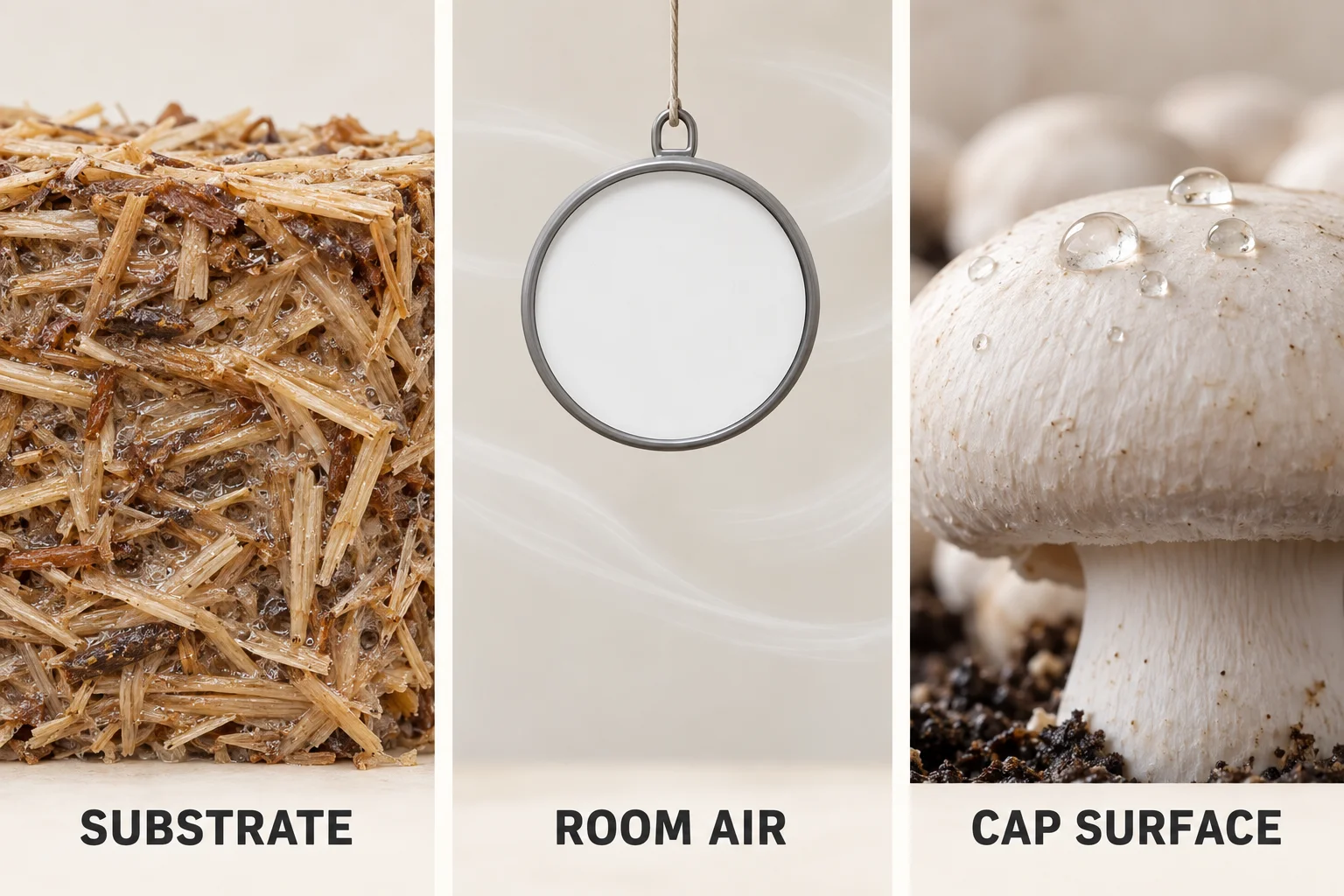
Generated comparison of water in substrate, a symbolic room-air instrument and droplets on a Button mushroom cap.
AI-generated teaching illustrationThree different water observations. The blank dial is symbolic, not a measurement, and the pictured wet substrate and cap are not target conditions.

Before you begin

  • A room sketch with racks, doors and air openings
  • Instrument identities and their measurement type
  • Crop stage, recent watering and control-change history

Use the linked crop and technical lessons for method-specific detail. Practical work involving chemicals, pressure, electrical equipment or uncertain crop health requires competent supervision; illustrations are not operating specifications.

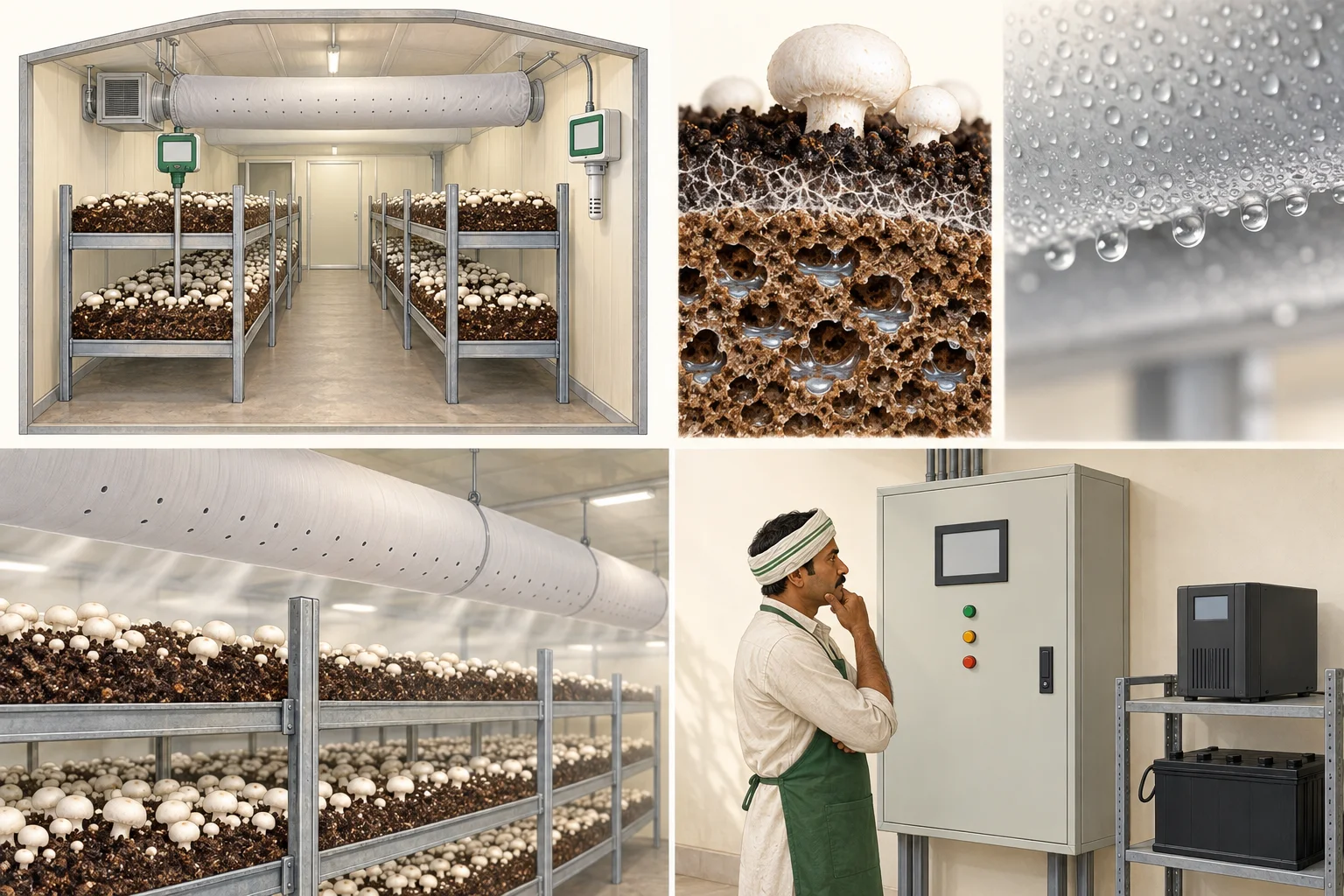
Educational grow-room illustration showing separate crop and room measurement locations.

Conceptual AI teaching scene

Stage 1

Map measurements

Room air, supply air and growing material are different measurement targets. A probe at one position does not describe the whole room. Measurements become comparable when the instrument, location, time and method are recorded.

Put it into practice
Mark representative positions on the sketch. Compare instruments together before interpreting differences between distant locations.
Check your work
The record says what was measured and where, not simply temperature OK.
Conceptual illustration contrasting moisture within a growing layer and droplets on a surface.

Conceptual AI teaching scene

Stage 2

Separate three water questions

Water inside substrate, water vapour in air and liquid droplets on a crop surface are different observations. A humidity display cannot by itself tell you whether the growing material needs water.

Put it into practice
Observe the material, air reading and surface condition separately. Add the time and last watering event.
Check your work
The proposed action addresses the observed problem rather than reacting to a single humidity number.
Illustration of growing racks and a fabric air-distribution duct.

Conceptual AI teaching scene

Stage 3

Trace the air

Recirculation moves room air; ventilation exchanges it with outside air. Loading, obstructions and distribution affect where air goes. Equipment capacity alone does not demonstrate uniform conditions around every rack.

Put it into practice
Trace supply, return, fresh-air entry and exhaust. Compare crop-zone observations before and after an authorised adjustment.
Check your work
The change has a documented purpose and no blocked or newly neglected crop zone.
Illustration of a responsible operator inspecting a closed control cabinet.

Conceptual AI teaching scene

Stage 4

Plan failure response

An alarm needs an owner and a response procedure. Decide which records are required during a power interruption and who handles refrigeration or electrical faults. Crop staff should not improvise work inside electrical equipment.

Put it into practice
Run a paper exercise: the alarm occurs while the regular operator is away. List contact, safe observations and escalation.
Check your work
The standby person can find the procedure and distinguish an operational check from specialist repair.

Common mistakes—and the better question

More humidity must mean wetter substrate
Inspect and record the growing material separately.
Several simultaneous adjustments will reveal the cause
Use a documented plan; uncontrolled changes obscure the explanation.

A task to complete, not just a page to read

Make a room-round map

Compare the same marked locations over successive rounds. Explain whether a difference follows the instrument, crop material, location or a recent operation.

Bring back this evidence

A map, matched readings and one reasoned next-check statement.

Completing this self-guided task is not verification of practical competence. Review it with a suitable instructor before relying on it for farm operation.

Study the detailed lessons in order

Controlled Environment & Climate. Every lesson keeps its explanations, practical exercise, mistakes and self-checks.

  1. Air & Compost TemperatureSeparate crop response, room air and compost heat.
  2. RH, Evaporation & CondensationInterpret moisture movement as a connected system.
  3. CO₂, Fresh Air & DistributionConnect respiration, ventilation and spatial delivery.
  4. Sensors, Mapping & Control LogicVerify measurement before control action.
  5. Refrigeration & Electrical AwarenessRecognise boundaries requiring qualified specialists.

Keep the field guidance beside the lesson

Open the main subject guide →Environmental MeasurementEvaporation and Crop Water DemandCrop-Level Air DistributionProduction Room Commissioning

Sources, scope and review

Editorial learning material; no independent technical review is claimed. The tasks are original teaching exercises. Source-specific numerical schedules remain in the detailed lessons with their context, rather than being turned into universal instructions here.