


Room Mapping
One number for a whole room is an average of places where nothing is growing and places where everything is.
- By the end you can lay out a repeatable set of measuring points.
- By the end you can tell a distribution problem from a set point problem.
- By the end you can link picked weight to position in the room.
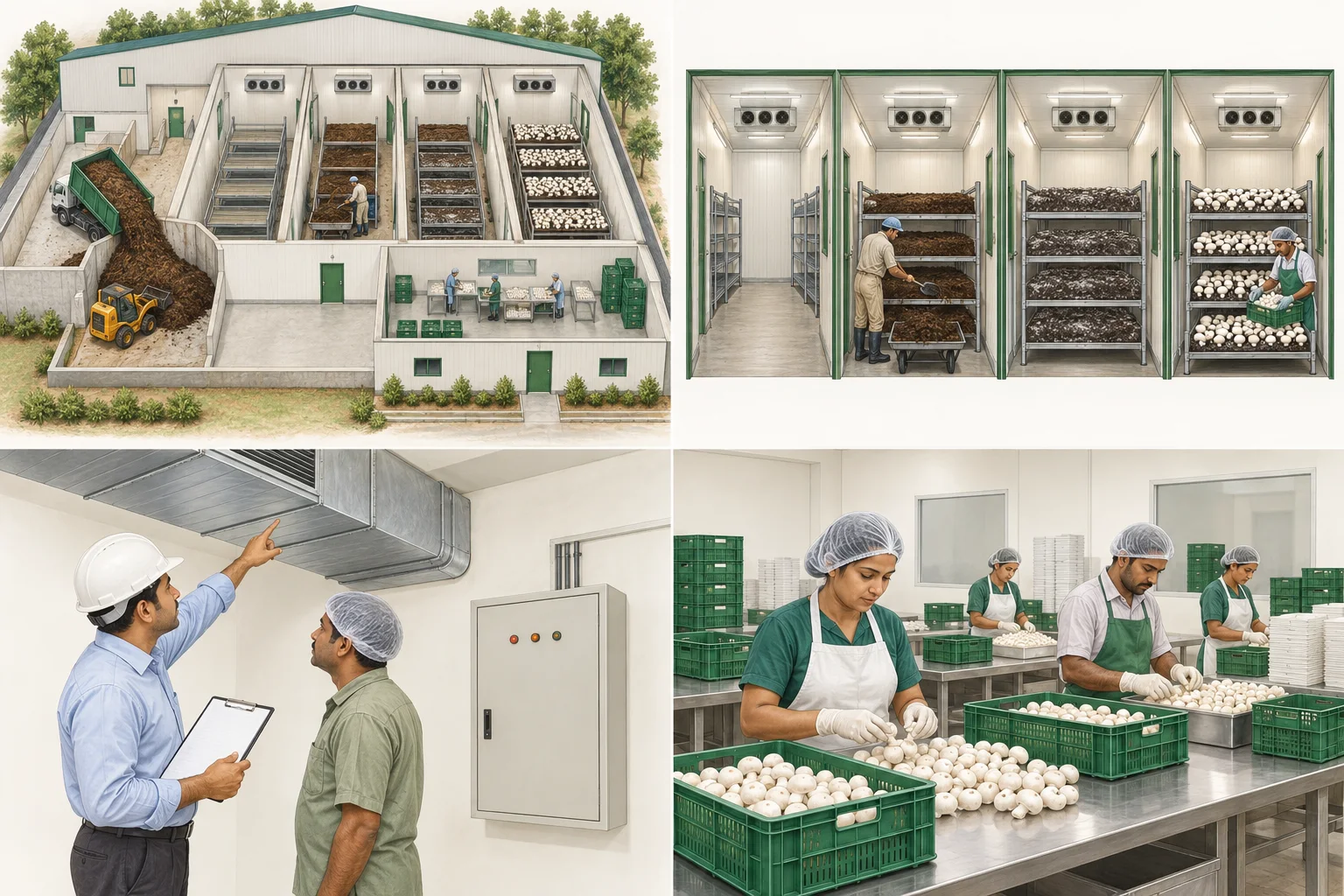
Controlled room: how the air moves
Cooled, humid air drops from the overhead duct onto the beds, returns through the room, and 20 to 30 percent fresh air is mixed in. About 15 cm per second over the beds, 4 to 6 air changes an hour. Source: ICAR-DMR manual.
Read numerical examples with their source, method and crop context. They are not universal operating instructions. Historical prices are not current quotations.
Check performance
- Notice
- Installed equipment must be checked against an agreed operating brief.
- Understand
- A component list is not proof of loaded-room performance.
- Try it
- Agree measurements, load conditions and acceptance tests before ordering.
01A room is never one climate
Three published facts guarantee variation. The bed runs 1 to 2 C above the air around it. Air leaves the handling unit at 14 C to deliver 17 C at the bed, so it warms along its path. Air speed at the bed is limited to 15 cm per second, so the far end gets whatever is left.
Add a door that opens on to a warm corridor, tiers at different heights, and beds of different depth, and one room easily holds two climates.
The controller shows one number because it has one sensor. That number is a place, not a room.
02Make a nine point map
Take three positions along the room, near the unit, middle and far end, at three heights, bottom, middle and top tier. That is nine points.
At each point record air temperature, bed temperature, humidity, carbon dioxide if you have a meter, and whether you can feel air movement. Use the same instrument, the same person and the same time of day, because the comparison matters more than absolute accuracy.
Write the nine readings on a grid drawn in the room file, not on a loose slip, so the next crop can be compared with this one.
03What the map tells you
A spread of more than a degree or two between points, a corner sitting outside the 80 to 85 per cent humidity band, or carbon dioxide well above the 1000 to 1500 ppm cropping band at the far end all say the same thing: the room is not distributing what the machine is making.
That is a baffle, duct, deflector or loading problem. Changing the set point to fix it only moves the whole room, and usually makes the good end wrong as well.
Fix distribution first, then set points, then blame the equipment.
04Map the stages that matter
Map at least three times in a crop: at venting, during the first flush and during the third flush, when air changes drop from 6 to 4 per hour.
Keep the same nine points every time. A map that moves cannot be compared.
Then put the crop beside the climate. Record picked weight by position, not just by room. If the far end gives less weight at every mapping, you have evidence that survives an argument, and a target for the next shutdown. Photograph the grid sheet at the end of each crop and keep it with the room file.
Map one room this week
- Draw the room and mark nine fixed points, three along by three high.
- Read air and bed temperature and humidity at each point in one round.
- Note at every point whether you can feel air moving on your hand.
- Repeat at the same time of day on three days and average each point.
- Record picked weight by position for the same room.
Write in your farm diary: Grid sheet with nine readings per round, dates, instrument used, picked weight by position.
Mistakes that cost a crop
- Trusting the controller sensor as if it described the whole room.
- Mapping once, then never repeating it at the same points.
- Changing the set point to fix a corner, which spoils the rest of the room.
Check yourself
Three questions, instant answersThe far end of a room reads warm, dry and high in carbon dioxide. This is:
Why keep the same nine points every time?
Which pairing turns a map into evidence?
An editorial self-check, not a certificate. Answers are not stored, not even on this device.
Words used in this lesson
- Room map
- A grid of fixed points where the same readings are taken.
- Spread
- The difference between the highest and lowest reading in a room.
- Baffle
- A plate or sheet that redirects air inside a room.
- Distribution
- How evenly the room delivers what the machine produces.
References & further reading
Operating values require stage, strain, sensor and production-system context.
Open current reference