


Corrective Decisions
When a room goes wrong the useful question is rarely which cure. It is which measurement next, and what to contain while you find out.
- By the end you can pick the next measurement instead of the next product.
- By the end you can contain a suspect room without spreading the problem.
- By the end you can say where the chemical decision stops being yours.
From symptom to cause
A first look, not a diagnosis. Source: ICAR-DMR manual and disease bulletin.
| What you see | Likely cause | First step |
|---|---|---|
| Long stems, small caps | CO₂ too high (above about 1,500 ppm) | More fresh air |
| Green patches on compost | Trichoderma; low pH or leftover ammonia | Isolate, remove; check next batch |
| No pins after casing | Room not aired and cooled | 16 to 18 °C, ventilate |
| Brown sunken spots on caps | Bacterial blotch; wet caps | Dry the surface, humidity under 85% |
| White wet lumps | Wet bubble from casing | Salt, remove; steam next casing |
| Small flies | Sciarid or phorid flies | Screens, light traps, hygiene |
Read numerical examples with their source, method and crop context. They are not universal operating instructions. Historical prices are not current quotations.
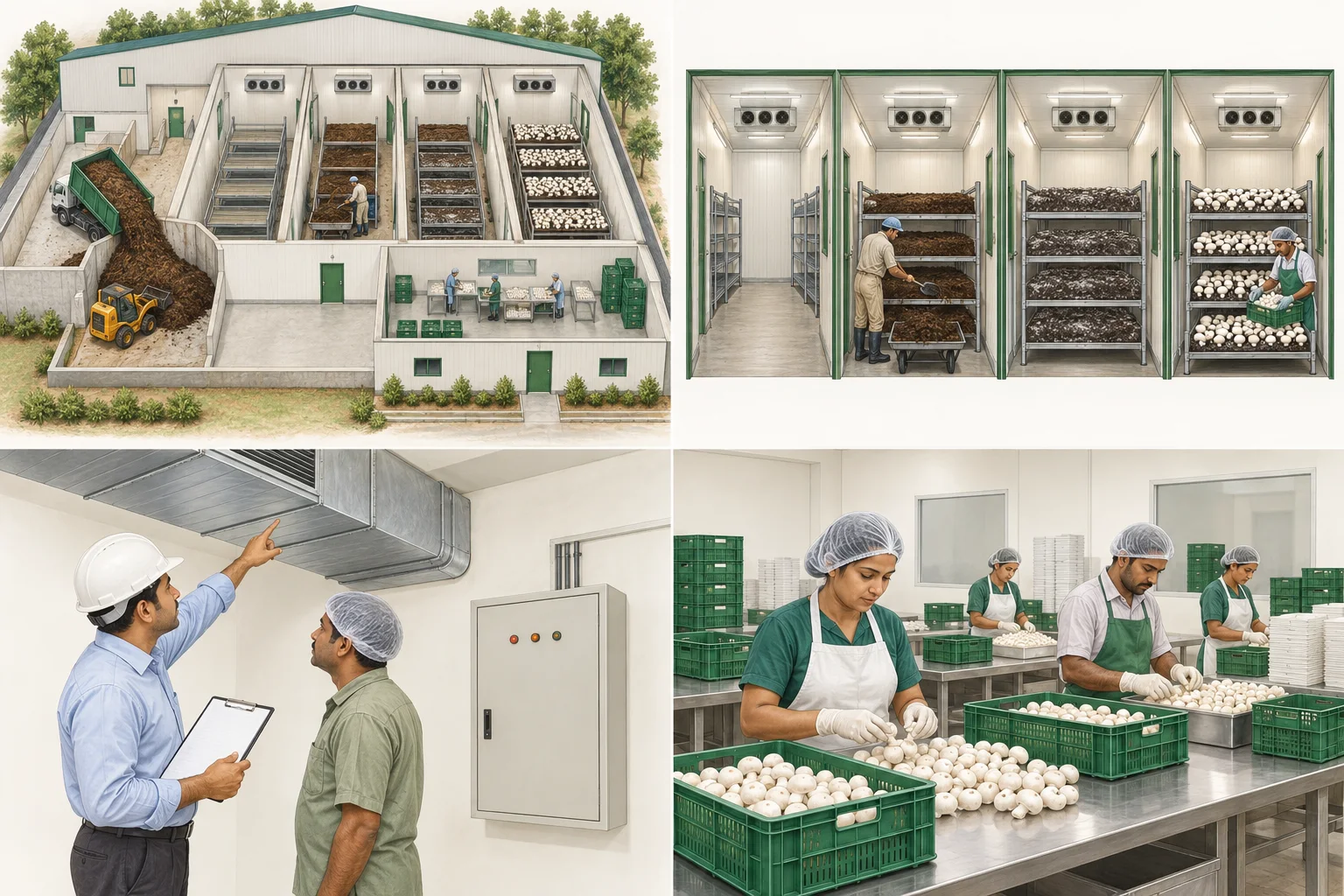
Train the operation
- Notice
- People, food handling and buyer specifications complete the system.
- Understand
- Installed racks alone do not demonstrate a working enterprise.
- Try it
- Ramp up with crop, utility, labour and buyer-acceptance records.
01The next measurement, not the next product
Under uncertainty the cheapest safe action is nearly always another measurement. Where exactly is the problem, where is it not, which flush is running, and what changed about three days before it appeared.
Most corrective actions on a mushroom farm are reversible only in one direction. You can always take another reading. You cannot unspray a room or un-water a bed.
So the operator's first move is to close the information gap: readings at the affected position and at a clean position in the same room, taken with the same instrument, in the same hour.
02Contain before you diagnose
Containment does not need a diagnosis and can be done today. Pick the clean rooms first and the suspect room last, then stop moving people, tools and crates back.
Cover an affected patch rather than brushing it, because brushing throws spores into the air. Bag waste at the bed instead of carrying it open through the corridor.
These steps cost nothing and are never wrong. If the problem turns out to be watering rather than disease, you have lost one morning of convenience. If it is disease, you may have saved the rest of the crop.
03Speed decides the order
Some problems set the clock. DMR states that dry bubble, left uncontrolled, can destroy a crop in 2 to 3 weeks, so it outranks a slow quality complaint.
Bacterial blotch needs 20 C with a water film on the cap for more than about three hours, which is something you can end this afternoon with air movement and watering discipline. False truffle appears above 23 C.
For flies, DMR's thresholds decide: any live adult in the first flush, or more than 20 catches per trap per week from the second flush onwards, is an action point.
04Where your decision stops
Two boundaries are not the operator's to move. The first is chemical: this course prints no product names or doses, approvals change, and mushrooms are eaten fresh. Check the current label approval for mushrooms in India and your state advisory, and remember NHB's minimum 48 hour gap between spray and picking.
The second is the end of the crop. NHB records a cook out at 70 C held for 12 hours for pathogens, and 2 to 3 hours for insects, with spent compost buried under at least 10 cm of manure.
A suspect crop is finished properly, not quietly emptied.
Run one corrective decision properly
- Write the observation in one sentence, with room, position and flush.
- Take paired readings at an affected and a clean position in that room.
- Apply containment: picking order last, cover the patch, bag waste at the bed.
- List what you changed in the three days before the problem appeared.
- Decide the next measurement and the date you will review it.
Write in your farm diary: Observation, paired readings, containment done, recent changes, next measurement and review date.
Mistakes that cost a crop
- Reaching for a product before taking a second reading.
- Brushing an affected patch, which throws spores into the room air.
- Emptying a suspect room quietly without a cook out.
Check yourself
Three questions, instant answersA suspect patch appears in one room. The best first action is:
Which containment step costs nothing and is never wrong?
Why does dry bubble outrank most other problems?
An editorial self-check, not a certificate. Answers are not stored, not even on this device.
Words used in this lesson
- Containment
- Steps that stop spread before the cause is known.
- Paired reading
- The same measurement taken at an affected and a clean position.
- Action threshold
- A count at which you must act, agreed in advance.
- Cook out
- Heating a room and its compost at the end of a crop.
References & further reading
Operating values require stage, strain, sensor and production-system context.
Open current reference