


Stage Transitions
A calendar tells you when to look at the crop. The crop tells you when to move it to the next stage.
- By the end you can name the evidence each stage change needs.
- By the end you can write a transition note a manager can check.
- By the end you can say when a day count is wrong.
Button mushroom crop cycle
Mycelium and the first pinheads on compost, the evidence a transition looks for.
- CompostDay 0Pasteurised, ammonia below 10 ppm
- Spawn run12-15 days22-25 °C in the dark
- CasingDay 153-4 cm layer, pH 7-7.5
- Case run7-10 daysMycelium reaches the surface
- PinningDay 25Air the room, 15-18 °C
- FlushesDay 32-70Three flushes, 7-10 days apart
Read numerical examples with their source, method and crop context. They are not universal operating instructions. Historical prices are not current quotations.
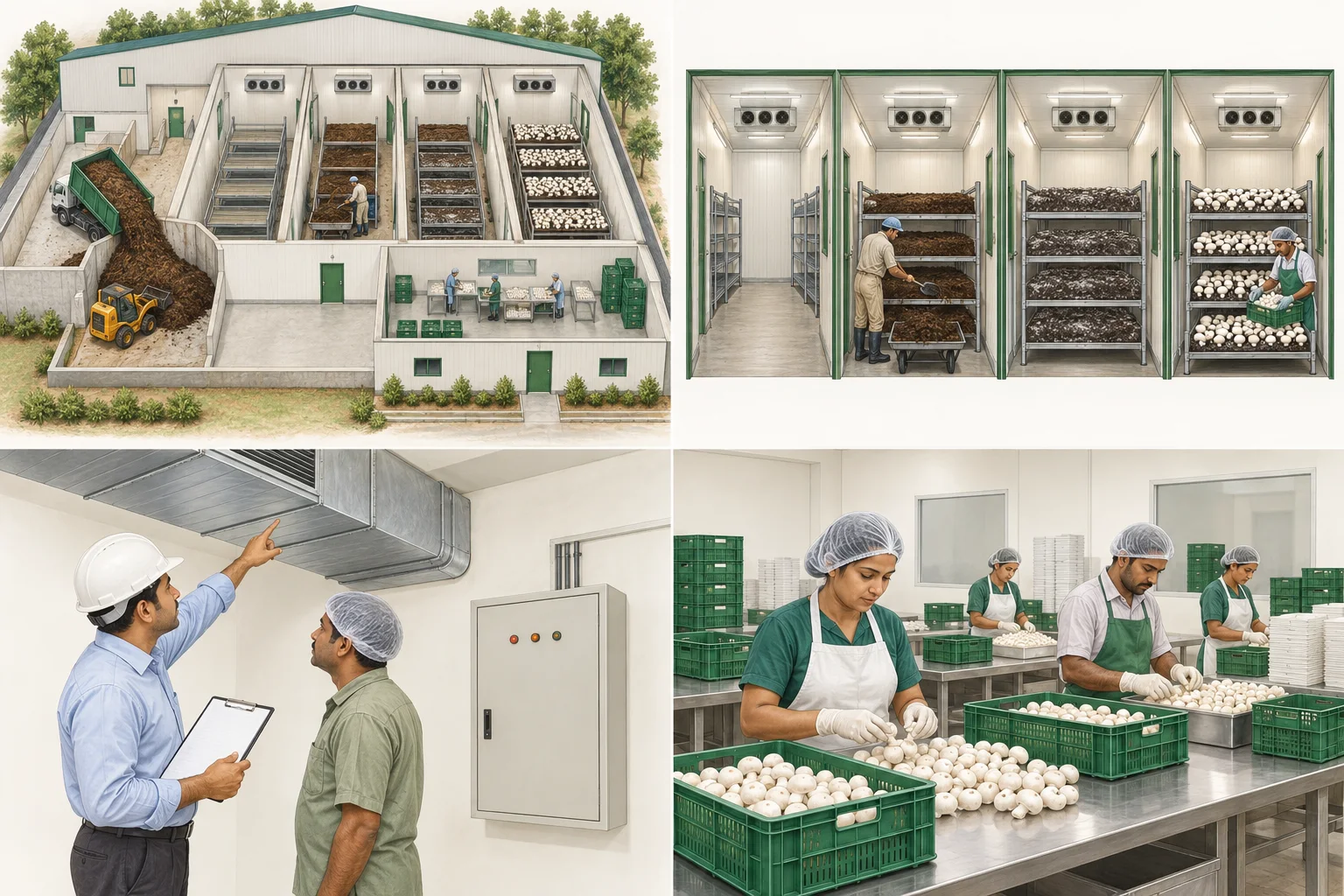
Rotate the rooms
- Notice
- Rooms can be filling, growing, harvesting or resetting at the same time.
- Understand
- Peak work and utilities overlap even when fills are staggered.
- Try it
- Include turnaround and delays in the occupancy calendar.
01Spawn run to casing
The evidence is in the compost, not the diary. Spawn run is complete when the dark brown compost mass has turned light brown and white mycelium runs through the block.
DMR gives 12 to 14 days under controlled conditions, and the Hindi farmer folder gives 12 to 15 days for seasonal cultivation with long method compost. Those are windows for looking, not instructions to case.
Casing a block that is not fully run buries live but unspread mycelium, and the crop comes late and uneven. Check several trays across the room, including the coolest end, before you decide.
02Casing to venting
Case run is held at 23 to 25 C air with about 95 per cent humidity, and DMR notes that no fresh air is given, so carbon dioxide reaches around 7500 ppm. Case run is about 7 days.
The evidence to vent is mycelium visible at the casing surface across the room, not the seventh day on a calendar.
Check casing moisture at the same time, because the casing carries the crop through pinning at 48 to 52 per cent. A dry casing at venting will pin thinly however good the air settings are.
03Venting to cropping
At venting you choose a schedule and commit to it. Air comes down towards the fruiting band, carbon dioxide to 800 to 1000 ppm, and humidity from about 98 down to 92 per cent.
DMR expects pinheads 3 to 4 days after venting. If nothing shows by day five, the answer is in your own record: was the mycelium really at the surface, did carbon dioxide actually fall, was the casing dry.
Changing three settings at once at that moment destroys the evidence. Change one thing, wait the published time, and write down what happened.
04Write the defence before you act
An operator should be able to defend every transition a week later. A short note does it.
Write the date and time, what was measured and where in the room, what the crop looked like in at least three places, which schedule you chose, what you expect within 72 hours, and what observation would prove you wrong.
That last line is the valuable one. If you expect pins in four days and none appear, the note tells you exactly which assumption failed, instead of leaving the whole crop open to guesswork.
Write one transition note
- Pick the next transition due in any room and name it on paper.
- Measure at three places in the room, including the coolest end.
- Describe what the compost or casing looks like in each place.
- Write the decision, the schedule chosen and what you expect in 72 hours.
- Add one line naming the observation that would prove you wrong.
Write in your farm diary: Room, stage, date and time, three readings with positions, decision, expectation, disproof line.
Mistakes that cost a crop
- Casing on a date while part of the room is still unrun.
- Changing temperature, air and water together, which hides the cause.
- Keeping transitions in memory, so nobody can check them later.
Check yourself
Three questions, instant answersThe evidence to case a room is:
Why is carbon dioxide high during case run?
No pins on day five after venting. The best first step is:
An editorial self-check, not a certificate. Answers are not stored, not even on this device.
Words used in this lesson
- Transition
- A planned change from one crop stage to the next.
- Case run
- The days after casing when mycelium grows up into the casing.
- Transition note
- A short written record of the evidence behind a stage change.
- Disproof line
- The observation that would show your decision was wrong.
References & further reading
Operating values require stage, strain, sensor and production-system context.
Open current reference