A practical guide to growing mushrooms in IndiaA joint educational initiative by MushroomWale & DMR Solan
MushroomFarming.in

A joint educational initiative by

MushroomWale.com
ICAR–Directorate of Mushroom Research, Solan logoICAR–DMRSolan
← All books

Understanding crop problems

Contents · choose a chapter or topic
Start here
  1. 01Understanding crop problems
  2. 02What you need before starting
Records that make sense
  1. 03Follow one batch from input to sale
When something goes wrong
  1. 04Describe the problem before naming a disease
Finish the crop properly
  1. 05The next crop begins with this crop’s clean-up
The process
  1. 06Describe without naming a disease
  2. 07Limit unnecessary movement
  3. 08Compare explanations
  4. 09Learn from the outcome
In the field
  1. 10Describe what changed before naming a disease
  2. 11Describe what changed before naming a disease · continued
  3. 12Write it in your farm notebook
  4. 13Protect the workflow while the cause is investigated
  5. 14Useful low-disturbance checks
  6. 15Compare explanations and look for evidence against them
  7. 16Practice investigation: pins fail only near the inlet
  8. 17Close the investigation with a prevention change
  9. 18Close the investigation with a prevention change · practical sequence
  10. 19Where the field guidance comes from
Observation & Pattern
  1. 20Observation & Pattern
  2. 21Describe first, name later
  3. 22The five facts
  4. 23Reading the pattern
  5. 24Mushroom sign or room sign?
  6. 25Read the numbers in context
  7. 26Read the numbers in context
  8. 27A ten-minute observation walk, daily this week
  9. 28Avoid these mistakes
  10. 29Check your understanding
  11. 30Check your understanding
  12. 31Check your understanding
  13. 32Words used in this lesson
  14. 33Sources and field reference
Differential Diagnosis
  1. 34Differential Diagnosis
  2. 35Three bins, not one
  3. 36The environmental bin has numbers
  4. 37Infectious and pest signs that look alike
  5. 38Order the tests, act on the first cause
  6. 39Read the numbers in context
  7. 40Read the numbers in context
  8. 41Read the numbers in context
  9. 42Build a three-column differential for one live problem
  10. 43Avoid these mistakes
  11. 44Check your understanding
  12. 45Check your understanding
  13. 46Check your understanding
  14. 47Words used in this lesson
  15. 48Sources and field reference
Evidence & Negative Evidence
  1. 49Evidence & Negative Evidence
  2. 50Evidence that splits the decision
  3. 51Negative evidence
  4. 52A case, step by step
  5. 53Process records as confirmation
  6. 54Read the numbers in context
  7. 55Read the numbers in context
  8. 56Read the numbers in context
  9. 57Write one evidence chain end to end
  10. 58Avoid these mistakes
  11. 59Check your understanding
  12. 60Check your understanding
  13. 61Check your understanding
  14. 62Words used in this lesson
  15. 63Sources and field reference
Biosecurity & Chemical Caution
  1. 64Biosecurity & Chemical Caution
  2. 65Control the routes
  3. 66Contain first, then treat
  4. 67The India label gate
  5. 68Why old lists cannot be copied
  6. 69Read the numbers in context
  7. 70Read the numbers in context
  8. 71Read the numbers in context
  9. 72Close the routes this week
  10. 73Avoid these mistakes
  11. 74Check your understanding
  12. 75Check your understanding
  13. 76Check your understanding
  14. 77Words used in this lesson
  15. 78Sources and field reference
Practise and review
  1. 79Mistakes to avoid
  2. 80Prepare an adviser-ready crop report
Sources and next steps
  1. 81Keep learning with the field guides

Start here

Chapter opening

Understanding crop problems

Learn to make an observation useful to a crop specialist. This is not image recognition or permission to prescribe a chemical; photographs need crop, stage, pattern and history.

Read one page, study its picture, then turn to the next. Use Contents whenever you want a particular topic.

Understanding crop problems01

Start here

Practical workbook

What you need before starting

Keep these beside you while you learn. You do not need to buy equipment just to read this book.

  1. Crop species, strain if known, stage and batch ID

  2. A camera and a way to label images

  3. Recent input, watering, handling and room records

Understanding crop problems02

When something goes wrong

Look closely

Describe the problem before naming a disease

Start with what you can show: crop and stage, date first noticed, number or area affected, location, recent operations and whether the pattern is spreading. Photograph a whole-room view, an affected area, an unaffected comparison and a close detail.

A brown mark, slow patch or unusual shape can have more than one explanation. Record relevant material lots, watering, environment and insect observations. Keep the distinction between “I saw this” and “I think this caused it”.

Follow the farm’s containment procedure while seeking qualified advice. Do not open suspect material just to smell it, move it through clean work, or choose a pesticide from a photograph. A specialist may require samples, records or testing before recommending action.

Understanding crop problems04

Finish the crop properly

Look closely

The next crop begins with this crop’s clean-up

Before the final harvest, decide who removes the crop, which route they use, where used material waits and how equipment is released for the next fill. Do not let the new crop’s arrival date become the only reason to declare the room ready.

Separate removal, cleaning, any method-specific sanitation, drying, maintenance and inspection into recorded tasks. A room can look empty while drains, tools, rack joints or damaged surfaces still need attention. Qualified advice is required for chemical use and heated or pressurised sanitation systems.

Spent mushroom material is not automatically suitable for every reuse. Its properties and prior inputs matter. Avoid uncontrolled dumping, runoff and pest harbourage; verify locally acceptable storage, transport and reuse or disposal arrangements.

Understanding crop problems05

The process

Practical workbook

Describe without naming a disease

Start with the change: colour, shape, growth rate, distribution or timing. A whole-room view, an affected-area view and a detail answer different questions. Keep an unaffected comparison when available.

Understanding crop problems06

The process

Practical workbook

Limit unnecessary movement

Suspect material, tools and footwear can complicate an investigation when moved between areas. Do not open or shake a suspect bag to obtain a better picture or deliberately smell it.

Understanding crop problems07

The process

Practical workbook

Compare explanations

A symptom that follows one batch across rooms asks different questions from a symptom near one air outlet across batches. Such patterns guide the next check; they do not prove a pathogen.

Understanding crop problems08

The process

Practical workbook

Learn from the outcome

Keep the adviser or laboratory finding with the original observations. Record the action, its purpose and what changed afterwards. Prevention depends on an observed weak point, not merely a new poster on the wall.

Understanding crop problems09

In the field

Field notes

Describe what changed before naming a disease

Write the mushroom species, crop stage, first observation date and affected material. Describe what is visible: slowed colonisation, altered colour, damaged caps, soft tissue, poor pinning or insects. Include how many bags or which bed area appear affected and whether the pattern is expanding. These observations are more useful than writing a disease name inferred from one image.

Take a room overview, a view of the affected bed or bags, a close view and a healthy comparison at the same stage. Keep lighting and distance consistent. Mark the affected area on a room map. Do not open suspect bags or move material through clean areas simply to improve a photograph. Ask the receiving specialist how to collect and send a sample when one is required.

Understanding crop problems10

In the field

Field notes

Describe what changed before naming a disease · continued

Construct a short timeline of spawning, casing, watering, ventilation changes, new deliveries, equipment failures and movement between rooms. A cause must fit both the visible signs and the history. A laboratory result, crop inspection or additional measurements may be needed to distinguish look-alike problems.

Understanding crop problems11

In the field

Field notes

Write it in your farm notebook

Crop and strain; batch IDs; stage; onset; extent; photographs; recent events; measured conditions; actions already taken; questions for the specialist.

Understanding crop problems12

In the field

Field notes

Protect the workflow while the cause is investigated

Reduce unnecessary movement from affected areas to clean work. Use the farm's agreed handling route and clean tools between tasks. Give staff a clear description of the affected area so it is not harvested, watered or visited as though nothing has changed. Handle waste under the established crop-health procedure; improvising removal can distribute contaminated material.

Keep product quality and worker safety separate from the wish to save a crop. Escalate unusual spoilage, widespread deterioration, unidentified contamination or exposure concerns to the appropriate specialist. Do not apply a chemical because a picture resembles a disease. Any proposed use must match the current authorised crop use and label, and the person recommending it must understand the actual problem.

Understanding crop problems13

In the field

Compare the evidence

Useful low-disturbance checks

Useful low-disturbance checks
PatternQuestions to compareEvidence that helps
Several rooms after one deliveryDo they share spawn, compost, casing or transport?Lot IDs and receipt records
One edge or rack levelDoes air, water, temperature or access differ here?Room map and matched readings
Sudden change after an operationWhat changed, where and when?Shift log and before/after photos
Repeated insect activityAre entry points, waste or incoming materials involved?Identified monitoring points and trends
Understanding crop problems14

In the field

Field notes

Compare explanations and look for evidence against them

Separate biological causes from environmental, material and handling causes. Several can coexist. For example, cap damage can follow handling, persistent wetness or a crop-health problem; appearance alone may not separate them. Ask what observation would make each explanation less likely. Healthy beds using the same compost may be informative, but they do not automatically clear that compost if the handling and environment differed.

For each possible cause, list a check, the result and what remains unresolved. Do not replace an unknown with a precise-looking confidence percentage. Send the record to the specialist with a specific question: what further evidence is needed, what can be done immediately, and what would confirm the identification? This produces a better consultation than asking for a medicine against a photograph.

Understanding crop problems15

In the field

Field notes

Practice investigation: pins fail only near the inlet

Start by comparing surface moisture, airflow exposure, casing history and measurements in the affected and healthy zones. A distribution problem becomes one possible explanation. If abnormal tissue or spreading patches also occur away from the inlet, preserve those observations and widen the investigation. The spatial clue guides checks; it does not settle a diagnosis.

Understanding crop problems16

In the field

Field notes

Close the investigation with a prevention change

A useful report states the finding, its confidence, what action was taken and the result. If the cause was not established, retain that uncertainty. Review whether receiving checks, room turnaround, staff movement, water management, pest exclusion or record keeping would have detected the problem earlier.

Track recurring problems by crop stage and material lot. Compare rates using a consistent denominator, such as affected bags out of bags received, rather than only the count of photographs. Assign the preventive change to someone and check whether the next crop follows it. Cleaning instructions and monitoring sheets have value only when their use can be observed.

Understanding crop problems17

In the field

Practical workbook

Close the investigation with a prevention change · practical sequence

  1. Detect: Describe and map the first signs.

  2. Protect: Use the agreed hygiene and movement controls.

  3. Investigate: Compare material, environment, handling and biological explanations.

  4. Learn: Record the finding and verify a specific prevention change in the next crop.

Understanding crop problems18

In the field

Sources & further reading

Where the field guidance comes from

ICAR-DMR: crop advisory archive: Seasonal crop-health context. Historic chemical advice is not reproduced as a current recommendation.

ICAR-DMR: technical publications: Further crop and disorder references; the investigation worksheet is original editorial guidance.

Understanding crop problems19

Observation & Pattern

Chapter opening

Observation & Pattern

Most crop losses are named wrongly on the first day, and the wrong name leads to the wrong action. Describing what you see before deciding what it is costs nothing.

  • By the end you can describe a problem in five facts: what, where, how many, since when, what changed.
  • By the end you can tell a spreading pattern from a uniform or localised one.
  • By the end you can separate a mushroom sign from a room sign and count flies against a published threshold.
Understanding crop problems20

Observation & Pattern

Field notes

Describe first, name later

A disease name is a conclusion. An observation is a fact. When a grower says "I have green mould", the adviser still asks: green where, on compost or casing, in one bag or twenty, since when? The name skipped every question that decides the action.

ICAR-DMR describes bacterial blotch by behaviour, not name: cap spots that enlarge when temperature is at least 20 °C and a film of water stays on the cap more than 3 hours. That tells you where to look, what to measure and what changed. Write the description before any name; if the name proves wrong, the description is still true.

Understanding crop problems21

Observation & Pattern

Field notes

The five facts

Every diary entry carries five facts. What: the sign in plain words, with a photo and a coin for scale. Where: room, rack, shelf height, bag numbers, distance from door and air inlet. How many: a count, not "some", repeated 48 hours later. Since when: the date and the crop day, meaning days after spawning or casing. What changed: watering, a power cut, a new casing lot, a visitor, in the previous three days.

The five facts do half the diagnosis. Trouble only near the inlet points at air. Trouble in every bag from one compost batch points at compost. Trouble the day after a power cut points at temperature.

Understanding crop problems22

Observation & Pattern

Field notes

Reading the pattern

Pattern is the shape of the problem across the room. Uniform: every bag the same, usually environment or a whole compost or casing lot. Spreading: a few bags on day one, neighbours by day three, the signature of infection or a moving pest. Localised: only under the leak or by the door, so look for a physical cause there. Single bag: one odd bag, often a filling or spawn fault.

Speed matters as much as shape. ICAR-DMR warns that dry bubble, left uncontrolled, can destroy a crop in 2 to 3 weeks. A count that doubles every two days is an emergency; a flat count is a fault, not an epidemic.

Understanding crop problems23

Observation & Pattern

Field notes

Mushroom sign or room sign?

Some signs that look like disease are the room talking. ICAR-DMR describes high carbon dioxide at pinning producing onion-shaped mushrooms with a bulbous base and small cap, and later long stalks with small open caps. In oyster the same cause gives a trumpet-mouth shape. No organism is involved; spraying wastes money and adds residue.

Pests are counted, not guessed. ICAR-DMR's sciarid table says any live adult in the first flush is already a reason to act, and from the second flush more than 20 per trap per week. NHB describes the trap: a 15 W yellow bulb over a polythene sheet coated with mustard oil.

Understanding crop problems24

Observation & Pattern

Compare the evidence

Read the numbers in context

These figures belong to the named source and method. Historical costs are not current quotations. A value without its stage, material basis or measurement location is not a farm instruction.

Source-specific reference figures
What is measuredValue and basisSource and limitation
Bacterial blotch: cap spots enlarge at20 °C and aboveICAR-DMR manual, 2011. Only with a free water film on the cap.
Water film allowed on caps3 hours maximumICAR-DMR manual, 2011. Dry the caps within this time after watering.
Understanding crop problems25

Observation & Pattern

Compare the evidence

Read the numbers in context

These figures belong to the named source and method. Historical costs are not current quotations. A value without its stage, material basis or measurement location is not a farm instruction.

Source-specific reference figures
What is measuredValue and basisSource and limitation
Dry bubble destroys an uncontrolled crop in2-3 weeksICAR-DMR manual, 2011. Why a spreading count is an emergency.
Sciarid threshold from the second flush20 adults per trap per weekICAR-DMR manual, 2011. First flush: any live adult. The PDF table is partly garbled; this figure is legible.
Understanding crop problems26

Observation & Pattern

Practical workbook

A ten-minute observation walk, daily this week

Record: Date, crop day, room, five facts, count now and at 48 h, trap count, pattern word.

  1. Walk the same route daily: door, inlet side, middle, far wall, bottom and top shelves.

  2. Write the five facts for anything unusual and photograph it with a coin for scale.

  3. Count affected bags today and after 48 hours; write both numbers side by side.

  4. Hang one yellow light trap and record the weekly count beside the flush number.

Understanding crop problems27

Observation & Pattern

Pause and recall

Avoid these mistakes

  • Naming the disease first and fitting evidence to it, so the room is never checked.
  • Writing "some bags" instead of a count, which hides whether the problem is spreading.
  • Photographing the mushroom but not its position, so the pattern is lost.
Understanding crop problems28

Observation & Pattern

Pause and recall

Check your understanding

Choose your answer before opening the explanation. This is a learning exercise, not a competency assessment.

Leggy mushrooms with small open caps appear only far from the inlet. First suspect?

  1. High carbon dioxide
  2. Wet bubble
  3. Sciarid larvae
  4. Old spawn
See the answer and why

High carbon dioxide ICAR-DMR lists long stalks with small caps as a CO2 symptom; the pattern points at air.

Understanding crop problems29

Observation & Pattern

Pause and recall

Check your understanding

Choose your answer before opening the explanation. This is a learning exercise, not a competency assessment.

Which entry is an observation, not a conclusion?

  1. Green mould in room 2
  2. White fluffy growth on casing, 6 bags, rack 3, day 21, new casing lot
  3. Disease has started
  4. Bags are infected
See the answer and why

White fluffy growth on casing, 6 bags, rack 3, day 21, new casing lot It carries what, where, how many, since when and what changed.

Understanding crop problems30

Observation & Pattern

Pause and recall

Check your understanding

Choose your answer before opening the explanation. This is a learning exercise, not a competency assessment.

Second flush, 8 sciarid adults in the trap this week. Action?

  1. Above threshold, act now
  2. Below 20 per trap per week; keep counting, tighten screens
  3. Flies stop mattering now
  4. Change the compost
See the answer and why

Below 20 per trap per week; keep counting, tighten screens The published trigger from the second flush is more than 20 per trap per week.

Understanding crop problems31

Observation & Pattern

Visual glossary

Words used in this lesson

Symptom
See related figure: Understanding crop problems

What the crop shows: spot, shape, colour, smell. Not the cause.

Crop day

Days counted from spawning or casing.

Action threshold

A published count at which to act.

Understanding crop problems32

Differential Diagnosis

Chapter opening

Differential Diagnosis

The same brown spot can be a bacterium, a mite, or water that sat on the cap too long. Three causes, three different actions, and only one costs nothing.

  • By the end you can sort any symptom into three bins: infectious, pest, environmental.
  • By the end you can quote the published thresholds behind common button mushroom problems.
  • By the end you can order the tests by cost and speed and act on the first cause.
Understanding crop problems34

Differential Diagnosis

Field notes

Three bins, not one

Differential diagnosis is a long name for a short habit: before choosing a cause, list the other causes that could give the same sign, then rule them out one at a time. In a mushroom room the causes fall into three bins.

Infectious: a fungus, bacterium or virus grows on the crop, spreads from a point, and needs a source such as casing, spawn, air or hands. Pest: an insect, mite or nematode feeds and leaves tunnels, adults or larvae a hand lens can find. Environmental: temperature, moisture, gas or compost chemistry is wrong; the sign is uniform or tied to a spot and disappears when corrected. The actions differ: hygiene, screens and traps, or a thermometer and a valve.


Understanding crop problems35

Differential Diagnosis

Field notes

The environmental bin has numbers

Indian sources publish thresholds for this bin, so it is the easiest to test. ICAR-DMR states false truffle manifests above 23 °C; NHB's model DPR adds the working ceiling, avoid 26 to 27 °C in spawn run and after casing, and keep cropping below 18 °C. NHB says bacterial blotch is favoured above 20 °C with relative humidity above 85 percent; ICAR-DMR adds the 3-hour limit for water on caps.

Compost chemistry has bands too. ICAR-DMR gives pH 7.2 to 7.8; below it green mould is favoured, above it white plaster mould. Compost wetter than 72 percent at spawning invites plaster moulds; NHB links weepers to compost below 64 percent under wet casing.

Understanding crop problems36

Differential Diagnosis

Field notes

Infectious and pest signs that look alike

Wet bubble makes shapeless wet masses that may drip amber liquid; ICAR-DMR notes its resting spores survive up to three years in casing soil. Dry bubble makes dry, deformed mushrooms with split leathery caps. Green mould shows as green patches, linked by ICAR-DMR to immature spawn and low pH.

Pests overlap with these. Sciarid larvae tunnel into stems and pinheads, which die and brown, and a hurried eye reads disease. Mites cause reddish-brown discolouration. The difference is that pests leave the pest: adults in the trap, larvae in a cut stem, mites moving under the lens. Find the organism and it is a pest problem, whatever the mushroom looks like.

Understanding crop problems37

Differential Diagnosis

Field notes

Order the tests, act on the first cause

Test the cheapest and fastest first. A thermometer takes a minute, a hand lens five, a pH strip ten, a laboratory days. For brown-spotted caps: read temperature and RH now and check how long caps stayed wet; look for mites or larvae; only then treat blotch as the working diagnosis.

Causes chain. A room above 20 °C and 85 percent RH is an environmental fault that also invites blotch; low pH invites green mould; flies carry spores bag to bag. Correct the condition first, because it is under your control this hour, then contain the organism. If a chemical is considered at all, current label approval for mushrooms in India comes first. This site gives no doses.

Understanding crop problems38

Differential Diagnosis

Compare the evidence

Read the numbers in context

These figures belong to the named source and method. Historical costs are not current quotations. A value without its stage, material basis or measurement location is not a farm instruction.

Source-specific reference figures
What is measuredValue and basisSource and limitation
False truffle appears above23 °CICAR-DMR manual, 2011. February to early March on the north Indian plains.
Ceiling in spawn run and after casing26-27 °CNHB DPR model, 2018. Cropping below 18 °C.
Understanding crop problems39

Differential Diagnosis

Compare the evidence

Read the numbers in context

These figures belong to the named source and method. Historical costs are not current quotations. A value without its stage, material basis or measurement location is not a farm instruction.

Source-specific reference figures
What is measuredValue and basisSource and limitation
RH ceiling to limit bacterial blotch85 %NHB DPR model, 2018. With temperature above 20 °C; a hard ceiling, not a midpoint.
Compost pH band for button mushroom7.2-7.8 pHICAR-DMR manual, 2011. Below favours green mould; above favours white plaster mould.
Understanding crop problems40

Differential Diagnosis

Compare the evidence

Read the numbers in context

These figures belong to the named source and method. Historical costs are not current quotations. A value without its stage, material basis or measurement location is not a farm instruction.

Source-specific reference figures
What is measuredValue and basisSource and limitation
Compost moisture ceiling at spawning72 %ICAR-DMR manual, 2011. NHB: weepers below 64 percent with wet casing.
Understanding crop problems41

Differential Diagnosis

Practical workbook

Build a three-column differential for one live problem

Record: Symptom, three-column list, each test with result and date, causes ruled out, working diagnosis.

  1. Write one current symptom in five facts.

  2. Draw three columns with at least one cause in each; note each test's cost and time.

  3. Run the environmental tests today: bed temperature, RH, hours caps stayed wet, compost pH strip.

  4. Run pest checks tomorrow with a hand lens and the trap count; cross out ruled-out causes.

Understanding crop problems42

Differential Diagnosis

Pause and recall

Avoid these mistakes

  • Jumping to an infectious name for a spot that a thermometer and the watering log would explain.
  • Treating pest damage as disease while the flies keep breeding.
  • Testing the expensive explanation first and leaving temperature, RH and pH unchecked.
Understanding crop problems43

Differential Diagnosis

Pause and recall

Check your understanding

Choose your answer before opening the explanation. This is a learning exercise, not a competency assessment.

Compost at 27 °C in spawn run, late February on the plains; a cream brain-like mass appears. Which bin?

  1. Environmental fault enabling false truffle
  2. Pest: mites
  3. Environment only, nothing growing
  4. Green mould
See the answer and why

Environmental fault enabling false truffle ICAR-DMR: false truffle manifests above 23 °C; NHB's ceiling is 26 to 27 °C.

Understanding crop problems44

Differential Diagnosis

Pause and recall

Check your understanding

Choose your answer before opening the explanation. This is a learning exercise, not a competency assessment.

First test for brown spots on caps?

  1. Laboratory sample
  2. Buy a bactericide
  3. Temperature, RH and hours caps stayed wet
  4. Discard the bags
See the answer and why

Temperature, RH and hours caps stayed wet Fastest and cheapest, and the blotch thresholds decide whether the room is the cause.

Understanding crop problems45

Differential Diagnosis

Pause and recall

Check your understanding

Choose your answer before opening the explanation. This is a learning exercise, not a competency assessment.

Compost pH 6.6 with green patches. The differential says?

  1. pH is fine; blame spawn
  2. Low pH favours green mould; compost chemistry is a probable cause
  3. Green patches are harmless
  4. Raise room temperature
See the answer and why

Low pH favours green mould; compost chemistry is a probable cause ICAR-DMR lists compost pH below 7.2 to 7.8 as a Trichoderma trigger.

Understanding crop problems46

Differential Diagnosis

Visual glossary

Words used in this lesson

Differential diagnosis
See related figure: Understanding crop problems

Listing every cause that could produce a sign, then ruling them out.

Environmental

Caused by a wrong condition, with no organism needed.

Weepers

Mushrooms that exude water; NHB links them to dry compost under wet casing.

Understanding crop problems47

Evidence & Negative Evidence

Chapter opening

Evidence & Negative Evidence

A measurement is worth taking only if its answer would change what you do next. Many growers collect numbers that change nothing and skip the one that would have saved the crop.

  • By the end you can pick a measurement by asking which decision it splits.
  • By the end you can use negative evidence, what is absent, to rule causes out.
  • By the end you can follow a complete evidence chain from symptom to decision.
Understanding crop problems49

Evidence & Negative Evidence

Field notes

Evidence that splits the decision

Suppose green mould is suspected in a new compost batch. Two readings are available: compost pH and room light. Only one changes the decision. If pH is below 7.2 the recipe or Phase II must be corrected; if it sits inside 7.2 to 7.8 the search moves to spawn and casing. Light changes nothing.

That is the test for every measurement: write the decision first, then ask whether each possible result leads to a different action. ICAR-DMR's compost chapter gives the splitting numbers for button compost: pH 7.2 to 7.8, moisture 68 to 72 percent for synthetic long-method compost or 64 to 66 percent after Phase II, and ammonia below 10 ppm at spawning.

Understanding crop problems50

Evidence & Negative Evidence

Field notes

Negative evidence

Absence is evidence. No fly adult in the trap for a week and no larva in twenty cut stems weakens a pest explanation for dead pinheads. Inlet end and far end looking identical weakens an air explanation. Trouble in bags from three compost batches rules out one bad batch.

Negative evidence has one rule: it counts only if you actually looked, in the right place, with the right tool. "I saw no mites" means nothing without a hand lens. "Temperature was fine" means nothing if the thermometer hangs by the door instead of sitting in the bed. Record what was checked, how and where.

Understanding crop problems51

Evidence & Negative Evidence

Field notes

A case, step by step

A seasonal button grower in the Haryana plains, crop day 30, finds soft wet lumps dripping amber liquid on six bags of one rack. Day two: nine. Day four: fourteen, neighbours affected. Pattern: spreading from a point.

Competing causes: wet bubble, dry bubble, over-wet casing. Splitting evidence: the amber drip and shapeless wet mass fit wet bubble, not dry bubble's leathery cracks; casing moisture in unaffected bags is normal, negative evidence against an environmental cause; and this crop's casing was a new FYM and loam lot that was never steamed. ICAR-DMR's wet bubble folder states the resting spores survive up to three years in casing and that steaming casing at 54.4 °C for 15 minutes prevents the disease. The decision does not wait for a laboratory.

Understanding crop problems52

Evidence & Negative Evidence

Field notes

Process records as confirmation

Some confirmations are logs, not tests. If the Phase II log shows a compost peak above 60 °C, ICAR-DMR's manual explains olive green mould and a weak spawn run with one number, because above 60 °C the thermophilic organisms that finish compost are killed. If no ammonia check was made at spawning and the crop shows ink caps, the missing check is the evidence.

At crop end, NHB's model DPR sets cook-out at 70 °C in the compost for 12 hours to kill pathogen spores. Stop gathering evidence once the next action is clear; write the decision, the date and the one result that would reverse it, then watch the count.

Understanding crop problems53

Evidence & Negative Evidence

Compare the evidence

Read the numbers in context

These figures belong to the named source and method. Historical costs are not current quotations. A value without its stage, material basis or measurement location is not a farm instruction.

Source-specific reference figures
What is measuredValue and basisSource and limitation
Casing steam treatment against wet bubble54.4 °C for 15 minutesICAR-DMR wet bubble folder. Casing is the primary source.
Wet bubble spore survival in casing3 yearsICAR-DMR wet bubble folder. An untreated casing lot is evidence in itself.
Understanding crop problems54

Evidence & Negative Evidence

Compare the evidence

Read the numbers in context

These figures belong to the named source and method. Historical costs are not current quotations. A value without its stage, material basis or measurement location is not a farm instruction.

Source-specific reference figures
What is measuredValue and basisSource and limitation
Phase II ceiling60 °CICAR-DMR manual, 2011. Above it: olive green mould and loss of thermophilic flora. Target is 58 to 59 °C.
Free ammonia at spawning10 ppm maximumICAR-DMR manual, 2011. The nose cannot detect below about 10 ppm.
Understanding crop problems55

Evidence & Negative Evidence

Compare the evidence

Read the numbers in context

These figures belong to the named source and method. Historical costs are not current quotations. A value without its stage, material basis or measurement location is not a farm instruction.

Source-specific reference figures
What is measuredValue and basisSource and limitation
End-of-crop cook-out70 °C for 12 hoursNHB DPR model, 2018. 2 to 3 hours at 70 °C for insect stages.
Understanding crop problems56

Evidence & Negative Evidence

Practical workbook

Write one evidence chain end to end

Record: Decision line, readings kept and struck out, results with probe position, negative evidence with method, reversal condition, 48-hour count.

  1. Take a problem from your diary, or the Haryana case; write the decision you face in one line.

  2. List every possible reading; strike out those whose result would not change the decision.

  3. Take the remaining readings, noting probe position and tool.

  4. Write three things looked for and not found, then the decision and the result that would reverse it.

Understanding crop problems57

Evidence & Negative Evidence

Pause and recall

Avoid these mistakes

  • Collecting readings that change nothing while compost pH or the Phase II peak is never checked.
  • Claiming something is absent without having looked with the right tool.
  • Waiting for laboratory certainty while a spreading count doubles.
Understanding crop problems58

Evidence & Negative Evidence

Pause and recall

Check your understanding

Choose your answer before opening the explanation. This is a learning exercise, not a competency assessment.

Which reading splits the decision for suspected green mould in fresh compost?

  1. Room light level
  2. Compost pH against 7.2 to 7.8
  3. Bags per rack
  4. Polythene colour
See the answer and why

Compost pH against 7.2 to 7.8 The result sends you either to the compost process or to spawn and casing.

Understanding crop problems59

Evidence & Negative Evidence

Pause and recall

Check your understanding

Choose your answer before opening the explanation. This is a learning exercise, not a competency assessment.

"I saw no mites" counts as negative evidence only if:

  1. Said confidently
  2. A hand lens was used and the check recorded
  3. The room was dark
  4. The crop was young
See the answer and why

A hand lens was used and the check recorded Absence counts only when you looked in the right place with the right tool.

Understanding crop problems60

Evidence & Negative Evidence

Pause and recall

Check your understanding

Choose your answer before opening the explanation. This is a learning exercise, not a competency assessment.

The Phase II log shows a 63 °C compost peak. Which two problems does that explain?

  1. Flies and mites
  2. Olive green mould and loss of thermophilic flora
  3. Blotch and weepers
  4. None; 63 °C is ideal
See the answer and why

Olive green mould and loss of thermophilic flora ICAR-DMR sets 60 °C as the ceiling for both.

Understanding crop problems61

Evidence & Negative Evidence

Visual glossary

Words used in this lesson

Negative evidence
See related figure: Understanding crop problems

Something looked for with the right tool and not found.

Cook-out

Heating spent compost at crop end to kill pathogens before emptying the room.

Thermophilic flora
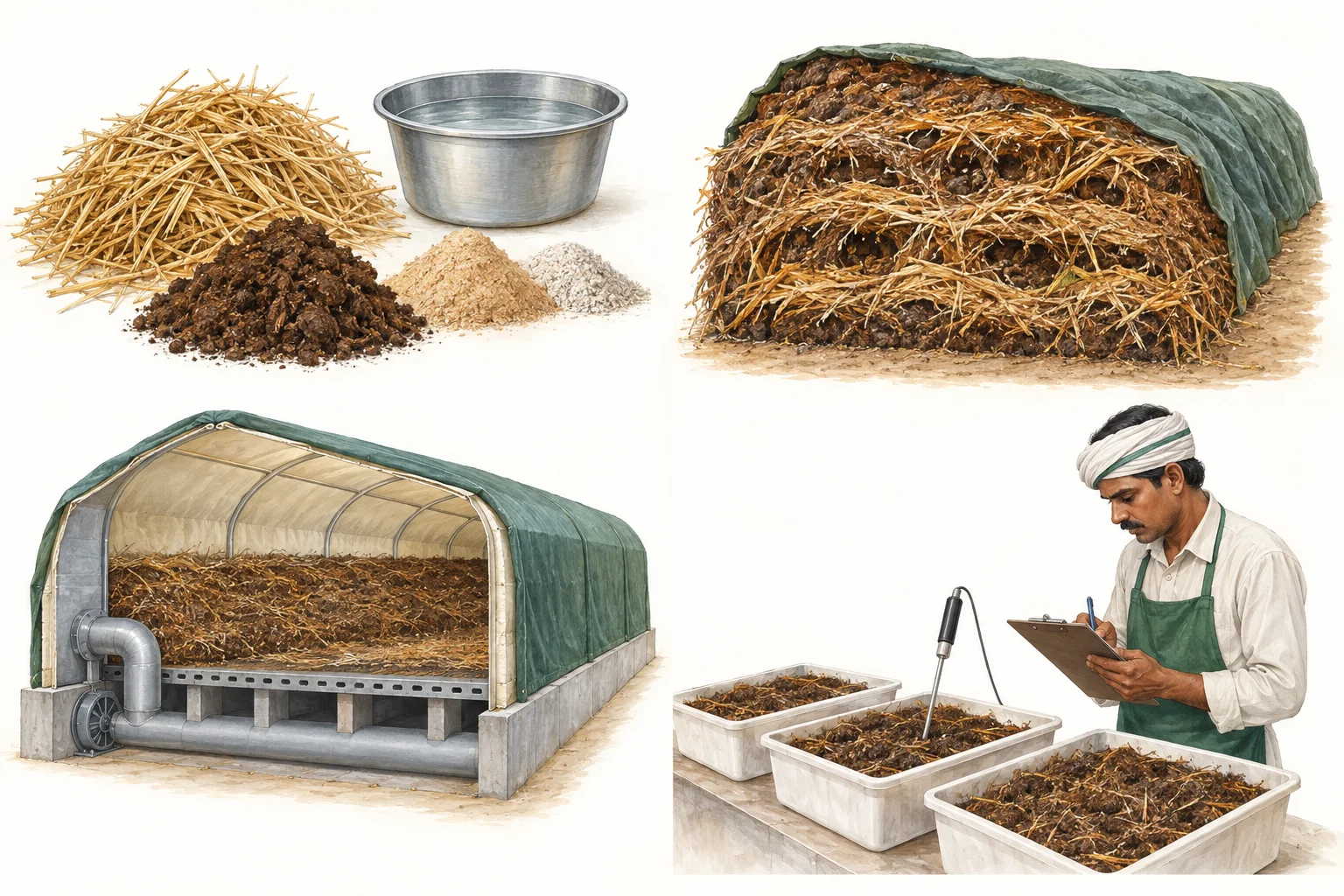
Conceptual compost heap cutaway showing straw structure and internal spaces.
AI illustration · details

AI teaching illustration. The heap has structure, depth and internal variation. One central reading does not describe every part of the material.

Open full image ↗

Heat-loving microbes that finish compost; killed above 60 °C.

Understanding crop problems62

Evidence & Negative Evidence

Sources & further reading

Sources and field reference

Crop-health evidence and differential diagnosis system: Identification and current India label verification remain separate gates.

Understanding crop problems63

Biosecurity & Chemical Caution

Chapter opening

Biosecurity & Chemical Caution

Almost every serious mushroom disease arrives on something that came through the door: casing, spawn, shoes, flies or air. Controlling the door costs less than any cure.

  • By the end you can name each entry route and its physical barrier.
  • By the end you can run a contain-first routine within the hour.
  • By the end you can apply the India label gate and explain why older chemical lists cannot be copied.
Understanding crop problems64

Biosecurity & Chemical Caution

Field notes

Control the routes

Every route into the room has a cheap physical answer. Air: ICAR-DMR recommends 2 micrometre mesh filters on fresh-air entry points to hold back mould spores. Flies: NHB says screening doors and ventilators with nylon net of 35 mesh or finer checks their entry. Casing: ICAR-DMR's wet bubble folder gives steam at 54.4 °C for 15 minutes; the manual's general casing pasteurisation is 60 to 65 °C for 6 to 8 hours. Spent compost: NHB says put it in the pit under at least 10 cm of manure to stop fly breeding.

People and tools are the last route. A foot dip, crates kept to one room, and visiting the sick crop last need no product at all.

Understanding crop problems65

Biosecurity & Chemical Caution

Field notes

Contain first, then treat

When a problem is found, the order is contain, diagnose, decide. Containment happens within the hour: cover the affected spot with damp paper so spores are not blown across the room; lift the bag or casing patch into a sealed bag and carry it out without passing over healthy beds; wash hands and tools; mark the rack in the diary.

Then close the routes: screens, filter, foot dip, who entered. Only when spread is stopped does the differential decide whether more is needed. Many outbreaks end at containment; a treatment applied while the source stays open is money spent at the wrong end. At crop end, NHB's cook-out of 70 °C for 12 hours contains the room itself.

Understanding crop problems66

Biosecurity & Chemical Caution

Field notes

The India label gate

This site gives no chemical doses, for a reason. In India a pesticide may be used only on the crop and for the pest on its approved label, registered through the Central Insecticides Board and Registration Committee. Mushroom is a minor crop and few products carry a mushroom label. A dose copied from a manual, a neighbour or a shop is not a legal or safe basis.

The gate is one question, asked before purchase: is this product currently approved for mushrooms in India, for this problem, and what does the current label say? If the answer is not a current label, the answer is no. NHB's model DPR keeps one timing rule: at least 48 hours between any spray and picking.

Understanding crop problems67

Biosecurity & Chemical Caution

Field notes

Why old lists cannot be copied

ICAR-DMR's 2011 manual and older folders list chemicals of their time, including some now banned in India. The dataset behind this site records a compost formulation containing BHC (lindane), an organochlorine no longer permitted. Formalin, carbendazim, malathion and dichlorvos appear throughout, each with its own regulatory and residue conditions today, and the manual and the Hindi folder disagree by a factor of ten on one insecticide dose.

Those documents stay valuable for causes, thresholds and process. Treat any chemical name in them as a historical record that must pass the label gate, and expect many will not. The practices that have not aged are physical: filters, screens, steam, cook-out, visit order and a diary.

Understanding crop problems68

Biosecurity & Chemical Caution

Compare the evidence

Read the numbers in context

These figures belong to the named source and method. Historical costs are not current quotations. A value without its stage, material basis or measurement location is not a farm instruction.

Source-specific reference figures
What is measuredValue and basisSource and limitation
Fly screening on doors and ventilators35 mesh or finerNHB DPR model, 2018. Nylon net.
Fresh-air inlet filter2 micrometre meshICAR-DMR manual, 2011. Restricts disease and competitor mould spores.
Understanding crop problems69

Biosecurity & Chemical Caution

Compare the evidence

Read the numbers in context

These figures belong to the named source and method. Historical costs are not current quotations. A value without its stage, material basis or measurement location is not a farm instruction.

Source-specific reference figures
What is measuredValue and basisSource and limitation
Casing steam against wet bubble54.4 °C for 15 minutesICAR-DMR wet bubble folder. General casing pasteurisation: 60 to 65 °C for 6 to 8 hours.
Manure cover on spent compost10 cm minimumNHB DPR model, 2018. Checks fly breeding.
Understanding crop problems70

Biosecurity & Chemical Caution

Compare the evidence

Read the numbers in context

These figures belong to the named source and method. Historical costs are not current quotations. A value without its stage, material basis or measurement location is not a farm instruction.

Source-specific reference figures
What is measuredValue and basisSource and limitation
Minimum spray-to-picking interval48 hoursNHB DPR model, 2018. A timing floor; the product must first pass the label check.
Understanding crop problems71

Biosecurity & Chemical Caution

Practical workbook

Close the routes this week

Record: Route checklist with repair dates, casing lot and treatment, visit order, visitor log, product register with label status.

  1. Walk every route: inlet filter, screens, foot dip, crates; note what is missing or torn and repair it.

  2. Record the casing lot with treatment method, temperature and time; do not use an untreated lot.

  3. Write a visit order on each door, youngest crop first, sick room last; start a visitor log.

  4. For every product on the farm, record whether a current mushroom label exists in India and the date checked.

Understanding crop problems72

Biosecurity & Chemical Caution

Pause and recall

Avoid these mistakes

  • Treating before containing, so the product is applied while spores keep arriving.
  • Copying a chemical and dose from an older document without checking today's label status.
  • Using an untreated casing lot to save time, then fighting wet bubble for three crops.
Understanding crop problems73

Biosecurity & Chemical Caution

Pause and recall

Check your understanding

Choose your answer before opening the explanation. This is a learning exercise, not a competency assessment.

Wet bubble appears on one rack. First action?

  1. Buy a fungicide today
  2. Cover and remove affected bags, then check the casing treatment record
  3. Increase ventilation
  4. Wait for the laboratory
See the answer and why

Cover and remove affected bags, then check the casing treatment record Contain first; ICAR-DMR points to untreated casing as the usual source.

Understanding crop problems74

Biosecurity & Chemical Caution

Pause and recall

Check your understanding

Choose your answer before opening the explanation. This is a learning exercise, not a competency assessment.

A 2011 manual names a chemical and dose. What decides whether it can be used today?

  1. The manual's authority
  2. A neighbour's experience
  3. A current approved label for mushrooms in India
  4. The shop's advice
See the answer and why

A current approved label for mushrooms in India Older lists include products now banned or restricted; only a current label passes the gate.

Understanding crop problems75

Biosecurity & Chemical Caution

Pause and recall

Check your understanding

Choose your answer before opening the explanation. This is a learning exercise, not a competency assessment.

Which is NOT a published physical measure?

  1. 35-mesh screens
  2. 2 micrometre inlet filters
  3. Steaming casing at 54.4 °C
  4. Spraying walls weekly with whatever is available
See the answer and why

Spraying walls weekly with whatever is available An unlabelled spray is neither a barrier nor a permitted practice.

Understanding crop problems76

Biosecurity & Chemical Caution

Visual glossary

Words used in this lesson

Biosecurity
See related figure: Control the routes

Practices that keep disease and pests out and stop them moving between rooms.

Label gate

A chemical is considered only if it holds a current approved label for mushrooms in India.

Containment
See related figure: Control the routes

Stopping spread within the hour: cover, remove, seal, wash, mark.

Understanding crop problems77

Biosecurity & Chemical Caution

Sources & further reading

Sources and field reference

Crop-health evidence and differential diagnosis system: Identification and current India label verification remain separate gates.

Understanding crop problems78

Practise and review

Pause and recall

Mistakes to avoid

A similar photograph confirms the disease. Use published photographs as comparison evidence, not a diagnosis.

A spray recipe is the first response. Use competent diagnosis and current authorised guidance before considering treatment.

Understanding crop problems79

Practise and review

Practical workbook

Prepare an adviser-ready crop report

Use a training case or your own documented observations. Include three image scales, chronology, affected and unaffected locations and previous interventions.

Understanding crop problems80

Sources and next steps

Sources & further reading

Keep learning with the field guides

English editorial teaching material. Independent technical review and full Hindi translation remain pending. Reading or completing an exercise is not proof of practical competence.

Illustrations are not diagnostic evidence, construction drawings or operating specifications. Use species-, strain- and method-specific guidance for practical work.

Understanding crop problems81

English learning edition · Independent technical review pending. Keyboard: focus the reading page and use ← / →. Page turning does not mark practical competence.