


Differential Diagnosis
The same brown spot can be a bacterium, a mite, or water that sat on the cap too long. Three causes, three different actions, and only one costs nothing.
- By the end you can sort any symptom into three bins: infectious, pest, environmental.
- By the end you can quote the published thresholds behind common button mushroom problems.
- By the end you can order the tests by cost and speed and act on the first cause.
From symptom to cause
A first look, not a diagnosis. Source: ICAR-DMR manual and disease bulletin.
| What you see | Likely cause | First step |
|---|---|---|
| Long stems, small caps | CO₂ too high (above about 1,500 ppm) | More fresh air |
| Green patches on compost | Trichoderma; low pH or leftover ammonia | Isolate, remove; check next batch |
| No pins after casing | Room not aired and cooled | 16 to 18 °C, ventilate |
| Brown sunken spots on caps | Bacterial blotch; wet caps | Dry the surface, humidity under 85% |
| White wet lumps | Wet bubble from casing | Salt, remove; steam next casing |
| Small flies | Sciarid or phorid flies | Screens, light traps, hygiene |
Read numerical examples with their source, method and crop context. They are not universal operating instructions. Historical prices are not current quotations.
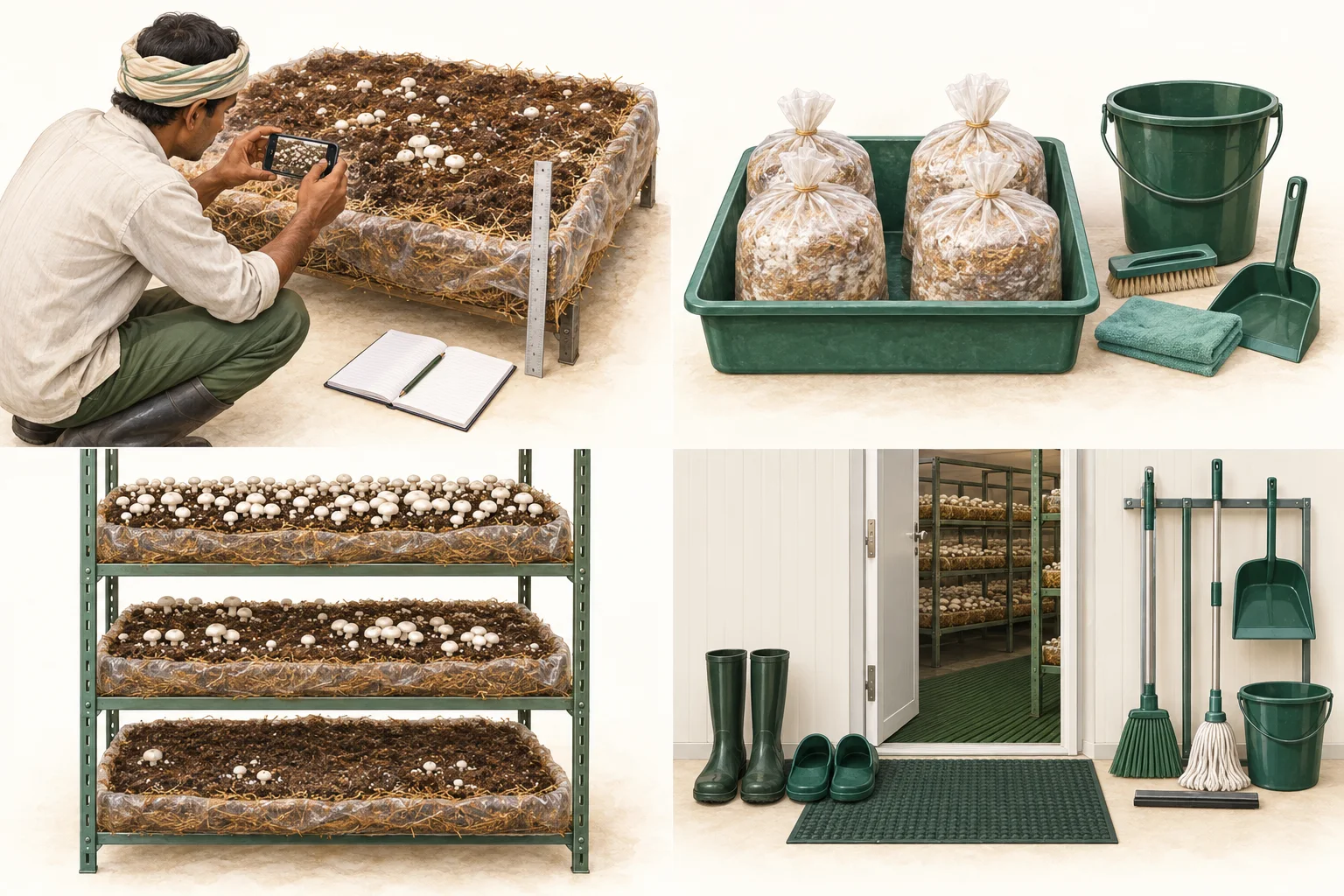
Compare locations
- Notice
- A location-linked pattern and a batch-linked pattern suggest different checks.
- Understand
- Visible differences guide investigation; they do not confirm a disease.
- Try it
- Compare inputs, watering and measurements before assigning a cause.
01Three bins, not one
Differential diagnosis is a long name for a short habit: before choosing a cause, list the other causes that could give the same sign, then rule them out one at a time. In a mushroom room the causes fall into three bins.
Infectious: a fungus, bacterium or virus grows on the crop, spreads from a point, and needs a source such as casing, spawn, air or hands. Pest: an insect, mite or nematode feeds and leaves tunnels, adults or larvae a hand lens can find. Environmental: temperature, moisture, gas or compost chemistry is wrong; the sign is uniform or tied to a spot and disappears when corrected. The actions differ: hygiene, screens and traps, or a thermometer and a valve.
02The environmental bin has numbers
Indian sources publish thresholds for this bin, so it is the easiest to test. ICAR-DMR states false truffle manifests above 23 °C; NHB's model DPR adds the working ceiling, avoid 26 to 27 °C in spawn run and after casing, and keep cropping below 18 °C. NHB says bacterial blotch is favoured above 20 °C with relative humidity above 85 percent; ICAR-DMR adds the 3-hour limit for water on caps.
Compost chemistry has bands too. ICAR-DMR gives pH 7.2 to 7.8; below it green mould is favoured, above it white plaster mould. Compost wetter than 72 percent at spawning invites plaster moulds; NHB links weepers to compost below 64 percent under wet casing.
03Infectious and pest signs that look alike
Wet bubble makes shapeless wet masses that may drip amber liquid; ICAR-DMR notes its resting spores survive up to three years in casing soil. Dry bubble makes dry, deformed mushrooms with split leathery caps. Green mould shows as green patches, linked by ICAR-DMR to immature spawn and low pH.
Pests overlap with these. Sciarid larvae tunnel into stems and pinheads, which die and brown, and a hurried eye reads disease. Mites cause reddish-brown discolouration. The difference is that pests leave the pest: adults in the trap, larvae in a cut stem, mites moving under the lens. Find the organism and it is a pest problem, whatever the mushroom looks like.
04Order the tests, act on the first cause
Test the cheapest and fastest first. A thermometer takes a minute, a hand lens five, a pH strip ten, a laboratory days. For brown-spotted caps: read temperature and RH now and check how long caps stayed wet; look for mites or larvae; only then treat blotch as the working diagnosis.
Causes chain. A room above 20 °C and 85 percent RH is an environmental fault that also invites blotch; low pH invites green mould; flies carry spores bag to bag. Correct the condition first, because it is under your control this hour, then contain the organism. If a chemical is considered at all, current label approval for mushrooms in India comes first. This site gives no doses.
Build a three-column differential for one live problem
- Write one current symptom in five facts.
- Draw three columns with at least one cause in each; note each test's cost and time.
- Run the environmental tests today: bed temperature, RH, hours caps stayed wet, compost pH strip.
- Run pest checks tomorrow with a hand lens and the trap count; cross out ruled-out causes.
Write in your farm diary: Symptom, three-column list, each test with result and date, causes ruled out, working diagnosis.
Mistakes that cost a crop
- Jumping to an infectious name for a spot that a thermometer and the watering log would explain.
- Treating pest damage as disease while the flies keep breeding.
- Testing the expensive explanation first and leaving temperature, RH and pH unchecked.
Check yourself
Three questions, instant answersCompost at 27 °C in spawn run, late February on the plains; a cream brain-like mass appears. Which bin?
First test for brown spots on caps?
Compost pH 6.6 with green patches. The differential says?
An editorial self-check, not a certificate. Answers are not stored, not even on this device.
Words used in this lesson
- Differential diagnosis
- Listing every cause that could produce a sign, then ruling them out.
- Environmental
- Caused by a wrong condition, with no organism needed.
- Weepers
- Mushrooms that exude water; NHB links them to dry compost under wet casing.
References & further reading
Identification and current India label verification remain separate gates.
Open current reference