


Evidence & Negative Evidence
A measurement is worth taking only if its answer would change what you do next. Many growers collect numbers that change nothing and skip the one that would have saved the crop.
- By the end you can pick a measurement by asking which decision it splits.
- By the end you can use negative evidence, what is absent, to rule causes out.
- By the end you can follow a complete evidence chain from symptom to decision.
From symptom to decision, each step adds one piece of evidence that splits the path.
- DescribeFive facts, pattern, date, photo.
- List causesOne or more in each bin.
- Choose splitting testsOnly readings that change the action.
- Record absencesChecked how, where, and not found.
- Decide and watchRecheck the count in 48 hours.
Read numerical examples with their source, method and crop context. They are not universal operating instructions. Historical prices are not current quotations.
Look, explain, then apply
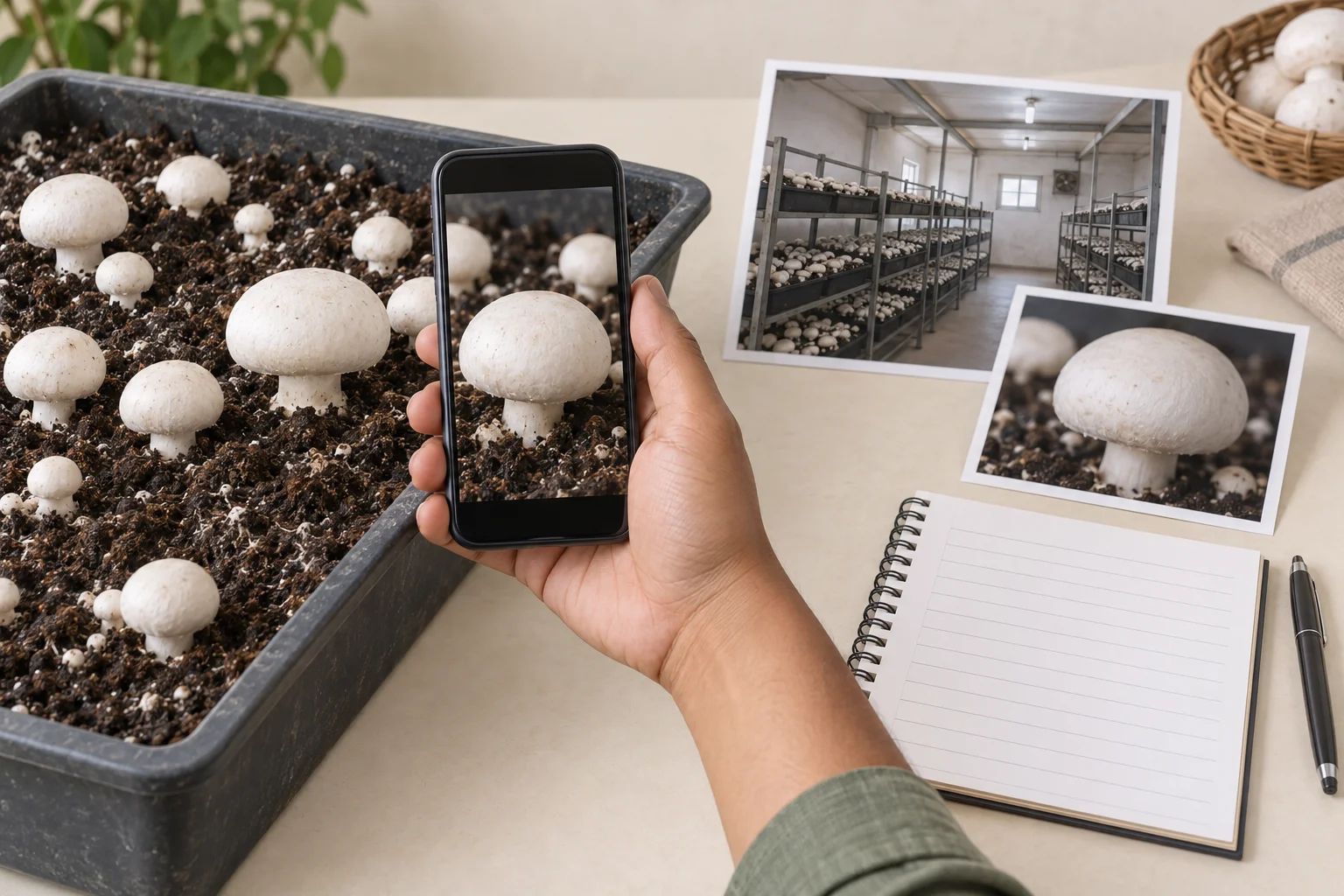
Document the room, affected area and detail. All pictured scenes are synthetic; these are not disease-reference photographs or laboratory findings.
See where this fits in the full workflow →01Evidence that splits the decision
Suppose green mould is suspected in a new compost batch. Two readings are available: compost pH and room light. Only one changes the decision. If pH is below 7.2 the recipe or Phase II must be corrected; if it sits inside 7.2 to 7.8 the search moves to spawn and casing. Light changes nothing.
That is the test for every measurement: write the decision first, then ask whether each possible result leads to a different action. ICAR-DMR's compost chapter gives the splitting numbers for button compost: pH 7.2 to 7.8, moisture 68 to 72 percent for synthetic long-method compost or 64 to 66 percent after Phase II, and ammonia below 10 ppm at spawning.
02Negative evidence
Absence is evidence. No fly adult in the trap for a week and no larva in twenty cut stems weakens a pest explanation for dead pinheads. Inlet end and far end looking identical weakens an air explanation. Trouble in bags from three compost batches rules out one bad batch.
Negative evidence has one rule: it counts only if you actually looked, in the right place, with the right tool. "I saw no mites" means nothing without a hand lens. "Temperature was fine" means nothing if the thermometer hangs by the door instead of sitting in the bed. Record what was checked, how and where.
03A case, step by step
A seasonal button grower in the Haryana plains, crop day 30, finds soft wet lumps dripping amber liquid on six bags of one rack. Day two: nine. Day four: fourteen, neighbours affected. Pattern: spreading from a point.
Competing causes: wet bubble, dry bubble, over-wet casing. Splitting evidence: the amber drip and shapeless wet mass fit wet bubble, not dry bubble's leathery cracks; casing moisture in unaffected bags is normal, negative evidence against an environmental cause; and this crop's casing was a new FYM and loam lot that was never steamed. ICAR-DMR's wet bubble folder states the resting spores survive up to three years in casing and that steaming casing at 54.4 °C for 15 minutes prevents the disease. The decision does not wait for a laboratory.
04Process records as confirmation
Some confirmations are logs, not tests. If the Phase II log shows a compost peak above 60 °C, ICAR-DMR's manual explains olive green mould and a weak spawn run with one number, because above 60 °C the thermophilic organisms that finish compost are killed. If no ammonia check was made at spawning and the crop shows ink caps, the missing check is the evidence.
At crop end, NHB's model DPR sets cook-out at 70 °C in the compost for 12 hours to kill pathogen spores. Stop gathering evidence once the next action is clear; write the decision, the date and the one result that would reverse it, then watch the count.
Write one evidence chain end to end
- Take a problem from your diary, or the Haryana case; write the decision you face in one line.
- List every possible reading; strike out those whose result would not change the decision.
- Take the remaining readings, noting probe position and tool.
- Write three things looked for and not found, then the decision and the result that would reverse it.
Write in your farm diary: Decision line, readings kept and struck out, results with probe position, negative evidence with method, reversal condition, 48-hour count.
Mistakes that cost a crop
- Collecting readings that change nothing while compost pH or the Phase II peak is never checked.
- Claiming something is absent without having looked with the right tool.
- Waiting for laboratory certainty while a spreading count doubles.
Check yourself
Three questions, instant answersWhich reading splits the decision for suspected green mould in fresh compost?
"I saw no mites" counts as negative evidence only if:
The Phase II log shows a 63 °C compost peak. Which two problems does that explain?
An editorial self-check, not a certificate. Answers are not stored, not even on this device.
Words used in this lesson
- Negative evidence
- Something looked for with the right tool and not found.
- Cook-out
- Heating spent compost at crop end to kill pathogens before emptying the room.
- Thermophilic flora
- Heat-loving microbes that finish compost; killed above 60 °C.
References & further reading
Identification and current India label verification remain separate gates.
Open current reference