


A practical guide to growing mushrooms in IndiaA joint educational initiative by MushroomWale & DMR Solan
MushroomFarming.in

A joint educational initiative by

MushroomWale.com
ICAR–Directorate of Mushroom Research, Solan logoICAR–DMRSolan

Read · Observe · Practise · Check

Commercial planning: prove the operating model

Connect market demand, compost supply, room occupancy, utilities, labour and finance before comparing equipment offers. A project proposal must describe how the farm will operate, not only what will be built.

Begin the walkthrough ↓
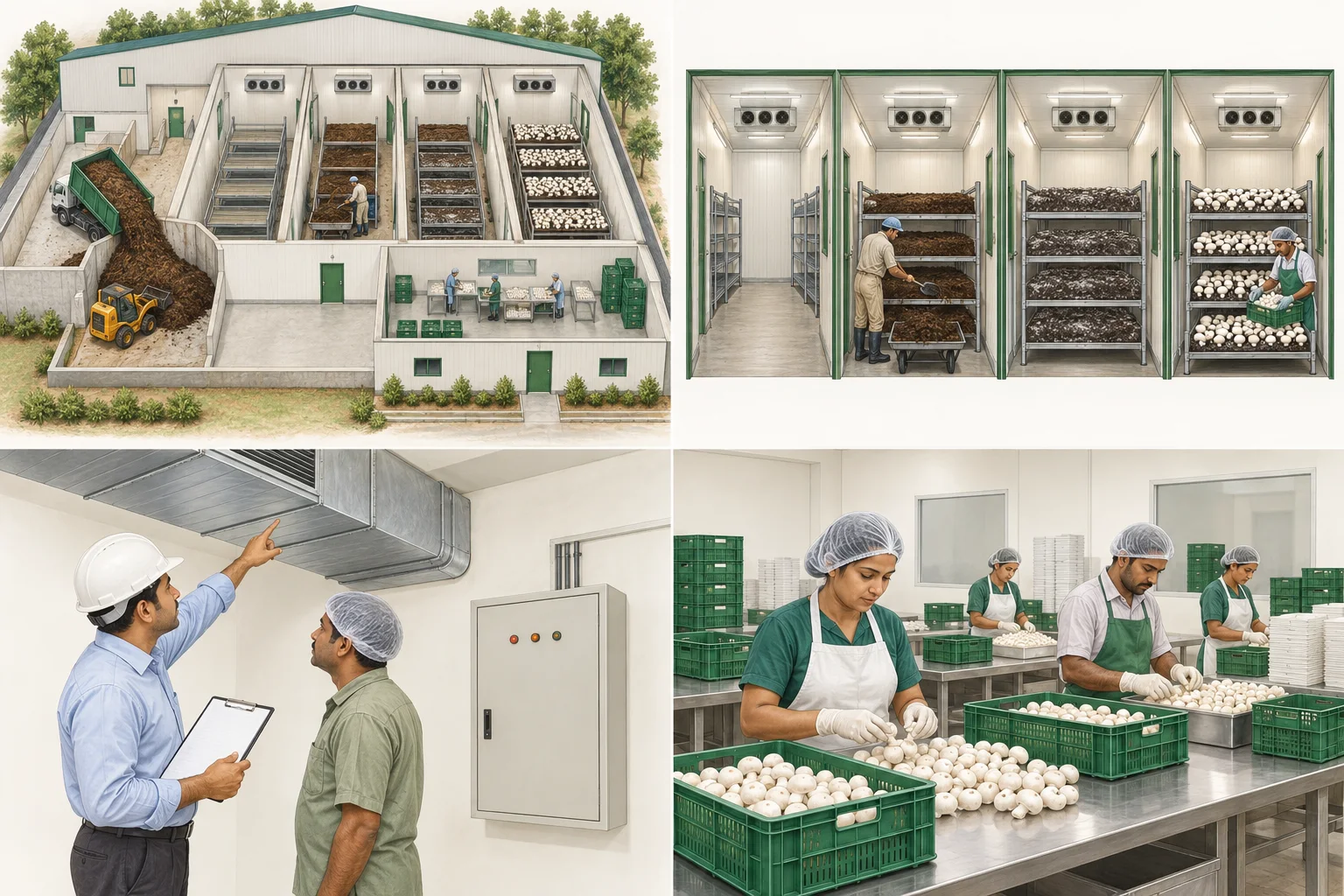
Conceptual commercial mushroom farm cutaway with separate growing and handling areas.
AI-generated teaching illustrationConceptual learning scene, not a diagnostic photograph or construction specification.

Before you begin

  • Defined cultivated product and buyer requirements
  • Incoming compost/substrate stage
  • Site information, utility availability and comparable written quotations

Use the linked crop and technical lessons for method-specific detail. Practical work involving chemicals, pressure, electrical equipment or uncertain crop health requires competent supervision; illustrations are not operating specifications.

Conceptual commercial mushroom farm cutaway with separate growing and handling areas.

Conceptual AI teaching scene

Stage 1

Define what enters and leaves

State whether the farm produces compost, receives Phase II material or receives colonised material. Identify accepted product, packing and dispatch requirements. These choices move work, equipment and risk between suppliers and the farm.

Put it into practice
Draw the production boundary and mark every outside supplier and buyer interface.
Check your work
No operation is assumed to be included in both a supplier quote and the farm plan, or omitted by both.
Conceptual comparison of growing rooms at different operating stages.

Conceptual AI teaching scene

Stage 2

Build the room calendar

Growing, harvesting, emptying, cleaning and maintenance all use time. Staggering room fills changes the timing of labour, harvest and utility peaks; it does not eliminate them.

Put it into practice
Create a room-by-week calendar and test one delayed delivery and one extended turnaround.
Check your work
Output and resource needs follow the calendar rather than a multiplication of best-case yields.
Illustration of an engineer and grower inspecting air handling and closed controls.

Conceptual AI teaching scene

Stage 3

Procure against a duty

Ask what operating requirement each quoted component fulfils and how the completed system will be tested. Include installation, access, controls, service and training in the comparison.

Put it into practice
Make a responsibility matrix for supplier, installer, engineer and farm operator.
Check your work
Each important requirement has an owner, evidence and an acceptance test.
Illustration of workers grading mushrooms in a clean commercial packing room.

Conceptual AI teaching scene

Stage 4

Ramp up with measured results

A newly installed farm has not yet demonstrated repeatable crop output or buyer acceptance. Track commissioning, pilot production and subsequent expansion as separate decisions.

Put it into practice
Compare actual utility use, labour, crop losses and accepted sales with the plan before increasing loading.
Check your work
The expansion decision records measured results and unresolved risks.

Common mistakes—and the better question

More rooms automatically create more sales
Validate buyer capacity and payment terms.
A turnkey label defines every responsibility
Use explicit scope and handover requirements.

A task to complete, not just a page to read

Challenge a project proposal

Identify its three most important unsupported assumptions. Show how a delay, lower accepted output or higher power cost changes the plan.

Bring back this evidence

An operating calendar, responsibility matrix and revised risk case.

Completing this self-guided task is not verification of practical competence. Review it with a suitable instructor before relying on it for farm operation.

Study the detailed lessons in order

Commercial Project Planning. Every lesson keeps its explanations, practical exercise, mistakes and self-checks.

  1. Species & MarketStart from a verified market and production fit.
  2. Capacity & Production SystemConnect ambition to operational evidence and constraints.
  3. Infrastructure, Climate & PowerDefine full project inputs before equipment selection.
  4. Economics, Finance & RiskStress-test project assumptions and funding timing.
  5. Capstone Project DecisionChoose Proceed, Conditional, Pilot or Reject and defend the reasoning.

Keep the field guidance beside the lesson

Open the main subject guide →Production Room EngineeringMushroom farm feasibility checkMushroom market validationMushroom farm working-capital calculator

Sources, scope and review

Editorial learning material; no independent technical review is claimed. The tasks are original teaching exercises. Source-specific numerical schedules remain in the detailed lessons with their context, rather than being turned into universal instructions here.