


Capstone Project Decision
Four honest verdicts exist at the end of a feasibility study, and three of them are not a green light. Picking the right one is the skill.
- By the end you can state which of the four verdicts your evidence supports.
- By the end you can design a pilot with a written pass and fail condition.
- By the end you can list the records that will defend your decision to a bank.
A pilot buys evidence cheaply before the project buys equipment.
- Assemble the fileCapacity chain, prices, buyers, quotations, funding, low case.
- Find the weakest evidenceThe number you could not source is the one to test.
- Choose the verdictProceed, conditional, pilot or reject, with three reasons.
- Run the pilot cycleOne species, one room, every reading written down.
- Review on the dateCompare measured results with your assumptions.
Read numerical examples with their source, method and crop context. They are not universal operating instructions. Historical prices are not current quotations.
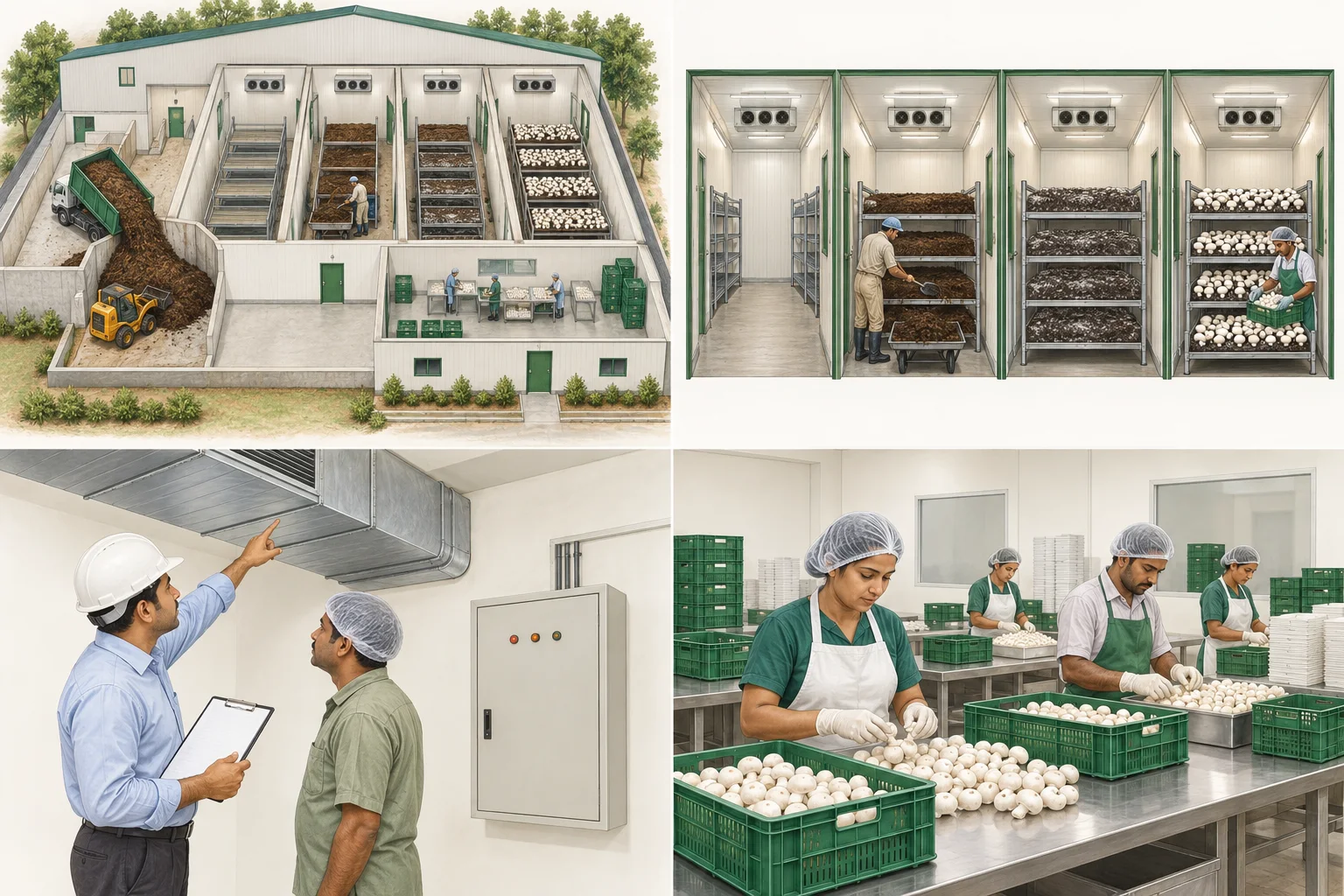
Train the operation
- Notice
- People, food handling and buyer specifications complete the system.
- Understand
- Installed racks alone do not demonstrate a working enterprise.
- Try it
- Ramp up with crop, utility, labour and buyer-acceptance records.
01The four verdicts
Proceed means the evidence is complete and the low case still works. Conditional means it works once one or two named conditions are met by a named date, such as a signed buyer agreement.
Pilot means the economics look plausible but are unproven on your site, so you buy evidence before equipment. Reject means the low case does not pay or the market is not there, and the real saving is the money you did not spend.
Write the verdict you chose, the three facts that decided it, and the date you will review it.
02What evidence each verdict needs
Proceed needs the whole file: a costed capacity chain, three weeks of dated local prices, named buyers with quantities, quotations for the main equipment, a funded working capital line, and a low case that still pays the instalment.
Conditional needs the same file with the open items listed as conditions, each carrying an owner and a date. Pilot needs only enough to run one honest cycle and measure it. Reject needs the reason written down, because the same idea returns next year and the study should not start again from nothing.
03A pilot that proves something
A pilot is an experiment with a written question, not a small farm. Decide in advance which result makes you proceed and which makes you stop.
MIDH carries a route sized for this: a low cost or small scale production unit with a cost norm of Rs 2 lakh for a 200 sq ft structure, assistance at 50%, up to five units per beneficiary, as the guideline states. The state implementing agency decides whether you qualify.
A short cycle species suits a pilot. ICAR-DMR gives 45 to 60 days from straw to oyster mushrooms and 4 to 5 weeks for paddy straw.
04Defend the decision with records
The defence of a decision is the diary behind it: room temperature twice a day, substrate weight per bag, spawn lot and date, first pin date, kilograms picked per day, kilograms sold, rate received and payment date.
One completed cycle of those records answers most questions a bank or scheme officer asks, and replaces borrowed assumptions with measured ones.
Size matters to the paperwork too. MIDH places mushroom projects up to Rs 20 lakh of total project cost with the State Level Executive Committee, so the scale you choose decides who reads your file.
Write the decision note
- List every assumption in your plan and mark which ones have a named source.
- Pick the weakest assumption and design one cycle that tests it.
- Write the pass and fail result before the cycle starts.
- State your verdict in one sentence with three supporting facts and a review date.
Write in your farm diary: Verdict, three facts, weakest assumption, pilot question, pass and fail lines, review date.
Mistakes that cost a crop
- Treating reject as failure, when it is the cheapest outcome of a study.
- Running a pilot with no written question, so every result looks encouraging.
- Scaling straight to a large unit before one cycle has been measured on site.
Check yourself
Three questions, instant answersYour market evidence is strong but your yield is unproven on site. The verdict is:
MIDH places mushroom projects with the State Level Executive Committee up to:
A pilot is useful only if you decide in advance:
An editorial self-check, not a certificate. Answers are not stored, not even on this device.
Words used in this lesson
- Conditional verdict
- Approval that depends on named conditions with dates and owners.
- Pilot
- One small cycle run to test the weakest assumption.
- Review date
- The day you reopen the decision with new evidence.
References & further reading
Outputs are scenarios from explicit assumptions, not forecasts.
Open current reference