


Economics, Finance & Risk
A project report proves nothing when every number sits at its best. It proves something when the low case still pays the instalment.
- By the end you can build a cost sheet from quantities, not from a target profit.
- By the end you can state what the scheme funds and what it leaves to you.
- By the end you can run a three way sensitivity test and read it honestly.
Quantities first, then costs, then the stress tests that decide it.
- QuantitiesSubstrate, spawn, casing, room hours and kilograms per cycle.
- Cost linesA rupee figure on each quantity, with its quotation.
- FundingTerm loan, own funds, working capital limit, scheme assistance.
- SensitivityLow yield, low price, fewer cycles, separately and together.
- Risk tableRisk, early signal, action and owner on one page.
Read numerical examples with their source, method and crop context. They are not universal operating instructions. Historical prices are not current quotations.
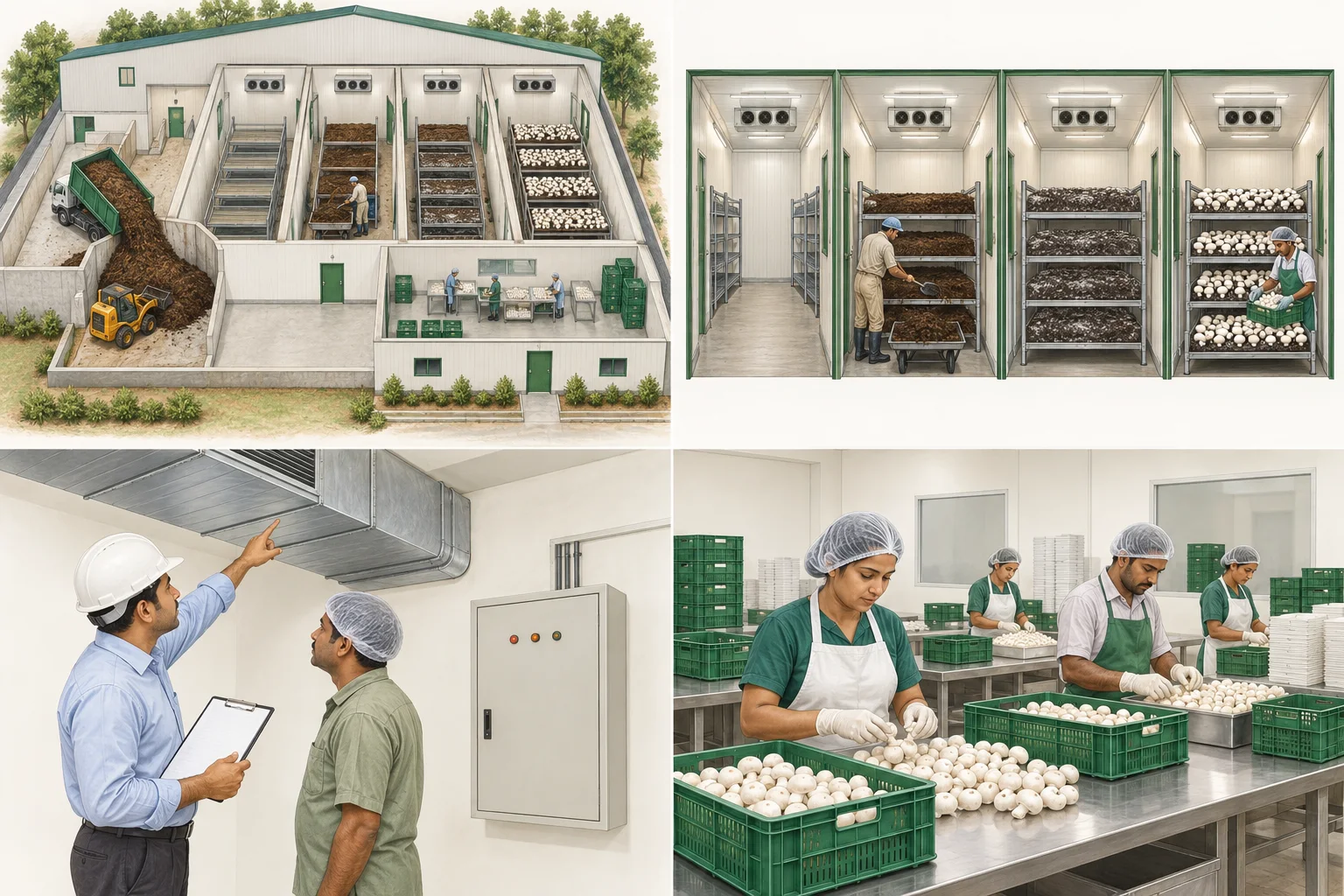
See the whole operation
- Notice
- Receiving, growing, packing and dispatch need coordinated space.
- Understand
- Capacity is a whole-farm outcome, not just the number of racks.
- Try it
- Define the incoming compost stage and the product buyers will accept.
01The cost sheet follows the capacity sheet
Build the money from the capacity chain you already wrote. Substrate tonnes per cycle give the straw and compost bill. Fill weight gives the spawn bill. Room hours give the power bill. Kilograms picked give the labour and packing bill.
Built this way, every cost line has a quantity behind it, and a lender can test the line by testing the quantity. Built backwards from a target profit, it will not survive one question.
Carry the same yield figure into the production, revenue and repayment tables. A report using three different yields fails on arithmetic, not on farming.
02What the scheme funds and what it does not
The MIDH guidelines set a cost norm of Rs 30 lakh for a mushroom production unit, with assistance at 40% of cost for the private sector and 50% in the North Eastern and Himalayan states, Scheduled areas, vibrant villages, Andaman and Nicobar and Lakshadweep. Public sector units are covered at 100%.
The implementation guidance adds that the subsidy is credit linked and back ended, that a bank loan is mandatory for a private applicant, and that it covers buildings, infrastructure, machinery and equipment only, with no recurring, staff or contingency costs.
The state implementing agency decides eligibility and release.
03Sensitivity: three numbers, one at a time
Test the plan by moving one assumption at a time and watching the instalment cover. Yield: use the bottom of the published strain range, not the top. Price: take 20% off your recorded local rate. Cycles: five per room per year instead of six.
Run the three separately, then together. If the plan survives only at everyone's best, it is not yet a plan.
The fact base shows why ranges matter. For shiitake, DMR's folder reports 35 to 45% of wet substrate weight and the 2011 manual reports 15 to 30% for the same method.
04Risk, owner, trigger
Every risk needs three things beside it: who watches it, what the early signal looks like, and what happens next. A vague paragraph about uncertainty is the part nobody reads twice.
Keep money risks and crop risks in one table, because they arrive together. A contaminated batch is also a missed delivery, which is also a delayed payment, which is also a missed instalment.
- Market risk: one buyer taking more than half your output.
- Input risk: a single compost or spawn supplier with no alternative.
- Finance risk: working capital quietly funded out of the term loan.
Stress test your own sheet
- Attach a quantity and a quotation to every cost line.
- Check that the same yield figure appears in production, revenue and repayment tables.
- Rerun the sheet three times: low yield, low price, five cycles.
- Write a risk table with an early signal and an owner for each row.
Write in your farm diary: Quantity per cost line, yield used and its source, three sensitivity results, risk table.
Mistakes that cost a crop
- Writing the profit first and choosing assumptions that reach it.
- Assuming the subsidy will cover salaries or straw, which the guidance excludes.
- Using different yields in the production and repayment tables of the same report.
Check yourself
Three questions, instant answersMIDH assistance for a private mushroom production unit is stated as:
Two DMR documents give shiitake yield as 15 to 30% and 35 to 45%. You should:
Which cost does MIDH assistance not cover?
An editorial self-check, not a certificate. Answers are not stored, not even on this device.
Words used in this lesson
- Sensitivity test
- Rerunning the plan with one assumption changed.
- Credit linked
- Assistance tied to a sanctioned bank loan.
- Cost norm
- The published cost ceiling a scheme uses for a unit.
References & further reading
Outputs are scenarios from explicit assumptions, not forecasts.
Open current reference